|
International Civil Liberties Monitoring Group
Coalition pour la surveillance internationale des libertés civiles
November 21, 2026 - 21 novembre 2026
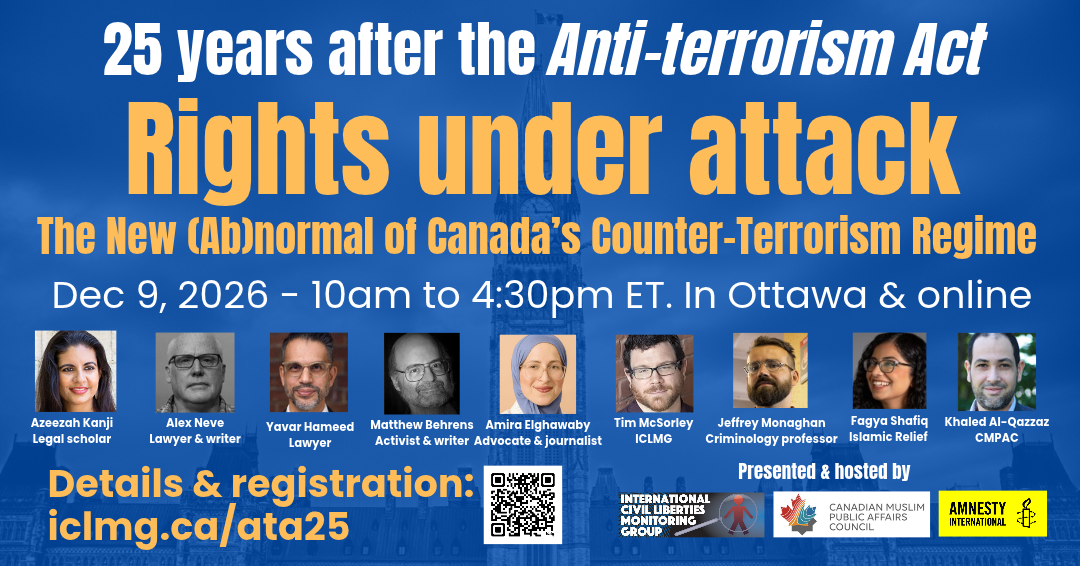
| Bimonthly news round-up about national security's negative impact on civil liberties in Canada and abroad | | 25 years after the Anti-terrorism Act: Rights under attack! | | The New (Ab)normal of Canada’s Counter-Terrorism Regime | | |
A one-day conference organized by the International Civil Liberties Monitoring Group, Amnesty International Canada and Canadian Muslim Public Affairs Council
When: December 9, 2026, 10am to 4:30pm ET
Where: Amnesty International Canada in Ottawa & via Zoom
What: three panels, with lunch included. Free but registration required.
| |
December 18, 2026, marks the 25th anniversary of the adoption of Canada’s first Anti-terrorism Act (ATA). Introduced and adopted over a period of just two months following the attacks of Sept. 11, 2001 – with minimal debate or scrutiny – the legislation enacted sweeping changes to Canadian national security law. These changes set the stage for policing, surveillance, judicial and immigration policies, among others, for the decades to come.
The impacts have ranged from the seemingly banal – removing shoes and emptying water bottles at the airport – to some of the gravest human rights and civil liberties violations imaginable, including rendition to abuse and torture, hardening of borders and restrictions on migration and asylum, rising xenophobia, racism and Islamophobia, limits on freedom of expression and assembly, the criminalization of dissidents, such as Indigenous land defenders and Palestinian solidarity activists, sweeping surveillance measures and the erosion of privacy, the proliferation of secretive terrorism watch lists and the growing use of secret evidence in courts. It also includes the ever-growing and broadening application of these powers under the guise of fighting “terrorism” or protecting “national security,” in Canada and around the world.
How does this “new normal” continue to impact civil liberties and human rights today? What lessons can we learn from the fight against the negative impacts of anti-terrorism laws over the past 25 years? Join us on Dec. 9 to explore these questions over the course of three panels about the impacts on the law, media, and civil society. Source
Share and invite your networks on Facebook + Bluesky + Instagram + Twitter + LinkedIn
| |
Civil Society to Carney: Intercede on Bill C-22 before it’s too late | A letter from 26 leading rights, refugee and privacy experts and organizations, including the ICLMG, urges the Prime Minister to back targeted Senate amendments, warning Bill C-22 threatens his ambition for a sovereign Canadian economy integrated with Europe. | |
OpenMedia 19/11/2026 - Today, OpenMedia and 25 leading civil liberties, refugee rights and privacy organizations and experts delivered a joint letter to Prime Minister Mark Carney, asking him to intercede in the Senate’s ongoing consideration of Bill C-22, the Lawful Access Act. The Standing Senate Committee on National Security, Defence and Veterans Affairs (SECD) is currently hearing from its final round of witnesses before considering amendments and a final vote, which may occur before its December recess. Signatories say the Prime Minister is the one person who can still ensure critical changes are made to dangerously ill-considered legislation.
The House made limited amendments to Bill C-22 before passing it to the Senate, cutting the metadata retention period from one year to six months and adding a narrow clause limiting compelled decryption. But signatories warn the changes leave the bill’s most dangerous architecture intact: the power to force providers to retain metadata on everyone in Canada or abroad, and the power for the Minister of Public Safety to issue secret orders compelling any electronic service to build government access into its systems.
The letter argues these two provisions directly undercut the government’s own priorities. Population-wide metadata retention and secret access orders are out of step with European and international human rights standards, putting Canada’s GDPR adequacy status and its ambition to become the EU’s first associate member at risk. They threaten the privacy-first services Canadians rely on as alternatives to U.S. Big Tech – services the government would like to see adopted as components of Canadian digital sovereignty. And by undermining private communication, they put some of the most marginalized communities in Canada at greater risk, such as survivors of intimate partner violence, human rights defenders, and diaspora communities facing transnational repression.
Bill C-22 is the government’s second attempt to pass these powers. They first appeared in Bill C-2, the so-called “Strong Borders Act,” in June 2025, which would have let police and CSIS demand information about people’s online accounts without a warrant. More than 300 civil society organizations joined OpenMedia in demanding its complete withdrawal, and in October 2025 the government dropped lawful access from its border legislation. It reintroduced the provisions as a standalone bill, C-22, in March 2026, with the most dangerous part — now Part 2 — carried forward intact.
In today’s letter, signatories ask the Prime Minister to direct his Government Representative in the Senate to bring forward two key amendments: striking section 5(2)(d)’s power to require retention of metadata on all users, and forbidding any regulation or secret ministerial order that would require a provider to access, intercept or circumvent end-to-end encrypted communications. They argue this protection must be locked in legislative text, so a future Cabinet cannot redefine it away, and that all obligations should be subject to full judicial authorization and public by default. The full letter and list of signatories is available in English and French here. Source
UN Human Rights Watchdog Finds Proposed Surveillance Law (Bill C-22) Runs Afoul of International Human Rights
Projet de loi C-22, Loi concernant l’accès légal: Mémoire présenté par la CSILC au Comité sénatorial SECD
ACTION We don't want state surveillance. Senators: Stop Bill C-22!
| Meta would 'consider' pulling services from Canada if lawful access bill passes as is | Company says government amendments don't protect encrypted data | |
CBC News 02/11/2026 - Representatives from Meta say the social media company would have to "consider" pulling encryption services from Canada if the government's proposed lawful access bill passes without further changes.
Bill C-22 would force tech companies to adapt their systems so they all have the ability to hand over information to investigators with a warrant.
The legislation is currently being studied in the Senate, where Meta representatives said the bill leaves encrypted information — meant only to be viewed by users sharing the information — vulnerable to malicious actors.
"Ultimately, the Canadian government would be enforcing and imposing a law that it is not technically feasible to comply with and still offer secure, end-to-end encrypted services to Canadians," Robyn Greene, Meta's director of privacy and public policy, told senators on the national security committee on Monday evening.
Meta services include Facebook, Instagram and the encrypted messaging app WhatsApp. When asked if the legislation would mean the company would pull some of its services from Canada, Meta's head of public policy for Canada Rachel Curran said the company would have to "review all of our options." But she said it is something the company would have to "consider."
Bill C-22 also grants the minister the authority to issue confidential ministerial orders to electronic service providers (ESPs) operating in Canada, requiring them to build surveillance and monitoring capabilities into their systems. Orders would first be reviewed by the intelligence commissioner — an independent quasi-judicial official.
Another change reduces the length of time that tech companies would have to retain metadata to six months from up to a year, after cybersecurity experts warned that data would be an attractive target for hackers. Curran told the Senate committee that the government's amendments don't go far enough to protect encrypted data.
Encrypted messaging service Signal has also consistently said it would withdraw from Canada if the bill passes.
"If we are forced to choose between betraying our users and leaving Canada, we will not compromise the security of Canadians," Signal vice-president Udbhav Tiwari told the Senate committee. Tiwari called on the government to make further changes to the bill, including explicit assurances to protect encrypted data.
Tech giant Apple also said earlier this month that the amendments aren't enough. "While we appreciate attempts to improve C-22, the bill could still undermine Apple's ability to offer the powerful privacy and security features our users expect from us, including encryption, even as AI and other evolving technologies provide hackers with new tools to exploit cybersecurity weaknesses," the company said in a statement. Read more - Lire plus
Canada’s Bill C-22 Puts Survivors of Gender-Based Violence at Risk
Why Canadian tech is standing against Bill C-22
UK court rules Apple can share the top secret order everyone already knew
Privacy expert Michael Geist: Three Fixes for Lawful Access: Making the Case for Amending Bill C-22 at the Senate National Security Committee
| Former CEO of Israeli spyware company seeking Ontario contracts for his new firm | Dream Group is registered to lobby Doug Ford’s office to buy its cyber defence software | |
Investigative Journalism Foundation 10/11/2026 - An Israeli cyber defence firm led by the former CEO of NSO Group, the company behind the controversial Pegasus spyware, has registered to lobby the premier of Ontario and government departments about getting public contracts.
Dream Group says it “helps governments secure and transform their most sensitive information into decisions and capabilities that turn nations into Super Nations.” Dream Group was co-founded by Shalev Hulio, the former CEO of NSO Group, a company that landed on a U.S. watch list for acting contrary to that country's national interests.
“It’s very worrisome that anyone who’s been involved with NSO Group or Pegasus spyware could be fishing for government contracts in Ontario,” said Tim McSorley, a national co-ordinator with the International Civil Liberties Monitoring Group.
While it appears Dream Group focuses on cyber defence rather than spyware, it still “raises a huge red flag” that an individual linked to spyware could “be trusted to sell equipment that would protect the data of people in Ontario or anywhere in Canada,” McSorley said.
NSO Group’s Pegasus has reportedly been used worldwide to potentially target tens of thousands of individuals’ phones. Targets have included academics, lawyers, journalists and government officials, according to reporting by the Organized Crime and Corruption Reporting Project. [...]
Unlike NSO Group, which licensed its software to foreign governments for fighting crime, Dream Group says it’s focused on protecting data and infrastructure. It says it operates at the “forefront of cyber and artificial intelligence research.”
Eva Galperin is the director of cybersecurity at Electronic Frontier Foundation, a digital rights non-profit in San Francisco. In spite of her expertise in this field, she can’t say for certain what Dream does. “One of the big problems with the use of a term like AI in somebody’s marketing word salad is that it can mean anything,” she said. “As the technical person, their website does not clear anything up.”
It’s not unusual for tech companies’ marketing to be “hyperbolic and extraordinarily vague,” Galperin said, but she is still skeptical of Dream Group. “When the CEO of a very prominent company that enables human rights abuses goes and starts another company, the chances that it is also based on a lack of respect for human rights are pretty high.”
On its website, Dream promises “total sovereignty" and “end-to-end National Sovereign AI.” Galperin says this marketing “implies that the data will be stored and processed within Canada — also that [Dream is] happy to prey on other countries’ growing distrust of reliance on American AI technology.” The company is looking to build a roster of public sector clients and now, according to provincial lobbying filings, it has its sights set on Ontario.
Dream Group’s Nov. 3 filing said the company wants to “meet and educate office holders on our sovereign stack solutions, built to rigorously support prosperous, secure, and resilient digital government.” Its lobbying is targeting Premier Doug Ford’s office, plus six other cabinet members’ offices, including those responsible for infrastructure, artificial intelligence adoption and procurement.
Christian Medina, the manager of global programs for data governance and AI ethics non-profit Open North, pointed out that Canada’s privacy legislation also hasn’t been updated in years — not since before the recent explosive growth seen in AI and other technologies.
McSorley said it is “crucial that the government not rush into adopting hyperbolic and well-marketed AI tools without making sure the legislation is in place to ensure that our privacy is protected.” Read more - Lire plus
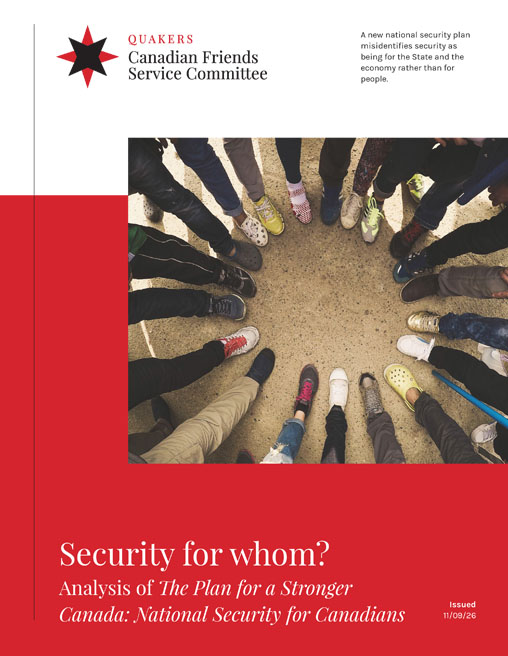
| Security for whom? Analysis of “The Plan for a Stronger Canada: National Security for Canadians” | |
CFSC 09/11/2026 - Canada has released its first national security policy in more than twenty years. But, according to a new analysis by CFSC, The Plan for a Stronger Canada: National Security for Canadians:
- Misidentifies security as being for the State and the economy rather than for people.
- Commits Canada to an unprecedented military build-up without a public account of its costs or trade-offs.
- Leaves the Canadian Armed Forces as Canada’s default emergency responder.
- Is nearly silent on conflict prevention, diplomacy, and peacebuilding.
- Names climate change as a threat but does not resource addressing it.
- Seeks to secure the Arctic through military presence rather than recognizing Inuit Peoples’ sovereignty and rights and working in partnership with Inuit Peoples.
- Expands security and intelligence powers without matching attention to oversight, civil liberties, and conscience.
We call on the Government of Canada to:
- Adopt a human-security definition of national security, adding housing, income security, health system capacity, and climate resilience to Canada’s strategic capabilities.
- Publish a full costing of the path to 5% of GDP, including what it will displace, report annually to Parliament, and use NATO’s 2029 review to reassess the target.
- Direct a defined share of new defence-related spending—beginning with, but not limited to, NATO’s 1.5% resilience category—to conflict prevention, diplomacy, climate monitoring, and civil preparedness.
- Establish a standing civil climate protection force (such as the Youth Climate Corps), coordinated through a national climate-security task force, so the Canadian Armed Forces is no longer Canada’s default emergency responder.
- Restore conflict prevention and peacebuilding as an explicit pillar of national security, with multi-year funding and a peace lens applied across government.
- Reverse cuts to climate science and international development assistance, and decline to subordinate assistance to trade interests.
-
Ground Arctic security in Inuit leadership, the UN Declaration on the Rights of Indigenous Peoples, community wellbeing, and diplomacy.
- Drop the target of a 50% increase in arms exports, report transfers to the United States, and
- Strengthen independent oversight and explicit protection for peaceful protest and conscience.
- Include civil society and peacebuilding organizations in implementation, and invite a parliamentary study of conflict prevention.
-
Measure security by community wellbeing, through a resilience index built on existing indicators of housing, food security, income, and health access. Read more - Lire plus
| Seeking Justice for Hassan Diab Event | |
WHEN: Tuesday, November 24, 2026 at 5:30PM
WHERE: Fellowship Hall, First Unitarian, 30 Cleary St, Ottawa
EVENT HIGHLIGHTS:
- Short Video: “Enough is Enough! The Unjust Case of Hassan Diab”
-
Speaker: William Bourdon, French Lawyer for Hassan Diab
-
Speaker: Don Bayne, Canadian Lawyer for Hassan Diab
-
Speaker: Monia Mazigh, Author, Academic, and Human Rights Activist
-
Music Performance (video): Raphael Weinroth-Browne, Cellist
This is an opportunity to meet Hassan Diab, engage with the speakers, and participate in a discussion and Q&A.
The event is free and open to the public – Everyone is welcome!
Light refreshments will be served.
BACKGROUND:
Hassan’s case represents a troubling example of failures in the Canadian justice system and Canada’s extradition law. The injustice began in 2008 when Dr. Hassan Diab, a Canadian citizen living in Ottawa and teaching at Carleton University and the University of Ottawa, was arrested for alleged involvement in a 1980 Paris synagogue bombing. He has always maintained his innocence and insisted that the case is one of mistaken identity.
After lengthy extradition proceedings, Hassan was extradited to France in 2014 on the basis of deeply flawed evidence. He spent 38 months in a French prison, much of it in solitary confinement. A thorough investigation by two of France’s most respected investigative judges found no grounds to put him on trial. Crucially, key evidence — including fingerprint analysis, handwriting comparisons, and a strong alibi — excluded him as the suspect. In January 2018, the investigative judges ordered his immediate release, and he returned to his home and family in Canada.
Yet the injustice did not end there. Shockingly, in April 2023, a political trial held in absentia at the Paris Special Assize Court disregarded the investigative judges’ findings and declared Hassan Diab guilty. The proceedings were marred by serious irregularities, including the use of discredited “intelligence”, the suppression of exculpatory evidence, defamatory claims, and perjured testimony. This declaration of guilt represents a profound miscarriage of justice.
Today, Dr. Diab lives under the constant threat of a second extradition to France. After nearly twenty years of legal and personal turmoil, Dr. Diab and his family continue to live with uncertainty and injustice.
It is time for Canada to take a principled stand. The government must unequivocally reject any future extradition of Hassan Diab and reaffirm its commitment to justice, human rights, and the protection of its citizens from wrongful persecution. Source
ACTION Sign new Open Letter to Prime Minister Mark Carney Regarding Dr. Hassan Diab
| Refugee Rights Groups Sue to Stop Canada From Handing Over Asylum Seekers to ICE | The lawsuit says handing asylum seekers over to the abuse-perpetrating US is a violation of Canada’s constitution. | |
Truthout 12/11/2026 - anada is violating its own constitution by turning asylum seekers away at the border with the United States, where they face serious threats under U.S. President Donald Trump, Canadian legal experts and rights advocates say.
Amnesty International Canada, the Canadian Council for Refugees, and the Canadian Council of Churches are in court this week to challenge a decades-old pact that allows Canadian officials to summarily send most refugees back at the U.S. border.
People rallied in Toronto and Montreal, the two largest cities in Canada, on Monday to show support for the case and call on the Canadian government to rip up the Safe Third Country Agreement (STCA).
In Montreal, dozens of protesters held posters that read, “Canada must protect, not send back” and “Humanity has no borders.” “If Canadians don’t feel safe in the United States, we can be sure that refugees aren’t safe either,” Lauren Lallemand, co-executive director of the Canadian Council for Refugees, told the crowd. “The asylum system in the U.S. is failing, and those who flee in search of safety deserve to be protected.”
The Agreement
The Safe Third Country Agreement, which came into force in 2004, is premised on the idea that Canada and the U.S. each offer people access to a robust refugee protection system. In practice, it means that asylum seekers can seek protection in the first country they arrive in, but not both: someone in the U.S. cannot apply for asylum in Canada, or vice versa. For years, the restriction applied to asylum claims made at official crossings along the border.
But if people entered Canada irregularly between ports of entry (via farmers’ fields or rural roads, for example), they could circumvent the pact — and as Trump began to crack down on immigration during his first term, tens of thousands of people made dangerous crossings into Canada to request protection. In 2023, amid public and political pressure to crack down on immigration, Prime Minister Justin Trudeau and President Joe Biden closed the loophole, extending the Safe Third Country Agreement to the entire 5,525-mile border.
Now, only people who meet specific conditions — such as unaccompanied minors or individuals with relatives who are already in Canada — are exempt from being turned away under the Safe Third Country Agreement. Lauren Lallemand, co-executive director of the Canadian Council for Refugees, addresses the crowd at a rally in Montreal, on November 9, 2026.
“Extremely Urgent, Harmful”
The lawsuit being heard in Federal Court in Toronto this week argues that the Safe Third Country Agreement violates equality rights under Section 15 of Canada’s constitution, known as the Canadian Charter of Rights and Freedoms. According to the complainants, that’s because the pact disproportionately harms racialized asylum seekers, including women fleeing gender-based violence, children, and members of the LGBTQ+ community.
Julia Sande, a lawyer at Amnesty International Canada, explained that Section 15 applies to everyone who is physically in the country, including refugee claimants. “Canada cannot deport people to face torture, harm [and] persecution in another country,” she said. “It would be a violation of their Charter rights, even if it’s another country doing the harm, because it’s Canada’s decision to send them out … [and] to put them in [harm’s way] when harm is reasonably foreseeable.”
While conditions for asylum seekers and refugees in the U.S. have been concerning for a long time, Sande said the situation has deteriorated dramatically under the administration of U.S. President Donald Trump. She pointed to the expansion of immigration detention as one example. “Things are obviously extremely urgent and extremely harmful,” she said.
“We all act in horror at what’s unfolding in the United States. You hear Canadian citizens talking about being afraid to go there, being afraid of ICE,” she told Truthout. “I have a hard time believing that you could find anyone here who would say, ‘Yeah I’d really like my government to hand a child over to ICE to be thrown in detention … and ultimately sent back to a country where they fled gang violence.’” Read more - Lire plus
How Canada indirectly deports people to a country it deems too dangerous for deportations
ACTION Canada: End the Safe Third Country Agreement
EVENT “Nothing About Us Without Us”: Learnings with the Migration and Technology Monitor, Nov 24, 12PM ET
| CMPAC on Canada recognizing the genocide in Myanmar but not Gaza | |
CMPAC 19/11/2026 - We welcome Minister Anita Anand's statement on today’s ICJ judgment finding Myanmar responsible for #genocide against the Rohingya. It affirms that Canada stands behind the Genocide Convention and the Court’s authority to enforce it.
Canada’s position in this case was principled and consistent. It recognized the genocide, sanctioned over 240 individuals & entities and supported international accountability. We now ask the Government of Canada to apply the same standard to the genocide in Gaza.
Canada is a state party to the Genocide Convention, and Article I obliges it to prevent genocide and to punish it. The ICJ has indicated binding provisional measures in South Africa v. Israel, and UN investigative bodies have raised grave concerns about genocide in Gaza.
We call on the Government of Canada to:
1. Recognize the genocide in Gaza, as it did for the Rohingya
2. Support the ICJ proceedings in South Africa v. Israel, including by filing a declaration of intervention under Article 63 of the ICJ Statute, as it did in Gambia v. Myanmar.
3. Support the ICC and comply with its arrest warrants, in line with the Rome Statute and Canada’s Crimes Against Humanity and War Crimes Act. Source
A seismic ICJ ruling has found Myanmar responsible for genocide. But will it help the Rohingya?
ACTION This is Apartheid, This is Persecution: Demand Meaningful Action to Protect Palestinian Human Rights Defenders
EVENT CCLA's webinar on Encampments and Equality Rights, Nov 24, 2pm ET
Israel Used a U.S.-Made Missile to Kill Six at Gaza’s Nasser Hospital
Israel launches ground operation in central Gaza
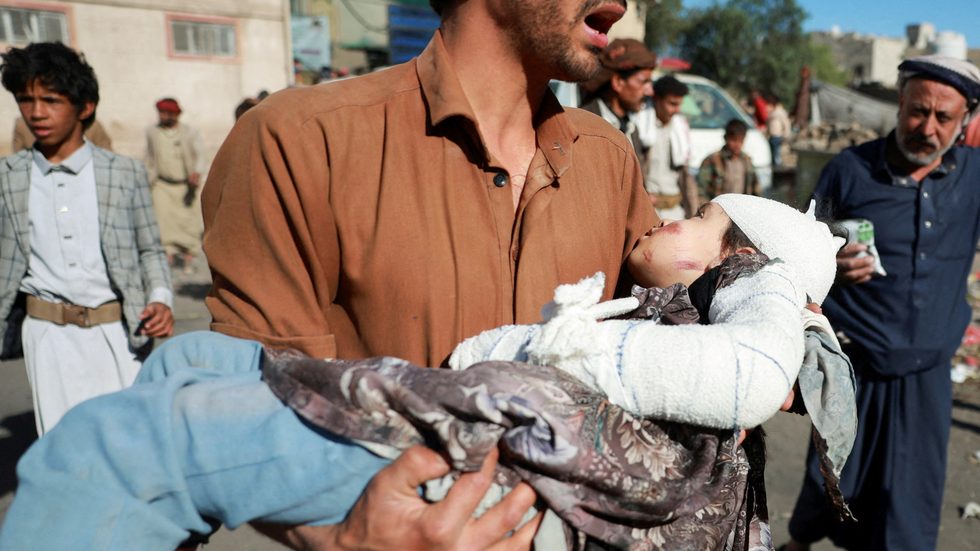
| Saudi Airstrikes on Homes in Yemen’s Sanaa Province Massacre 44 Civilians: Health Ministry | |
Anti-war news 08/11/2026 - The death toll in Saudi airstrikes that hit civilian homes in the Bani Hashish District of Yemen’s Sanaa province on Saturday has risen to 44, according to the Health Ministry within the Sanaa-based Ansar Allah-led Yemeni government.
The death toll makes the attack the worst civilian massacre committed by the US-backed Saudi coalition since Riyadh reignited the war back in July by bombing the Sanaa International Airport.
According to Health Ministry spokesman Dr. Anis al-Asbahi, who announced the updated death toll,21 children and 10 women were among those killed. Another 40 Yemenis, including eight children and nine women, were wounded.
The strike came a day after Ansar Allah, the Houthis, said that Saudi airstrikes hit a crowded market in the southwestern Taiz province, killing at least 30 people. The Saudi-backed Yemeni government claimed the market was hit by Houthi ballistic missiles, but it provided no evidence for the claim, and the Saudi bombing campaign has been killing scores of civilians.
According to the Yemen Data Project, the Saudi bombing campaign killed at least 140 civilians and wounded 286 in October, making it the worst month for civilian harm from Saudi airstrikes in Yemen since December 2017. Source
| When the U.S. Military Implemented AI, Civilian Deaths Rose | |
The Intercept 18/11/2026 - On a balmy night in 2019, 35-year-old Barakat was on his way home, driven by friends through the ancient, mountainous Syrian village of Barisha, one among the previously abandoned Byzantine “Dead Cities.”
“I was with my best friends. They wanted to drop me off at home,” the father of five later told NPR. Barakat and his two companions had finished their day’s work as agricultural laborers at an olive press. “We had pumpkin seeds and bought coffee on the road and were having fun.”
Unknown to them, a fateful military operation was occurring nearby. Three hundred meters away, a team of U.S. special forces was raiding the compound of Islamic State leader Abu Bakr al-Baghdadi. As the attack unfolded, most U.S. surveillance and reconnaissance assets were trained on the compound itself. Yet, known to few at the time, a new set of artificial eyes had been introduced to U.S. warfare in Iraq and Syria. Computer vision target detection, part of the Pentagon’s algorithmic warfare program known as Project Maven, enabled the military to recognize enemy personnel and vehicles through AI-assisted fusion and analysis of images and video.
As Barakat’s vehicle headed south through Barisha, Maven’s AI detected a vehicle that the U.S. military’s human eyes had missed. The ground commander then proceeded to call in the attack. “At that moment, the helicopters arrived. Suddenly, we were hit. I didn’t know what was going on. I was just trying to escape death,” Barakat told NPR. His right arm was blown off, with his left hand partially disabled. His friends, Khaled Mustafa Qurmo and Khaled Abdel Majid Qurmo, were killed. The U.S. military ultimately rejected Barakat’s claim of harm. The results of a second Pentagon review, opened after an NPR investigation, were never released.
A spate of articles have hailed this as the year of AI warfare — from Ukrainian drones to Israel’s algorithmic decision support systems. A recent project that I worked on tracked how the rapid and potentially dangerous introduction of AI is transforming every part of the “kill chain.”
The AI-powered attack on Barakat may have occurred seven years ago, but new research has shown that many of these systems had been fielded years earlier than previously known, prompting questions about the extent of artificial intelligence’s role in historical attacks — and how it has already impacted civilian harm. [...]
In striking similarity to Barakat’s case, less than a year after Maven’s deployment in Somalia, on August 2, 2018, U.S. Africa Command struck and killed four individuals it claimed were “terrorists” in a vehicle. Amnesty International found that three civilians had been killed, prompting the command to declassify its assessment in a disclosure to The Intercept — revealing the military didn’t know the identities of those killed. Read more - Lire plus
US Launches Series of Airstrikes in Somalia Amid Heavy Fighting Between al-Shabaab and US-Backed Forces
Türk calls on States to agree to international treaty banning 'killer robots'
What are the dangers of Intelligence Agencies using AI tools for surveillance?
|
UN human rights committee publishes guidance on freedom of association, which criticises vague laws targeting ‘extremism’
| |
The Guardia 19/11/2026 - The UN human rights committee has warned against the misuse of counter-terrorism and national security legislation as the UK’s highest court considers the lawfulness of the ban on Palestine Action.
In its first comprehensive guidance on freedom of association, the committee criticises vaguely worded laws targeting “extremism” or “undesirable” organisations.
While the document, published on Thursday, does not explicitly refer to Palestine Action, Hélène Tigroudja, the vice-chair of the committee, said the decision to issue the guidance on freedom of association had been spurred by events in countries including the UK, North Korea, Russia, China and Israel.
She said there were accepted grounds for restricting the exercise of freedom of association, such as national security and the fight against terrorism, but added: “These legitimate purposes are too often so vaguely defined by domestic legislation, and more importantly, so extensively misused by authorities to silence by way of criminalising associations such as climate activists, children and young-led movements, human rights defenders, journalists, trade unionists, that these aims must be used with a heightened caution.
“In this regard, what is observable at a global level, is the abuse of the ‘terrorism’ rhetoric to target associations and/or their members and to expose them not only to public opinion’s criticism but also to sanctions, including criminal punishment such as heavy fines or arrest and detention for the individuals.” Last year’s decision to ban Palestine Action has been criticised by civil liberties groups, politicians of different stripes, a former director of public prosecutions and a former director of the security services.
Palestine Action was the first direct action group to be banned under the UK Terrorism Act, placing it alongside the likes of al-Qaida and Boko Haram. In the supreme court case, its aims was described by its lawyer as: “disruption of the supply of weapons from the United Kingdom to Israel at a time when the international court of justice (“ICJ”) had found ‘a real and imminent risk [of] irreparable prejudice’ to the rights of Palestinians in Gaza not to be subjected to acts of genocide”.
The UN human rights committee guidance states: “The right to defend human rights, the reporting of human rights violations, or the advocacy for accountability, for instance, cannot as such be labelled as a threat or breach of public order.” The decision of the supreme court as to whether the ban on Palestine Action was lawful is awaited after it heard a challenge to proscription earlier this month, on the basis that it disproportionately interfered with the rights to freedom of speech and protest.
Huda Ammori, a co-founder of Palestine Action who brought the legal challenge, said of the committee’s report: “This goes to the heart of the Palestine Action case. The government cannot simply label a movement ‘terrorist’ and use that designation to suppress political dissent by extinguishing the fundamental rights of its members and supporters.
“I urge the supreme court to heed this clear warning and overturn this unjust, dangerous and disproportionate ban. If the courts fail to uphold these fundamental freedoms, we will take our case to the European court of human rights. The criminalisation of direct action protest has no place in a democracy, and we will not stop fighting until this Orwellian proscription is overturned.” Source
New “Terrorist” Threat: Pessimists
‘Labelled terrorists’: How France is using anti-terror powers to deter protests
| | Protection becomes intrusion: Counter-terrorism measures violate the right to privacy | |
OHCHR 10/11/2026 - As mass surveillance and biometric data collection are increasingly employed as counter-terrorism measures, oversight and accountability have not kept pace.
This unchecked potential causes many threats, especially interference to privacy, through persistent surveillance and discriminatory profiling.
On a global scale, civil society organizations and human rights defenders have become subject to increased security screenings, abuse of personal data, and arrest.
On 16 September 2026, UN Human Rights presented a report to the Human Rights Council, which examined key developments in relation to counter terrorism and the right to privacy in the context of digital technologies within the period of July 2024 to June 2026.
The Human Rights Council urged States to ensure that any interference to the right to privacy was regulated by law, and consistent in legality, necessity, and proportionality, in line with Article 17 of the International Covenant on Civil and Political Rights. States' response to terrorism has fallen short of these standards. [...]
Evolving technology and access to personal data have provided States with the potential to monitor populations in public and private spheres. For instance, facial recognition and fingerprinting in smart city systems operate without the legal safeguards, transparency or oversight required by international human rights standards.
Biometric identifiers, like fingerprints, are permanent, and so long-term consequences arise, like persistent surveillance, discriminatory profiling, and increased security screenings. These are clear infringements on an individual’s right to privacy.
Surveillance of private life
The lines have been blurred between surveillance conducted for law enforcement, intelligence gathering, and for unlawful purposes. Surveillance systems allow for continuous monitoring, collection of data on individuals’ movements and behaviors, and go beyond law enforcement purposes. In the report, UN Human Rights noted that these surveillance procedures operate with limited transparency and oversight.
Being surveilled and prosecuted discourages individuals and communities from participating in public life, and narrows the space for freedom of expression, association, and peaceful assembly. The following are national examples of the illegal use of biometric data, citizen-reporting, mass surveillance, unlawful measures in the name of counter-terrorism protections.
Spain’s use of spyware to monitor politicians and activists between 2017-2020 led to the Human Rights Committee urging the use of surveillance to be compliant with Article 17 of the International Covenant on Civil and Political Rights.
In the Bolivarian Republic of Venezuela, following the elections in July 2024, authorities promoted the use of a citizen-reporting application, and authorized inspections of mobile phones. In the Russian Federation, 20,813 people were placed on a list of terrorists and extremists by April 2026.
The Human Rights Committee has expressed concerns on the expansion of Canadian surveillance measures for broad "national security” purposes, especially against racial or ethnic minorities and advocates for environmental rights, land rights or the rights of Palestinians. The Committee also expressed concerns on Bill C-2, the proposed Strong Borders Act, which would expand the surveillance powers of authorities at the cost of privacy protections.
Labelling of terrorism
The label of “terrorist” is being increasingly applied to silence individuals peacefully exercising their fundamental freedoms, especially political opponents and dissidents. In several settings, this has led to the harassment, surveillance, and criminalization of journalists and civil society organizations.
Systems designed to detect or remove content labelled as “terrorist” or “extremist” operate based on overbroad labelling that goes beyond terrorism-related offences. In Algeria, terrorism-related charges against trade unionists, journalists and human rights defenders, are upheld by legal amendments which broaden the scope of terrorism-related offences. In the Russian Federation, 20,813 people were placed on a list of terrorists and extremists by April 2026.
The Special Rapporteur on the promotion and protection of the right to freedom of opinion and expression, Leopoldo Maldonado Gutiérrez, noted that in the Philippines, “red tagging” was prevalent, where activists labelled as terrorists led to their unlawful surveillance, arbitrary detention, and killing. In Belarus, the Islamic Republic of Iran, Myanmar, the Russian Federation and Türkiye, journalists, lawyers, political opponents, civic activists and human rights defenders have been detained on terrorism related charges.
Counter-terrorism laws have generated a devastating effect on humanitarian and human rights organizations operating in regions affected by conflict. UN Human Rights reports that in Côte d’Ivoire, the 2015 anti-terrorism law was reportedly used to charge opposition members with “terrorist acts” ahead of the 2025 presidential elections, restricting democratic participation. In Togo, civil society organizations were denied access to the affected area of an emergency mandate and reports of multiple cases of arbitrary arrest and enforced disappearance. Source
ACTION Fix Bill C-34: No ban. No Surveillance!
| | OTHER NEWS - AUTRES NOUVELLES | | ICLMG ACTIONS DE LA CSILC | | The Justice Minister must end the injustice against Hassan Diab! | | |
In April 2023, despite clear exculpatory evidence, the French Court of Assize conducted an in absentia trial that unjustly declared Dr. Hassan Diab guilty and sentenced him to life in prison. The proceedings amounted to a sham trial and a mockery of justice.
Since that ruling, Dr. Diab and his family have lived in constant uncertainty, facing the ongoing threat that a second extradition request could be made at any time.
Please click below to send a new letter demanding that Justice Minister Sean Fraser categorically refuse any future extradition request and put an end—once and for all—to this ongoing miscarriage of justice.
| |
Canada: Abolish rights-violating terrorist entities list!
| | |
On October 15, 2024, the Canadian government placed the Samidoun Palestinian Prisoner Solidarity Network on Canada’s terrorist entities list. While ostensibly a tool to protect the safety and security of people in Canada and internationally, the list is an arbitrary political tool that undermines freedom of association, of expression and due process in the courts. Its effectiveness as a national security tool has never been demonstrated in a manner that justifies its use.
Due to these deep flaws, and more, the ICLMG has consistently called for the list to be abolished since the Canadian coalition’s founding in 2002. Please join us in urging the Canadian government to abolish the rights-violating terrorist entities list once and for all. Thank you!
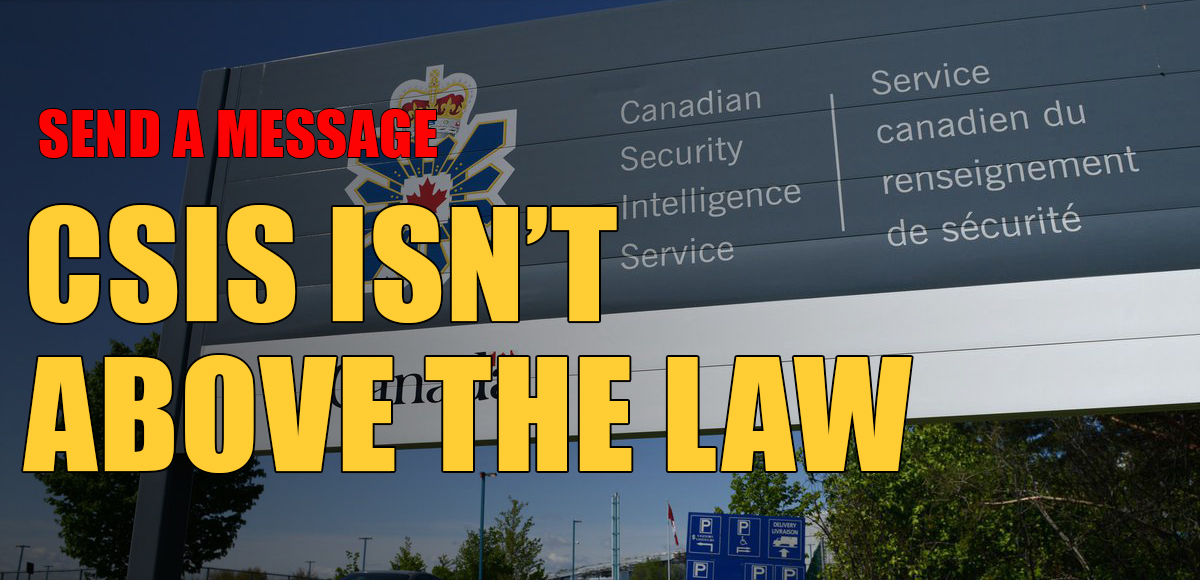
| | Canada must repatriate all Canadians detained in NE Syria/Iraq now! | Every day the government fails to bring these Canadians home, it places their lives at risk from disease, malnutrition, violence, and ongoing military conflicts. United Nations officials have even found that the conditions faced by Canadians in prison are akin to torture. Please click below to urge the federal government to repatriate all Canadians illegally and arbitrarily detained in northeast Syria without delay. | | 23 years of fighting deportation to torture: Justice for Mohamed Harkat! | | CSIS isn't above the law! | | |
In recent years, at least three court decisions revealed the Canadian Security and Intelligence Service (CSIS) engaged in potentially illegal activities and lied to the courts. This is utterly unacceptable, especially given that this is not the first time these serious problems have been raised. CSIS cannot be allowed to act as though they are above the law.
Send a message to the Public Safety Minister demanding that he take immediate action to put an end to this abuse of power and hold those CSIS officers involved accountable. Your message will also be sent to your MP and to the Minister of Justice.
| | Reform Canada's extradition law now! | |
Canada’s extradition system is broken. One leading legal expert calls it “the least fair law in Canada.” It has led to grave harms and rights violations, as we’ve seen in the case of Canadian citizen Dr Hassan Diab. It needs to be reformed now.
Click below to send a message to urge the Prime Minister, the Minister of Justice and your MP to reform the extradition system before it makes more victims. Thank you!
Version française: Le Canada doit réformer la loi sur l'extradition!
| | Canada must protect encryption! | |
Canada, with other G7 nations, continues to push to weaken our access to strong, reliable encryption, after decades of being supportive of strong encryption. We need encryption to safeguard our data, our online transactions, our communications, and to protect the lives of journalists and human rights activists.
Please send a message to the Prime Minister of Canada, the Minister of Public Safety, as well as your Member of Parliament, to urge them to reverse course and once again commit to protecting encryption.
Regardez la vidéo avec les sous-titres en français + Agir
| | Protect our rights from facial recognition! | Facial recognition surveillance is invasive and inaccurate. This unregulated tech poses a threat to the fundamental rights of people across Canada. Federal intelligence agencies refuse to disclose whether they use facial recognition technology. The RCMP has admitted (after lying about it) to using facial recognition for 18 years without regulation, let alone a public debate regarding whether it should have been allowed in the first place. Send a message to the Prime Minister and the Public Safety Minister calling for a ban now. | | What we've been up to in the first half of 2026! | |
ICLMG 01/07/2026 - Thanks to the support of our members and donors, we were able to do a lot and work on the following issues since January:
- State surveillance bill C-22
- New social media and online harms bill C-34
- Impacts of Countering Terrorism Financing on charities, non-profits, solidarity work and international assistance
- Canada’s complicity in torture
- Islamophobia and anti-Palestinian racism
- Artificial Intelligence regulatory frameworks & national security
- Canada's No Fly List
- Foreign interference regulations
- Xenophobic bill C-12
- Anti-protest and anti-freedom bill C-9
- Review of Canada’s 7th report on the International Covenant on Civil and Political Rights
- UN Global Counter-terrorism strategy
- We were interviewed or quoted in a dozen media pieces
- We published our News Digest every two weeks
-
Our National Coordinator, Tim McSorley, received CMPAC’s 2026 Community Partner Award
Read our full summary of activities for the first half of 2026 and our plan for the rest of the year
| | Les opinions exprimées ne reflètent pas nécessairement les positions de la CSILC - The views expressed do not necessarily reflect the positions of ICLMG. | | |
THANK YOU
to our amazing supporters!
We would like to thank all our member organizations, and the hundreds of people who have supported us over the years, including on Patreon! As a reward, we are listing below our patrons who give $10 or more per month (and wanted to be listed) directly in the News Digest. Without all of you, our work wouldn't be possible!
James Deutsch
Bill Ewanick
Kevin Malseed
Brian Murphy
Colin Stuart
Bob Thomson
James Turk
John & Rosemary Williams
Jo Wood
The late Bob Stevenson
Nous tenons à remercier nos organisations membres ainsi que les centaines de personnes qui ont soutenu notre travail à travers les années, y compris sur Patreon! En récompense, nous nommons ci-dessus nos mécènes qui donnent 10$ ou plus par mois et voulaient être mentionné.es directement dans la Revue de l'actualité. Sans vous tous et toutes, notre travail ne serait pas possible!
Merci!
| | | | |