Journalist Jonathan Rauch's new book contends that a “Constitution of Knowledge” channels our discourse in constructive directions by defining the bounds of intellectual customs. Acting as a filter for debates, it sorts out true and good from their opposites, pointing us in progressive directions. But humans often act against the common good. And the revolution in information and communication technology has been used maliciously to manipulate those impulses. Therefore, we need now to revive and strengthen this Constitution of Knowledge in our politics and civil affairs. This all seems like a reasonable argument. "Plausible, but not persuasive," protests historian George McCully, founder of the Catalogue for Philanthropy. The book's main flaw, according to McCully, is Rauch's premise that no assertion is true until it has been accepted socially. "If you and I, in our research, make some new and original discoveries based on adequate evidence, those discoveries according to Rauch’s book are not 'knowledge' until other people agree with them," McCully adds.
|
|
Connecticut Gov. Ned Lamont nominated Charlene M. Russell-Tucker as the state's next commissioner of education, succeeding Miguel Cardona, who was tapped to serve as U.S. secretary of education. A 20-year employee of the Connecticut Education Department, Russell-Tucker oversaw its Office of Student Supports and Organizational Effectiveness before becoming deputy commissioner in March. ... Among out-of-region comings and goings, Freeman A. Hrabowski will retire after this academic year as president of the University of Maryland, Baltimore County, where he has been recognized for building STEM programs and improving graduation rates. ... See more on these and other changes in NEJHE's "Comings and Goings" tally of new appointments in New England higher ed and beyond.
Pictured: Charlene M. Russell-Tucker
|
|
|
Adult education is particularly important in New England due to the region’s aging population. New England’s median age is 41, compared with the national median age of 39. Because of this, older workers play a more pronounced role in the regional economy, and adult education takes on added significance, writes Miles Rubens, a Dartmouth College student and NEBHE policy & research intern. Adult learning is an important focus of NEBHE. In 2019, the board designated one of its four strategic priorities as enhancing postsecondary opportunities for adult learners. In a new series of fact sheets, NEBHE provides updated data on adult learners in the six New England states, highlighting economic conditions, universities that serve adult learners, educational attainment figures, and labor market information. Among key findings: Nursing is the region's most frequently listed skill, fueled by an aging population and persistent pandemic. |
|
|
Geodemographic Scanning Identifies Shifting Populations
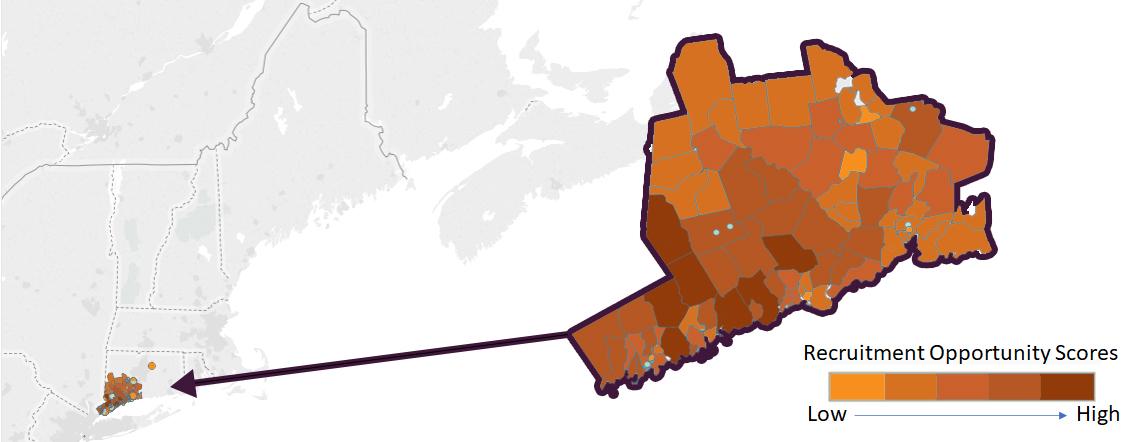
Maguire Associates has developed a new method for scanning populations based on key admissions criteria to find new or deeper core markets for schools to target for admissions. The geodemographic scanning provides the ability to project areas of target population increase as well as potential problem areas of declining feeder populations through 2025. The team at Maguire Associates has a range of approaches and techniques to deliver a customized research program to meet your needs. From now until September 30, you can get $500 off a geodemographic analysis for your school. Take the opportunity now to find the best fit populations to fill your incoming class.
|
|
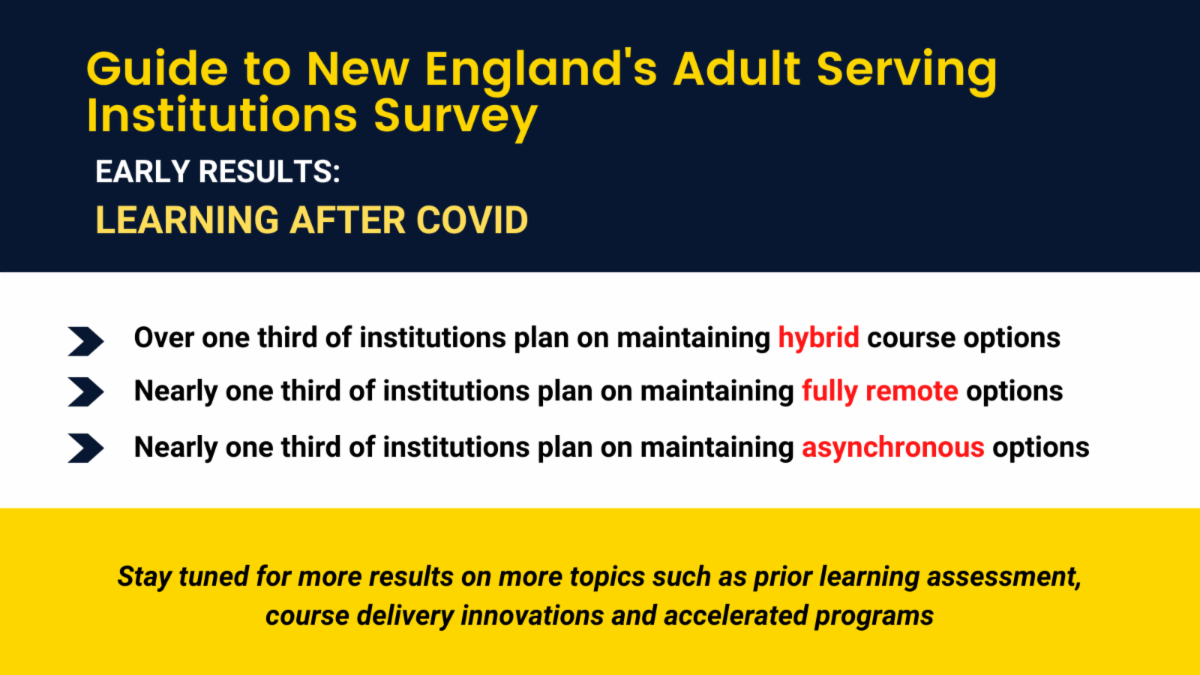
In keeping with its priority to better serve adult learners in New England, NEBHE has released early results of the second biennial Guide to New England's Adult-Serving Colleges and Universities Survey. The survey covers topics including open educational resources, recognition of prior learning experiences and innovations in course delivery and student services. Above are some early results related to learning after Covid.
|
|
|
To subscribe to The Monthly Policy Dispatch, click here or contact NEBHE Associate Director of Policy Research and Analysis Stephanie Murphy at policy@nebhe.org.
|
|
|
We seek an intern for the fall 2021 and spring 2022 semesters to support NEBHE’s Regional Student Program, Tuition Break. The internship requires a commitment of 10-20 hours per week (negotiable). This is a paid position with preference for a student that is eligible for Federal Work Study. A successful intern will be a graduate student or upper-class undergraduate student who can effectively research and communicate detailed and technical information. To apply, eligible candidates should email a cover letter and resume to tuitionbreak@nebhe.org with a subject line of “RSP Internship.” See full position description here.
|
|
|
Recently from The New England Journal of Higher Education
|
|
|
We must hold higher education accountable for reopening without relapsing into the same cyclical pattern of forgetting the pain and trauma of BIPOC students," writes Sara Jean-Francois, assistant director of NEBHE’s Tuition Break program. Last year, as the world was shaken by Covid-19 and colleges and universities were forced to develop sustainable programs for distance learning, BIPOC students experienced another pandemic: the inhumane and cruel loss of Black lives. Jean-Francois. who has researched race-conscious college campuses and recently earned her master’s degree from Brandeis University's Heller School for Social Policy and Management, warns: "This time, higher education should not be able to forget; institutions need to be reminded to say their names—all of their names. And we—myself included—need to hold institutions accountable for the promises they made last spring. Remind them that their students, faculty, staff and administrators are not exempt from doing the hard work, their BIPOC students do matter just as much as the lives that have been lost."
|
|
|
Is it possible to achieve a consensus broad enough to impose one national rule for the investigation and discipline of student misconduct? The U.S. Department of Education is poised to reverse Trump-era rules governing claims of sexual misconduct on campus under Title IX. Those rules themselves reversed the Obama Education Department's. The 2024 election may bring more big change. General counsels at colleges and universities risk whiplash watching the back and forth. At stake are questions like: Does the respondent have a right to confront and cross-examine the complainant? Does the respondent have a right to counsel in their meeting with student affairs personnel? Do colleges and universities have to abide by a common definition of "consent" to intimacy in their student conduct manuals? Boston College Law School lecturer Thomas A. Barnico writes that the main source of the problem is that federal officials want to dictate hotly contested standards of conduct for millions of students in thousands of colleges in a country of 330 million people.
|
|
|
NEJHE NewsBlast is a summary of NEJHE content and other news around NEBHE prepared weekly by NEJHE Executive Editor John O. Harney and emailed every Wednesday to opinion leaders and practitioners. When responding to NEJHE content, please make sure that your remarks are relevant, courteous and engaging. Individuals are responsible for their comments, which do not represent the opinions of the New England Board of Higher Education. We urge commenters to briefly note their occupational or other interest in the topic at hand. Please refrain from offensive language, personal attacks and distasteful comments or they may be deleted. Comments may not appear immediately. Thank you for staying engaged.
|
|
NEJHE NewsBlast is sponsored by
|
|
For more information about partnering with NEBHE, click here
or send an email message to our events coordinator Marla Phippen.
|
|
© 2020 New England Board of Higher Education |
|
|
|
|
|
|
|