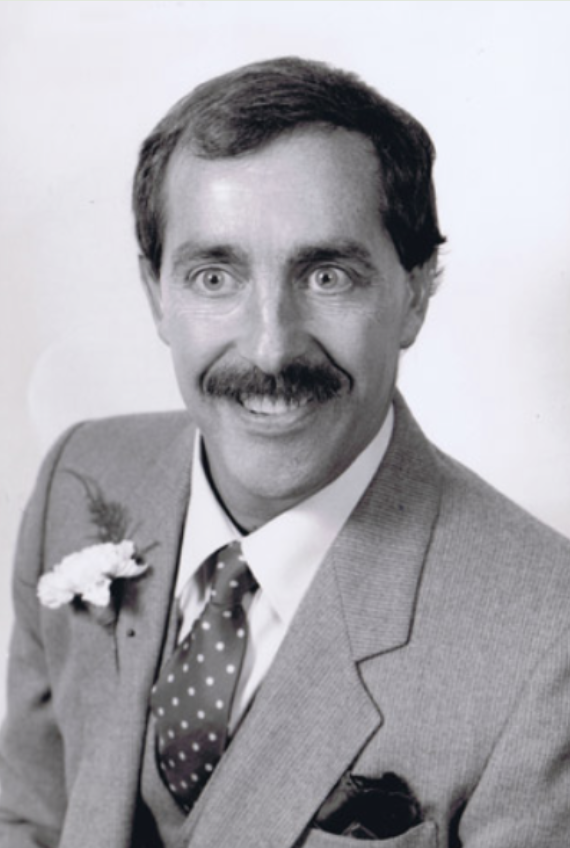
Although not large physically (barely 5’8” and 155 pounds),2 nicknamed “Ollie” (his middle name is Oliver), Wayne Goss played with fierce determination and a competitive fire which elevated him to a legendary status.
Wayne played in a total of 44 junior-level games between 1965 and 1967, but tallied an impressive 183 points (111 goals and 72 assists).
During his 14-year senior career, Wayne Goss made the all-star team eleven times (nine times on the 1st team, twice on the 2nd team). Note: the three seasons Wayne did not make the all-star team was due to injuries – in 1973, he suffered a fractured jaw; 1980 when he ruptured a disc and subsequent back surgery had him on the sidelines for weeks; and 1981 when ongoing back pain delayed his return to playing. However, he did recover and won the 1981 Mann Cup MVP while leading the Salmonbellies to victory.
By the time his career was completed, Wayne Goss held or shared 44 Western Lacrosse Association and Mann Cup records. In 335 regular-season games, he netted 612 goals and 799 assists for 1,411 points. Add to that 441 points (200 goals, 241 assists) in 130 playoff games and you have a total of 812 goals and 1,040 assists amassing a total of 1852 points in 465 games. He also accumulated 586 penalty minutes. Wayne played his last game in September 1981 as part of a Mann Cup championship team. At that point in time, he held the individual player most total points record for the WLA.
Included in his incredible individual accomplishments – WLA Outstanding Rookie (1968), WLA Top Scorer twice (1970, 1975), four times awarded the Western Lacrosse Association Most Valuable Player (1969, 1970, 1971, 1975), three times WLA playoff MVP (1968, 1969, 1976), and the Mann Cup MVP (Mike Kelly Award) in 1981. In addition, Wayne Goss earned Sport B.C.’s Special Merit Award as the 1981 Athletic Comeback of the Year.
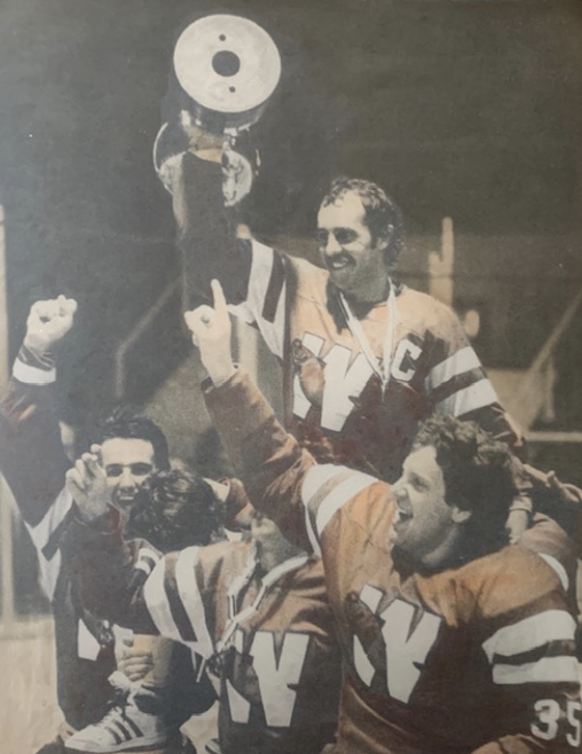
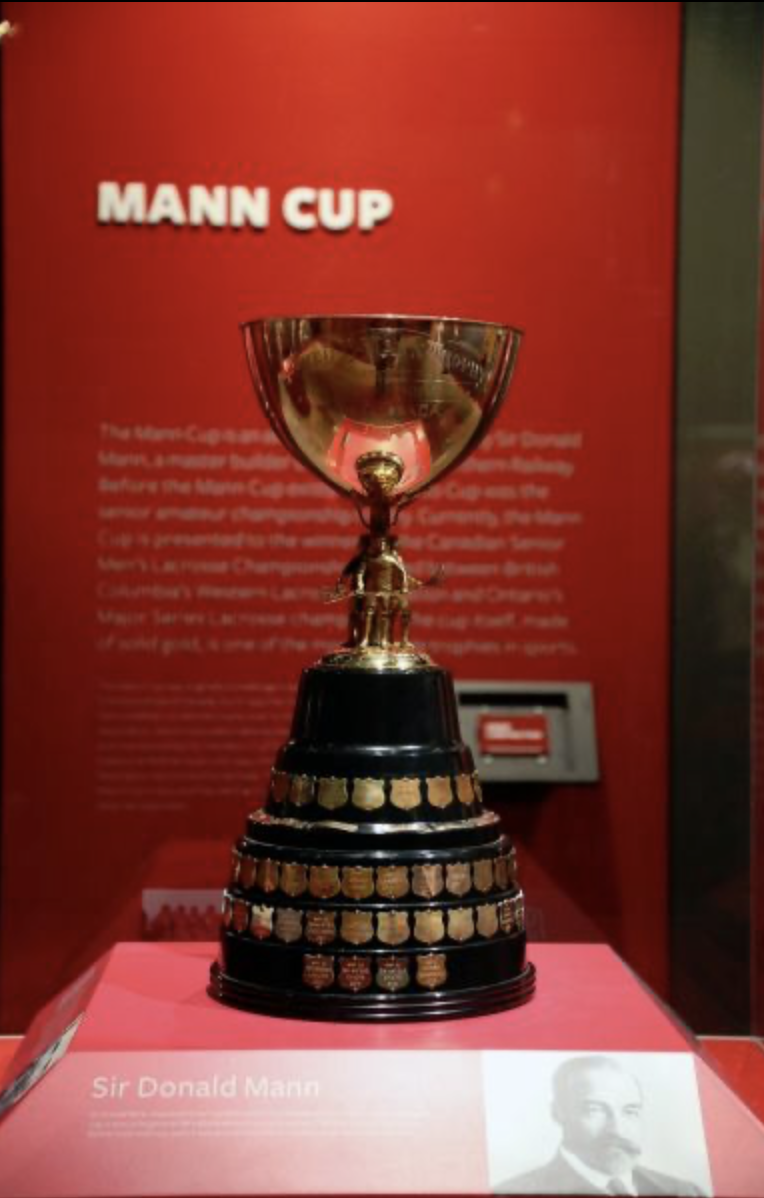
Acknowledged for his superb skills including excelling at playmaking, goalscoring, winning face-offs and penalty killing - Wayne Goss was an integral part of five Mann Cup championships (1970, 1972, 1974, 1976, 1981).
Celebrating a Mann Cup Win
In addition to his career as a Salmonbellie of the WLA, Wayne Goss was part of the 1968 National Lacrosse Association championship game played in New Westminster, with the Salmonbellies winning in six games over Detroit. Wayne also represented Canada playing in the 1974 world field lacrosse in Australia.
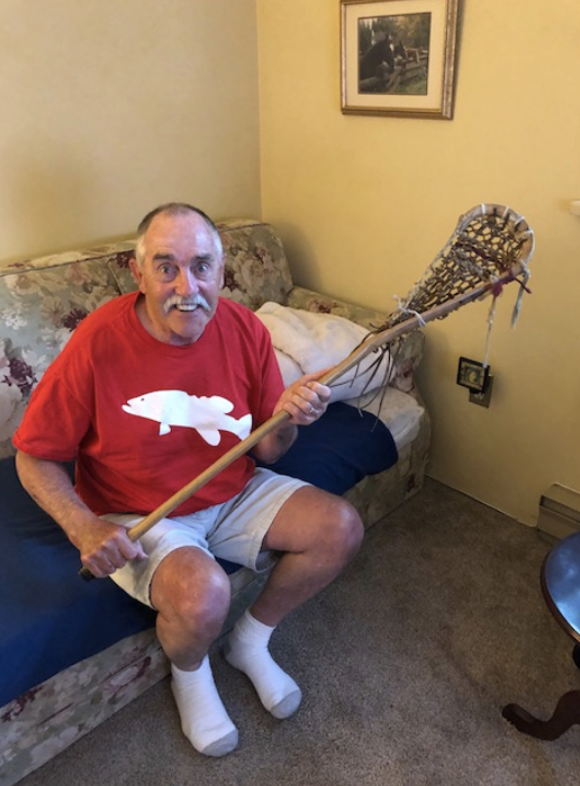
When reflecting upon his life, it must be acknowledged at age 35, Wayne suffered a devastating injury which changed his life. While helping a friend build a cabin, Wayne was struck by a board which led to him falling over 30 feet. The catastrophic accident left Wayne Goss unconscious for two weeks. He suffered an injury which affects his balance, co-ordination and speech. However, with medical intervention, commitment to therapy and the tremendous support of his wife Carol, Wayne Goss strived to recover. Yes, his speech is somewhat slurred, but that does not deter him. Flashing his trademark smile and overall zest for life, Wayne is always willing to share lacrosse stories. (Of note: part of Wayne’s therapy while recovering was therapeutic horseback riding. No surprise, being the intense competitor he is, Wayne Goss went on to win two gold medals at the B.C. Equestrian Disabled Games). Such an accomplishment speaks volumes of his character and what an incredible person he truly is. (And how blessed he is to have Carol Goss for his wife). Goss continues to live a full life and is a role model exhibiting the epitome of the human spirit to endeavour and strive regardless of the challenge.
Forever a Salmonbellie
Wayne Goss had a ton of panache, showmanship, and charisma, traits that do not show up in statistics. He had so much charisma. As a fan, you wanted to watch him, expected him to do something exciting, and you were seldom disappointed.
The sweater number thirteen worn by Wayne Goss was retired and raised to the rafters at Queens Park Arena by the Salmonbellies in 1983. Wayne was inducted into the Canadian Lacrosse Hall of Fame in 1986 and the British Columbia Sports Hall of Fame in 1989. When you hear the name Wayne Goss, you know you are thinking of one of the greatest lacrosse players in the history of the sport.
WAYNE GOSS – INTERVIEW QUESTIONS
At what age did you begin playing lacrosse? Who introduced you to the game?
I was about 10 or 11 when I first began playing lacrosse. My older brother Rob was playing and we’d go watch. My brother Ed’s friend, Rick Messenger, gave him a stick and ball and Rick’s dad, who was the coach, asked him to try out for the Peewee team. As boys, Ed and I did lots of things together and I was asked to try out too. Lacrosse wasn’t a costly sport – all you needed was a lacrosse stick and a pair of $1.49 runners in those days. We didn’t wear helmets! I was playing baseball and soccer and my baseball coach told me I couldn’t play baseball and lacrosse at the same time, so once the baseball season ended, I chose lacrosse. I also got a job selling ice cream at Queen’s Park Arena so I could watch the Seniors play.
Known as a gifted goal scorer and playmaker, how did you develop your skills?
I studied the goalies when they played, and I practiced, practiced, practiced. I used to do a lot of wall ball. I’d put an X on the wall and shoot at it repeatedly. I carried my stick as much as I could, so it felt like it was a part of my body. I tried to keep in good shape with running and gym workouts.
What personal strengths do you believe made you such a great player?
I like to win. I am very competitive. I love exercising, so it was no problem to work out. I played other sports – baseball, hockey and soccer, I feel that playing other sports helped enhance my lacrosse skills. I didn’t stick to just one sport. However, in lacrosse, I loved the thrill of beating a goalie.
Did you have a favourite “go to” play or move? (Did you come up with your own plays?) If yes, please tell us about them.
Yes, I would look at one spot and shoot at another. The goalies usually couldn’t tell where I was going to shoot. My bread-and-butter shot was a bounce shot. I would observe other players and how they shot, and then create my own style, what worked for me. I’d aim at a specific spot. It was successful for me.
What made you such a passionate player?
I fell in love with lacrosse early on, as I said, I loved to win and as a younger person, I liked the attention it brought me. I was confident regarding my skills and ability. There were times when I felt like I would get in the “zone” mentally and it would feel like I could score at will. That didn’t always happen, but when it did, it was an amazing feeling. Of course, I had many teammates that fed me the ball, and helped me along the way.
Do you think you had any particular weaknesses?
Defense! But I did like to play both ends. I could be hot headed at times as a young player, a bit cocky. Hopefully I matured as the years went on.
As a youngster, was there a particular player you admired or tried to model yourself after? If so, who and why?
I would pretend to be Jack Bionda, I think lots of kids my age did. I also admired Cliff Sepka, Paul Parnell, and had great respect for Dave Tory, who passed on all kinds of tips regarding faceoffs.
As you developed to become the genuine star player you were, was there any particular teammate you admired?
My friend and teammate Ken Winzoski. He was responsible for getting me on to the Senior Salmonbellies team – they had a choice of Al Lewthwaite, my brother Ed and me. Ken and I had played together all the way up to Senior and he spoke up for me. I was small and my brother and Al were much bigger, more aggressive players, so I really thought they would choose one of them. I’ve always felt that Ken helped me make the team. Ken wore the #12. When choosing jerseys, he said - “Choose #13 Wayne and make It famous!” So it was because of Ken that I wore #13. I also always admired Cliff Sepka, Paul Parnell, my brother Ed, my good friend Steve d’Easum, and later – Eric Cowieson, Lyle Robinson and Geordie Dean.
Was there any particular opposition player you found tough to play against?
Ward Sanderson! He was a tough opponent, that never let up on me. I don’t remember him ever being a dirty player towards me, just intimidating. Now when we see each other, we laugh about it. Another tough opponent was Bob Salt, he was hard to beat. He was a good, hard, clean player.
Was there any specific goalie you had trouble scoring on?
I was up against many great goalies, but the most difficult to score on was Dave Evans. He was tough.
Did you have a favourite coach? If so, who and why?
For Juniors – Keith Jackson. He wasn’t much older than us, but he knew the game and kept things light and in perspective. For Seniors - Ron Hemmerling, we called him Hammer. He just came along at the right time for our team, he had the expertise and a great sense of humour. He brought the fun back to the game and we won under his guidance.
Was there any particular team you played on that holds a special place in your memory?
Each year was special, particularly the years we won the Mann Cup. But the 1981 Mann Cup championship has a special place for me. It was the last year I played, and I achieved a Mann Cup scoring record, now long since broken - but when I think of how hard my teammates worked to get me that record, it gives me chills. It was done with 6 seconds to go in the final game.
Was there any particular personal highlights or achievements you are most proud of?
- Winning the scoring race while not always on the power pla
- Winning the World Championship in 1968 in Detroit
- Winning Mann Cups in 1970, 1972, 1974, 1976 and 1981
- Playing one game with the Victoria Shamrocks in 1979 – they went on to win the Mann Cup that year. They had a strong team and didn’t need call ups, but it was fun to get to know all the great players on that team. To this day, the Victoria Shamrocks treat me very well when we go over to see a game
- Playing for Canada in the 1974 World Field Lacrosse Championships in Australia.
How do you think your teammates and coaches would describe you?
I would hope they would say I was a good team man and a quiet leader. I wasn’t a rah-rah kind of guy in the dressing room but tried to lead by example. I think I had the player’s respect.
Was there any one important lesson you learned from your time as one of the true legends of lacrosse?
I disliked the opposition intensely when I was playing against them, but when it was all said and done, we are friends afterwards. Be humble. It can all change in a heartbeat. But most of all, enjoy every moment, it goes by quickly.
- Over the years, there have been articles previously claiming Wayne Goss played briefly for Coquitlam. This is false information. Wayne Goss played his entire career as a member of the New Westminster Salmonbellies – a fact he takes immense pride in. The Goss Family are pleased to know this information is being corrected.
- During the hiring process for the New Westminister Fire Department - to meet the height requirement of 5’8”, Wayne stuffed newspapers in his shoes. It worked. Clearly, an indicator of Wayne Goss’s strategic intelligence, which was also huge part of his success as a lacrosse player.