|
In this edition:
- A message from the Director of Education
- Senior Leaders' Briefing
- Inspection Updates
- Diocesan Education Team Update
- Admissions
- Pupil Premium Grants
- Governor Briefing: Disadvantaged Pupils
- How trusts and schools narrow attainment gaps between ethnic groups
- National Parent Study Findings
- Heads and Chairs Working Together
- Attendance
- New Guidance on Supporting Gender-Questioning Pupils
- Headteacher Wellbeing Report
- Chair of Governors' Network
- Additional Updates
| |
|
A message from Simone Bennett,
Diocesan Director of Education
I hope that the first couple of weeks of the new term have got off to a positive start and that the break isn’t a distant memory just yet.
As I begin my tenure as Director of Education, on behalf of myself, the Education Team and the Board of Education, I want to extend a huge thank you for all that you are and do in your governor roles. We never forget that your role is a voluntary one, but our schools, quite literally, could not do what they do without you!
In the ever-changing world of schools and education, this term will no doubt be busy, bringing its joys and challenges in differing measure. Whatever that balance is for you at present, please remember that you are not alone. We are here to support and walk with you as closely as we can as you faithfully serve your schools and communities.
As such, I hope this update will offer a range of opportunities, training and insights to support and enhance your work with us in the coming weeks.
With my appreciation and prayers, I hope to see you virtually at the Senior Leaders' Briefing next Thursday.
God bless.
Simone
| |
|
|
Senior Leaders' Briefing
Thursday 18th January 5 pm - 6 pm
FREE to schools in the ESP
A termly meeting for senior leaders, including governors, to update them on national, local and diocesan matters. An excellent opportunity to keep up to date and network with colleagues from across the diocese.
Please note, last term's enrollment does not provide you with access this term.
| | | |
|
Inspection Updates
SIAMS
The new SIAMS Framework, which came into place back in September, is now well underway. Last term we had twenty-one SIAMS inspections across the Diocese. The new report format begins with the identified key strengths and then two to three areas for development. Whilst the way these are written will vary according to school context there are some key themes which emerge from over one hundred strengths identified in all of the reports.
These reports recognise the:
- deep commitment of leaders to being a church school.
- centrality of worship to the life of the school.
- impact of the vision throughout the life of the school.
- pivotal role religious education plays within the curriculum.
- nurturing nature of the school as seen in highly effective inclusive practices.
- positivity of relationships across the school community and the impact this has on learning.
Looking at the common areas for development across the reports, almost nine in every ten development points (88%) fit into the following four themes.
They need to improve the:
- school's approach to spiritual development.
- way pupils are encouraged to seek justice and become agents of change.
- robustness of monitoring by leaders, including governors.
- quality of religious education, in particular how faiths other than Christianity are taught.
We have been delighted that the majority of reports reference the support the school has received from the Diocese. Whilst we recognise that the report is not about us, it does provide us with external verification that the support we offer is working.
If your governing board would like help to prepare for your SIAMS inspection, please don't hesitate to contact your named adviser. Remember all of our team are serving SIAMS inspectors.
| |
|
|
New to the SIAMS Framework
Tuesday 2nd July 1 - 3.30 pm
Church House, Leeds
£85 for schools in the ESP
Join us for this half-day exploration of what this means to schools. This session is for all those new to the SIAMS framework. This includes school leaders and governors.
Please note that much of the content is a repeat of the 10/10/23 course.
| | | |
|
OFSTED Paused
Sir Martyn Oliver has begun his five-year tenure as His Majesty’s Chief Inspector (HMCI). This has started with a pause to inspections for the first three weeks of the year and additional training for inspectors, as an initial response to the Ruth Perry inquest.
In several early interviews with the press, Sir Martyn has stated that he will give the time to “listen- to parents, to professionals in the sectors we work with, and to people with an interest in our work”. He has pledged to work closely with the unions who have given a cautious response.
Ofsted's all-inspector mental health awareness training can be watched here.
Inspections are due to resume on 22nd January.
| |
|
Diocesan Education Team Update
In December we said a fond farewell to Richard Noake who had served for 10 years as Diocesan Director of Education. As a result roles within the team have been adjusted with Simone Bennett taking on the role of Director of Education until such time that a recruitment process takes place. Darren Dudman will step up as Deputy Director of Education. We hope that this continuity within the team will ensure that service levels remain at the same high standard. We are currently recruiting for a new adviser, you can see the advert here.
Later in January, we welcome Bethany Maclean to our team. Bethany will take on the role of School Business Support Officer and work alongside Kevin and the Diocesan Environment Officer, Jemima Parker, on supporting schools with building matters and sustainability.
| |
|
Admissions
For those schools that are responsible for their own admissions.
Just a reminder that it is a statutory requirement that all schools who are their own admissions authorities and all academy trust boards must determine (agree) their admissions arrangements for the academic year 25/26 by February 28th. This needs to be done whether you have consulted on changes or not and should be recorded in the minutes of a board meeting by that date.
Sutton Trust Selective Comprehensives Report
New research published by the Sutton Trust has found that 155 secondary comprehensives in England are more socially selective than the average grammar school. These include Church of England schools. The Trust’s Selective Comprehensives 2024 report finds that, on average, pupils who are eligible for Free School Meals (FSM) are less likely to attend a top-performing comprehensive even if there is one in their area. This has not improved since 2016, and there are some indications that it has got worse.
You can access the report here.
Just a reminder that our admissions guidance states that 'The DBE invites all of its church schools, through their vision, and hence their policy and practice, to make the needs of the most vulnerable and disadvantaged a priority. For those schools, academies and MATs, who are their own admission authorities, this should also be reflected in their admission arrangements.'
If you would like further advice on your admission policy contact your named adviser.
| |
|
Application
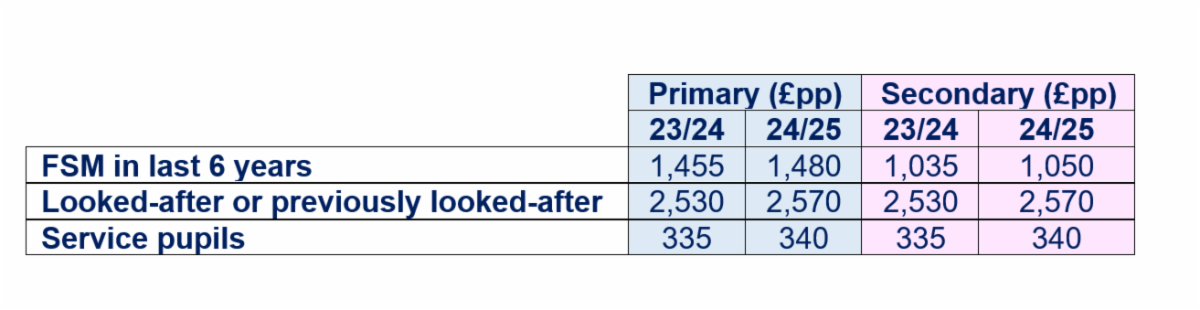
The government has announced planned increases in the Pupil Premium grant for 2024 and 25. These increases are way below inflation. The figures are in the table below.
Further details can be found on the DfE website here. Governors who wish to know about the pupil premium, how schools support disadvantaged pupils and their role within this may wish to attend our next governor briefing, see below.
| |
|
|
Governor Briefing: Disadvantaged Pupils
Tuesday 30th January 6 - 7 pm
FREE to schools in the ESP
What is different about an approach to disadvantaged pupils in a church school context? What is the Pupil Premium and what is my role in relation to it? What is my role as a governor in monitoring the provision for these pupils? What does best practice tell us about how to support disadvantaged pupils?
| | | |
How trusts and schools narrow attainment gaps between ethnic groups | |
A recent government study has found that schools effectively closing attainment gaps among students from diverse ethnic backgrounds achieved this through curriculum diversification and a celebration of cultural diversity. Commissioned in response to the Sewell report on race and ethnic disparities, this study focused on successful strategies employed by nine MATs and one local authority school. including prominent organisations like United Learning, The Harris Federation, and Academies Enterprise Trust, were interviewed by researchers from Isos Partnership. Leaders consistently emphasised the need to focus interventions on individual educational needs, such as literacy and reading.
In the past three years, all trusts had examined and adjusted their curriculum to guarantee greater representation. The trusts cultivated a "feeling of belonging among students" by implementing practices that intentionally considered characteristics such as ethnicity, religion, nationality, and broader experiences associated with socio-economic status. A chief executive from one trust contended that there was no compromise between maintaining a curriculum rich in knowledge, rigour, and challenge, and ensuring that it provided opportunities for every individual to identify themselves and others reflected in the curriculum.
You can read the preliminary research report here.
| |
National Parent Study Findings | |
|
Approximately 1 in 3 parents are facing challenges covering the expenses of sending their children to school, with the cost of school uniforms emerging as a significant worry, according to a recent survey conducted by Parentkind.
In England, nearly one-third of parents are finding it difficult to meet the financial demands of their child's education. The survey, published in December by Parentkind and conducted by YouGov, reveals that 50% of parents express concern about the expense of uniforms, while 45% are troubled by the cost of school trips. Additionally, 20% are apprehensive about the expenses related to transportation to and from school. Specific to England, 34% of parents are troubled by the overall cost of sending their child to school, and 27% find it challenging to manage the associated expenses.
Beyond the cost of living crisis, researchers found that 875,000 primary school children don’t have enough age-appropriate books at home with a significant minority of parents not reading regularly with their children. Another major worry was the high levels of anxiety and depression which were reported by parents, particularly for parents with children at secondary school. At the secondary level, over half of parents expressed dissatisfaction with the support offered by schools for children dealing with such issues.
You can access the National Parent Survey here.
The Child Poverty Action Group have produced a guide for schools on how they can support families in times of hardship. You can access the guide here.
| |
Heads and Chairs Working Together | |
The relationship between head and chair is of paramount importance and often there is insufficient time for heads and chairs to work together to plan for strong governance. As a result, we are running a repeat of our one-day, face-to-face course to provide quality facilitated time for the head and chair to reflect on their relationship and plan together to make the board more effective. There will be time to reflect on the professional relationship between head and chair, clarify your roles and what is strategic and operational in your context. There will also be an opportunity to review your board's effectiveness and consider your roles in supporting its wider work so that you can leave the day having made a plan, together, for improving board effectiveness.
Feedback from the course previously included:
'The impact of this course was better than expected, it was good to have a safe space to work 1 to 1 with the headteacher'
'Excellent ideas and strategies to further improve our work '
'...lots of practical ideas to take back and implement...useful and valuable!'
| |
|
|
Heads and Chairs Working Together for Strong Governance
Tuesday 9th July 9.30 am - 3 pm
Church House, Leeds
£160 for schools in the ESP
(The Head pays and the Chair of Governors attends for free!)
| | | |
|
Attendance continues to be a key issue for many of our schools. The DfE have recently announced an expansion of their school attendance hubs scheme. A national marketing campaign has also begun with the strapline 'moments matter, attendance counts'.
National data shows that 22.3 per cent of pupils missed more than one in 10 sessions in the 2022-23 academic year. Compared to the 22.5 per cent rate in 2021-22. This is little movement despite a huge focus from school leaders, including governors. Almost two in five disadvantaged pupils were persistently absent. Before the pandemic, the persistent absence rate sat at between 10 to 13 per cent.
Very recent polling for the Centre for Social Justice by YouGov has found that nearly three in ten parents (28 per cent) surveyed agree that the pandemic has shown it is not essential for children to attend school every day. This 'breakdown in the social contract' was referenced in Ofsted's annual report last year. You can read The Missing Link: Restoring the Bond Between Schools and Families report here.
| |
New Guidance on Supporting Gender-Questioning Pupils | The non-statutory gender questioning children guidance for schools was published recently to much media attention. This is draft guidance and part of a consultation process which runs until the 12th of March. Although governors may wish to familiarise themselves with the guidance, we are advising schools not to amend their policies as a result of the document at this stage. Of course, governors could respond the consultation, follow this link to do so. | |
Headteacher Wellbeing Report | |
In December, the headteachers' association, the NAHT, published the results of their annual all-member in England survey. It demonstrates the negative impact of workload, inspection and accountability on personal wellbeing.
Almost half (49%) of school leaders in England said they identified that they required professional mental health or well-being support, with over a third (38%) accessing some. Leaders said Ofsted pressures were the factor that had the greatest impact on their mental health over the last year.
Governing boards have the ultimate responsibility for looking after the wellbeing of school leaders. We know through the many headteacher appraisals we support that most boards do an amazing job of supporting their headteachers. Please do get in touch with your named adviser from our team if you require any support. Just a reminder that all of our named advisers have been headteachers and approach the job with some understanding. Many headteachers use their Diocesan adviser for pastoral support, so do let us know if we can be of support.
The report also recognises that the current context acts as a powerful deterrent to those aspiring to headship. 57% of school leaders would not recommend leadership as a career choice and 61% said their work satisfaction had declined over the last twelve months. Approaching two-thirds (61%) of assistant and deputy heads said they do not aspire to headship, an increase of more than half since 2016 (40%).
We are aware of the recruitment crisis because we are involved in so many recruitment processes.
-
Please do let your named adviser know if your headteacher has indicated that they will be leaving.
- You may also want to encourage your deputy or assistant headteachers to attend our Deputy Headteacher Pathway next year to help prepare them for future leadership roles.
-
If you have a deputy in school who has expressed an interest in becoming a church school headteacher then you may want to support them by suggesting that they attend our Applying for Headship in a Church School course.
The NAHT Crisis Point report can be read here.
| |
|
|
|
Chair of Governors' Network
Tuesday 6th February 6 pm - 7 pm
FREE to schools in the ESP
A termly opportunity for those in the role of Chair of Governors to share ideas and resources and discuss matters relating to the leadership of the board. You may wish to invite your vice-chair of governors as part of your succession planning process.
| | | |
Other items of news which may be of interest... | |
|
© Anglican Diocese of Leeds, 2024
Diocesan Education team
Church House, 17-19 York Place, Leeds, LS1 2EX
0113 200 0540
info.ed@leeds.anglican.org
www.leeds.anglican.org/education/home
Why am I receiving this email?
This email from the Diocesan Education Team is sent to those who have asked to receive it by 'subscribing' or who receive it because they have a relationship with the diocese, holding an office or position in a church in the diocese, a church school or access our services through the Enhanced Service Plan. However, if you do not wish to continue to receive these emails, simply use the 'Unsubscribe' button below.
Under no circumstances are email addresses shared with third parties.
| | | | |