AUGUST 10, 2026

CONTRIBUTIONS HELP PAY FOR THE WEBSITE, CONSTANT

CONTACT, AND DUES TO ATTEND CLUBS TO HEAR

SPEAKERS. THANK YOU FOR YOUR CONTINUED SUPPORT!

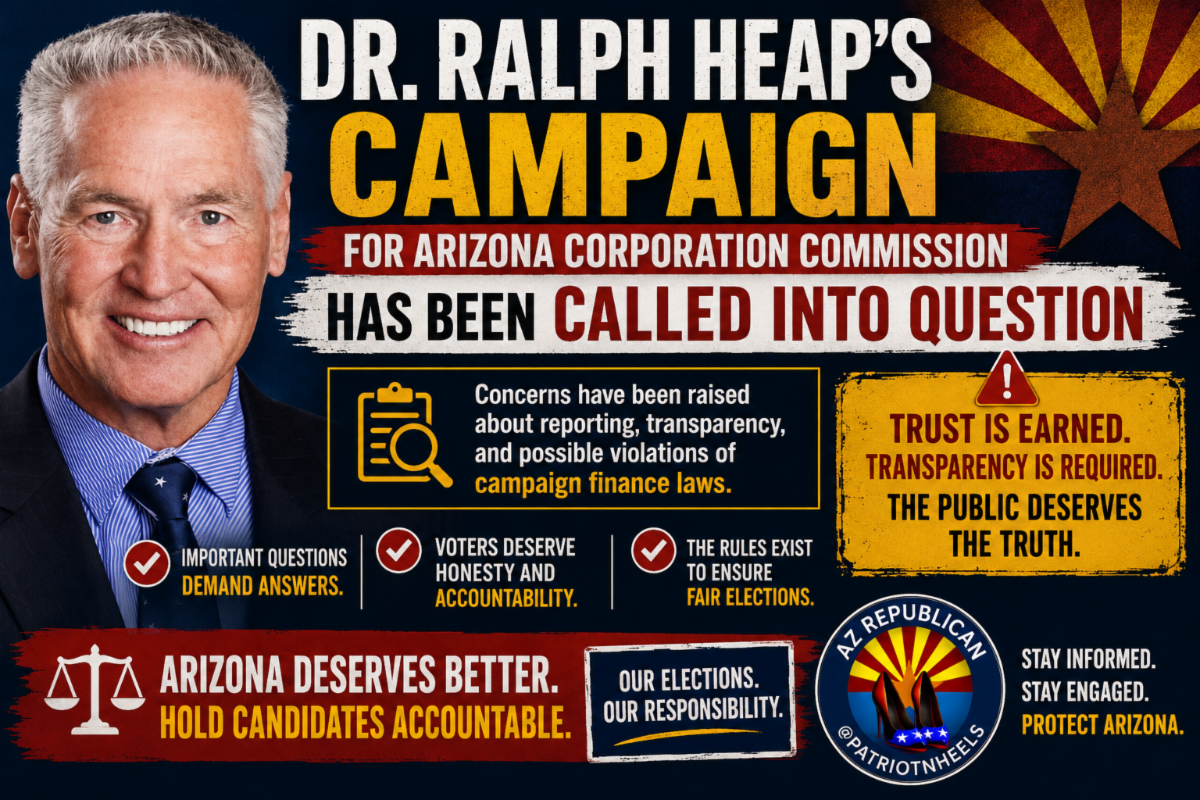
Time Is Running Out: Ralph Heap Should Withdraw from the Race


Time is running short for Arizona Corporation Commission candidate Dr. Ralph Heap, and so is the opportunity to resolve the growing controversy surrounding his campaign finance reporting

.

On Tuesday, August 4, the Arizona Citizens Clean Elections Commission voted 4-0 not to allow Dr. Heap to withdraw from the Clean Elections system. As a result, he remains bound by the program's requirements and cannot access approximately $360,000 in Clean Elections campaign funds until the outstanding issues surrounding his campaign finance reports are resolved.


This decision follows complaints alleging that campaign expenditures were not properly reported. I originally filed a complaint with the Arizona Citizens Clean Elections Commission after noticing hundreds of Dr. Heap campaign signs appearing throughout Arizona while his campaign finance reports did not appear to reflect the level of spending necessary to produce and install them. Since then, I have also filed a complaint with the Arizona Secretary of State's Office. If campaign finance violations are ultimately found, the potential penalties under Arizona law can be substantially greater than those imposed through the Clean Elections process.


The Commission's vote means Dr. Heap must now address the reporting issues before he can receive taxpayer-funded campaign dollars. Until that happens, his campaign remains in a difficult position.


In my opinion, the best course of action is for Dr. Heap to withdraw from the race. Doing so would allow the Arizona Republican Party to select another qualified Republican nominee for the general election. However, time is running out. Ballots are scheduled to go to print on August 20, leaving only a short window for any changes to be made.


Regardless of where someone stands politically, campaign finance laws exist to ensure transparency and maintain public confidence in our elections. Candidates seeking public office should be held to those standards, and voters deserve complete confidence that those seeking to regulate others are willing to fully comply with the laws governing their own campaigns.

Maricopa County Certifies the 2026 Primary Election


The Maricopa County Board of Supervisors officially canvassed the results of the 2026 Primary Election, marking another important milestone in Arizona's election process. A canvass is the formal certification of the election results after all eligible ballots have been counted, signature curing has been completed, provisional ballots have been reviewed, and election officials have verified the accuracy of the tabulation.


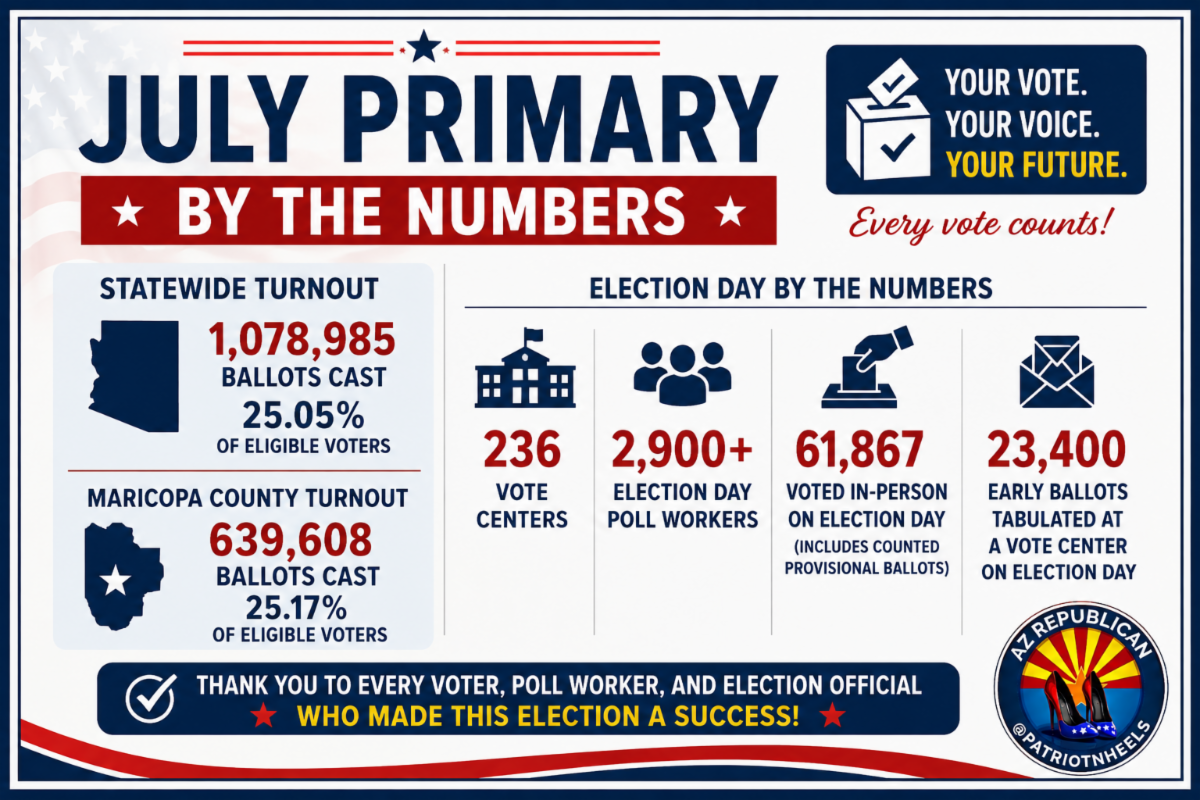
This year's primary reflected several noteworthy statistics. Maricopa County operated 236 Vote Centers staffed by more than 2,900 Election Day poll workers. More than 61,800 voters cast their ballots in person on Election Day, while approximately 23,400 voters took advantage of Arizona's new early ballot check-in process, bringing their early ballot to a Vote Center, presenting identification, and having their ballot tabulated immediately rather than waiting for post-election signature verification.


County election officials also worked through approximately 3,000 ballots requiring signature curing and reviewed roughly 1,000 provisional ballots before determining whether they could legally be counted. These steps are an important part of ensuring every eligible voter has the opportunity to have their ballot counted while maintaining the integrity of the election.


One trend that stood out from this year's primary was voter participation. While more than 639,000 Maricopa County voters cast ballots, turnout continued the decline seen in recent primaries. Historically, turnout is significantly higher when a presidential candidate is on the ballot. With no presidential contest driving voter interest this year, participation was lower than in 2020, 2022, and 2024.


The canvass does not change election results; instead, it confirms that all required procedures were followed and that the official vote totals are accurate. It represents the final step at the county level before election officials begin preparing for the General Election.


Now that the primary has been certified, the focus shifts to November. Candidates, political parties, and voters alike have just a few months remaining to make their case to the electorate. Whether you supported the winning candidate in the primary or not, the General Election will determine who ultimately serves our communities, making it more important than ever for voters to stay informed, become engaged, and most importantly, cast their ballot.

Arizona Republicans Have an Independent Voter Problem


Republicans have spent a tremendous amount of time talking about voter registration. Register more Republicans, grow the party, and win elections. It sounds simple.


But the latest Maricopa County registration numbers suggest we need to have a much bigger conversation—not just about how many Republicans we are registering, but how many voters we are losing and, most importantly, who will actually decide the November election.


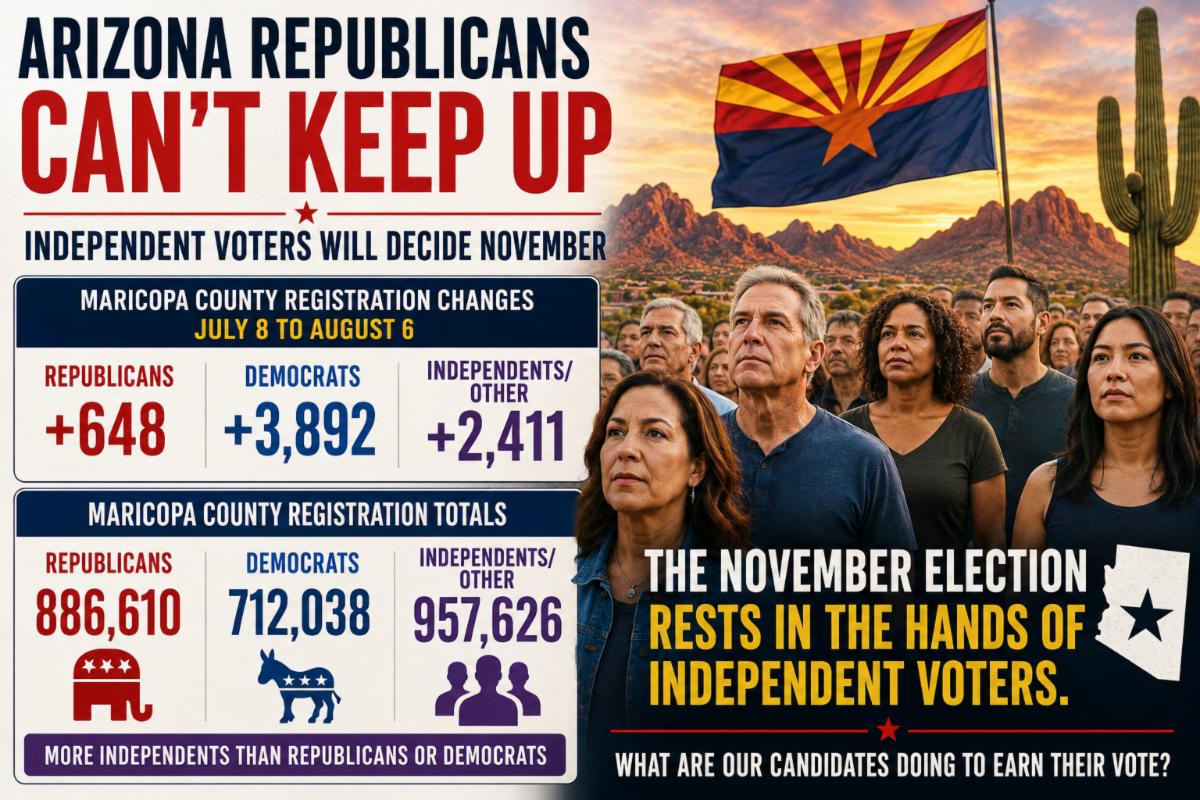
Between July 8 and August 6, Maricopa County voter registration changed by:


Republicans: +648

Democrats: +3,892

Independents/Other: +2,411


Those numbers should get the attention of every Republican candidate and party leader in Arizona.


The current Maricopa County registration totals are:


Republicans: 886,610

Democrats: 712,038

Independents/Other: 957,626


Read that last number again.


There are now more independent and other-party voters in Maricopa County than registered Republicans or Democrats.


That means November cannot simply be about turning out the Republican base. Republicans absolutely need strong turnout from registered Republicans, but in competitive races, that alone may not be enough.


November rests in the hands of independent voters.


Registration Is Only Part of the Story

Republicans frequently celebrate registering new voters, and we should. Every new Republican registration matters.


But registration efforts cannot be judged only by how many people enter through the front door. We also have to ask how many are walking out the back door.


If we register one new Republican while two existing Republicans change their registration to independent, we haven't grown the party—we've lost ground.


That is why Republicans need to start looking at net registration, retention and voter behavior instead of simply announcing how many new voters were registered at an event or through a particular program.


The July 8-to-August 6 numbers are particularly concerning because Democrats posted a gain of 3,892 voters while Republicans gained only 648. That means Democrats' registration growth during this period was approximately six times greater than Republican growth.


Whatever Republicans are doing right now, the numbers tell us it isn't enough.


Why Are Voters Leaving the Republican Party?

That is the question Republican leadership should be asking.


Some independent voters are conservatives who still vote Republican but no longer want the party label. Others may vote Republican in one race and Democrat in another. Some are frustrated with both parties. Others simply don't want partisan politics determining every decision they make.


Instead of criticizing these voters for leaving the party, calling them RINOs and other names, maybe Republicans should be asking why they left—and what it will take to earn their votes again.


Calling someone a RINO because they disagree with us on one issue isn't going to bring them back. The Republican purity test is driving out reliable voters over a single issue of disagreement.


Demanding absolute loyalty to every candidate isn't going to bring them back.


Relitigating every internal Republican Party fight isn't going to bring them back either.


Republicans have to give independent voters a reason to vote Republican. And I am not sure extreme right candidates is the answer.


My question to you is do we want a moderate Republican in office or do we want a Democrat to win the race?


What Are Our Candidates Doing to Earn Their Votes?

This may be one of the most important questions of the 2026 General Election.


What are Republican candidates doing right now to communicate with Arizona's independent voters?


Are they talking about the issues that affect families every day—housing costs, electricity rates, water, education, public safety, transportation, taxes and the cost of groceries?


Are they attending events outside traditional Republican circles?


Are they knocking on the doors of independents?


Are their mailers reaching independent households?


Are their digital campaigns speaking to persuadable voters, or are they simply preaching to

people who already agree with them?


And perhaps most importantly, are candidates giving independents something to vote for, rather than simply telling them what they should vote against?


Winning a Republican primary and winning a general election require two very different strategies.


The primary is over.


The Math Matters

Maricopa County is home to nearly one million independent and other-party voters. They represent the largest registration group in the county.


Republicans cannot afford to ignore them.


We can hold every Republican meeting, knock on every Republican door and convince every Republican we know to vote—but if independent voters break heavily toward Democrats in November, Republicans could still lose critical statewide and local races.


The Republican message now has to expand beyond the Republican base.


That does not mean abandoning conservative principles. It means explaining why those principles matter to someone who doesn't have an "R" next to their voter registration.


Limited government matters because families should keep more of what they earn.


Public safety matters because every family deserves to feel safe in their neighborhood.

Property rights matter whether someone is Republican, Democrat or independent.


Good schools matter to every parent and taxpayer.


Reliable water and affordable electricity aren't partisan issues.


Neither is responsible government.


November Is About Addition

Republicans have spent enough time dividing ourselves into camps and deciding who is Republican enough.


From now until November, the objective needs to be addition.


Keep Republicans.


Bring former Republicans back.


Reach independents.


Persuade voters who may not agree with us on every issue but agree with us on enough issues to vote for our candidates.


The registration numbers are sending Republicans a warning. Democrats gained nearly 3,900 voters in Maricopa County between July 8 and August 6 while Republicans gained fewer than 650.


We can ignore those numbers, make excuses for them, or learn from them.


There are 957,626 independent and other-party voters in Maricopa County.


They may very well decide who governs Arizona after November.


So perhaps the most important question Republican candidates should be answering today is a very simple one:


What are you doing to earn their vote?


Arizona Faces Major Water Decision as Federal Government Proposes Deep Colorado River Cuts


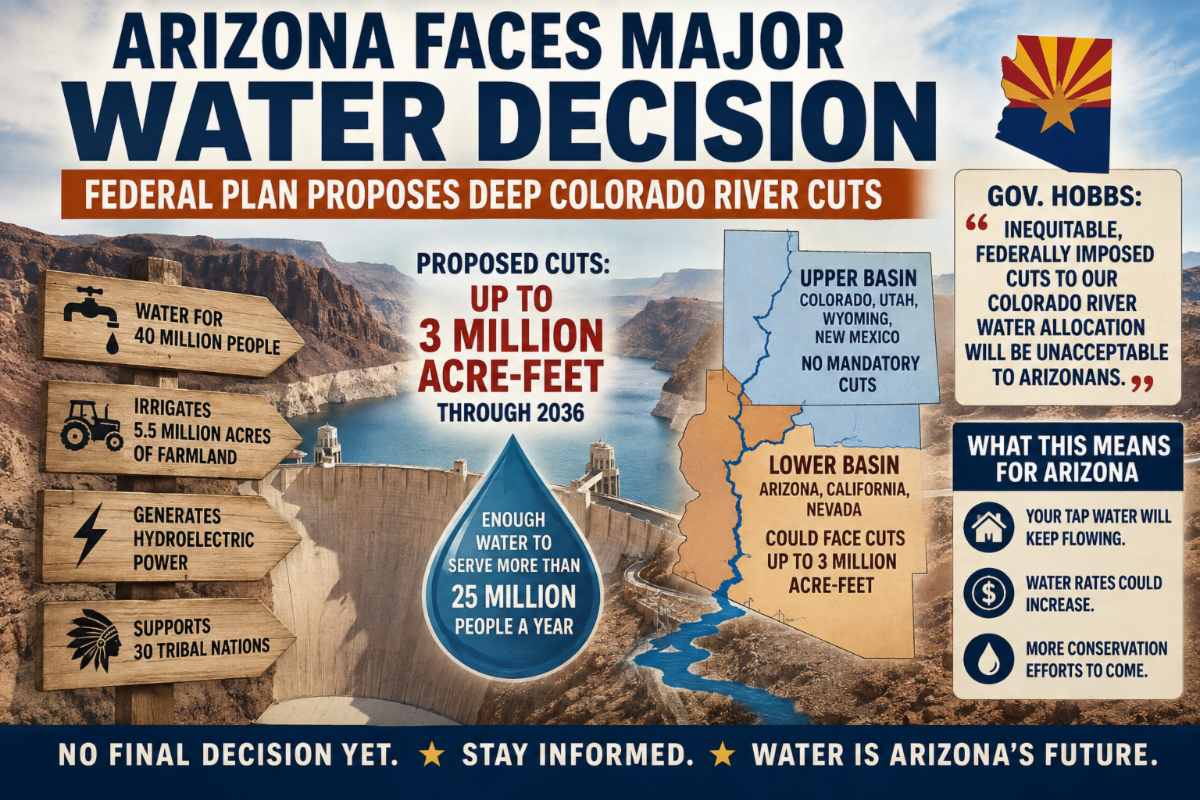
Arizona could soon face one of the most significant water policy decisions in decades as the federal government moves closer to adopting a new plan for managing the Colorado River through 2036. While no final decision has been made, the proposal released by the U.S. Bureau of Reclamation on July 31 could require Arizona, California, and Nevada to collectively reduce their Colorado River use by as much as 3 million acre-feet annually, depending on drought conditions and reservoir levels. That is enough water to supply more than 25 million people each year.


The proposal comes after years of negotiations between the seven Colorado River Basin states failed to produce a long-term agreement before the current operating guidelines expire at the end of 2026. As a result, the federal government is stepping in with a framework designed to protect Lake Mead and Lake Powell from reaching critically low elevations that could threaten water deliveries and hydropower generation.


Why Arizona Could Be Hit the Hardest

Arizona has long known that it would bear a disproportionate share of future shortages because of its junior priority rights under the Colorado River Compact and subsequent agreements. California holds many of the basin's oldest and most senior water rights, while Nevada has a comparatively smaller allocation.


Under the federal proposal, Arizona could once again shoulder the largest burden among the Lower Basin states. Meanwhile, Colorado, Utah, Wyoming, and New Mexico—the Upper Basin states—would not face mandatory consumption cuts under the current framework, a point that has generated significant frustration in Arizona.


Governor Hobbs Pushes Back

Governor Katie Hobbs responded quickly to the proposal, calling some of the federal options "unacceptable."


She pointed to the compromise proposal previously developed by Arizona, California, and Nevada, describing it as one of the largest conservation efforts in Colorado River history. Hobbs argued that if the federal government adopts that Lower Basin proposal for 2027 and 2028, Arizona would avoid disproportionately large reductions while still helping stabilize the river system.


The Governor also emphasized Arizona's importance to the nation's economy, noting that the state produces food, critical minerals, advanced semiconductor technology, and defense systems. She warned that severe water reductions could impact agriculture, manufacturing, economic growth, and national security.


What Does This Mean for Residents?

The proposal does not mean Arizona homeowners will suddenly lose running water.

Water experts say residents are unlikely to receive notices telling them to stop using water. However, the proposal could have long-term consequences.


Cities throughout central Arizona may need to invest in more expensive alternative water supplies, which could eventually increase water rates for consumers. Officials also expect continued efforts to encourage permanent conservation through water-efficient landscaping, reuse programs, and other conservation measures.


The Bigger Picture

The Colorado River supplies drinking water to approximately 40 million people, irrigates about 5.5 million acres of farmland, supports 30 Tribal Nations, and generates hydroelectric power throughout the Southwest. Yet decades of drought, rising temperatures, and demand that exceeds the river's average flow have placed enormous strain on the entire system.


The Bureau of Reclamation's proposal also allows annual releases from Lake Powell ranging between 5 million and 12 million acre-feet, depending on hydrologic conditions, in an effort to better protect both Lake Powell and Lake Mead over the next decade.


What Happens Next?

The proposal is not the final word. Federal officials will continue refining the operating plan before the new rules take effect with the 2027 water year. Water experts expect additional details about exactly how reductions will be divided among the Lower Basin states in the coming days and weeks.


One thing is becoming increasingly clear: the era of abundant Colorado River water is over. Arizona has spent decades preparing for shortages through conservation, groundwater management, reclaimed water, and infrastructure investments. The challenge now will be ensuring those efforts are enough to protect Arizona's families, farmers, businesses, and economy while securing a fair share of one of the Southwest's most valuable natural resources.

The Hero at In-N-Out: When an Armed Citizen Stood Between a Killer and More Victims


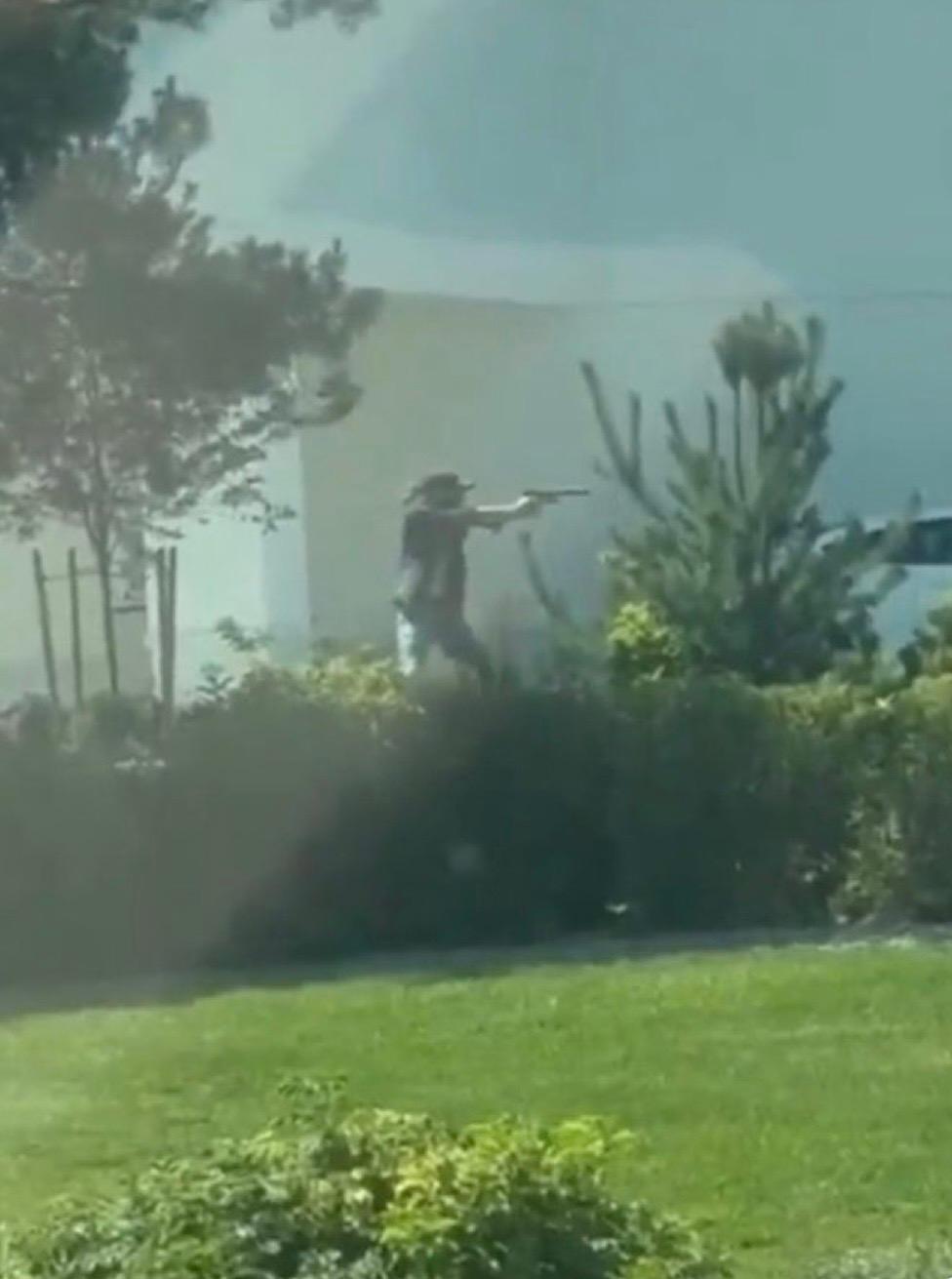
The tragic shooting at the In-N-Out Burger in Twin Falls, Idaho, has once again reminded America of the evil that exists in our society. Innocent people lost their lives, families were forever changed, and an entire community is grieving. As investigators continue to determine every detail of what happened, eyewitness accounts indicate that an armed citizen confronted the gunman during the attack, potentially interrupting the violence and preventing even greater loss of life. Authorities are still investigating the full sequence of events, but multiple witnesses reported seeing an armed civilian engage the shooter.


That citizen deserves to be recognized as a hero.


When chaos erupted, he did not run away. He ran toward the danger. While others desperately sought safety, this individual chose to place himself between a murderer and innocent victims. We may never know exactly how many lives were saved because of his actions, but history has shown that active shooters are often stopped only when they encounter resistance.


This tragedy also brings back painful memories of another mass shooting—one that forever changed the gun rights debate in America.


On October 16, 1991, a gunman drove his truck through the window of a Luby's Cafeteria in Killeen, Texas, and murdered 23 people before taking his own life. Among those present was Dr. Suzanne Hupp, whose parents were killed in the attack. Dr. Hupp had left her lawfully owned handgun in her vehicle because Texas law prohibited her from carrying it inside the restaurant. She has often said she believes she could have confronted the killer had she been allowed to carry her firearm.


That horrific day became one of the driving forces behind Texas eventually adopting concealed carry laws.


The Second Amendment exists for moments exactly like these. It recognizes that every citizen has the inherent right to defend themselves and those around them when evil appears without warning. Police officers do extraordinary work, but they cannot be everywhere at once. In an active shooter situation, the first few moments are often the most critical.


It is also important to remember that the overwhelming majority of law-abiding gun owners are not the ones committing these horrific crimes. Criminals do not join organizations that promote firearms education, safety, and responsible ownership. They are members of the violent fringe of society who ignore laws and have no regard for human life. Passing another law would not have stopped someone already willing to commit murder.


Instead, this tragedy reminds us that ordinary Americans sometimes become extraordinary heroes.


The unnamed citizen who confronted the gunman did not know who the victims were. He did not know if he would survive. He simply acted.


As Idaho mourns those who were killed and prays for those who were injured, we should also take a moment to recognize the courage of the armed citizen who refused to stand by while innocent lives were under attack. His bravery serves as a reminder that heroes do not always wear a badge or a uniform. Sometimes they are simply ordinary Americans exercising a constitutional right and making an extraordinary decision when it matters most.

Ninth Circuit Clears the Way for Arizona to Enforce Two Election Laws


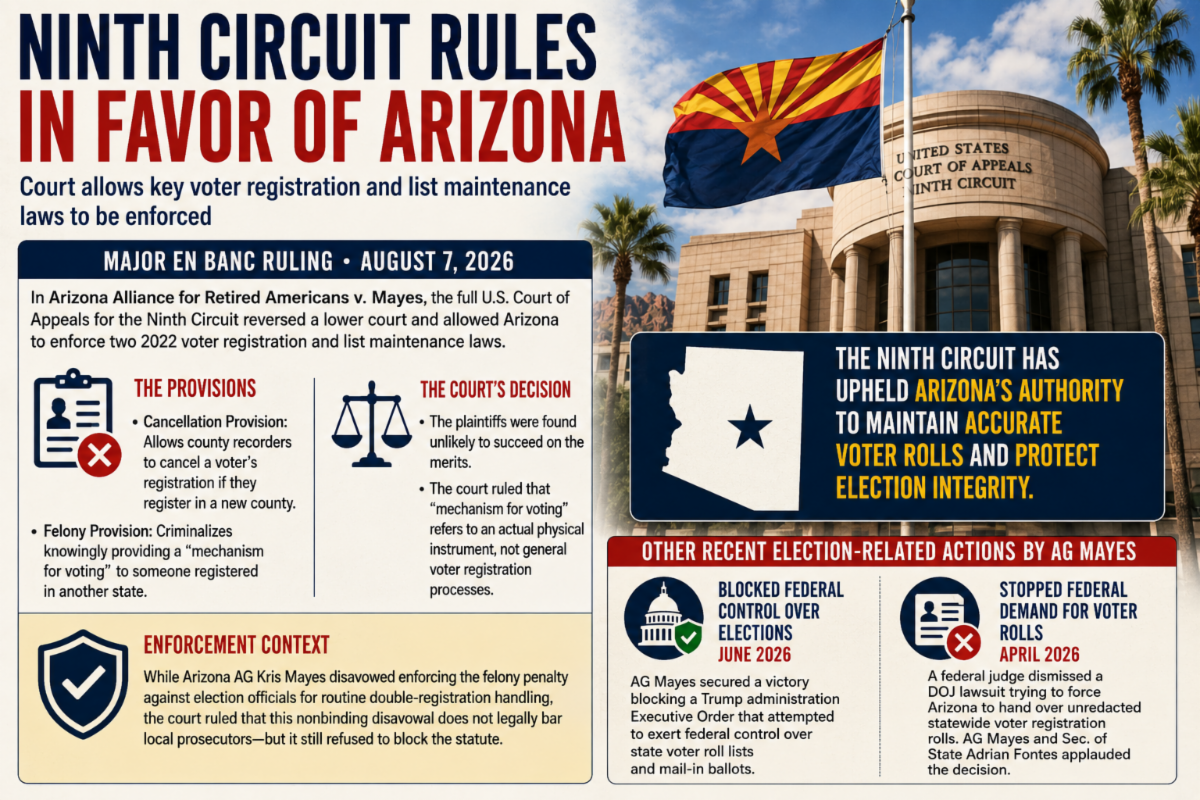
In a significant victory for Arizona's authority to maintain its voter rolls, the full U.S. Court of Appeals for the Ninth Circuit ruled on August 7 that two provisions of a 2022 Arizona election law may be enforced.


The en banc decision in Arizona Alliance for Retired Americans v. Mayes vacated a lower court's preliminary injunction that had prevented enforcement of the provisions. The case was brought by the Arizona Alliance for Retired Americans, Voto Latino and Priorities USA.


The ruling involves two very different provisions, but both deal with an increasingly important issue: keeping voter registration records current while determining exactly where the line should be drawn between election administration and voter access.


What Does the Law Do?

The first part of the law is referred to as the Cancellation Provision.


It requires a county recorder to cancel a person's existing registration in that county when the voter moves and registers to vote in another Arizona county.


In practical terms, if someone moves from Maricopa County to Yavapai County and registers to vote at the new address, that voter should not remain actively registered in both counties.


The second portion is known as the Felony Provision. It makes it a crime to knowingly provide a "mechanism for voting" to someone who is registered to vote in another state.


That language became one of the central issues in the lawsuit.


The organizations challenging the law argued that the phrase "mechanism for voting" could be interpreted broadly enough to include voter registration and voter mobilization activities. If that were true, organizations assisting people with voter registration could potentially face criminal consequences.


The Ninth Circuit rejected that interpretation at this stage of the case.

The court concluded that, when the phrase is read in the context of the entire statute, "mechanism for voting" is better understood as an actual instrument or technique used to vote—such as a ballot—rather than the general process of registering or educating voters.


That distinction is important.


The ruling does not say that registering voters is a felony simply because someone still has an old registration in another state.


The Court Also Addressed Who Can Challenge Election Laws

Another important part of this ruling involves something we hear about frequently but rarely discuss: legal standing.


Before a group can challenge a law in federal court, it generally must demonstrate that it has suffered, or faces, the type of concrete injury required by Article III of the Constitution.


The Ninth Circuit concluded that the organizations did not have standing to challenge the Cancellation Provision because they failed to demonstrate that it directly interfered with their voter-registration and voter-education activities sufficiently to establish an injury.


However, the court reached a different conclusion regarding the Felony Provision.


Because the criminal language could arguably reach activities performed by the organizations, the court determined they faced a credible enough threat of prosecution to establish standing to challenge that portion of the law.


Having standing, however, does not mean you win the case.

The Ninth Circuit then concluded that the organizations were unlikely to succeed on the merits of their challenge to the Felony Provision.


The result: the preliminary injunction against the two provisions was vacated.


An Interesting Twist Involving Attorney General Kris Mayes

There is an interesting political component to this case.


Arizona Attorney General Kris Mayes had disavowed enforcement of the Felony Provision against election officials engaged in routine handling of situations involving voters registered in more than one place.


But the Ninth Circuit pointed out that the Attorney General's position was not legally binding on Arizona's county prosecutors.


In other words, an assurance from the Attorney General about how her office intends to enforce a statute does not necessarily prevent another prosecutor with enforcement authority from taking a different position.


Despite that concern, the court still concluded that blocking enforcement of the statute was not justified under the legal standard before it.


Arizona Has Been Fighting Election Battles on Several Fronts

What makes this ruling particularly interesting is that it comes after Attorney General Mayes prevailed in two other major election-related federal disputes this year.


In April, a federal judge dismissed a U.S. Department of Justice lawsuit seeking Arizona's unredacted statewide voter registration rolls. Mayes and Secretary of State Adrian Fontes argued that those records contain sensitive information about millions of Arizona voters. The court concluded that the federal law cited by DOJ did not authorize the demand.

Then in June, Mayes and a coalition of states prevailed in their challenge to portions of President Trump's executive order involving federal elections.


That order sought, among other things, to tie voter eligibility and mail voting to federally maintained or pre-authorized lists. The court ruled that the challenged provisions exceeded presidential authority and blocked their implementation for the November 3, 2026 election and earlier federal elections in the plaintiff states.


So we have an interesting series of decisions.


Arizona successfully resisted an attempt by the federal government to obtain its full voter database.


Arizona successfully challenged an executive order attempting to impose federal requirements on portions of state election administration.


And now the Ninth Circuit has allowed Arizona to enforce state laws addressing duplicate registrations and providing mechanisms for voting to people registered in another state.

There is actually a common thread running through all three cases:


Who has the authority to administer Arizona's elections and maintain Arizona's voter rolls?


Accurate Voter Rolls Shouldn't Be Controversial

People move.


They move from one Arizona county to another. They move into Arizona from other states. They move out of Arizona.


Voter registration databases therefore constantly change.

Having someone's name appear in more than one registration database does not by itself mean that person voted twice or attempted to commit fraud. Often, it simply means a voter moved and an old registration has not yet been removed.


That is exactly why list maintenance matters.

Our election system should make it easy for every eligible citizen to register and vote while also maintaining accurate records so voters who have moved, died or otherwise become ineligible are handled according to the law.


Those two objectives are not mutually exclusive. We can protect voting rights and demand accurate voter rolls. We can make registration accessible and make sure voters aren't simultaneously maintained as active voters in multiple jurisdictions when the law requires otherwise. And we can protect voters from improper removal while still expecting election officials to perform responsible list maintenance.


A Significant Decision Heading Into November

The timing of this ruling makes it especially noteworthy.


Arizona is less than three months away from the November 3 General Election, and election administration is once again likely to receive intense scrutiny.


The Ninth Circuit's August 7 decision does not end every legal question surrounding Arizona election law. This ruling concerns a preliminary injunction, and much of the court's analysis dealt with standing and whether the challengers were likely to prevail on the merits.

But its immediate effect is significant: the injunction blocking these two provisions has been vacated.


For Arizona voters, the larger principle should be simple. Eligible voters should be able to vote. Their votes should be counted. The voter rolls should be accurate.

And Arizona election officials should have clear rules they can consistently follow.

With another major election approaching, that shouldn't be a Republican principle or a Democratic principle.


It should be an Arizona principle.

Thank you,

Lisa Everett


www.patriotnheels.com


Follow me on:

X - @patriotnheels

Facebook - @patriotnheels

Instagram - @patriotnheels