|
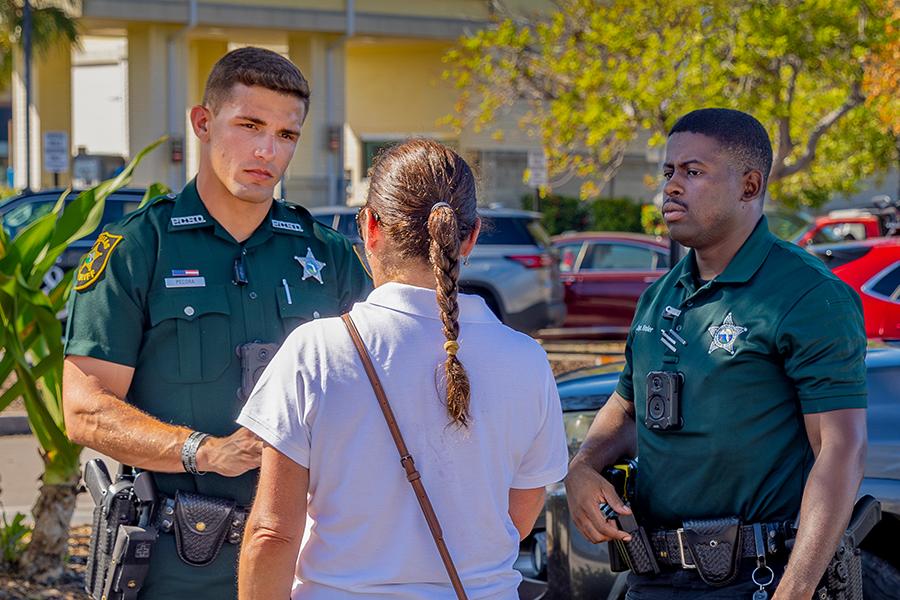
Not long ago, it was an idea out of a science fiction show – a Universal Translator, a Babel Fish that would let you communicate with anyone, in any language. Now, the Body Worn Cameras (BWC) that Pinellas County Sheriff’s Office (PCSO) deputies use can provide real-time translation in 57 different languages, allowing deputies to better help victims and form stronger community bonds. “We have a lot of non-English speakers in our community, whether it is Vietnamese, Laotian, Spanish,” said Lieutenant Jason Bahret. We also get tourists from all over the world. “Since the translation capability went live a few weeks ago it has been used by deputies every day. Already we’ve used about 17 different languages, including Greek, Hebrew, Arabic, Spanish, French, Russian, Ukrainian, and Polish.”
Before, if a deputy encountered a tourist or local who spoke another language, or who wasn’t completely fluent in English, they might have to ask for a translator. For a common language like Spanish there’s probably a deputy on duty who can help, but that means pulling them from their assigned area and waiting an hour for them to arrive. But what if you need Bosnian, Māori, or Urdu? It’s less likely there’s a deputy on duty who can help.
With the new BWCs, deputies can now do everything from having friendly citizen encounters to investigating crimes involving people who don’t speak English or are more comfortable in another language. “It’s getting used daily already in various levels of investigation, community engagement, giving directions, traffic stops, DUI investigations, domestic violence investigations.” If the person is a victim, witness, or suspect whose statements would be used in court, it would later have to be verified by a court-certified linguist, but it is an invaluable communication tool for getting information on-scene.
“If it is a known language – Portuguese, for example – you can direct it to translate to that language,” Lieutenant Bahret said. “The BWC will confirm the command, and when the deputy speaks it will immediately translate what they say to Portuguese. Then they can hold the BWC button and it will translate the Portuguese the citizen is speaking into English.” What if you can’t tell what language the person is speaking? “If you don’t know the language you can use auto-detect. It will listen to the person for about 30 seconds, then identify the language and translate it, as long as it is one of the 57 languages in the system.”
They’ve come across just a couple of languages common in Pinellas County that aren’t represented – Creole and Albanian – and have reported that so that they can be included in future upgrades.
Lieutenant Bahret said that because the translation is AI generated it is not 100 percent accurate – but it is 90-95 percent accurate. Inaccuracies can crop up when the person uses profanity or slang, because sometimes there isn’t a direct translation that makes sense in a different language. It is less accurate with hybrid or mixed languages such as Spanglish or Chinglish, but even a partial translation can still be helpful to a deputy.
Deputies first got BWCs about five years ago. When they take law enforcement action they turn on their camera. It will also automatically activate whenever a deputy draws their firearm, arms their Taser, or activates the light bar system in their cruiser. Having every encounter on camera is great for collecting evidence, and also for the deputies’ safety. BWC has 30 seconds of buffering. “It’s always recording,” Lieutenant Bahret said. “If I draw my firearm it will start the video clip 30 seconds back. The idea is that if I have to use force, I will capture the 30 seconds that led up to it.”
BWC is great for transparency and accountability. If a deputy makes a mistake, it can be viewed later so they can learn from it or receive discipline if necessary. But the reverse is also true –if a citizen makes a baseless complaint against a deputy, their supervisor can see what really happened with their own eyes. “Citizen complaints have been drastically reduced since we’ve started using BWC,” Lieutenant Bahret said. “We can play the video and immediately see if the citizen complaint is accurate.”
Adding translation capabilities to BWC brings a new level of utility to an already vital video ecosystem. Now, deputies are better able to help all of the people in Pinellas, no matter what language they speak. “We’ve made an investment in the ability to talk with our entire community. If you’re a victim of a crime, or a witness, or just need directions, we want to be able to communicate effectively with you.”
|