|
Dear Presidents’ Alliance Member,
In this week’s Member Update:
- The Presidents’ Alliance and AICUM File Amended Complaint Challenging Unlawful Student Visa Revocations and SEVIS Records Termination Policies
-
New! From Campus to Career: New Legal Pathways that Work Learning Tool, Student Guide, and Upcoming Webinar
- State Department Resumes International Student Visa Interviews, but Introduces New Prioritization Criteria, Expanded Social Media Vetting (New Toolkit for Campuses)
- ICYMI! Webinar on Travel Ban, Visa Revocations, Visa Interview Pause & Other Actions: Implications for International Students and Campus Responses
-
Policy Alert! DHS Calls for End of Duration of Status for International Students, Sending Proposed Rule to OIRA
-
Developing! DOJ Challenges to In-State Tuition Policies for Undocumented Students Continue
- Check Out Our Latest Analysis: Resettled Refugee Students in U.S. Higher Education
- Apply Today: Affiliate Partner Membership for Mission-Aligned Nonprofit Organizations
- Stay Engaged: Submit Your AY 2025-26 Institutional Membership Contribution
- Immigration in Brief
- Calendar of Events
- Top Reads
| | |
The Presidents’ Alliance and AICUM File Amended Complaint Challenging Unlawful Student Visa Revocations and SEVIS Records Termination Policies
On June 27, 2025, the Presidents’ Alliance on Higher Education and Immigration, joined by the Association of Independent Colleges and Universities in Massachusetts (AICUM), filed an amended complaint in the U.S. District Court for the District of Massachusetts. This filing updates the original complaint submitted on April 24, 2025, and challenges the Department of Homeland Security’s (DHS) unlawful mass termination of SEVIS records for F-1 students and participants in the Optional Practical Training (OPT) program. Through the amended complaint, we are asking the court to hold unlawful and set aside the policy under which the mass visa revocations and SEVIS record terminations were carried out, and enjoin the government from using these practices again.
This spring, DHS unlawfully terminated SEVIS records based on visa revocations and alleged criminal histories—neither of which is a lawful basis under current regulations. Although many records have since been reactivated, DHS and the State Department continue this unlawful practice. Under DHS’s direction, the Department of State arbitrarily revoked thousands of student visas solely because students’ names appeared in law enforcement databases, without any individualized review or due process. The Department of State has also misled affected students, and continues to do so, by sending emails falsely claiming they must leave the U.S. immediately, even though visa status governs entry, and are inapplicable to whether an already-admitted student may remain in the country. DHS has since formalized a policy allowing SEVIS record terminations based on visa revocations, continuing this unlawful practice.
To learn more about the filing, read the complaint and press statement here.
| | |
New! From Campus to Career: New Legal Pathways that Work Learning Tool, Student Guide, and Upcoming Webinar
The Presidents’ Alliance is pleased to announce a new suite of tools and resources to support noncitizen students and graduates in accessing employment-based immigration options.
| | |
Legal Pathways Learning Tool
This confidential online questionnaire is designed to help students and graduates in temporary or precarious statuses explore potential employment-based immigration pathways and learn more about each one. Developed by legal experts and in partnership with Innovation Law Lab, the tool guides users toward appropriate next steps, including seeking legal counsel. We encourage you to share this directly with students.
| | |
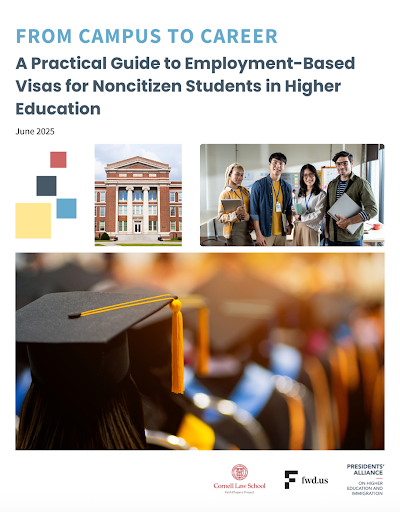
From Campus to Career: A Practical Guide to Employment-Based Visas for Noncitizen Students in Higher Education
Developed in partnership with FWD.us and Path2Papers, our new guide offers practical advice for students and higher education professionals navigating nonimmigrant and immigrant employment-based visa options after graduation. It provides clear guidance on what students can do during their academic journeys to strengthen their eligibility upon entering the workforce.
| | | Webinar – From Campus to Career: Preparing for Employment-Based Visas as a Student – July 9 at 2 PM ET | | Join the Presidents’ Alliance, Path2Papers, and FWD.us for an upcoming webinar introducing these new resources and providing an overview of employment-based visa pathways, such as H-1B, O-1, and employment-based green cards. Panelists will discuss concrete steps students can take now, strategies for securing sponsorship, and where to find additional support and free legal consultation opportunities. Speakers include: Anita Gupta (Presidents’ Alliance), Raju Patel (Path2Papers), Ali Procopio (FWD.us), and Dan Berger (Green and Spiegel / Path2Papers). | | |
State Department Resumes International Student Visa Interviews, but Introduces New Prioritization Criteria, Expanded Social Media Vetting (New Toolkit for Campuses)
Visa Interview Halt Lifted. On June 18, the State Department lifted its three-week halt on scheduling of new visa interviews for international students—a suspension that caused significant disruption during the peak admissions season. While the decision to end the freeze brought some relief to students and universities, the damage had already been done. The suspension disrupted existing processes and created great uncertainty, leaving many students in limbo and likely deterring some from choosing to study in the United States. The freeze took place at a time when at least 50 percent of new international students still needed to secure visa interviews in order to arrive in time for the fall semester. While the halt was lifted, the State Department also issued new directives prioritizing visa processing for physicians applying for J-1 exchange visas and for students attending institutions where international students make up no more than 15 percent of total enrollment—adding yet another layer of complexity and concern to the process.
The Presidents’ Alliance’s reaction to the restart of interviews for student visas can be found here.
Expanded Social Media Vetting. At the same time the State Department lifted the visa interview halt, it also introduced an expanded and troubling social media screening for all international students and exchange visitors applying for F, M, and J visas. The directive requires applicants to make all their social media accounts public for review and orders consular officers to search applicants’ entire online presence to identify "potentially derogatory information" including political activism, terrorism support, anti-Semitic activities, or "hostile attitudes" toward the United States. Since this screening is resource-intensive, embassies and consulates are expected to face reduced processing capacity, likely leading to longer wait times for appointments and visa approvals.
Presidents’ Alliance New Toolkit. These latest developments are part of a broader pattern of the administration’s enforcement actions targeting international students and scholars. These actions have created a general climate of fear, anxiety and uncertainty among international students, faculty, and staff on campuses, and severely disrupted the lives of directly affected students and other campus members. To support institutions, organizations, and individuals in communicating effectively with their elected leaders, specially their Senate and House delegations as well as governors and mayors, the Presidents’ Alliance developed a new toolkit that allows its users to focus on topics and issue areas that matter to them the most.
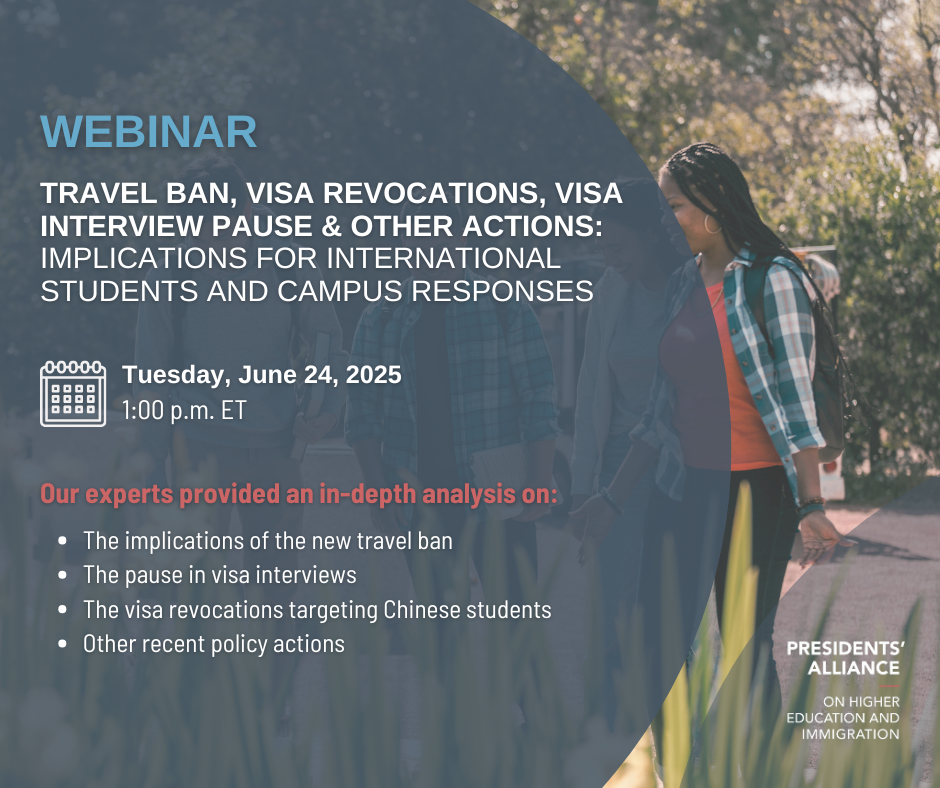
| | ICYMI! Webinar on Travel Ban, Visa Revocations, Visa Interview Pause & Other Actions: Implications for International Students and Campus Responses | | |
On Tuesday, June 24, the Presidents’ Alliance hosted a webinar on the implications of the new travel ban, the pause in visa interviews, visa revocations targeting Chinese students, and other recent policy actions. Besides an in-depth analysis of what these developments and their impact, the speakers also shared updates on ongoing litigation, and provided actionable tools and strategies that colleges, universities, and higher ed stakeholders can use to respond.
| |
|
Policy Alert! DHS Calls for End of Duration of Status for International Students, Sending Proposed Rule to OIRA
On June 27, 2025, DHS submitted a proposed rule to the Office of Information and Regulatory Affairs (OIRA) that would eliminate “duration of status” for F-1 students and J-1 exchange visitors—bringing it one step closer to publication in the Federal Register. While the rule must go through a public comment period before it can be finalized, its implications are deeply concerning. While we anticipated the current administration would renew their efforts to end D/S, it remains unclear how closely this version mirrors the Trump administration’s 2020 proposal—later withdrawn by the Biden administration. It likely shares key elements. The 2020 rule would have replaced the current flexible system with fixed end dates, requiring students and scholars to repeatedly apply for extensions through DHS. Such a change would create additional uncertainty, intrude on academic decision-making, increase bureaucratic hurdles, and risk deterring international students, researchers, and scholars from coming to the United States. The current duration of status framework, in conjunction with the Student and Exchange Visitor Information System (SEVIS), already ensures effective oversight without imposing unnecessary barriers.
Campuses should strongly consider submitting comments once the public comment period opens. To learn more, see our 2020 Comment Letter and Talking Points Template for campuses. We will update our resources for campuses once the proposed rule is published.
| |
Developing! DOJ Challenges to In-State Tuition Policies for Undocumented Students Continue
Background on Executive Order Prompting Federal Challenges. On April 28, 2025, an Executive Order directed the Attorney General, in consultation with the Secretary of Homeland Security, to “identify and take appropriate action to stop the enforcement of state and local laws, regulations, policies, and practices favoring [noncitizens] over any groups of American citizens.” The order specifically targets state laws that provide in-state tuition for higher education.
Texas Update. On June 4, a federal judge struck down Texas’s longstanding in-state tuition policy for undocumented students, known as the Texas Dream Act. In a new development, on June 24, the Austin Community College District Board of Trustees filed a motion to intervene in the lawsuit—becoming the second entity to do so, following an earlier motion by MALDEF.
| |
New DOJ Complaints: Kentucky and Minnesota. The Department of Justice filed two additional complaints in June targeting similar policies:
-
Kentucky (June 17): Challenging the state’s policy that provides reduced in-state tuition for undocumented students.
-
Minnesota (June 25): Challenging both the state’s in-state tuition policy and its North Star Promise Scholarship program.
The Presidents’ Alliance is actively working with partners to respond to these legal challenges and will continue to provide timely updates as developments unfold.
| Check Out Our Latest Analysis: Resettled Refugee Students in U.S. Higher Education | |
Who are the refugees enrolled in U.S. higher education? Where do they come from, and where do they study?
To mark World Refugee Day on June 20, we released new analysis highlighting the characteristics and enrollment trends of resettled refugee students in higher education. This analysis builds on and complements the Mapping the Refugee Student Population in U.S. Higher Education Report report originally published by the Presidents’ Alliance and Duolingo English Test in 2023, which was updated this spring and is available here.
| |
Apply Today: Affiliate Partner Membership for Mission-Aligned Nonprofit Organizations
The Presidents’ Alliance is thrilled to relaunch our Affiliate Partners initiative—designed for mission-aligned nonprofit organizations seeking a more formal relationship with our work. Through this partnership, organizations can deepen collaboration, stay informed on key policy developments, and amplify collective impact. We welcome applications from nonprofits that demonstrate aligned values, interests, or policy priorities. Applications are reviewed on a rolling basis by our Steering Committee.
| | Stay Engaged: Submit Your AY 2025-26 Institutional Membership Contribution | | |
Thank you for your continued engagement, partnership, and support of the Presidents’ Alliance. If you haven’t yet submitted your AY 2025-26 membership contribution, we invite you to do so today. Your annual dues are crucial as we navigate the escalating challenges facing higher education and immigration.
Your membership enables us to equip you with resources, tools, and services that support your institution and students; respond quickly and strategically to policy developments, including through virtual briefings, policy engagement, and legal action; produce actionable research and data-driven insights for you and your teams to use; and collaborate across campuses and build strategic partnerships across sectors and states.
As a paying member, you can also access discounted registration fees for our 2025 SUCCESS Convening at the University of Illinois Chicago from Thursday, September 11, to Friday, September 12, 2025.
Not yet a member? Now is a great time to join and take full advantage of all our offerings. We encourage you to review our full membership benefits for more information.
| |
If you have any questions about membership or need assistance submitting your institution’s contribution, please contact our Director of Development and Operations, Annie Nguyen, at annie@presidentsalliance.org.
Support our work as an individual! You can make a personal donation through our main website.
| | |
Immigration in Brief
-
The reconciliation bill passed the Senate 51-50 yesterday, with Vice President J.D. Vance casting the tie-breaking vote. The bill now returns to the House, with a vote anticipated before the start of the July 4th holiday weekend. The provision limiting access to federal financial aid for refugees, displaced students, and other humanitarian populations was not included in the final bill text, despite late-breaking efforts to add restrictions back in via amendment.
-
On June 27, the Supreme Court ruled 6-3 to limit federal judges’ use of nationwide injunctions in the birthright citizenship case. While the decision does not address the constitutionality of the executive order, it could allow the policy to take effect—at least temporarily—in states not party to the lawsuit, but not sooner than 30 days after the ruling. In response, a class action lawsuit has already been filed.
-
On June 27, DHS announced it will end Temporary Protected Status (TPS) for Haiti, putting about 500,000 Haitians at risk of deportation once the designation expires on September 2, 2025. Despite ongoing violence, DHS concluded conditions have improved enough for safe return. The move follows similar terminations for Afghans, Venezuelans, Cameroonians, and Nepalis under the Trump administration.
-
In his resignation letter, outgoing UVA president Jim Ryan stated that remaining in his role could jeopardize federal funding, lead to employee job losses, and result in students losing federal financial aid or having "their visas withheld."
| | |
Calendar of Events
-
July 9, 2025 | Webinar – From Campus to Career: Preparing for Employment-Based Visas as a Student | Register Here
-
September 10-12, 2025 | SUCCESS Convening at the University of Illinois Chicago | Register Here
| | |
Thank you for your support and engagement.
The Presidents’ Alliance Team
| | | | |