|
A Note from the Executive Editor...
Thank you for your interest in our Special Edition on Prevention.
The devastating shooting in Oregon brings another community into unimaginable grief—and renews the urgency of the work we must do together to prevent violence. Our hearts are with the victims, their families, and everyone whose life has been changed by this tragedy.
We cannot view these tragedies as something happening in "someone else’s" community. At any moment, it could be us: our community, our school, our family. At HSToday, prevention means recognizing what could happen and actively building the conditions, relationships, and pathways to intervention that can keep it from happening.
As we expanded our expert verticals this last year and a half, we added Prevention to give greater attention to the people, research, and interventions that can help stop violence before it occurs. This Special Edition reflects that commitment: bringing practical knowledge to the people who can put it to work.
We invite practitioners across disciplines to share your experience, your work, and the lessons others can use. What has helped you recognize concerning behavior, connect someone with support, or bring partners together to intervene? Where are the gaps? We also welcome submissions to Pracademic Affairs, our journal connecting scholarship with practice, to strengthen the exchange between research and those working on the front lines.
This is a community we must build together. Sharing knowledge, strengthening relationships, and learning from one another can help us act faster and intervene earlier. No single person, profession, agency, or organization can do this alone.
We must all become part of the solution. Join us. Please SHARE THIS RESOURCE!
Kristina
Kristina Tanasichuk
Executive Editor, Homeland Security Today
| | |
A Note from Prevention's Editor-At-Large....
In the aftermath of the tragedy in Bend, Oregon, our heart goes out to the victims, their families and the community.
It is human nature that in the wake of such tragedies, we all look for explanations. It is important to note that bad actors may try to fill the information void that understandably exists as investigators do their important work, with manipulative information designed to hijack our collective emotions and advance their agenda.
At HS Today, we encourage our readers to reflect on the victims, and also to turn their thoughts to preventing this from happening in other communities around the country. We all have a role to play.
Prevention isn’t about blame: it is about building the systems of care and positive interventions that help people thrive, building awareness of concerning behaviors and how to foster referrals for those individuals to someone who can help, and equipping individuals to navigate on- and offline information environments in a way that protects them from manipulation, dehumanization, hopelessness, or hate.
We do not yet know all the relevant details about what unfolded last week, and we will wait for a more clear picture to emerge before offering recommendations specific to this event. But we will also move with a sense of urgency to advance targeted violence prevention programs, research and the community of practice as we continue to mourn, and to learn.
Preventing targeted violence requires action across schools, workplaces, families, and communities. This special edition brings together a public health-informed prevention framework, lessons from school safety and threat assessment, practical resources, and research on the pathways that can lead to violence.
Explore HSToday’s Prevention Beat.
Bill
Bill Braniff
Editor-at-Large for Prevention, Homeland Security Today
Executive Director, Polarization & Extremism Research & Innovation Lab (PERIL), American University
| | |
A Coordinated Approach to Campus Safety: Bridging Clery, Title IX, and Behavioral Threat Assessment
By Mary Rohmiller and Kelly Berkell
Mary Rohmiller and Kelly Berkell examine how campus safety systems can work together. Their recommendations address governance, information sharing, joint training, and documented decisions across Clery, Title IX, and behavioral threat assessment and management.
Read the story here.
| |
|
Lessons From an Evaluation of Targeted Violence and Terrorism Prevention Efforts in Wood County, Ohio
By Megan K McBride and Lauren K Hagy
A year-long evaluation of Wood County’s youth prevention efforts offers lessons for school and community partners. The authors examine parent engagement, flexible threat assessment teams, continuity of care, and the relationships needed to sustain coordinated support.
Read the story here.
| | |
Pathway to Violence
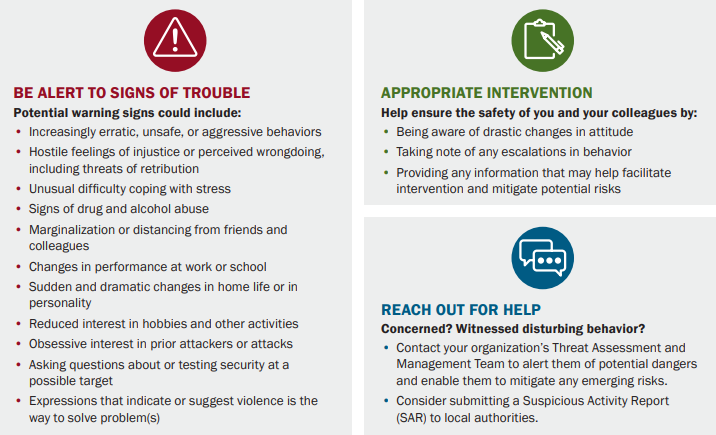
CISA’s factsheet and accompanying video explain a general pathway-to-violence framework. They cover behavioral indicators and include expert discussion of engagement strategies and responses to someone who may be moving toward violence.
Read the story here.
| | | | | |