Instagram  LinkedIn  Web  X  YouTube

Introduction

Dear Systems Science SIG members,


Welcome to the October 2025 edition of our newsletter. In this newsletter you will read more about:

- …the Systems Science SIG at ISBNPA 2025, by Alexandra Potts

- … Project spotlight: Systems Thinking is HOT! (But How Do You Actually Do It?), by Wilma Waterlander

- …the next Systems Science SIG webinar 

- …other updates related to Systems Science

- …recent publications related to Systems Science


Systems Science SIG @ ISBNPA2025

By Dr Alexandra Potts, Leeds Beckett University (Systems Science SIG Co-Chair)


CONFERENCE OVERVIEW: ISBNPA 2025 in Auckland, New Zealand, provided the first opportunity for the Systems Science Special Interest Group (SIG) to have presence at the annual conference, just under a year after launching. With many presenters drawing on systems science as part of their work, it was great to see continued traction in the use of systems science to tackle complex challenges such as obesity and physical inactivity. Highlights included keynote presentations by Professor Jim Sallis and Dr. Melody Ding, who shared innovative, collaborative approaches to transforming systems that support healthier, more active lifestyles. A panel discussion on translating research into practice featured insights into working with communities to improve health outcomes, with a particular focus on disrupting systems that fail local Māori populations, an issue powerfully addressed by Dr. Nikki Penetito-Hemara.


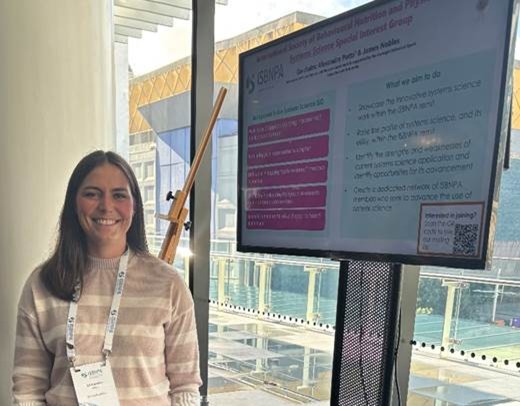
MARKETPLACE: Anneke Vang Hjort (Centre for Childhood Health, Copenhagen) and I represented the Systems Science SIG at the SIG marketplace, which was a new addition to this years’ conference program. This allowed us to engage with conference attendees to chat more about the SIG and also to speak to other SIG chairs about their SIG activities.


SIG AWARDS SESSION: Congratulations to Wilma Waterlander (Amsterdam UMC, The Netherlands) and Konsita Kuswara (Deakin University, Australia) who were nominated for the conference awards and presented at the awards session on Wednesday 11th June 2025. 


SIG SOCIAL: Members of the Systems Science SIG got together informally with the Policies and Environments and Participatory Research in Heath Promotion SIGs for a joint social on Thursday 12th June 2025 at Brew on Quay in Auckland. This informal gathering offered a great chance to exchange research ideas, share adventures in New Zealand, and enjoy some tasty food and drinks.

Join us in May 2026 at the ISBNPA Annual Meeting

Project spotlight:

Systems Thinking is HOT! (But How Do You Actually Do It?) 

By Dr. Wilma Waterlander, Department of Public and Occupational Health at the Amsterdam UMC/University of Amsterdam


This is how I opened my presentation at ISBNPA in Auckland: “Systems thinking is HOT!” And it’s true. But what exactly is systems thinking—and perhaps more importantly—how do you do it in practice?

When I say “systems,” I’m not talking about tidy, bounded entities like hospital systems or school systems (that’s more systematic thinking). What I mean is systemic thinking: the messy, fascinating interplay of many interrelated factors and feedback loops that, together, explain why things emerge the way they do. In Auckland, I shared how we applied system dynamics theory to a local obesity prevention approach, and the lessons we learned along the way.


We came away with three key lessons:

1. Interdependency between programme & context

Like any systems project, we started by “understanding the system.” Group Model Building, Participatory Action Research, Causal Loop Diagrams, Social Network Analysis… we threw the whole systems science toolkit at it.

What we underestimated was the context: how long it takes to understand who relevant stakeholders are outside the public health domain, how local government is organized, what’s brewing beneath the surface, and where momentum for change is hiding. And because context shifts over time (sometimes faster than your CLD drawing skills), you have to stay on top of it—constantly.


2. The dynamic and adaptive character

Instead of a standard, one-size-fits-all intervention, we developed an adaptive action programme, targeting different levels of the system. But here’s the catch: not every co-created action is a good action. Focus matters. Low-hanging fruit is tempting, but sometimes you need to reach higher branches. And momentum is precious—grab it when it comes. This does create a dilemma: what do you do with actions that have already started, or with stakeholders who are (understandably) attached to them?


3. Governance, governance, governance

Equal partnership between academia, policy, and practice? Regular meetings? Participatory Approach? We did it all. And yet… it was incredibly hard to maintain a true systems perspective. It is very easy to slip back into the comfort of the traditional path: fixed interventions, clear outcomes, neatly bounded budget sheets. Systems thinking demands that you ask, over and over: are we still on the systems path—or have we quietly wandered back to business as usual?

Conclusion: Systems thinking in practice is equal parts enlightening and humbling. It certainly isn’t about new tools or methods. It’s about flipping your perspective entirely. Think of the Kiwi “world upside-down” map: the land is the same, but the view is refreshingly different.


More information on the LIKE project?


●    Waterlander WE, Luna Pinzon A, Verhoeff A, Den Hertog K, Altenburg T, Dijkstra C, Halberstadt J, Hermans R, Renders C, Seidell J, et al. A System Dynamics and Participatory Action Research Approach to Promote Healthy Living and a Healthy Weight among 10–14-Year-Old Adolescents in Amsterdam: The LIKE Programme. Int J Environ Res Public Health. 2020;17:1–18. doi: 10.3390/ijerph17144928. – [link]


●    Waterlander WE, Singh A, Altenburg T, Dijkstra C, Luna Pinzon A, Anselma M, Busch V, Van Houtum L, Emke H, Overman ML, et al. Understanding Obesity-Related Behaviors in Youth from a Systems Dynamics Perspective: The Use of Causal Loop Diagrams. Obes Rev. 2021;22:1–16. doi: 10.1111/obr.13185 – [link]


●    Luna Pinzon A, Stronks K, Emke H, Van den Eynde E, Altenburg T, Dijkstra SC, Renders CM, Hermans R, Busch V, Chinapaw MJM, Kremers SPJ, Waterlander W. Understanding the system dynamics of obesity-related behaviours in 10- to 14-year-old adolescents in Amsterdam from a multi-actor perspective. Front Public Health. 2023;11:1128316. doi: 10.3389/fpubh.2023.1128316. – [link]


●    Emke H, Altenburg T, Dijkstra C, Pinzon AL, Stronks K, Waterlander W, et al. Applying systems thinking in youth-centred participatory action research for health promotion in an underserved neighbourhood. Frontiers in Public Health. 2024;Volume 12 – 2024. – [link](https://pubmed.ncbi.nlm.nih.gov/38887247/)


●    Luna Pinzon A, Waterlander W, de Pooter N, Altenburg T, Dijkstra C, Emke H, et al. Development of an action programme tackling obesity-related behaviours in adolescents: a participatory system dynamics approach. Health Research Policy and Systems. 2024;22(1):30. – [link]


●    Luna Pinzon A, Stronks K, Dijkstra C, Renders C, Altenburg T, Den Hertog K, Kremers SPJ, Chinapaw MJM, Verhoeff AP, Waterlander W. The ENCOMPASS Framework: A Practical Guide for the Evaluation of Public Health Programmes in Complex Adaptive Systems. Int J Behav Nutr Phys Act. 2022;19:1–17. doi: 10.1186/s12966-022-01267-3. – [link]


●    De Pooter N, Luna Pinzon A, den Hertog K, Altenburg T, Busch V, Dijkstra C, et al. Monitoring and adaptation of a system dynamics approach to prevent childhood overweight and obesity: findings from the LIKE programme. Health Research Policy and Systems. 2025;23(1):30. – [link]


●    Luna Pinzon A, Stronks K, Verhoeff A, Vaandrager D, den Hertog K, Waterlander W. Applying a participatory system dynamics approach to childhood overweight and obesity in the local context: reflections from the LIKE project. Health Research Policy and Systems. 2025;23(1):66. – [link]


Would you like your project in the spotlight? Contact Eline Meuleman (e.m.meuleman@vu.nl) or Naomi de Pooter (n.depooter@uu.nl).

 Systems Science SIG webinar

We organize several Systems Science SIG Webinars throughout the year. Are you interested in presenting in one, reach out to us!


The next (second) session in the series will take place in January/February 2026. The upcoming webinar will focus on the good, the bad and the ugly of communicating about systems approaches to diverse audiences.

Other updates related to Systems Science

LEVERAGE Global Forum and Feedback Workshop

📅 21 October 2025 | 🕐 13:00–17:00 BST (in-person lunch at 12:00)

📍 Bristol City Hall, UK & Online


Join presidents of leading systems science societies, WHO, The Lancet, the World Obesity Federation, and international experts to discuss the use of systems approaches in public health. After keynote talks and a panel discussion, the draft LEVERAGE guidelines for reporting health interventions and policies underpinned by systems methods will be presented.


👉 Registration (essential, limited spots): Register for the LEVERAGE Guidelines Global Forum and Feedback Workshop


Systems Evaluation Network Webinar

 📅 22 October 2025 | 🕒 15:00–17:00 BST

 📍 Online

Focus on contribution analysis, process mapping, and outcomes mapping, with practical insights and examples for applying these methods in systems evaluations.

 👉 Join the SEN community: Systems Evaluation Network LinkedIn group.


ISDS Seminar Series

 📅 3 December 2025 | 🕒 11:00–12:30 EST

 📍 Online

Adam Hulme presents “From Mapping to Meaning: Exploring Complex Systems with the Qualitative Systems Exploration Model (QSEM).”

 Learn about QSEM, a new semi-quantitative approach and web-based tool designed to enhance Group Model Building.

 👉 RSVP: link


Free Systems Thinking Training Series

 📅 October 2025 – April 2026 | 🕒 Six sessions

 📍 Online

Hosted by the WHO Collaborating Centre for Complex Systems Science at Queen’s University Belfast. The series will include short courses on systems thinking methods for NCD prevention and control.

Registration links will be shared ~6 weeks before each session.

 👉 Details: What's On | QUB


Conference: Systems Thinking and Systems Practice

 📅 24–26 March 2026

 📍 University of Hull, UK

The first-ever conference bringing together leading institutions and communities across systems thinking methods and practice. Organised by the Centre for Systems Studies, SCiO, and the OR Society, with contributions from STIG and IFSR. Expect rich discussions, global perspectives, and networking with practitioners, academics, and systems leaders.

 👉 Details here


Call for papers: Journal of Human Nutrition and Dietetics (JHND)

The Journal of Human Nutrition and Dietetics (JHND) released a call for papers focused on systems thinking and systems-based approaches to nutrition and dietetics:


“As an emergent topic, our goal is to develop a foundational knowledge base, inspire new research directions, and provide practical tools for embedding systems-based approaches in everyday professional work. We hope the special issue will serve as a landmark collection for practitioners, researchers, educators, and policymakers committed to transforming nutrition and dietetic practice through systems thinking.


You do not need to be a dietitian or nutritionist to author a paper, however, we strongly encourage interdisciplinary collaboration with nutrition and dietetic practitioners and submitted manuscripts must clearly link systems applications with nutrition and dietetics research, education, practice, and/or policy. Please let us know in the next two weeks if you are interested in submitting a manuscript for this special issue and questions you may have. We would be happy to review a draft abstract for alignment with the aims of this special issue. Additionally, we are seeking manuscript reviewers for this special issue. Let us know if you are interested in serving as a reviewer and the systems science/systems thinking knowledge or expertise you have.” – Dr. Angela Tagtow & Prof. Erin Bergquist


Recent publications

-      Applying a participatory system dynamics approach to childhood overweight and obesity in the local context: reflections from the LIKE project

-      Systems approaches in public health: beyond mapping the causes

-      Integrating Systems Thinking and Behavioural Science

-      Mapping Longitudinal Dynamics of Learning Communities Dealing With Dutch Healthy Weight Approaches: An Updated Causal Loop Diagram

-      Using Systems Methods for Systemic Problems: A Case Study of Poor Lawyer Wellbeing

-      Future-proofing cities against negative city mobility and public health impacts of impending natural hazards: a system dynamics modelling study

-      International experiences of systems approaches: re-thinking policies and governance to transform agrifood systems

SIG Leadership Role Opportunity

We are looking for someone to strengthen our Systems Science SIG team by supporting the social media and webinar planning aspect of the SIG. Together we organize the social media platform, news letters and organize several SIG Webinars throughout the year. The time commitment would be no more than an hour a week and would involve working closely with the current leadership team.


If you would like to get involved in this role, please contact the SIG Chairs, Dr Alexandra Potts (a.potts@leedsbeckett.ac.uk) or Dr James Nobles (j.d.nobles@leedsbeckett.ac.uk). Please also feel free to share this opportunity within your networks, particularly early career researchers and PhD students.


Be updated of all ISBNPA news
Stay Tuned at
Instagram  LinkedIn  Web  X  YouTube