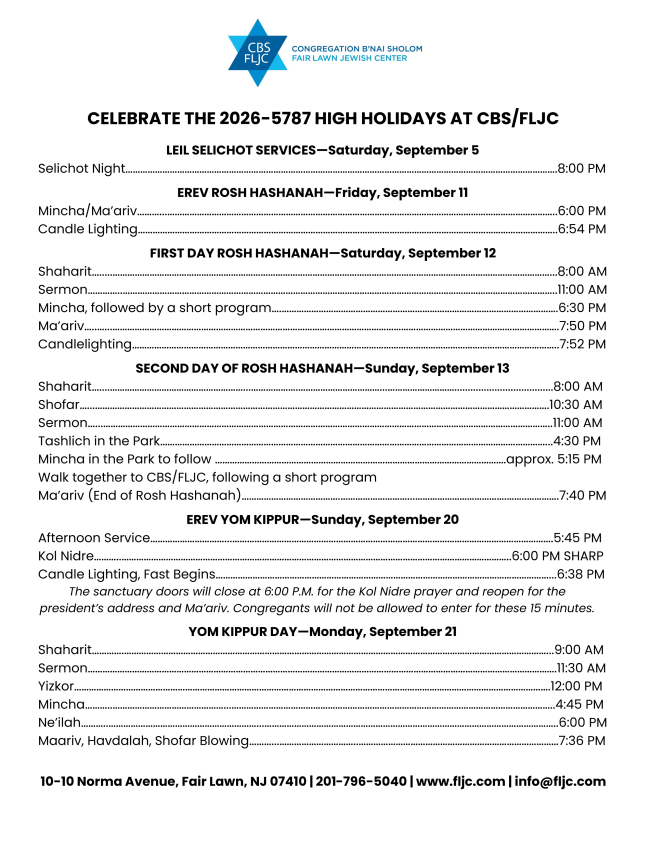
Please join us in shul for Rosh Hashanah
This evening, Jews across the world will be sitting down for the festive meal of Rosh Hashanah. It is an evening during which families come together to enjoy one another’s company and the delicious foods that we make special for the holiday.
Perhaps it is unsurprising to you that in our tradition, a tradition that sees symbolism in everything, food on Rosh Hashanah has taken on a special significance. In the 16h century, Rabbi Yosef Karo wrote of the practice on Erev Rosh Hashanah to eat beans (Hebrew: rubya), leeks (Hebrew: karti), beets (Hebrew: silka), dates (Hebrew: tamrei), and pumpkin (Hebrew: kara). As you eat each of these foods, Rabbi Karo notes, one should say a special hope for the new year, the wording of which plays on the Hebrew term for these foods.
When eating beans (rubya), one says: May it be Your will that our merit increases (yirbu). Rubya, pumpkin, and yiurbu, to increase, share a Hebrew root.
When eating leeks (karti) one says: May our haters be cut off (yikareitu). Karti, leeks, and yikareitu, to be cut off, share a Hebrew root.
When eating beets (silka) one says: May our enemies be removed (yistalku). Silka, beets, and yistalku, to be removed, share a Hebrew root.
When eating dates (tamrei) one says: May our enemies disappear (yitamu). Tamrei, dates, and yitamu, to disappear, share a Hebrew root.
When eating pumpkin (kara) one says: May our judgement be torn up (yikara) and our merits be called out before you. Kara, pumpkin, and yikara, to be torn up, sound very similar in Hebrew.
Another rabbi, Rabbi Moshe Isserles, adds that we also eat sweet apples and honey. As we eat apples and honey, we say: May we be renewed with a sweet year.
These intentions for the new year ring as true today as they did half a millennia ago. May our merit increase. May those who hate us, our enemies, be cut off, removed, and disappear. May our judgement be torn up. Whatever we eat this evening, let it bring us joy and nourishment, and let the joy and nourishment of this year’s Rosh Hashanah carry us through until Rosh Hashanah next year.
And, most of all, may it bring us a good and sweet new year, a shanah tovah umetukah to you and your loved ones. May you be written and sealed in the book of life.
Have a gut yohr!
-Rabbi Eitan Bloostein
|