| | |
POLICY & ADVOCACY UPDATE
Issue #62, 15 January 2026
| | | |
- From the AA CEO James Goodwin
- AA/AHA speak out on the importance of skilled migration to our industry
- New MD confirmed for Tourism Australia
- Net overseas migration for 2024-25
- Challenges for US inbound tourism
- Capital city hotel performance in December 2025
- Hotel performance in November 2025
| |
| |
From the AA CEO
As we step into 2026, I want to thank you for the commitment and professionalism you bring to make Australia’s hotel sector a great industry to be a part of.
The year just passed reminded us that our industry is built on people — our teams, our guests, and our communities. Across the country, hotels and motels played a vital role in welcoming travellers, accommodating essential workers, supporting local economies, and showcasing the very best of Australia to the world.
| | | |
|
Our ‘report card’ for 2025 shows some good growth in demand in most capital cities and importantly, a welcome increase in RevPAR.
Looking ahead, 2026 presents significant opportunity. Demand for travel continues to evolve, with guests seeking meaningful experiences and connections, sustainability, and value. At the same time, technology, workforce, and changing consumer expectations will continue to challenge us. To this end, our Policy Director Jenny Lambert is already leading some important work on migration with a significant submission already with the Federal Government.
I’m optimistic about what we can achieve together in 2026. Looking forward to seeing you at meetings and events throughout the year and I wish you a successful, safe, and rewarding year ahead.
James Goodwin
Chief Executive Officer
| | | | |
AA/AHA speak out on the importance of skilled migration to our industry
In a major joint AHA/AA submission made last week to the Joint Standing Committee on Migration, we mounted strong arguments in favour of a more responsive, simpler and less expensive skilled migration scheme to help the hotel sector fill our skills gaps. The submission firstly built a comprehensive picture of the economic contribution of the hotel sector, including its workforce size and challenges including skills shortages and a decline in funding support for apprenticeships. The submission then made a number of recommendations including:
- the importance of retaining a pathway to permanency for all skilled temporary migrants.
- allowing employers to sponsor any skilled occupation for temporary or permanent skilled migration, rather than the uncertainty created by annually reviewed occupation lists.
- considering a reduction in the core skilled migration income threshold particularly in regional areas
- improving processing times for visa applications
- halving the Skilling Australia fund levy to reduce overall costs and more fairly reflect the contributions to the SAF fund made by industries through better training funding including reversing the reduction in apprenticeship employer incentives for chefs.
| | | |
New MD confirmed for Tourism Australia
Last Friday, the Minister for Trade & Tourism, Senator Don Farrell, confirmed the appointment of Robin Mack as the Managing Director of Tourism Australia. Robin, who has been acting MD since the departure of Philippa Harrison at the end of August 2025, has worked for Tourism Australia for over a decade, his most recent substantive role being Executive General Manager Global Markets & Business Events.
| | | With almost 30 years of experience in tourism, and many years overseeing Tourism Australia’s operation in key markets around the world, the Minister noted that Robin is well placed to take up the position of Managing Director. Robin in pictured above (seated left) with the Prime Minister Anthony Albanese at the signing in July 2025 of an MOU with Chinese on-line travel agency Trip.com. | | |
Net overseas migration for 2024-25
Undoubtedly, one of the highest profile political issues in the last election and sure to be in the next federal election will be migration and in particular how the number of migrants impacts access to housing and strains infrastructure such as roads and public transport. Although emotions surrounding migration often leads to confusion around the numbers, undoubtedly a key focus in the debate will be what is known as "net overseas migration" or the NOM. NOM represents the net movement of both Australians and migrants who intend to stay (incoming) or leave (outgoing) for more than 12 months. In this way the NOM excludes most international tourists, as well as students who plan to study for less than a year (such as at an English Language college) or working holiday makers who stay less than one year. However, the NOM does include Australian citizens leaving for more than 12 months or returning from living overseas.
Against this important background, the ABS released in the week prior to Christmas the NOM for 2024-25 which was 306,000, down from 429,000 a year earlier. Migrant arrivals decreased 14% to 568,000 from 661,000 arrivals a year earlier. The largest group of migrant arrivals was temporary students with 157,000 people, but this was a decrease from 204,000 in 2023-24. Migrant departures increased 13% to 263,000 from 232,000 departures a year earlier. The number of Australian citizens returning home at 64,000 compared with 82,000 departing. This was still less than the average number of Australian citizens who departed in the five years prior to the pandemic. The number of VET student arrivals intending to study for over a year fell by more than half from 20,000 in 2023-24 to 8,700 in 2024-25. Higher ed students fell from 146,700 arrivals to 126,300.
In 2024-25, the top five countries of birth for people migrating to and from Australia were China, Australia, India, the United Kingdom and New Zealand. Analysis over the previous decade shows steady increases prior to the pandemic in net migration for those born in India and China. However, for the Chinese-born, a decline started from late 2017, well before the pandemic began. In 2024-25, net gains from India and China were lower than the previous year. Net gains from the United Kingdom and New Zealand were higher than the previous year.
| |
Challenges for US inbound tourism
An interesting article in the Australian Financial Review this week highlighted the challenges facing the United States tourism industry at the moment. On top of the potential negative impact of new powers to search social media of tourist visa applicants, data from the US National Travel and Tourism Office show that 4.5 million fewer international visitors arrived in the US last year compared with 2024. The World Travel & Tourism Council values this as a $US12.5 billion ($18.6 billion) loss in international visitor spending in 2025 alone. From Australia, annual visitation to the US fell 3.5 per cent in 2025, according to the Travel and Tourism Office. This fall has led to an increase in advertising in Australia using the America is beautiful theme. This tourism marketing is targeting nine key US tourism markets: Argentina, Australia, Brazil, India, Ireland, Japan, Mexico, South Korea and the UK. Industry estimates put the cost of the campaign at between $US12 million and almost double that, based on previous global pushes. The Trump government slashed Brand USA’s government funding from $100 million to $20 million in July as part of the US Congress’ budget reconciliation bill. Now the body survives mostly on industry contributions while a bill before Congress, the Visit USA Act, aims to restore funding ahead of the 2026 FIFA World Cup and 2028 Los Angeles Olympics.
| | |
Capital city hotel performance in early December
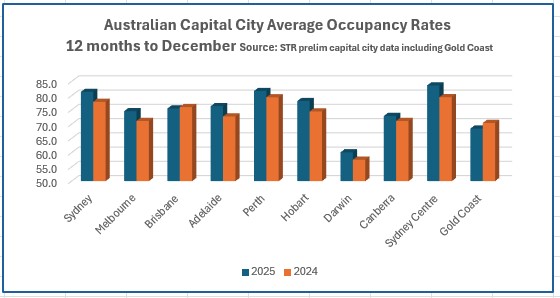
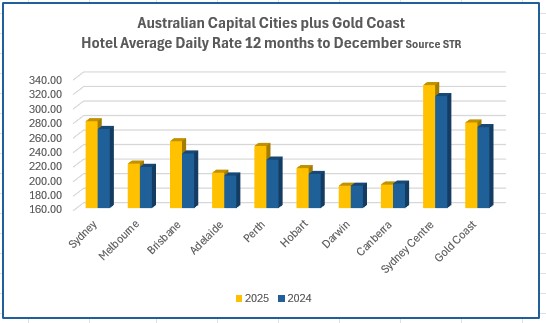
Preliminary capital city STR data for December shows that hotel performance remained relatively strong for most capital cities compared to the previous corresponding period last year with Melbourne and Adelaide the standout improvers in occupancy.
- Sydney experienced an average occupancy across the whole city 81.3% (up 3.2%), and 84.3% (up 2.7%) in the city centre. Sydney's ADR rose strongly by 11.1% to $349.08 and RevPAR was up strongly by 14.7% to $283.69. This performance was enhanced by occupancy of 95.4% and ADR of $1,003.10 for NYE.
- Melbourne's occupancy also strongly rose 10.5% to 76.9%, and ADR up 13.8% to $243.48; Brisbane occupancy was up 2.2% to 73.0%, and ADR strongly up by 16.1% to $281.28;
- Adelaide finished a strong second half of year with occupancy up 9.4% to 76.2% for December and ADR strongly up 15.6% to $248.82;
- Perth occupancy up 2.2% to 78.1% and ADR up 10.0% to $271.19;
- Hobart occupancy up 1.6% to 81.3% and ADR up 8.2% to $265.89;
- Darwin occupancy down 2.8% to 40.0% and ADR down 2.8% to $151.00;
- Canberra occupancy up 4.2% to 66.3% and ADR up 8.1% to $195.27; and,
- Gold Coast occupancy down 3.1% to 70.8% but ADR up 5.9% to $359.13.
The graphs below show the average occupancy rates and ADR for the capital cities across 2025 compared to 2024. Gold Coast and Brisbane were the only cities to experience a drop in average occupancy in 2025 compared to 2024, although in both cases their ADR was up. An annual report card on capital city hotel performance was issued as a media release (see here).
| | |
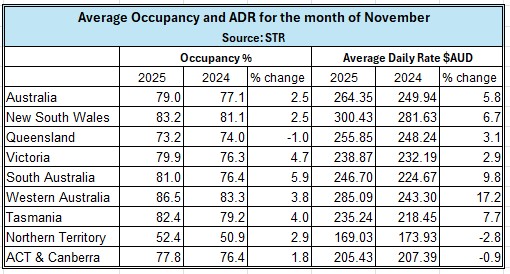
Hotel Performance in November
The STR hotel performance figures for November just missed the last advocacy update of 2025. For completeness, the table below provides a summary of occupancy and ADR experienced across Australia in November. As can be seen, improvements in rates can be seen across all of Australia with the exception of falls in the ADR compared to last year for the NT and ACT and om occupancy for Queensland. Western Australia and South Australia experienced particularly strong increases in the ADR compared to November 2024. For the eleven months to November 2025, the average occupancy rate across Australia was 73.3%, which was a 2.9% increase on the same period the previous year. The ADR experienced a slightly larger increase of 3.! to $244.13. The strongest increase in occupancy for the year to November was experienced by South Australia, followed by WA. Unsurprisingly, WA saw the largest increase in ADR up 7.0% followed by Queensland (up 4.7%).
| |
| | |
3 things for you to do today to support the industry's jobs and careers platform eeger.com.au:
- Register on eeger to build your employer profile
-
Follow eeger on LinkedIn to stay in touch
- List your job vacancies on the site that has been developed for industry by industry
| | | | |
Drop me an email at policy@accommodationaustralia.org or give me a call on 0418 277 919 if you have any national policy issue that you think AA should be following up. If you know an AA member who is not receiving this advocacy report but wants to, then encourage them to email me and we can add them to the distribution list. Back issues of the fortnightly advocacy updates can be found here.
Kind Regards
Jenny Lambert OAM
National Policy Director
Accommodation Australia
| | | | |