e-Newsletter | February 13, 2026 | |
Get your tickets today!
Revolutionary Privateers at Sea Symposium:
Newburyport and the Wider World
Monday, March 23, 8:00 a.m. to 4:00 p.m.
Firehouse Center for the Arts
International experts, field trips, tavern entertainments, and more!
| | |
Accounting for Independence
"Guns, Boxes, Knapsacks, Blankets, Cutlasses, etc."
by Sam Clewley
| | |
Hello Museum of Old Newbury members and fellow history lovers! My name is Sam Clewley and I am an historian with a passion for the American Revolution working at the MOON. I began work there as an intern, cataloguing the militaria collection, before going on to complete my graduate studies. The staff and collections here have been a key part of my education, and are a treasure.
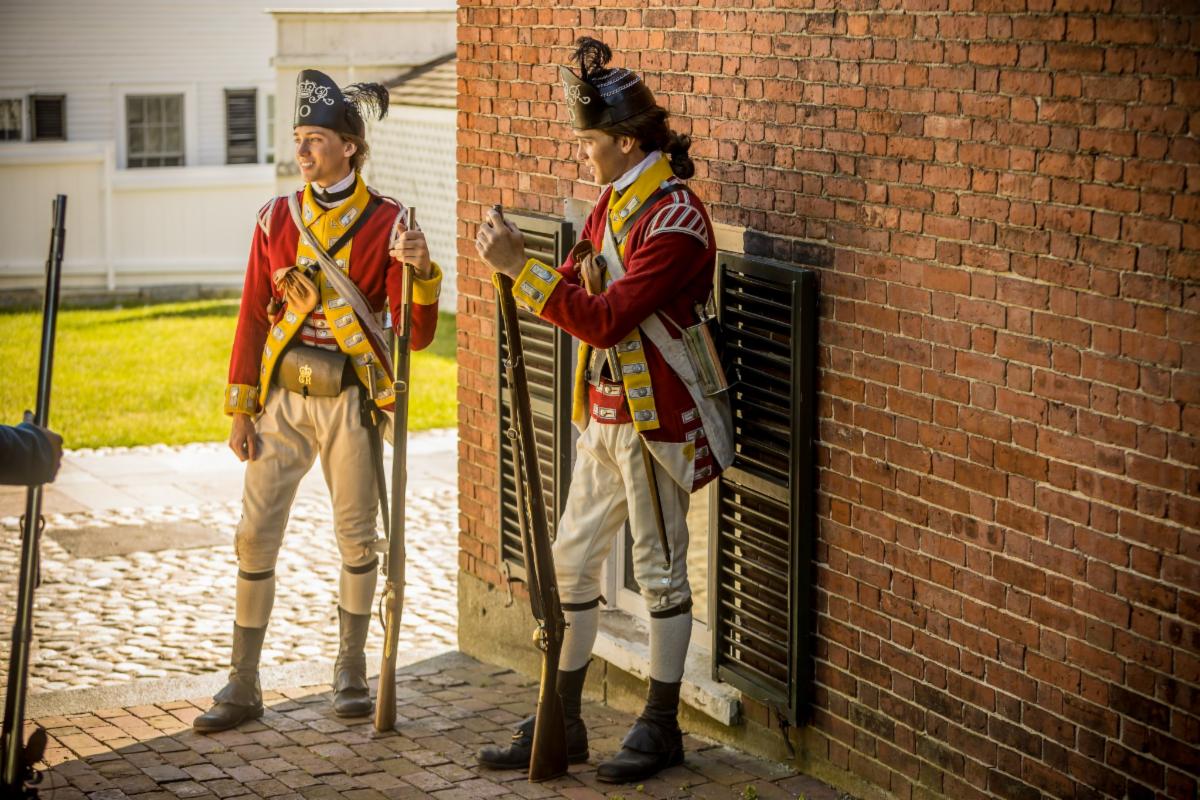
At the moment, I am working occasionally at the museum digitizing records, caring for collections, and doing, well, anything else that needs doing! I am also in a local historical reenactment group which represents the British 10th Regiment of Foot as they would have appeared in April, 1775, which is why, when this volume was discovered in a family collection of papers, Bethany Groff Dorau asked me to have a look through it and help the rest of the staff understand its impact.
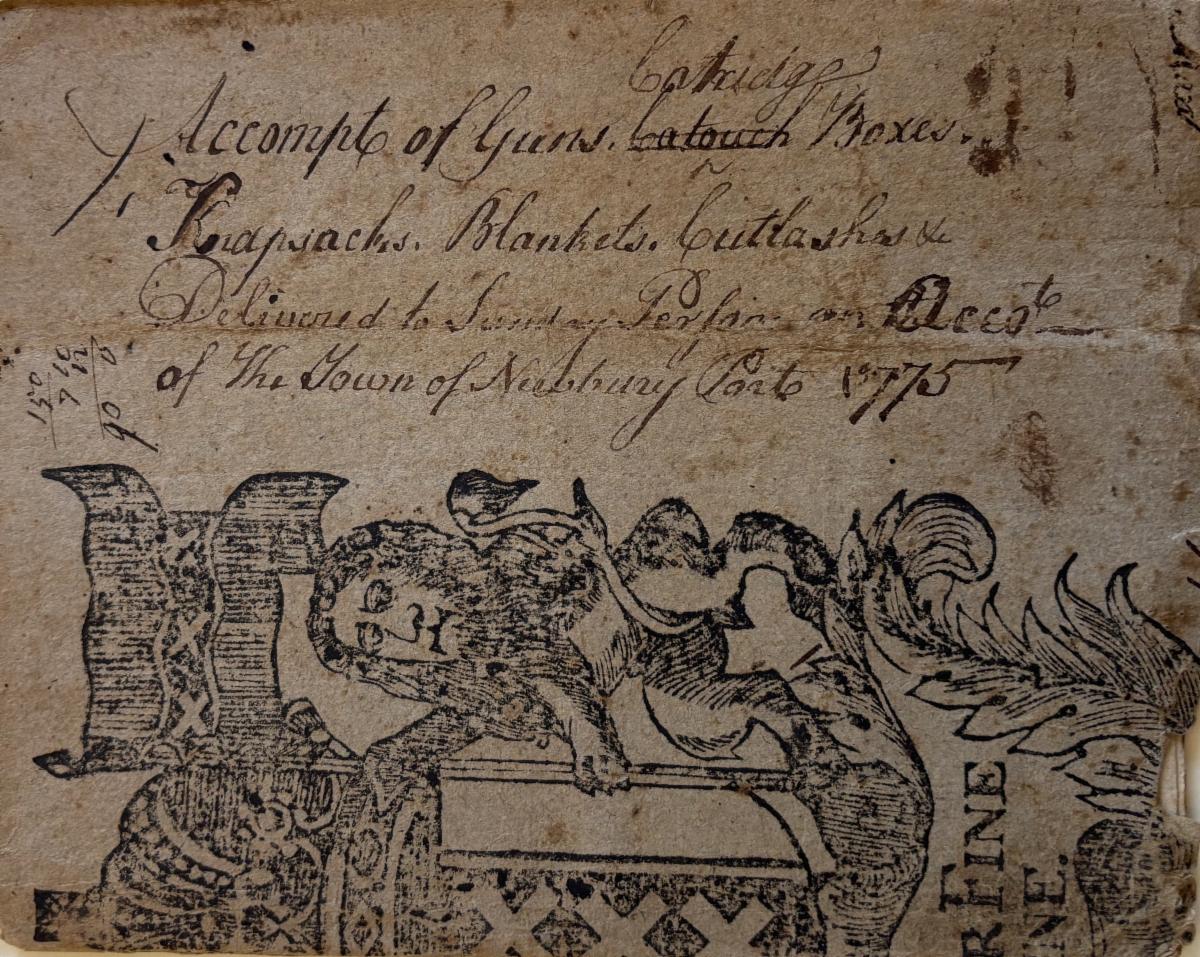
As we approach the 250th anniversary of our country’s founding, and in the midst of a season of MA250 programs, it seems fitting to share this with you all. This document is an account book from 1775-1777 which details weapons and equipment delivered to Newburyport in the early years of the war. Not only does this record contain many familiar names, but it also provides a sense of what the individuals from this area would have carried with them into battle.
This account book is a testament to Newburyport's preparation for war, and a glimpse into what it took to win our independence!
Read the full story after announcements...
| |
| |
Seasonal Saturday Tours!
Saturdays (weather permitting) 11am - 4pm
(last tour at 3pm).
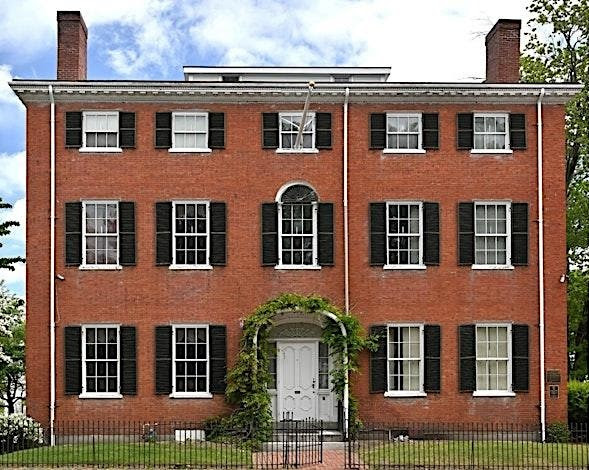
Guided tours of the Museum of Old Newbury’s 1808 Federal-style home, offered Saturdays this winter. History comes alive on every floor!
For Tickets
| | | |
| |
Newburyport's Road to Independence III: Loyalists, Prisoners, and the Homefront
Friday March 6, 2026, 7:00pm
Step into wartime Newburyport with Alex Cain as loyalists face persecution, prices soar, and fear hangs heavy as we move to independence.
Tickets Here
| | | |
| |
Newburyport's Road to Independence IV: American Rebels: Hancock, Quincy, Adams
Friday April 3, 2026, 7:00pm
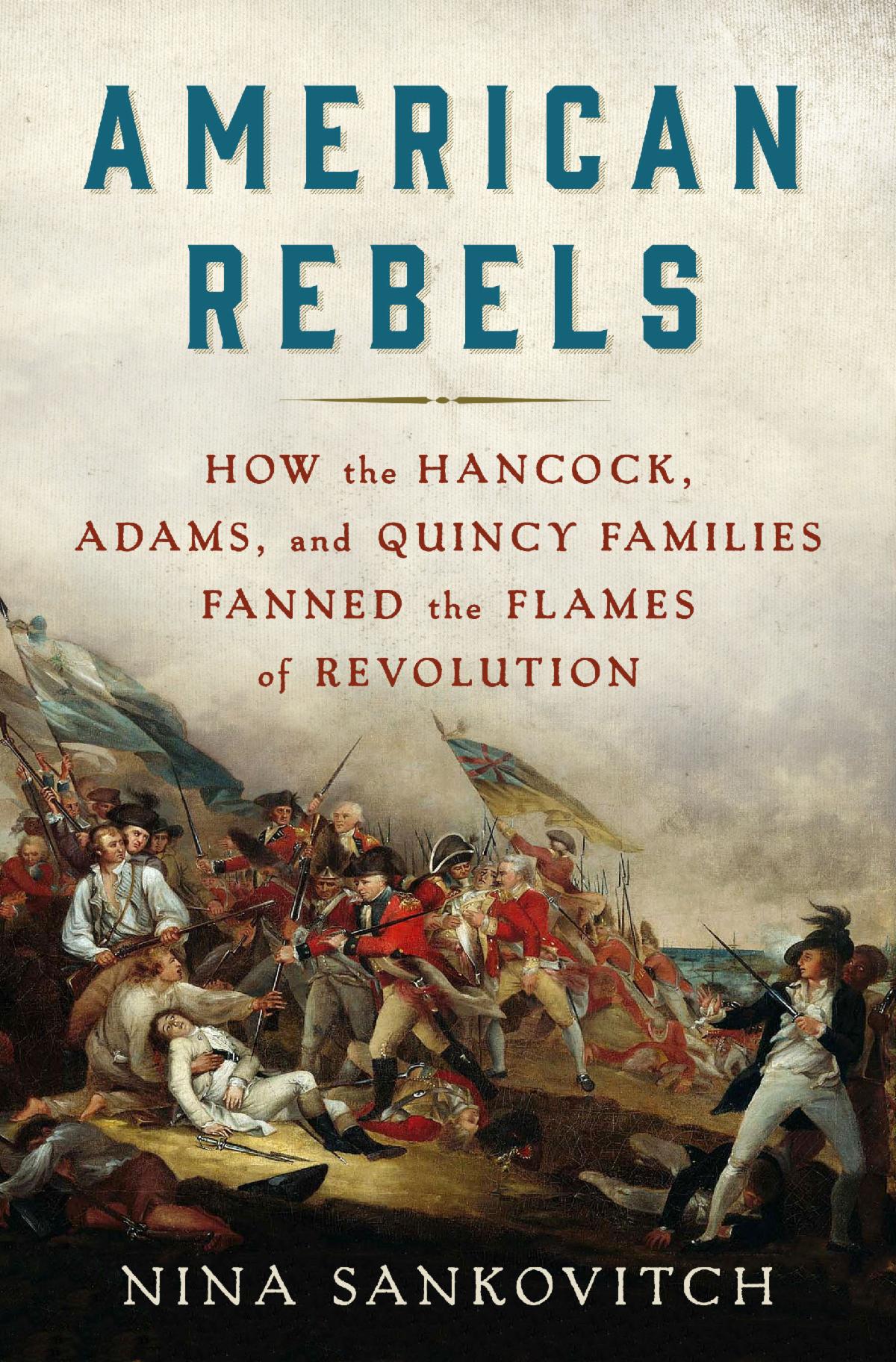
American Rebels: The Hancock, Adams, and Quincy Families Fanned the Flames of Revolution...in Newburyport and Beyond.
Tickets Here
| | | | |
Accounting for Independence
"Guns, Boxes, Knapsacks, Blankets, Cutlasses, etc."
by Sam Clewley
| | |
Top: The front cover of this 1775 account book has a printed coat of arms from Amsterdam, which seems unrelated to the subject matter.
Bottom: The author and twin, Noah, welcoming school groups at the Cushing House. Image courtesy of Amanda Ambrose Photography
Hello Museum of Old Newbury members and fellow history lovers! My name is Sam Clewley and I am an historian with a passion for the American Revolution working at the MOON. I began work there as an intern, cataloguing the militaria collection, before going on to complete my graduate studies. The staff and collections here have been a key part of my education, and are a treasure.
At the moment, I am working occasionally at the museum digitizing records, caring for collections, and doing, well, anything else that needs doing! I am also in a local historical reenactment group which represents the British 10th Regiment of Foot as they would have appeared in April, 1775, which is why, when this volume was discovered in a family collection of papers, Bethany Groff Dorau asked me to have a look through it and help the rest of the staff understand its impact.
As we approach the 250th anniversary of our country’s founding, and in the midst of a season of MA250 programs, it seems fitting to share this with you all. This document is an account book from 1775-1777 which details weapons and equipment delivered to Newburyport in the early years of the war. Not only does this record contain many familiar names, but it also provides a sense of what the individuals from this area would have carried with them into battle.
This account book is a testament to Newburyport's preparation for war, and a glimpse into what it took to win our independence!
| | |
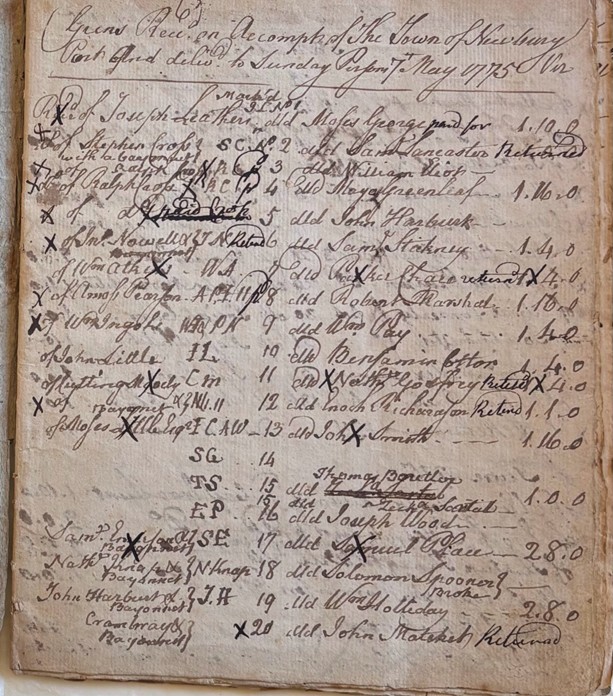
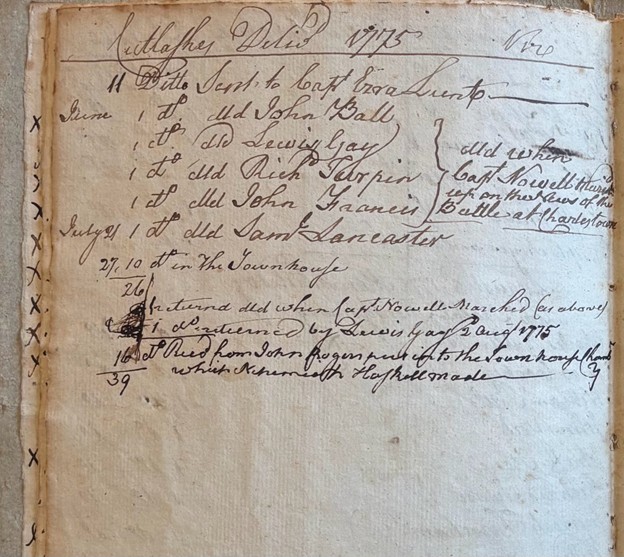
In the months following the battles of Lexington and Concord, Newburyport was preparing for war. Here is a list of some of the guns received by Newbuyport in May of 1775. Note names familiar in town, such as Stickney, Pearson, and Greenleaf.
Also of note is the mention of bayonets included with some of the guns. All soldiers were required to carry an edged weapon (sword or bayonet) in addition to their musket. Not all muskets were fitted for the use of a bayonet, and the fact that some of those guns supplied to Newburyport were so equipped would have allowed those soldiers carrying them to forgo the sword.
| | |
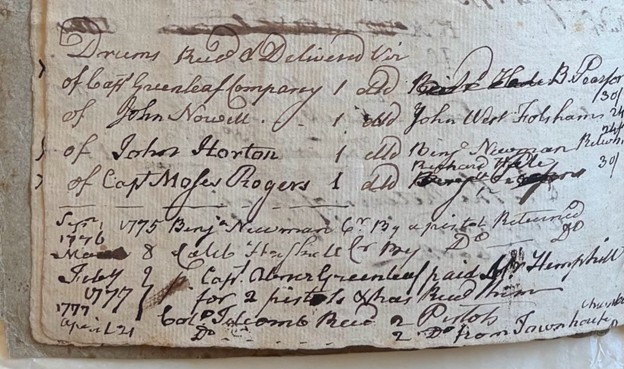
In this entry from May of 1775, there is a note of drums delivered, including to Captain Greenleaf’s company. Drums were important instruments of war that allowed officers to communicate with their men on the battlefield. During the height of battle when the noise was thundering and smoke obscured visibility, the drum would provide signals to the men; such as when to fire, retreat, or reload.
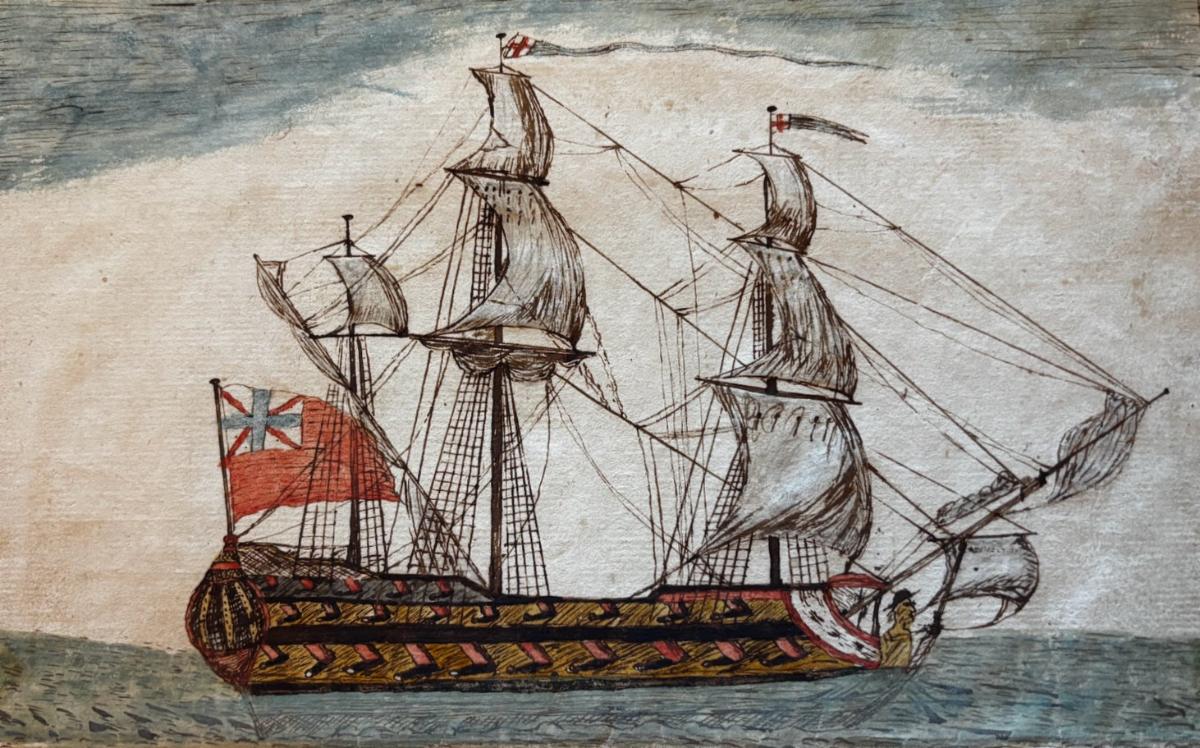
Note that on the bottom of this page, there is a note that a pistol was returned by Caleb Haskell. Haskell is also responsible for the illustration at the top of this newsletter. His drawing of a British vessel (we think - the flag is puzzling) is from the first page of an amazing privateering ship log we will examine in more detail at the symposium.
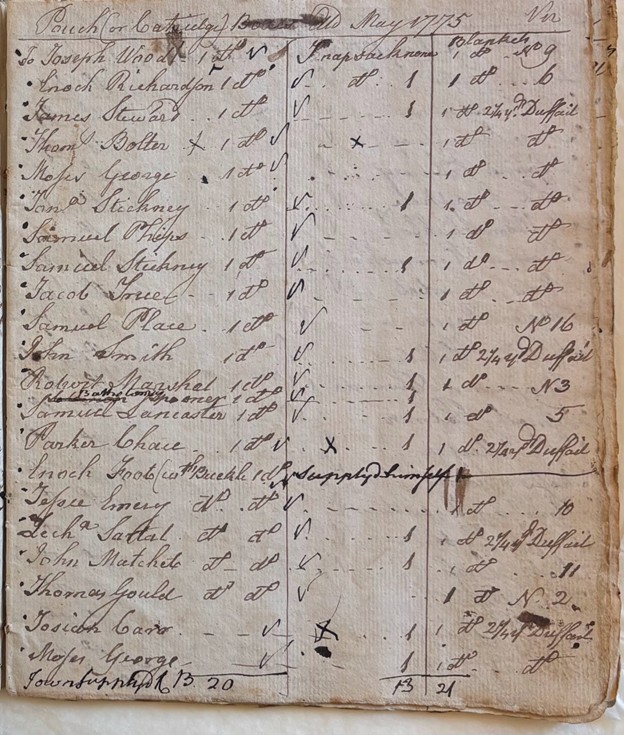
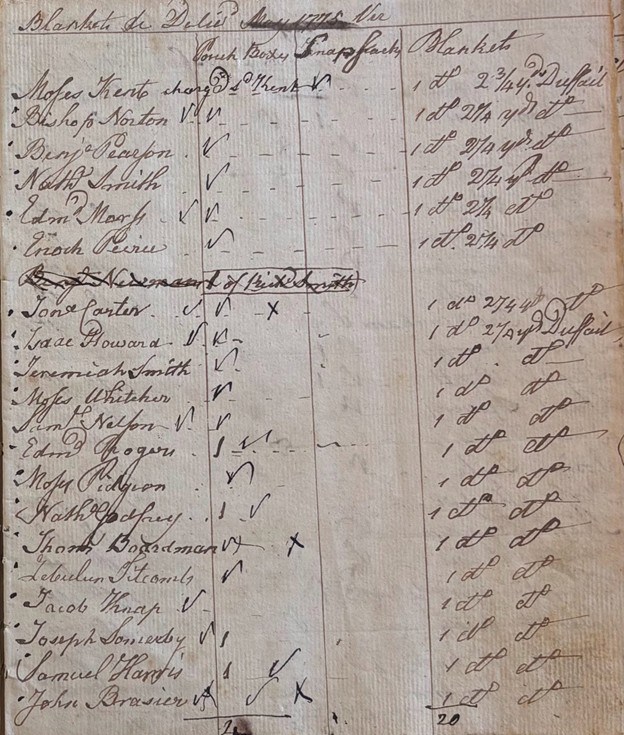
| | This section contains the list of pouches (or cartridge boxes). Pouches are where a soldier would have carried the ammunition for his musket. These would have carried pre-assembled rounds of ammunition. | | In May of 1775, Newburyport was also receiving snapsacks (backpacks) and blankets. These were vital and required pieces of equipment for soldiers, particularly those who were leaving home for an unknown duration of time. As the Siege of Boston continued in the wake of Lexington and Concord, Newburyport’s men needed to be prepared to stay in the field for extended periods. | | |
All of this equipment would have been necessary not only for the siege of Boston but also for the Battle of Bunker Hill, which occurred on June 17, 1775. Here the battle is referred to as “Battle at Charlestown.”
I hope you found this piece of Newburyport’s Revolutionary history intriguing as I do. We will be examining, researching, and digitizing this and other collections at the Perkins Art & Research Center over the next year. As we look back to our struggle for independence 250 years ago, documents like this offer rich perspective on how communities like Newburyport prepared for war.
| | |
Love Letters, Undelivered, Aboard a Newburyport Privateer
by Annabelle Svahn
| | |
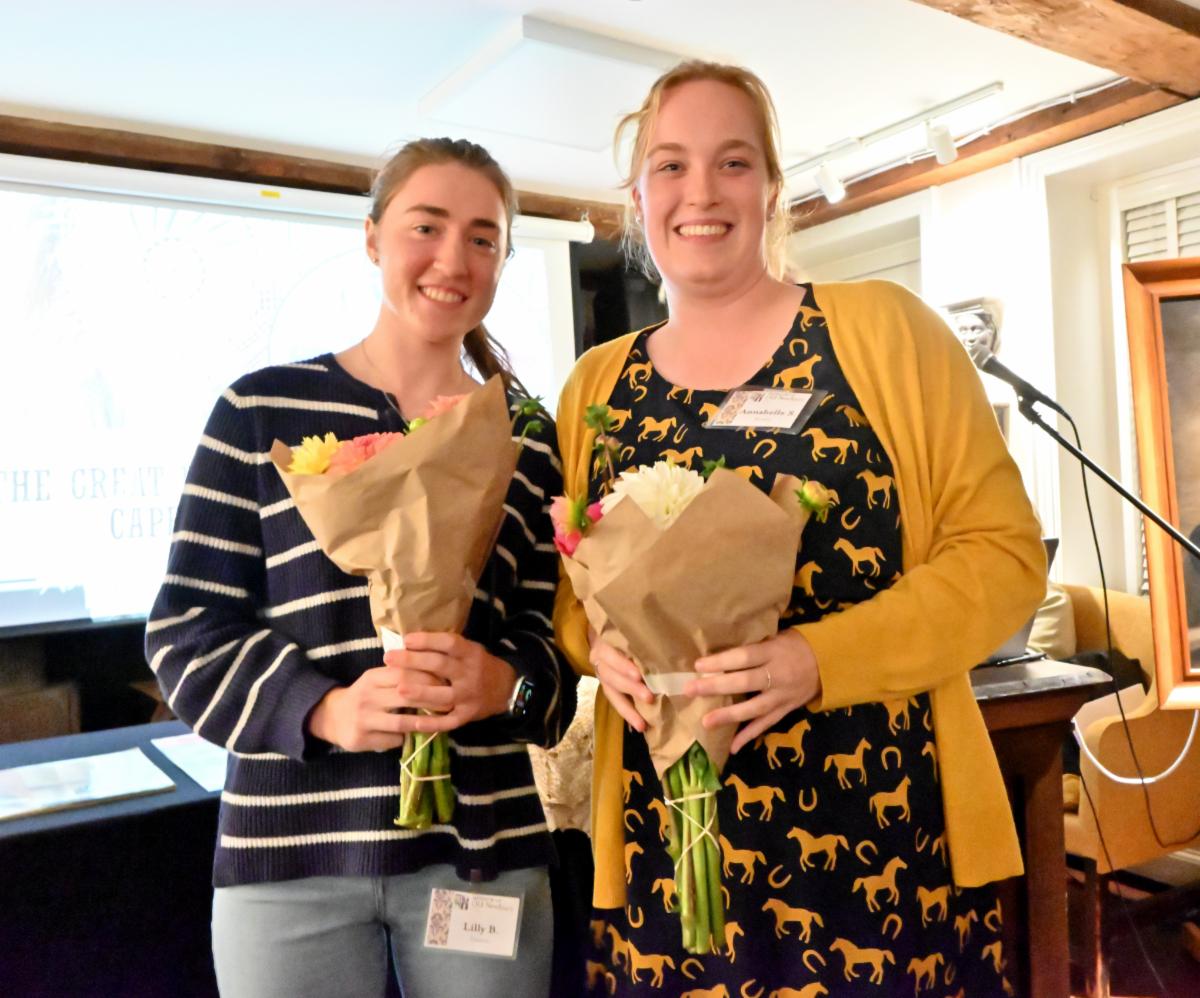
Hello from London! Some of you may remember me as the intern who wrote about the beaux of Ruth Graves. Apparently historical love letters are my thing, as here I am with some more stories about love.
Two weeks ago, I visited the National Archives in Kew, London to view the prize papers collection, the holdings of documents from ships seized by the British navy. Within these papers are many ships that originated in or were commanded by Newburyport sailors during the American Revolution. In many cases, these are the most complete records of these voyages as their papers were seized and kept by the courts who had to have evidence that these vessels were seized legally.
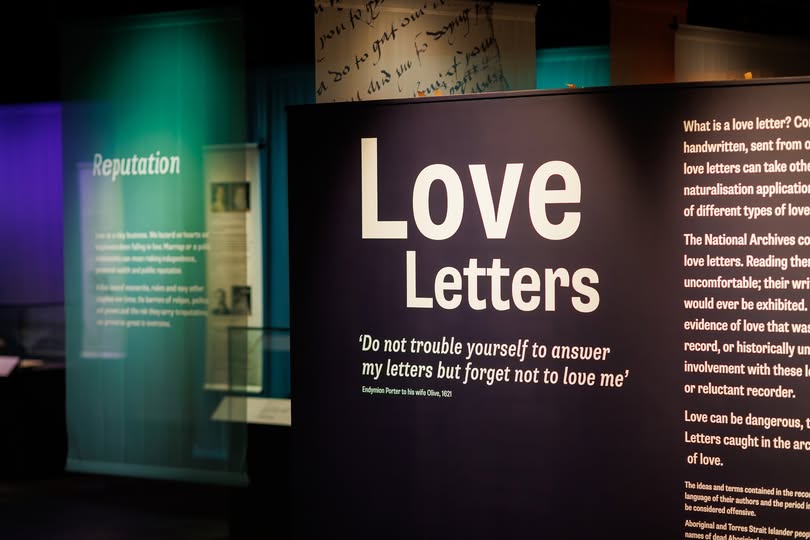
| | Before I went to start my research, I stopped in the National Archive’s current exhibit on Love Letters. The exhibition features correspondence of endearment throughout time and highlights all forms of love. Documents displayed include the final letter from Robert Dudley, Earl of Leicester to Queen Elizabeth and the ties of familial love found in Jane Austen’s will. I also spotted a story much closer to home, a draft of a letter in a ship log from Isaac Church to Rosanna of Wareham, Massachusetts while he was aboard the whaling ship the Desire. In his letter, he claimed he would run away to England so that he could “tear your image from my heart,” as Rosanna was already married. Church signed the letter “your affectionate friend and disconsolate admirer.” Church served the American Navy, and his ship was captured five years later. Whether his letter confessing his love to Rosanna was ever sent or received, we do not know. | | |
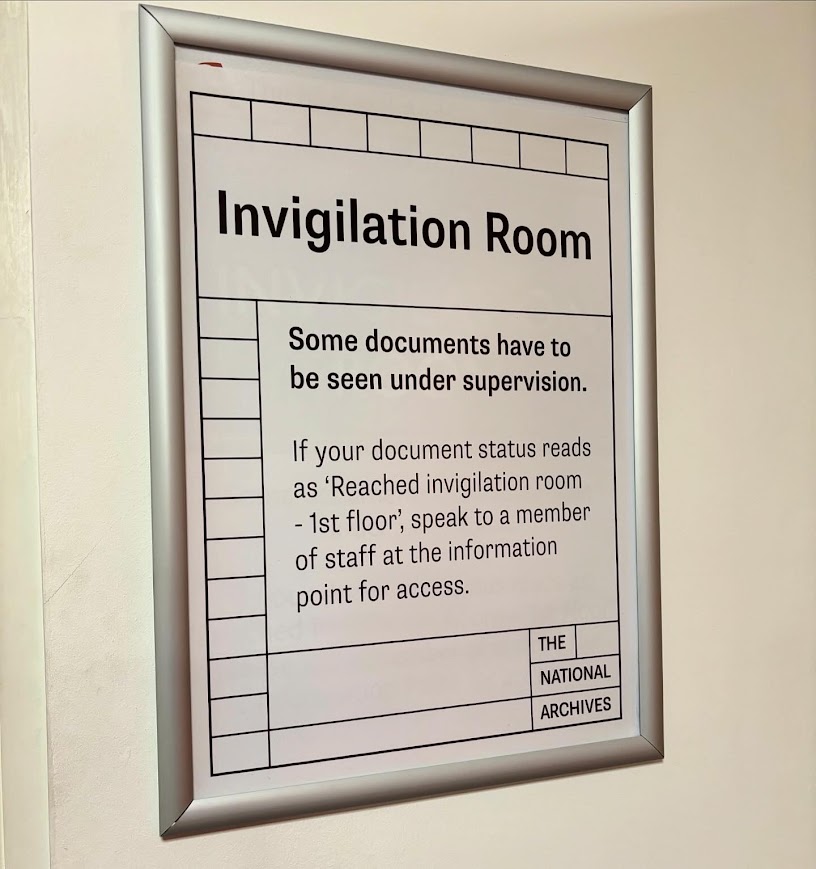
After visiting the exhibition, I procured my special researcher card and went into the archive to look at several boxes that contained ships linked to Newburyport. Some of the collections are so rare and valuable that researchers are locked in a special room, under observation!
I encountered French and Dutch ships captured by the British, as well as many American ones. One of the folders I opened was labeled “Betsey” commanded by “Gold.” (More commonly referenced as Gould in the papers.) The file, mysteriously, also contained letters mentioning a ship named the General Arnold. After reading all these documents, and with some help from Amanda Bevan, the lead archivist of the Prize Papers collection, I was able to piece together the story of the Betsey.
Sometime in mid-September, 1778, the British merchant vessel Betsey launched from Newfoundland, heading to Bilbao, Spain. It was intercepted on September 24, 1778, almost exactly half-way across the Atlantic, by the American privateer ship, the General Arnold, commanded by Moses Brown of Newburyport. The captured Betsey and its cargo set off back to Newburyport with prize captain Elisha Gould. Mariners on the General Arnold passed letters onto the Betsey to be delivered to their family members back home.
| | |
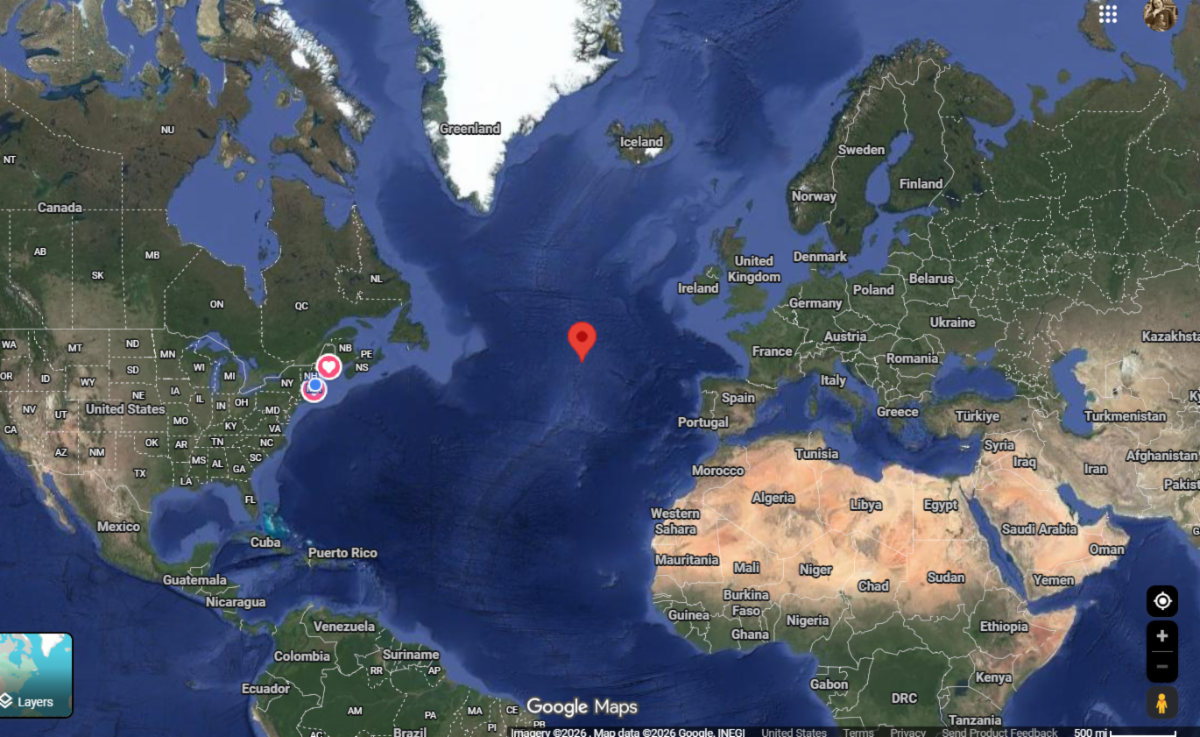
Top: The latitude and longitude of the capture of the Betsey were recorded, so it is possible to know with remarkable accuracy where she was taken.
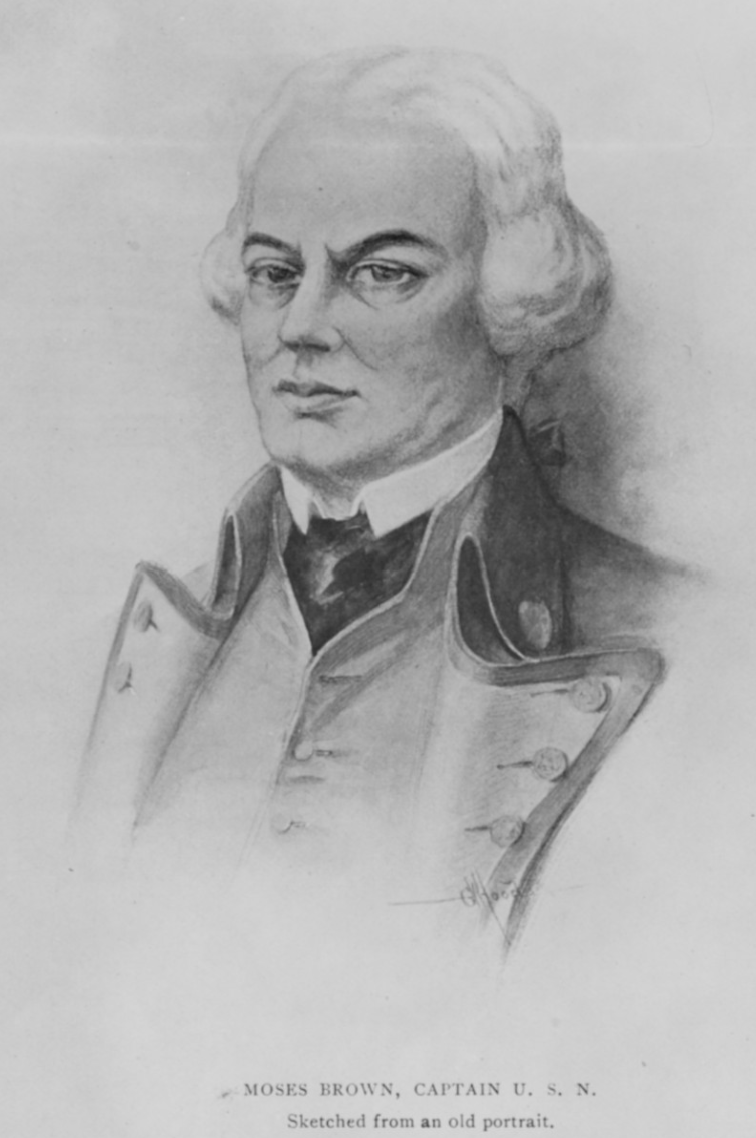
Bottom: This rather flattering image of Captain Moses Brown is from a 19th century biography. Other, perhaps more realistic portraits are in the collections of the Custom House Maritime Museum.
On October 28th, 1778, near Boston, the British ship the Grafton recaptured the Betsey. The Grafton took the Betsey as a prize back to New York, where legal proceedings were drawn up by Robert Bayard, the New York Vice-Admiralty Judge. The commander of the Grafton, Captain Andrew Wilkinson, affirmed in his interview that they took the “Betsey loaded with Fish under the command of one Elisha Gold” with 160 men aboard. His deposition affirmed that the Betsey’s crew were “rebels to our Lord King.” These records identify the Betsey’s original owner as Mr. Dobel of Newfoundland.
Included was the copy of the General Arnold's privateering commission dated April 17, 1778 and the orders from Moses Brown to Elisha Gould to deliver the ship and its cargo to Nathaniel Tracy and John Fletcher in Newburyport.
Most interesting to me, however, were the handfuls of letters stuffed into the bottom of the file.
These were letters from the crew of the General Arnold that were sent home on the Betsey but never delivered, as that ship was recaptured. When the ship's documents were seized, these letters became part of the evidence collected. These letters remained with the file after its capture off Boston to the Vice-Admiralty court in New York, and then all the way back to London, where they have remained for nearly 250 years. The citations from these letters have been edited for spelling and grammar for ease of reading.
| |
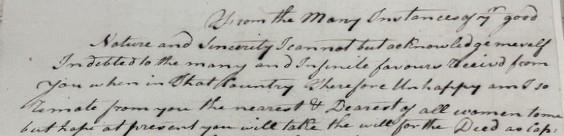
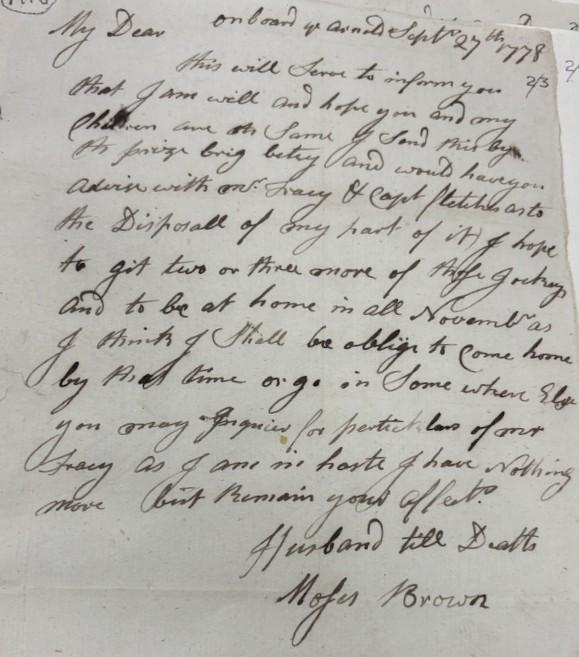
| The first letters in the file were those originally sent from Betsey's departure, intended to arrive in Europe. They included a letter from Samuel Drady, Ferryland, Newfoundland to “the nearest and dearest of all women to me,” thanking this unnamed woman for the "infinate favours received from you when in that country", and addressed to Tony Mulkahy at Ballybrekin (Ballybricken), Waterford, Ireland. Drady’s letter never reached Ireland and was collected aboard the Betsey in addition to letters intended to reach Newburyport. | Aboard the General Arnold, Moses Brown wrote to Nathaniel Tracy of Newburyport saying he ensures all the papers aboard the captured ship will be delivered to him. Moses Brown also wrote to his wife (above), informing her of their capture and hoped that he would be home by November. He ended his letter: “I have nothing more but remain your [affectionate] Husband till death.” | | |
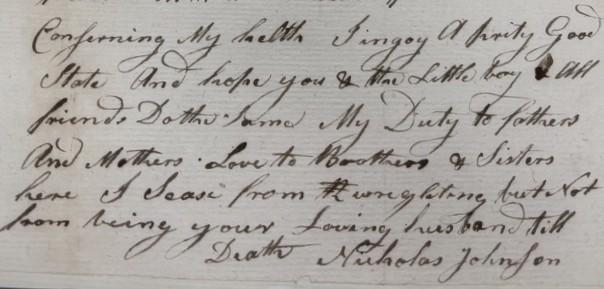
First Lieutenant Nicholas Johnson also wrote to his wife to inform her they had captured a British ship on the 24th, and that “concerning my health I enjoy a pretty good state and hope you & the little boy all friends do the same. My duty to fathers and mothers. Love to brothers and sisters. Here I cease from writing but not from being your loving husband till death.”
| | |
Moses Sawyer wrote to his parents, boasting about capturing a brig from Newfoundland bound to Bilbao, Spain loaded with fish. He concluded:
“I have not time to write more but beg to be remembered to my brothers
and sisters and all friends to remember dutiful son Moses Sawyer.”
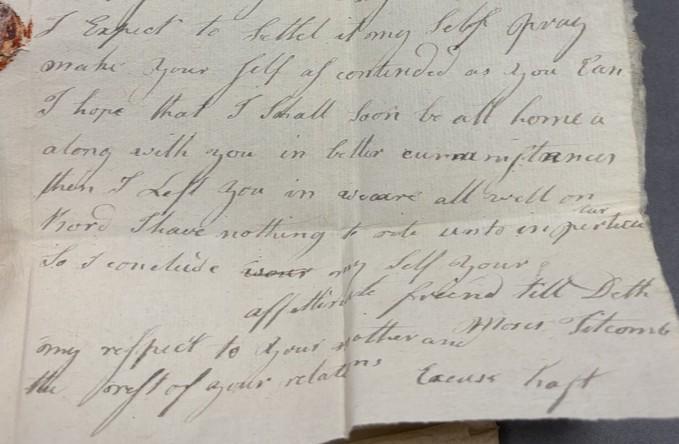
In the letter above, another Newburyport Moses, this one Moses Titcomb, wrote to Sally, "pray make yourself as contented as you can...I hope I shall soon be at home along with you, in better circumstances than I left you..."
| |
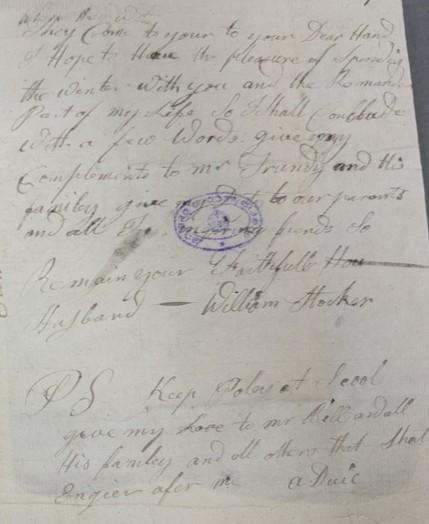
William Stocker wrote to his wife in Newcastle, New Hampshire, commencing his letter with: “Loving wife I take this opportunity to let you know that I am well.”
“I hope to have the pleasure of spending the winter with you and the remaining part of my life so I shall conclude with a few words. Give my compliments to Mr (Fundy?) and his family give my duty to our parents and all the inquiring friends So remain your faithful Hon. Husband, William Stocker.” He even included a short postscript, noting to “Keep Polly at school give my love to Mr. Bell and all his family and all others that shall enquire after me Adieu.”
| | |
What's a good love story without a bit of a mystery? Well, this collection has one for sure. I should add that this is the beginning of the research that could, and should, be done on these collections. They are a treasure trove!
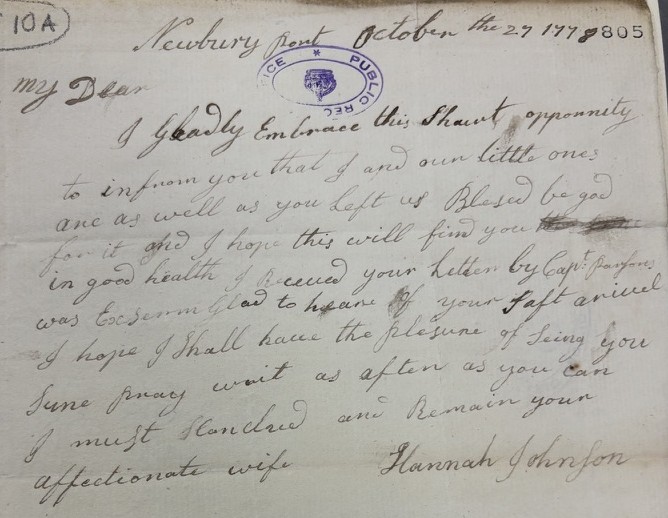
But, back to the mystery at hand. The letter above is dated October 27, 1778, from Newburyport, which, if the date is correct, would mean that it was sent FROM Newburyport just one day BEFORE the Betsey was recaptured by the HMS Grafton off Boston Bay. Hannah Johnson wrote, “I gladly embrace this short opportunity to inform you that I and our little ones are as well as you left us Blessed be God for it and I hope this will find you in good health I received your letter by Captain Parsons was extremely glad to have heard of your safe arrival. I hope I shall have the pleasure of seeing you soon. Pray write as often as you can. I must conclude and remain your affectionate wife, Hannah Johnson.”
And here's where the mystery deepens - Nicholas Johnson, first mate on the General Arnold, whose letter to his wife appears earlier in this article, it may be assumed, is the intended recipient of this letter.
Another twist - Nicholas Johnson's wife is named Elizabeth, not Hannah. His sister-in-law, married to his brother Eleazar, is Hannah (Pearson) Johnson. In 1778, Eleazar is in the wind, however, having captained the privateer Dalton and then sent to, and escaped from, Mill Prison in England. What is clear is that Hannah’s letter never reached her husband, as the ship was captured only a day later.
Why was this letter found aboard a vessel headed INTO Newburyport that was captured before it made it home? Was it misdated, misfiled? We may never know, but it is certainly worthy of more research.
While these are not all romantic love letters, they are correspondence between loved ones, and reveal the human nature and fond relationships of people of the past. They cared for one another, worried, and shared their affections as we did today. Vital records indicate that Nicholas Johnson, William Stocker, and Moses Sawyer survived the war. What happened to them after their capture on the Betsey is a subject for further research, but likely involved imprisonment on a British prison ship, such as the infamous HMS Jersey off New York harbor.
If these letters had made it to their destination, they likely would not have survived. As a result of the Betsey’s unfortunate capture, they ended up in British possession to be preserved as evidence and have been stowed far away in an archive for hundreds of years. Because of their survival, we can now remember the lives of these mariners and their loved ones.
| | Something Is Always Cooking... | | |
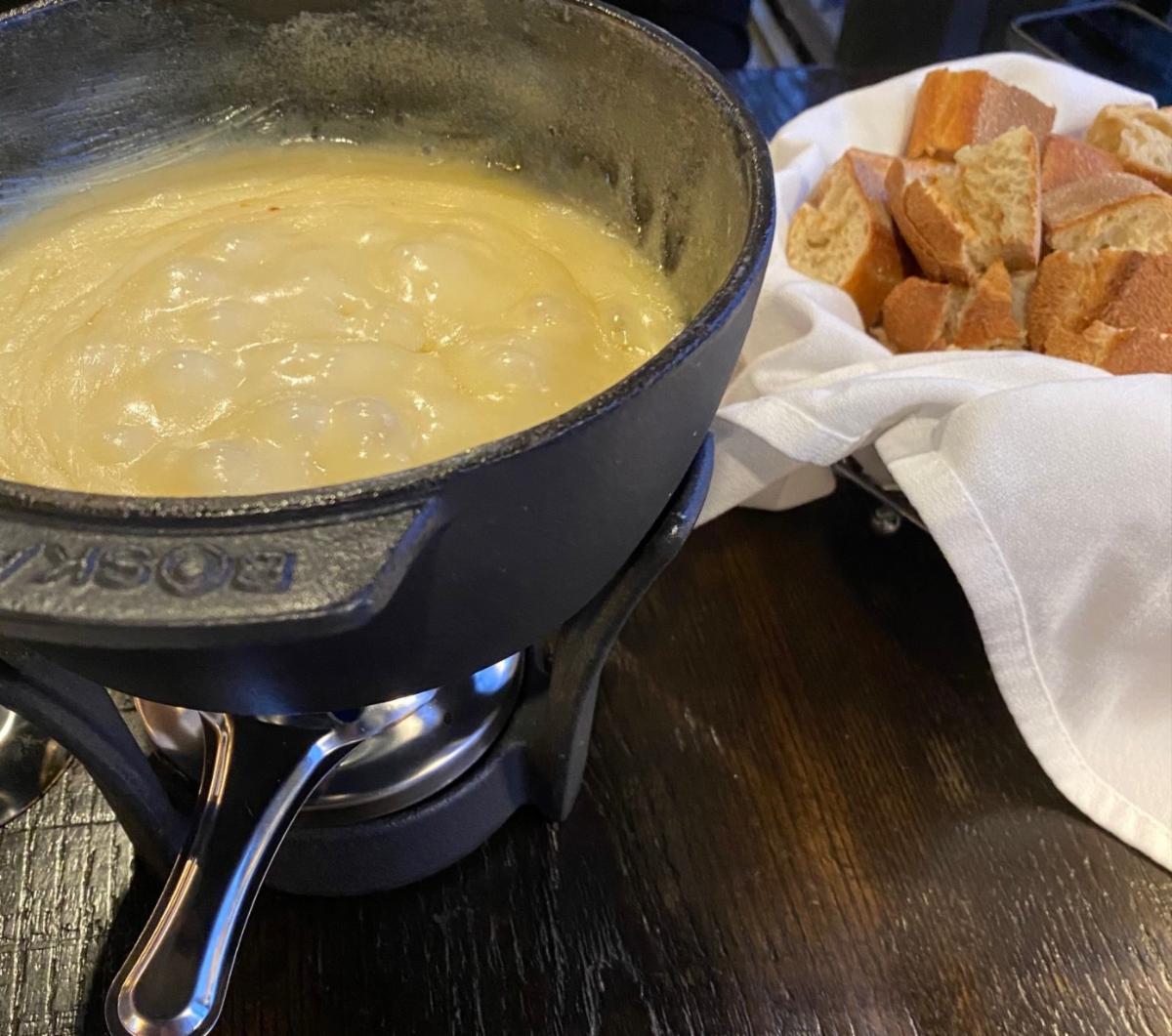
Classic Swiss Fondue
You don't have to strap on your funky disco shoes to enjoy this classic winter recipe (unless that is your thing, then groove away baby). This dish is hot, easy and and best when shared. Perfect for a valentine weekend or a gathering of friends. Adapted from a Food & Wine recipe.
Ingredients
For Fondu:
1 garlic clove, peeled and cut in half
16 ounces Gruyère cheese, grated
8 ounces Emmentaler cheese, grated
1 cup dry white wine (plus extra if needed to thin out to desired consistency)
1 1/2 tbs cornstarch
1 tsp fresh lemon juice
1 1/2 tbs kirsch
Fresh ground white pepper
Freshly grated nutmeg
Pinch of paprika (un-smoked) optional.
For dunking:
Cubes of crusty bread
Cornichons
Pickled onions
Boiled baby potatoes
Cherry tomatoes
Apple slices
Whatever you prefer
Instructions
Gather and prep all ingredients as this dish is served immediately when ready.
Step 1: Rub the inside of a fondue pot, cast-iron, enameled casserole or whatever heavy bottomed pot you have with the garlic clove; save any remaining garlic for another day.
Step 2: Combine grated Gruyere and Emmentaler with the cornstarch until dredged.
Step 3: Heat white wine in the prepared pot over medium heat until it starts to bubble, then add lemon juice.
Step 4: Using a wooden spoon, slowly add cheese mixture until blended, stir gently until mixture comes to a low boil.
Step 5: Add kirsch and a good pinch of pepper and nutmeg and cook, stirring gently, until creamy and smooth, about 5-8 minutes; don't overcook the fondue or it will get stringy.
Serve immediately.
Enjoy!
| | |
Click the image to do the puzzle
This ink and watercolor illustration graces the first page of Caleb Haskell Jr.'s (1754-1829) logbook, which includes notes from six voyages from 1779-1785. This remarkable volume is in the collection of the Museum of Old Newbury, and will be available for viewing at the Revolutionary Privateers at Sea Symposium: Newburyport and the Wider World on Monday, March 23.
Click HERE for more information.
| | |
|
Museum e-Newsletter made possible through the generosity of our sponsors:
| | | | | |