ASBURY FIRST MONDAY READER | JUNE 1, 2026

CONTENTS:

FINANCIAL SUSTAINABILITY UPDATE: FIXED ASSET REPLACEMENTS

by DAWN RIEDY and TIM MAHAN

WHAT THE SPACE MUSEUM TAUGHT ME ABOUT GOD: 
by JO URRIOLA-SCHONEWOLF

Financial Sustainability Update: Fixed Asset Replacements


What you will learn:

  • What is meant by fixed assets
  • Why there is a problem
  • What is the work ahead


Fixed Assets 

On the Asbury First campus we have several million dollars’ worth of fixed assets- the equipment, machinery, building elements and information technology that make our ministries possible. All of these assets have an expected useful life and will eventually need to be replaced. Replacement costs range from 100’s of dollars to 100,000’s of dollars (or more).


The Problem

In recent years, fixed asset replacements have been funded by reserving dollars in our Property Fund. Dollars come from two sources—the General Budget (this year $75,000) and distributions from restricted property care endowments (this year $33,000). While these amounts are sufficient to cover some fixed asset replacements, they are not sufficient to cover “big ticket” items such as a new roof, 1040 windows and other major HVAC or IT expenses. Therein lies the problem: we do not currently have a comprehensive plan for funding all of our replacement needs.


The Work Ahead

As we shared in our first 2026 update, planning for fixed asset replacements is key to achieving long term financial sustainability for Asbury First—and developing such a strategy and plan will be the 2026 focus of the Financial Sustainability Task Force. This work will take time and will involve the input and expertise of our staff as well as multiple governance committees and teams, including Property Stewardship, Finance, and Legacy Giving, to name a few.


We invite you to learn more–please see our detailed FAQ.


We welcome your questions, ideas and feedback. Please reach out to finance@asburyfirst.org.


We look forward to sharing our next Financial Sustainability Update with you in early September.


Thank you for your continued support.


With gratitude, 

Dawn Riedy, Finance Committee Chair 

Tim Mahan, Financial Sustainability Task Force Chair


I’ve always been the kind of person who can never do just one thing. This was normalized (and even praised!) when I was in school, as my list of extracurriculars was as long as my arm. Even in college and graduate school, I found myself taking on work alongside my studies and rehearsals. This is, in part, why children’s and youth ministry is so appealing to me: there’s always at least three things happening at once and I get to participate in them all. 

The same was true for my time in seminary. While I was taking classes at Wesley Theological Seminary in Washington, DC, I also worked with the astronomy education team at the Smithsonian National Air and Space Museum on the National Mall. I primarily worked in the planetarium and with our telescopes, but I also got the chance to wander around the museum off-hours and have the

exhibits to myself. I’ve spent hours of my life visiting artifacts like the Wright Brothers' flyer, the telescope that discovered Pluto, and astronaut and cosmonaut suits. 


Something you notice right away when you visit Air and Space is how influential the military has been in our discoveries about flight and space travel. The

rockets that took our astronauts to the Moon were designed by scientists who were brought to the US during Project Paperclip, meaning that they got their experience building rockets during World War II. Many of our astronauts have military training. Funding for many of the exhibits comes from companies that today make weapons of war. Knowing that this experience was brought to you by Nazis and Raytheon really puts a damper on your sense of awe and wonder at the vastness of space. 

I love astronomy and astrophysics. I love thinking about the universe beyond our planet. I dream of teaching on Mars one day. And, at the same time, I have to be honest with myself: some of my dreams have been built by people whose work ended other people's lives. It seems strange to say, but this knowledge truly challenged my faith. How could anything good come from such violent roots? 

I’ve wrestled with it over the years, but I’ve come to truly believe that God is with us, in good times and in bad. God is with everyone whose lives and family and homes are threatened by war right now and God is with us. God is with us when we dream and hope and explore and God is with us when we destroy. 

But God's presence with us and God's message to us is different in different situations. 


We are blessed when we are peacemakers and we are called to account when we are not. We are called to stop violence in all its forms, to repent, and to repair what we can, to turn the weapons of war into tools for growing things. 

When you think of all we as people can accomplish together, the International Space Station, Hubble and the JWST, the Apollo landings, remember what we as Christians are called to do. Choose to make good and beautiful things. Make good and beautiful things that mend the brokenness of violence and sow the seeds of wholeness. When we do this, then the Spirit of God can come among us and take our hopes and dreams to places we’ve never gone before. 

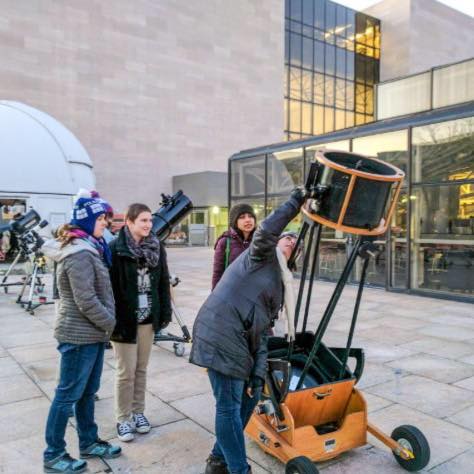
Image #1: Jo Urriola-Schonewolf and colleagues alligning a telescope at the Smithsonian National Air and Space Museum on the National Mall.

Image #2: photograph of our Sun taken through a solar telescope by Jo Urriola-Schonewolf.

Would you like to submit a story for inclusion in a future Monday Reader? Please do! 
We'd love to hear from you. Email David Stith at
dstith@asburyfirst.org to get started.

Asbury First United Methodist Church

1050 East Avenue, Rochester NY, 14607

(585) 271-1050

Facebook  Instagram  Youtube