|
Salesian Imagination
Reflection by Elizabeth Connell Wright
| | |
Excerpt from “Live Today Well”
by Fr. Thomas F. Dailey, OSFS
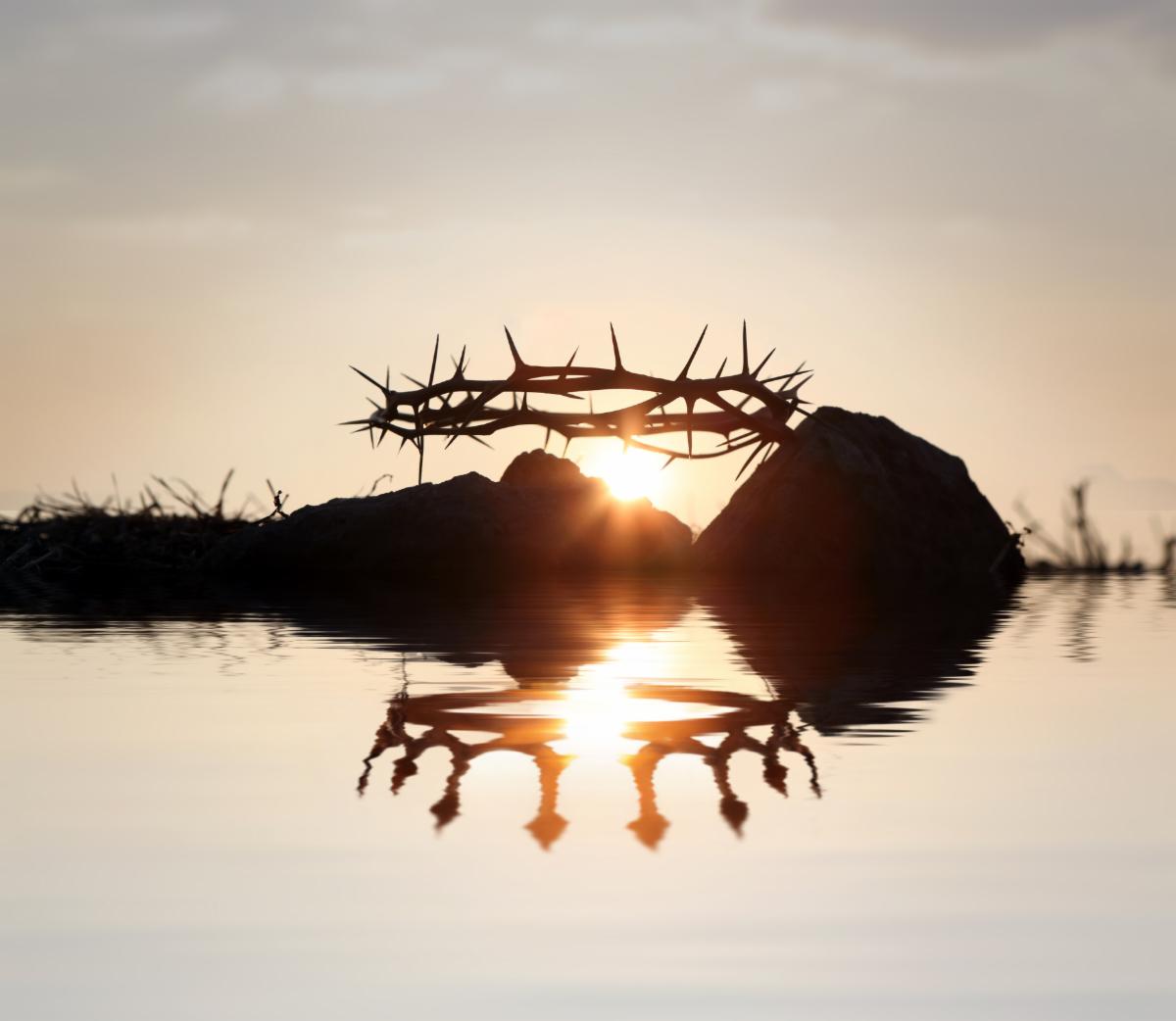
“Perhaps more so than any author of his time, St. Francis de Sales makes extensive use of the imagination. His writings contain numerous images (thirty-three thousand, by one count!) that give to his work a literary power to convey spiritual truths clearly, creatively, and eloquently. But for this saint, the imagination also has a productive power that is decidedly person. In his view, the forming of mental images, under the inspiration of the Holy Spirit, has “an inestimable efficacy to enlighten the mind and move the will” (On the Preacher and Preaching, p. 50). Cultivating this unique human faculty is a chief means for bringing about our continual conversion toward God.
In Salesian spirituality, using one's imagination produces an awareness of God's presence in our lives. As the saint explains: “Although faith assures us of his presence, yet because we do not see him with our eyes we often forget about him and behave as if God were far distant from us. We really know that he is present, but because we do not reflect on that fact we act as if we did not know it” (Introduction, part 2, chap. 2, p. 74). Thus, in order to pray at any time or in any place, all we need to do is imagine the reality of what we believe, that God remains always with us.
| | |
Our imagination is also beneficial in its power to excite within us those considerations and affections that motivate us to lead better lives. By imaginatively portraying God as gazing down on us from heaven or standing alongside us, we are likely to act differently. By picturing ourselves as the subjects in a Gospel story, we more vividly hear Jesus’ words or feel the effects of his touch or see the wonders of his power; and in this we experience the grace of divine revelation that empowers us to know the truth more fully, to show goodness through mercy, or to praise the beauty of the world around us.” (p. 90-91)
As we officially move into the holiday season this month, it can be easy to lose sight of God in the glittering distractions. Liturgically, Advent is a time of quiet reflection and preparation juxtaposed with a world that is bustling with festive sounds, sights, and even smells that hurry Christmas into the present before we have had time to even long for Christ — sometimes even before we have given thanks at our Thanksgiving table!
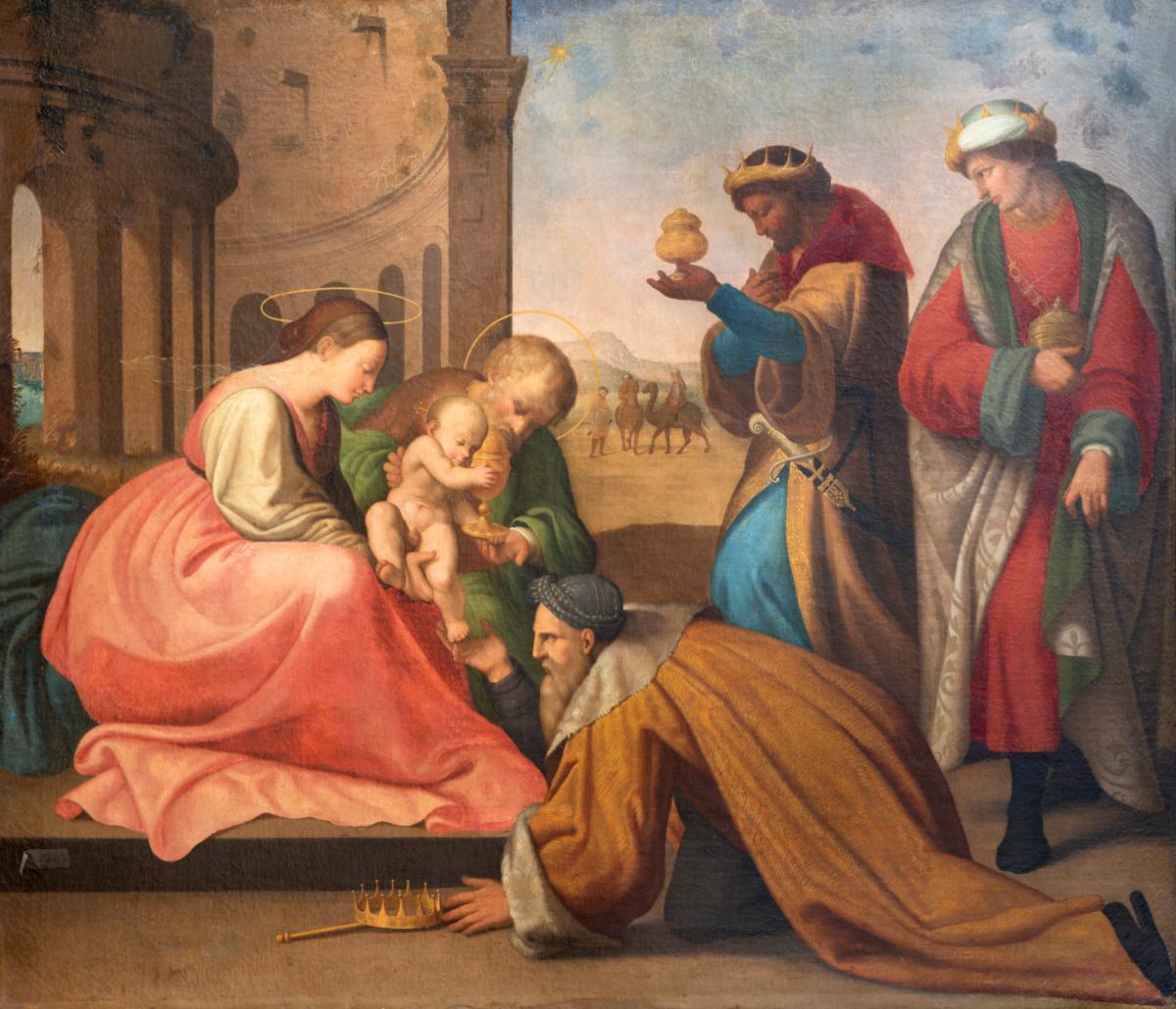
The Salesian imagination is a wonderful way to anchor ourselves during this lively, sometimes hectic, and perhaps even lonely season. Imagining the Father, Son, or Holy Spirit is right beside you is a very simple, yet powerful posture for prayer. The almighty grace of God the Father, the loving embrace of Christ, or the comforting fire of the Holy Spirit are always within our reach, through the door of our imagination. As St. Francis de Sales said, imagine yourself in the story of Christ, walking with him in his daily life or witnessing one of his miracles. This can be very powerful for your own spirituality. This coming Advent season, may each of us find the opportunity to employ Salesian imagination to strengthen our faith, quiet our hearts, and enrich the experience of longing for our Savior.
| | |
The Legacy of
Venerable Mary Lange
by Elizabeth Connell Wright
As we celebrate National Black Catholic History Month in November, we are reminded that we still await the canonization of an African American Saint. With seven on the path — Venerable Mother Mary Lange, Venerable Pierre Toussaint, Venerable Father Augustus Tolton, Venerable Mother Henriette Delille, Servant of God Sister Thea Bowman, Servant of God Julia Greeley, and Servant of God Martin de Porres Maria Ward — one will become the first African American Saint. Known as the “Saintly Seven,” these holy men and women faced lives marked by deeply rooted and painful discrimination. Living a life marked by holiness is challenging enough in the best of circumstances, but these saints – and many others — did so in spite of the harsh obstacles of racism they faced on a daily basis, including inside the Church and religious communities.
On a gorgeous fall day in late October, 24 parishioners from St. John Neumann boarded a bus to Baltimore to learn more about the saint our Racial Justice Ministry is embracing, due to her connection with St. John Neumann: Venerable Mary Lange. This was an opportunity not only to better understand Mary Lange and the challenges she faced, but to experience the people and places that are a living devotion to her legacy and the dream of her canonization.
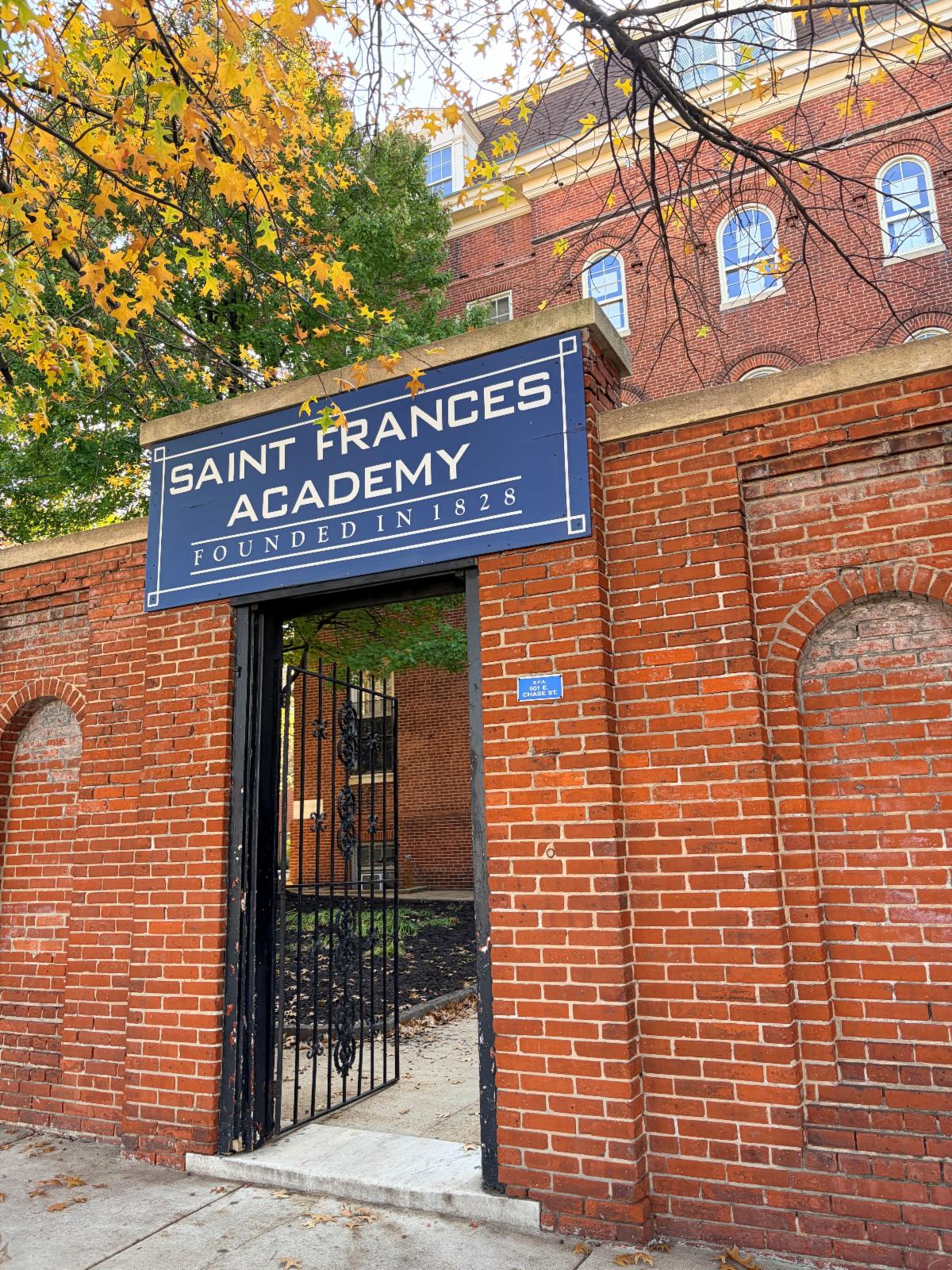
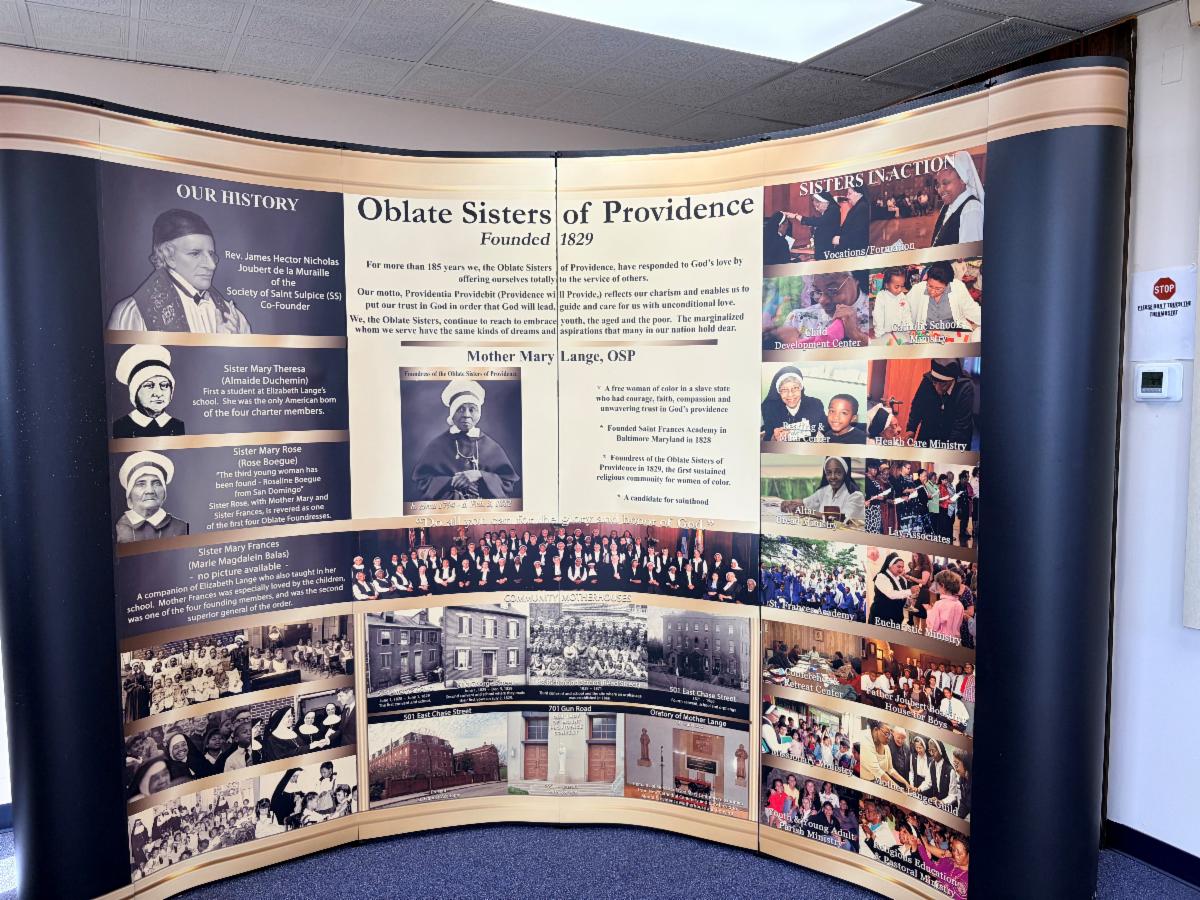
Born circa 1794 in Santiago de Cuba, she was named Elizabeth Clarisse Lange and believed to be from a wealthy, educated family. After fleeing Cuba during the rebellions of the early 1800s, she ended up in Baltimore and with Maria Balas began to teach Black children in her home. Fr. James Hector Nicholas Joubertt, SS, became a aware of their work and invited the women to begin a religious sisterhood with the mission to serve and teach the area’s Black children, a call they were already answering. Rosine Boegue and Theresa Duchemin joined the other two women, and in 1828, they opened a school for Black Catholic girls. Today, known as St. Frances Academy, it is the oldest continually operating school for Black Catholic children in the United States.
| |
On July 2, 1829, with the guidance of Fr. Joubert, the four women started their new religious order, and on March 22, 1832, they received recognition from Rome making the Oblate Sisters of Providence the “first successful Roman Catholic sisterhood in the world established by women of African descent” (oblatesisters.com). As expected for a group of Black women in the pre-Civil War United States, the sisters had to overcome significant challenges to keep serving their mission. They worked tirelessly to serve and educate Black children and families during difficult times and with little support or resources. During the cholera epidemic of 1832, they selflessly nursed the elderly and terminally ill who were suffering alone. (Their heroic role in the epidemic was ignored until October 30, 2023, when their ministry was formally recognized by the Baltimore City Council.)
In the 1840s, more challenges befell the sisters. In 1842, Fr. Joubert died leaving them without support and no one to minister to them. The sisters also lost the leadership of Mother Theresa Duchemin, one of the four original founders, who left for Michigan and started the Sisters, Servants of the Immaculate Heart of Mary, IHM (the first predominately white religious order started by an African American woman — a fact that the IHM sisters categorically denied until 1992.) Facing the possibility of closing, the Oblates sisters sought help through the Redemptorist order, which directed St. Alphonsus Church near their convent. Through their association with the Redemptorists, Fr. John Neumann, helped as a confessor and advocate during this turbulent period. In 1847, Fr. Thaddeus Anwander, a young priest only nine months post-ordination, became their ecclesiastic director for the next thirteen years. Due to his loving dedication and exceptional guidance, the Oblate Sisters regard him as their second founder.
| |
Today, the Oblate Sisters of Providence serve in Maryland, Florida, New York, and Costa Rica and have approximately 80 living members. Learn more about the history of the Oblate Sisters here.
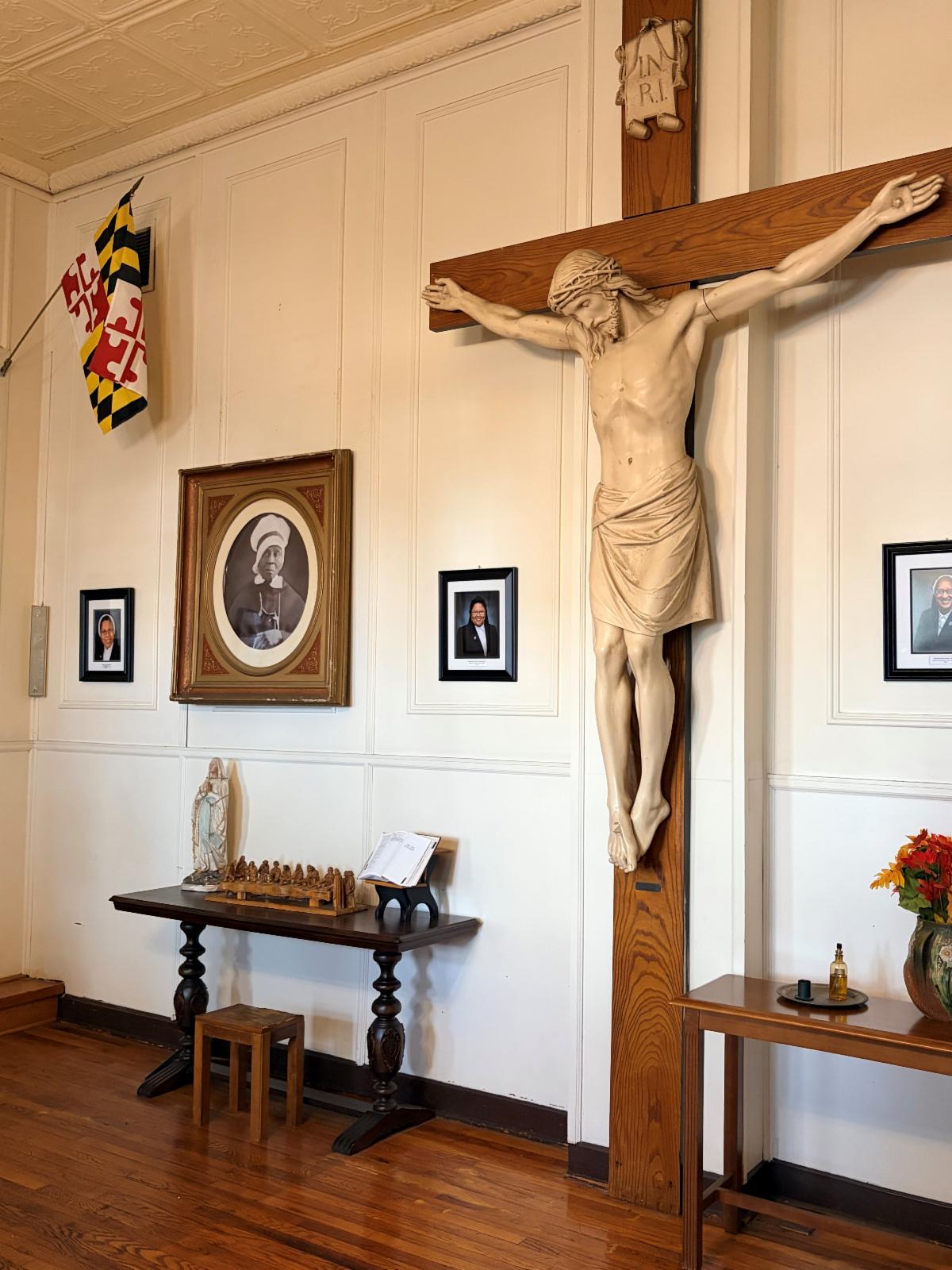
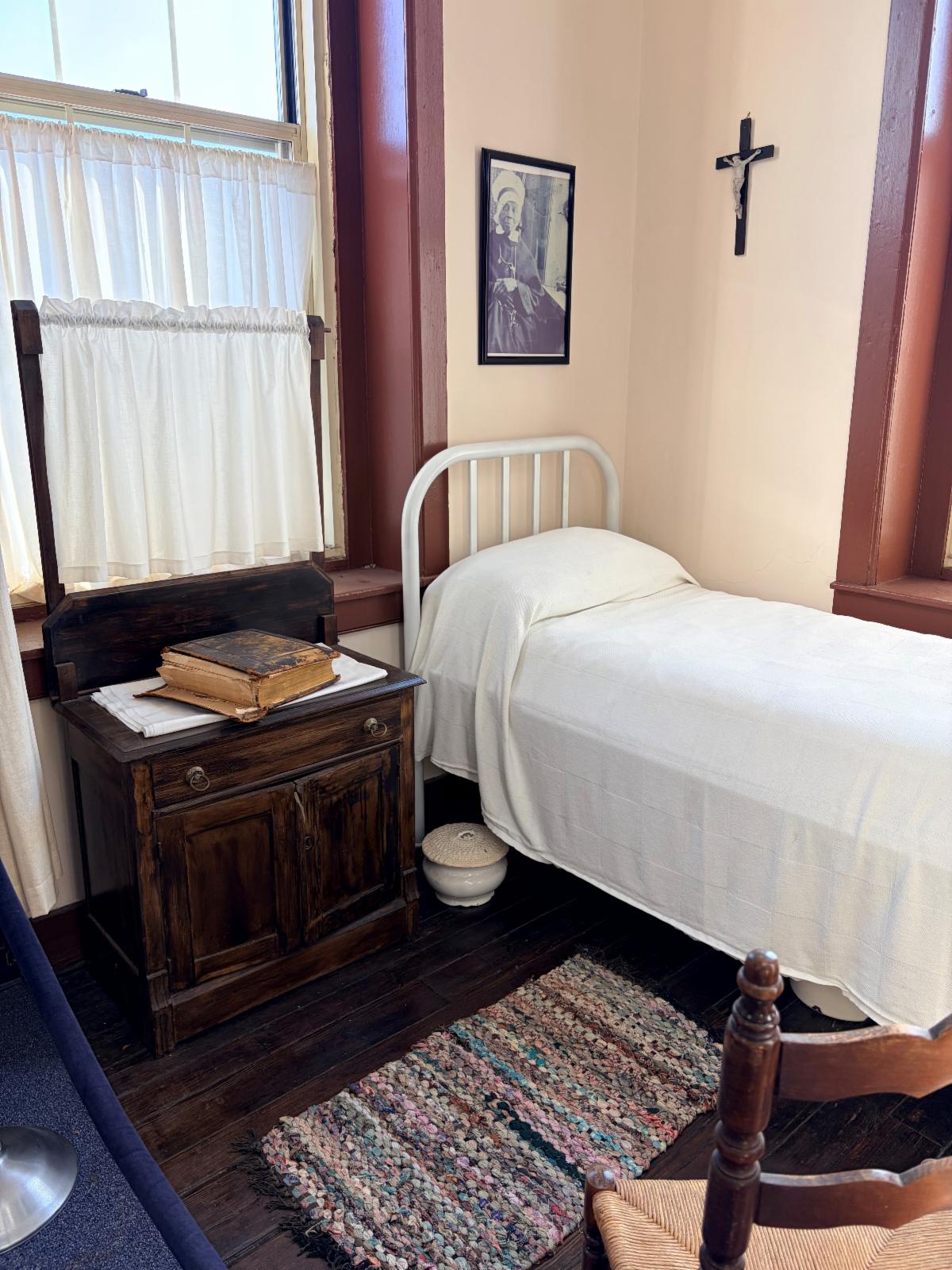
On our recent pilgrimage to learn more about Venerable Mary Lange, we first stopped at St. Frances Academy, entering the foyer you immediately can sense this is a special place. A gorgeous ceiling-high crucifix stands next to the portrait of Mother Mary Lange, hung under the Maryland state flag. Built in 1870, this was originally the fourth Motherhouse of the Oblate Sisters, and the place where Mother Mary Lange died in 1882. We climbed the stairs to Room 9, the exact “cell” where Mary Lange was given her last Eucharist, refusing pain medication in order to receive the Body of Christ. The Academy, which became co-ed in 1974, is named for Lange’s devotion to St. Frances of Rome. In the beautiful Chapel at St. Frances, students (who are called “scholars”), current and past, shared the impact that the Oblates Sisters of Providence have had on their lives. (I will also say that I was deeply impressed with the teens we encountered in the stairwells, who we surely made late to class as they politely waited for us to climb the stairs!)
| | |
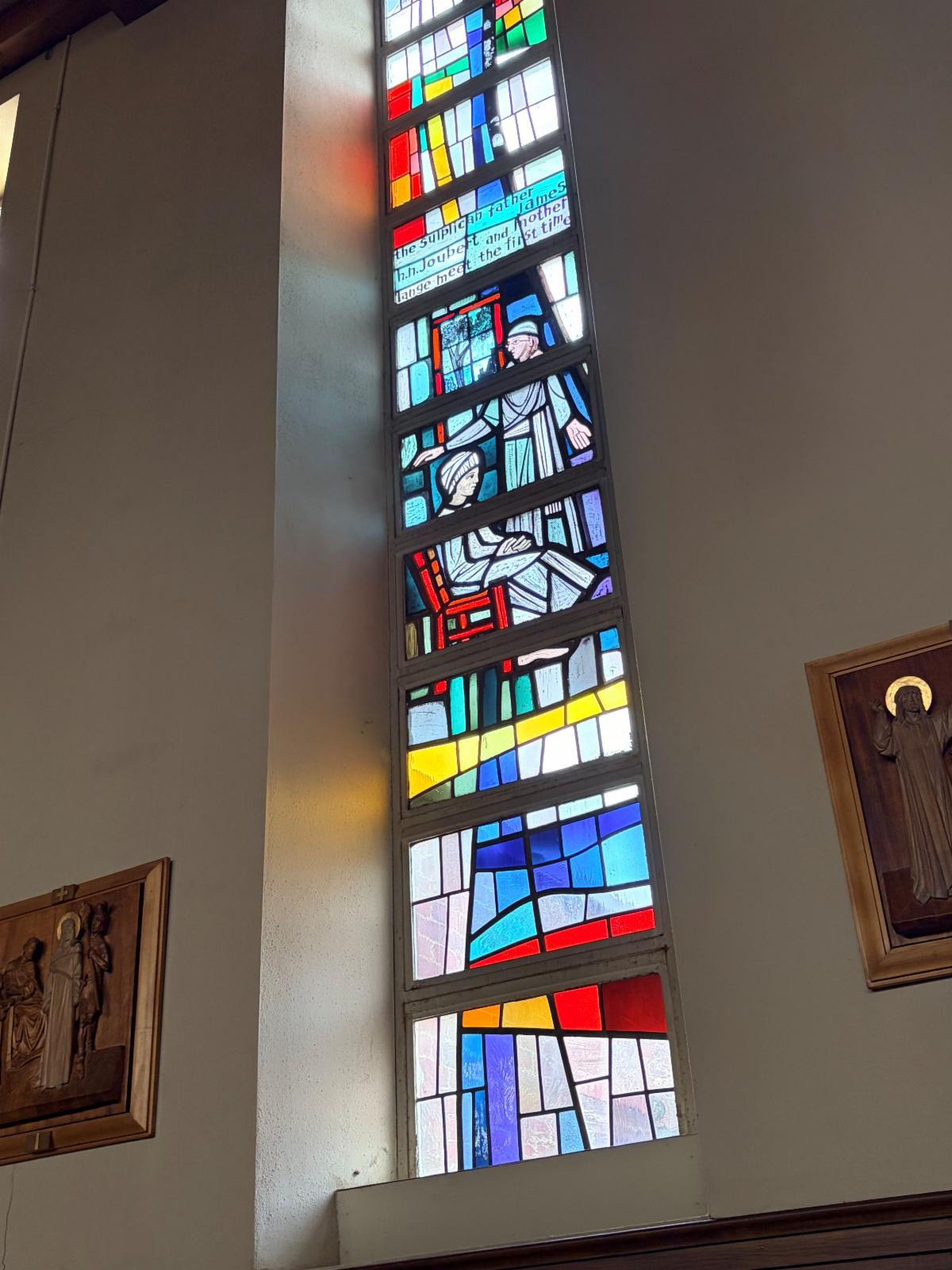
Next, we went to Our Lady of Mount Providence Convent, where the Oblate Sisters of Baltimore now live. We were delightfully welcomed to lunch with the Sisters and enjoyed some amazing fried chicken! Even better than the food was the company. I had the opportunity to sit and talk with Sister Magdala Marie Gilbert, OSP. At 95-years-old, she is the director of the Mother Lange Guild Board and writes their newsletter! She was delightful, full of love and energy surely inspired by Mother Mary Lange and their mission to serve with love. We were next invited to their Chapel featuring full-length stained-glass window telling the story of the Oblates Sisters of Providence from origin to present. Esther Sanders, lay associate of the Oblate Sisters, who graciously led our group the entire day, continued to walk us through the life of Mother Mary Lange and her legacy through the Gospel mission of the Oblate Sisters, using the stunning windows as a visual guide.
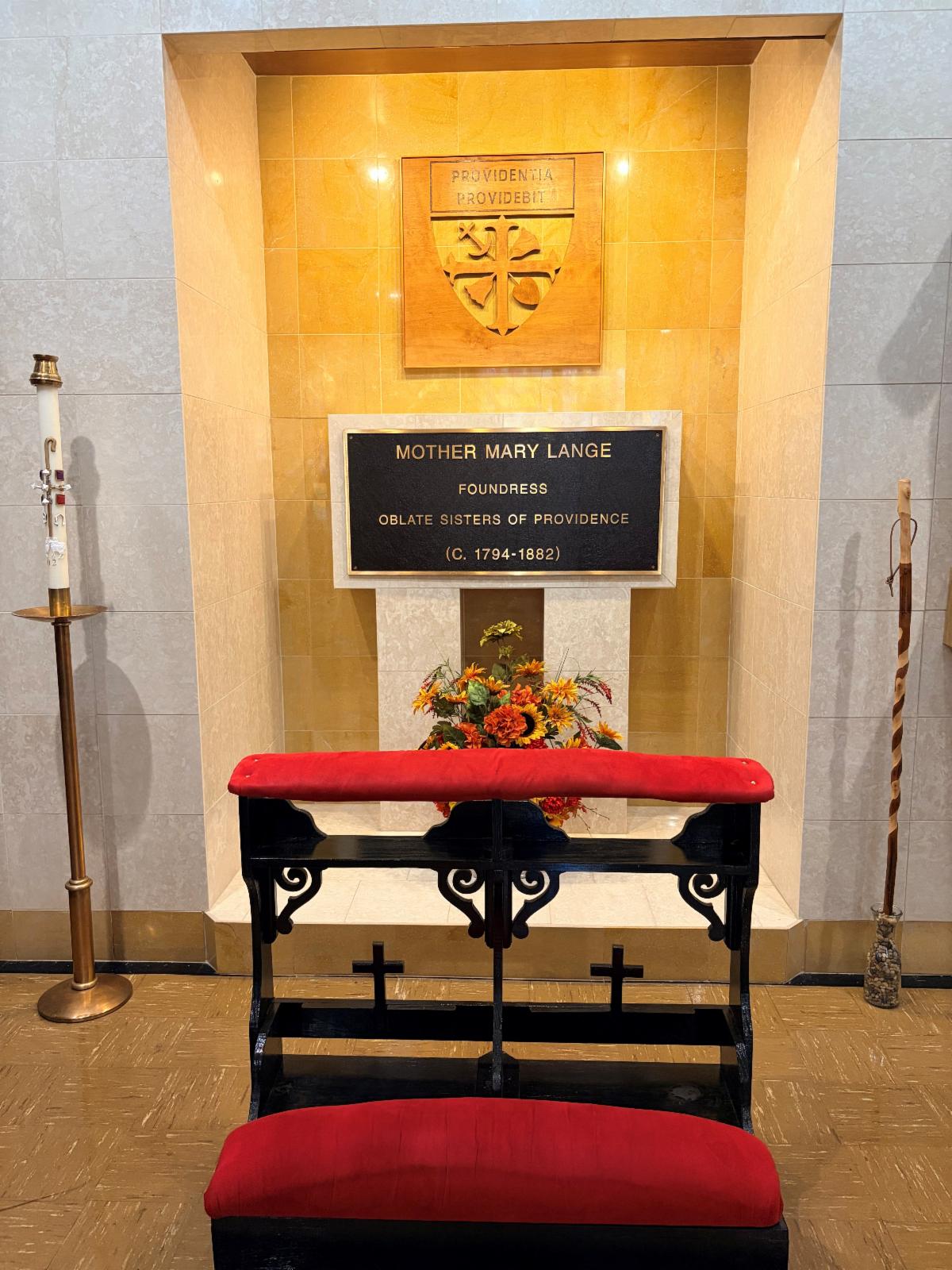
We ended our day in the Oratory, a small sacred space where the remains of Mother Mary Lange were entombed when they were moved from New Cathedral Cemetery in Baltimore on June 3, 2013. Together we prayed for the canonization of Venerable Mary Lange. It was a powerful day, enjoying the fellowship of other parishioners and the Sisters; I think we all came away with a better understanding of this fiercely courageous, radically loving, and bold woman of God. I look forward, with hope and prayer, to one day celebratimg her canonization.
Learn more about the cause for the canonization of Venerable Mary Lange.
On November 22, at the 9:30 a.m. Mass, Very Rev. Jamie Workman will celebrate Black Catholic History Month with us, followed by a reception in the Auditorium. Come join us for this special event. Additionally, visit the USCCB to download prayer cards for all the each of the Saintly Seven.
| | |
What do St. Pauline Visintainer, Patti LaBelle, and singer/heartthrob Nick Jonas all have in common? Diabetes. Diabetes can be a life-threatening disease if not recognized and well managed. This condition affects millions of Americans, many of whom don’t even know they have it. November is National Diabetes Month, a great time to talk about warning signs, but also appreciating that diabetes can be largely silent.
The CDC reports that approximately 40 million Americans have diabetes and more than one in four are unaware of it. Like hypertension, diabetes can cause years of damage before it is detected; high glucose levels cause inflammation and damage to the inner lining of blood vessels, which can lead to multiple health problems such as heart disease, stroke, kidney disease, nerve damage, wounds and infections, slow healing, visual problems, and possibly blindness. Blood glucose monitoring is one more important reason to schedule an annual appointment with your healthcare practitioner.
There is more than one type of diabetes, and the origin of all types is complex: it’s not just the consequence of consuming too much sugar and carbohydrates. Type I Diabetes (or IDDM, insulin-dependent diabetes) is an autoimmune disorder that destroys cells in the pancreas that produce insulin. Insulin is a hormone that converts blood sugar into usable energy and acts as a key that allows it to enter cells. Without insulin, glucose circulates through the body at high levels, causing life-threatening conditions such as diabetic ketoacidosis or DKA. DKA happens when the body breaks down fat cells instead of sugar for energy, producing large amounts of ketones. The signature sign of DKA is “fruity-smelling breath,” but one can also have rapid breathing, nausea, and confusion. Type I diabetics must have injectable insulin daily.
Type 2 Diabetes (or NIDDM, non-insulin-dependent diabetes) is the result of the pancreas being unable to produce enough insulin and/or the insulin not working correctly, a condition known as “insulin resistance.” Type 2 diabetics can take oral medications to help boost production, but some type 2 diabetics need injectable insulin as well. The risk for type 2 diabetes increases with age, family history, and decreased physical activity. Certain ethnic groups carry a higher potential for developing NIDDM, including African American, Latino, American Indian, Alaska Native, Asian American, and Pacific Islander heritage.
| |
Other types of diabetes include Gestational diabetes that develops in some women during pregnancy and usually resolves after delivery. Type 3c diabetes is the result of pancreatic damage from conditions such as pancreatitis, cystic fibrosis, and hemochromatosis, as well as surgical removal of the pancreas (pancreatectomy). Latent autoimmune diabetes in adults (LADA) is a slower form of the autoimmune version but often mistaken for type 2. LADA shares features of both type 1 and 2; Maturity-onset diabetes of the young (MODY) is the result of an inheritable genetic disorder; Neonatal diabetes, which can occur in babies before six months of age, may or may not become permanent; and Brittle diabetes, a form of Type 1 diabetes where the patient has broad swings of high and low blood sugar levels, often requiring hospital treatment and monitoring to regulate.
Prediabetes is a condition where the patient’s blood sugar is higher than normal, but not yet requiring medication. It happens when the body responds less effectively to insulin or doesn't make enough of it. Dietary and lifestyle changes can often reverse this condition, but blood glucose surveillance is often needed to detect it.
| |
A simple blood test called an A1C measures average blood sugar over the previous three months, giving a reasonably accurate picture of what is going on. A result below 5.7% is considered normal, 5.7-6.4% is prediabetes, and 6.5% or higher indicates diabetes. Diabetes is a serious health condition that affects not just your health, but also your quality of life. It is critically important, both short- and long-term, to be vigilant with detection, treatment, and monitoring.
This coming February, I have invited a Certified Diabetes Educator from St. John Neumann to share up-to-date clinical information about this disease, its signs, risks, and how to prevent it from progressing. Save the date: Sunday, February 21 at 3 p.m. for this health and wellness presentation, available in English and Spanish. There is so much we can do to mitigate damage from diabetes. Caring for our gift of health is a prayer of thanksgiving.
|
| |
Happy New Year!
by Elizabeth Connell Wright
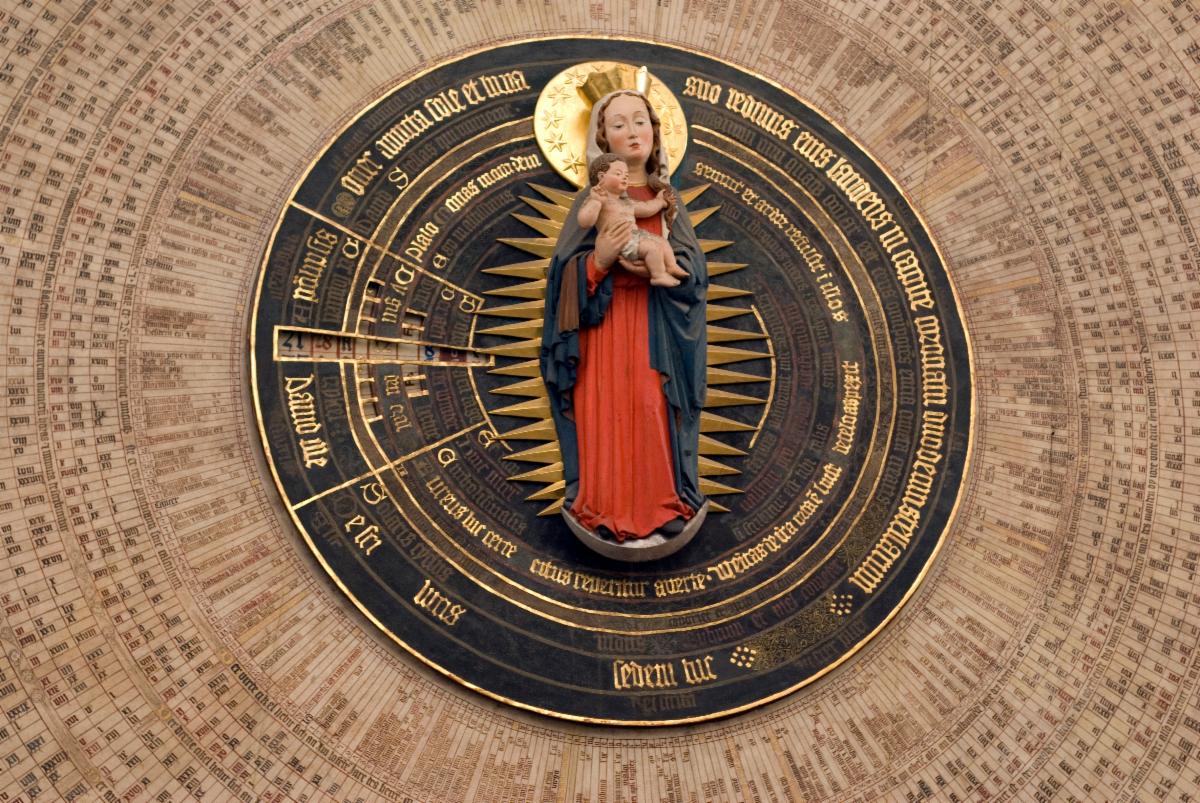
Many Catholics live their lives in sync with the liturgical calendar. The rhythm of the cycle, which can feel second nature to many of us “cradle Catholics,” guiding us in our personal relationship with Christ, influencing our worship and reflection as the liturgical practices and readings bolster our spiritual lives. This is to be expected as the liturgy is also in sync with the movements of our natural world, which is why the Church continues to seek knowledge of the universe through the Vatican Observatory and many other scientific initiatives. In 2011, Pope Benedict XVI reminded the faithful that the Church has used it keen observations and study of astronomy to establish liturgical days, calendars, and even prayer times. Each November, we conclude one year (This month, we conclude Year A.) and begin a new liturgical year (Year B). Much of what we liturgically celebrate and observe continues from the early Church, but like anything that is over 2000 years old, there have been enlightened updates and informed improvements along the way.
| |
On November 22, the last Sunday of the liturgical year, we will celebrate the Solemnity of Our Lord Jesus Christ, King of the Universe, “Christ the King.” A relatively very young feast day, Christ the King was instituted by Pope Pius XI’s encyclical, Quas Primas (In the First) on December 11, 1925. Initially, it was observed, as directed by Quas Primas, “on the last Sunday of the month of October.” The encyclical was intended as a reminder that Christ is King of the Universe in the aftermath of World War I and a time when, according to the encyclical, “the majority of men had thrust Jesus Christ and his holy law out of their lives.”
In his apostolic letter, Mysteri Paschalis (Paschal Mystery) on February 14, 1969, Pope Paul VI promulgated the General Roman Calendar of 1969, our current liturgical calendar, and as part of a new ranking and order of liturgical celebrations, Christ the King was renamed “Our Lord Jesus Christ, King of the Universe” and moved to the last Sunday of the liturgical year. It seems fitting to me that Christ the King (as many still call the feast) stands in the gap that concludes one year and ushers in a new. As Quas Primas originally said, “Do we not read throughout the Scriptures that Christ is the King? He it is that shall come out of Jacob to rule, who has been set by the Father as king over Sion, his holy mount, and shall have the Gentiles for his inheritance, and the utmost parts of the earth for his possession.” The feast simultaneously punctuates the liturgical cycle we are completing and serves as an introduction for the following year.
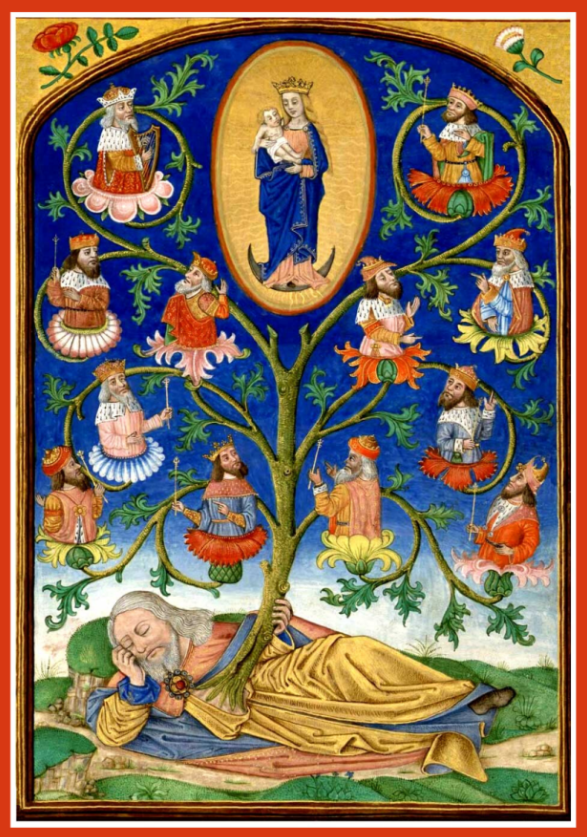
As we move into Advent the following Sunday, my family, like many, begins the ancient tradition of the Jesse Tree. Celebrating the genealogy of Christ Jesus leads us on the journey of salvation history, profoundly preparing our hearts for the birth of our Savior as we are reminded of the origin of the covenant. While it is easy and certainly also alluring to jump on the bandwagon of commercial Christmas, the beautiful discipline of immersing in salvation history and solidly embracing the preparation for the Light of Christ is a joy that cannot be matched by the glittering gifts of this world.
| |
Throughout Advent, we hope for Christ, and from the early Church, this period has been a period of penitential fasting and waiting. While today, we primarily baptize people into the Church at the Easter Vigil, in the early Church, baptisms were held on Epiphany as well, and the Advent season served as a time to prepare. In the first Sunday of Advent Gospel this year, Jesus tells his disciples, “Be watchful! Be alert!” (Mark 13:33) This is a theme for most of the first three weeks of Advent: we watch Jesus’ ministry, and John the Baptist reminds us that, “I am the voice of one crying out in the desert, ‘make straight the way of the Lord,’ as Isaiah the prophet said.”
It isn’t until December 18 that we reflect on the lineage of Jesus — the men and women (yes, there are four women named in Jesus' genealogy: Tamar, Ruth, the wife of Uriah (Bathsheba), and Mary) who were woven into the ancestry of the covenant. Now, we liturgically begin to focus on the messianic hope, and we are calling Christ to “come.” The “O” Antiphons, recited December 17-23, have been part of our liturgical preparation from at least the eighth century. The “O” Antiphon (because they each begin with “O”) are proclaimed in the Alleluia before the Gospel reading. On December 23, we conclude the antiphons declaring, “O Emmanuel, our King and Giver of Law: come to save us, Lord our God.” Our time of waiting ends and we celebrate Christmas on December 25. There is no clarity of how or when December 25 officially became Christmas, only that by 350 the Church of Rome had universally adopted December 25 as the celebration of the Lord’s birth. As it is for many Christian holidays, and Jewish observances before them, there is surely a pagan influence or foundation. The Winter Solstice has long been celebrated as the return to light, so it is fitting that this time would be sanctified as a time to celebrate the birth of Christ, Light of the World.
| |
On Christmas day, we celebrate the Nativity of the Lord and begin the “Twelve Days of Christmas,” December 25-January 5; the first eight of these days are the Christmas Octave, beginning on Christmas and ending on the Solemnity of Mary the Mother of God, January 1. On January 6, we celebrate the Epiphany, marking the manifestation of the divinity of Christ. The Sunday that follows Epiphany is the Baptism of the Lord, which concludes the Christmas liturgical season.
As the Christmas season ends, we return to Ordinary Time (the first of two seasons of Ordinary Time in a liturgical year), which lasts until Ash Wednesday. During this time, the Lectionary of the Church narrates the life of Christ calling us to conversion. The first season of Ordinary Time in the liturgical year can be as short as a few weeks (ending on the earliest date for Ash Wednesday of February 4) or as long as a couple months (ending on the latest date of March 10).
On Ash Wednesday we begin the 40-day Lenten season (In the West, Sundays are not counted, so 46 days from Ash Wednesday to Holy Thursday minus six Sundays equals the forty days), which has been observed since at least the early 4th century. Lent is a penitential season of fasting, prayer, and almsgiving. In the Lectionary, we hear Jesus’ temptation in the desert, calls to conversion of hearts, stories of Jesus’ public ministry, and Jesus’ journey to Jerusalem. Entering Holy Week, which begins on Palm Sunday, we commemorate the Passion of Christ. The Triduum marks the three-day pinnacle of the Church’s liturgical calendar as we embrace our Church's summit: the Paschal Mysteries. Celebrated since the early 4th century, Triduum begins the evening of Holy Thursday with the Mass of the Lord’s Supper, continues through Good Friday and the Easter Vigil to conclude on Easter evening when we enter the 50-day Easter season.
|
| |  | Early Christians didn’t just stop celebrating their feast of Passover with the Resurrection of Christ. Rather their Jewish roots and traditions transformed into new Christian celebrations. Passover is the first full moon after the Spring Equinox, while Easter is the first Sunday after the first full moon after the Spring Equinox. In most languages, the word for Easter is essentially Passover. (The Spanish word is Pascua, in French it is Paques, in Italian Pasqua, etc.) In English, however, the word “Easter” has no relation to the word “Passover.” No one really knows the origin, but of course there are theories that it has to do with a pagan goddess, but it also could be as simple as the fact that “east” means rising, and Easter is the celebration of the Resurrection of the Lord. Keeping in line with the eight-day feasts of Jews, the Easter Octave begins with Easter, and each day of the Octave is a Solemnity. In the early Church, it was called “White Week” because the newly baptized wore white as they continue to receive instruction during mystagogy. On the 50th day after Easter, we rejoice in the Holy Spirit at our Pentecost celebration.
After Pentecost, which can be May or June dependent on the Easter date, we begin the longer of our two seasons of Ordinary Time. While the name suggests otherwise, this is a significant time in the Church. According to the USCCB, “Ordinary Time is a time for growth and maturation, a time in which the mystery of Christ is called to penetrate ever more deeply into history until all things are finally caught up in Christ. The goal, toward which all of history is directed, is represented by the final Sunday in Ordinary Time, the Solemnity of Our Lord Jesus Christ, King of the Universe.” As we celebrate Christ the King this month, closing out Year A and welcoming Year B, take a moment to check your internal clock and continue to sync it with the liturgy, guiding your own spirituality and relationship with Christ, just as the Church has throughout the Scriptural history of salvation. Happy New Year!
One of the sources used for this article dives even deeper into our liturgical calendar:
Click here to learn more.
| | |
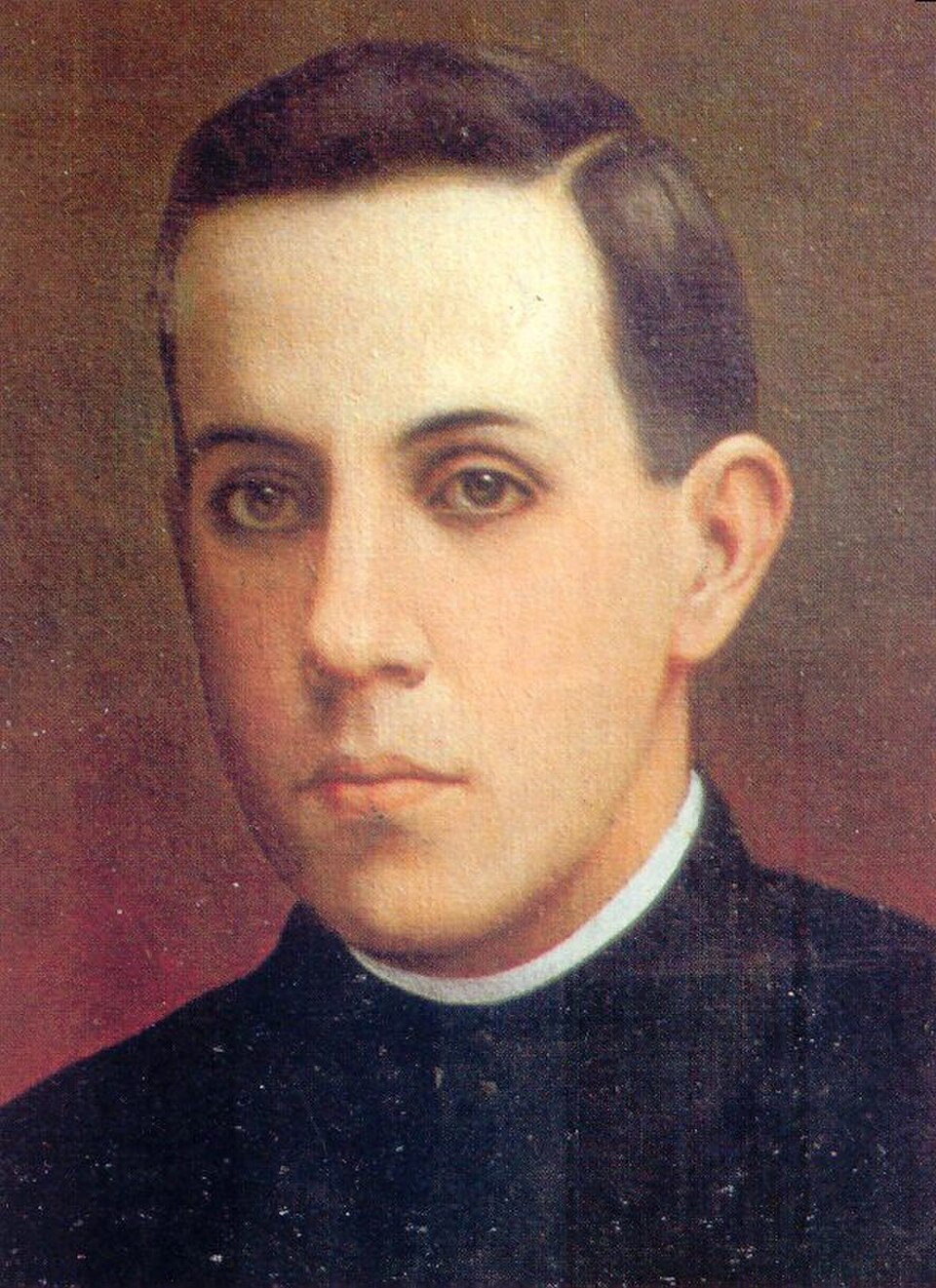
Blessed Miguel Agustin Pro
by Elizabeth Connell Wright
In 1928, St. José Sanchez del Rio, a flagbearer in the Cristero War was captured and viciously tortured when he refused to renounce his Catholic faith. Just before being executed, the 14-year-old famously shouted, “¡Viva Cristo Rey!” (Long live Christ the King!) Less than three months earlier, Jesuit priest, Fr. Miguel Augustin Pro had met a similar fate, and his battle cry was an inspiration for the faithful across Mexico.
Born on January 13, 1891, Miguel was the third of eleven children. On August 15, 2011, Pro began a Jesuit novitiate; that same year, the Mexican Revolution began. With the instability of the government accompanied by the rising of anti-Catholicism, the Jesuits left the country. For the next four years, Pro continued his Jesuit studies in Spain before going to Nicaragua to teach from 1919-1922. His studies continued with the French Jesuits in Belgium, where he was ordained a priest on August 31, 1925.
During his formation in other countries, Mexico continued to spiral deeper into anti-Catholic persecution. The Mexican Constitution of 1917 contained multiple articles intended to crush the power and influence of the Catholic Church in Mexico. Among other things, clergy were stripped of their right to vote, the Church lost the right to own any property, religious celebrations and sacraments were under strict government monitoring, and Catholic education was outlawed. In the beginning, the provisions were not strictly enforced, but in 1924, Plutarco Elias Calles, became president of Mexico. Fiercely anti-Catholic, Calles signed a new law in 1926, known as the Calles Law, which enforced all the constitutional articles to oppress Catholics.
| |
On July 8, 1926, Pro returned to Mexico, and three weeks later, with the support of Pope Pius XI, Mexican bishops suspended all religious activities requiring a priest, particularly Mass and sacraments. Their logic was that this would increase pressure on Calles to loosen the restrictions he had imposed on the faithful. Unfortunately, their thinking proved desperately wrong. Catholic persecution by the government escalated, and Catholics and their sympathizers responded with armed rebellion.
Just being a priest put Fr. Miguel Pro in extreme danger. Nonetheless, he secretly celebrated the Mass and administered sacraments in clandestine locations, even in disguise, and would sign letters and documents with his childhood nickname, Cocol. Under suspicion and surveillance by Calle’s radical government, Pro had once been arrest but released unharmed. However, in November 1927, someone threw a bomb into the car of Mexican General Alvaro Obregón. A car that was previously owned by one of Pro’s brothers was seen fleeing from the scene of the attempted assassination. Pro and his brothers, Humberto and Roberto, were detained in Mexico City and both Miguel and Humberto were condemned to death.
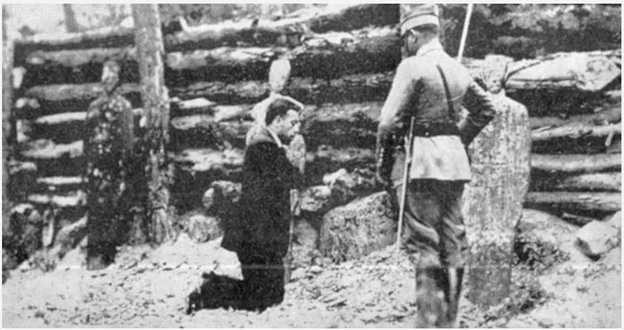
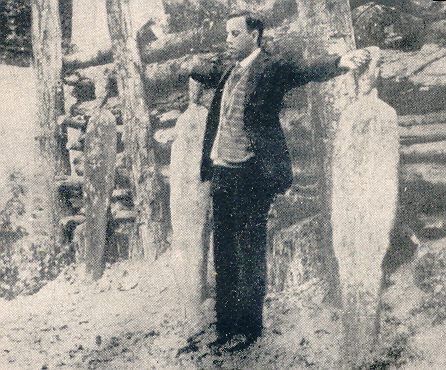
| On November 23, 1927, Fr. Miguel Pro blessed the soldiers lining his path as he was lead to his execution. He knelt quietly to pray before refusing a blindfold and outstretching his arms to in imitation of the crucified Christ. He clutched a crucifix in his right hand and a rosary in his left as he was martyred. Just before the firing squad was ordered to open fire, Fr. Miguel Pro shouted, “¡Viva Cristo Rey!” This became the battle cry of the Catholic rebels known as Cristeros. Embracing the new liturgical feast of Christ the King, the oppressed of Mexico united themselves with the Church faithful despite the widespread and cruel oppression they faced in their own country. | |
Believing they would serve as a warning to other Catholic rebels, the Mexican governments invited media to photograph the execution of Fr. Miguel Pro. The photos were printed in national newspapers across Mexico, but it did not strike fear into the people. Rather, their cause was emboldened by the martyrdom of Fr. Pro. Over 30,000 gathered for his funeral procession, and Cristeros were known to carry the newspaper cut-outs of Pro with his arms in the shape of a cross as inspiration. As his coffin was carried through Mexico City, the usual somber demeanor of a funeral was replaced by chants of “¡Viva Cristo Rey!”
On June 21, 1929, the Cristero War ended with a peace agreement between the Mexican government and Church representatives. While the agreement formalized the loosening of anti-Catholic enforcement, the Mexican Constitution was not amended to removed the articles until January 28, 1992. Following the amendments, the Vatican restored full diplomatic ties with Mexico.
Fr. Miguel Pro was beatified by Pope John Paul II on September 25, 1988. Upon his beautification, Pope John Paul II said, “The daily celebration of Holy Mass was the center of his life, as well as a source of strength and fervor for the faithful. Father Pro had organized the so-called “Eucharistic stations” in particular homes, where the Body of the Lord could be secretly received daily during the years of persecution.” His dedication to the Eucharist, along with his courage, remain an inspiration to Catholics. His feast day is November 23, the day after we will celebrate the Solemnity of Christ the King.
|
|
Giving Thanks
by O. Eugene Pickett
For the expanding grandeur of creation, worlds known and unknown, galaxies beyond galaxies, filling us with awe and challenging our imaginations: We give thanks this day.
For this fragile planet earth, its times and tides, its sunsets and seasons: We give thanks this day.
For the joy of human life, its wonders and surprises, its hopes and achievements:
We give thanks this day.
For our human community, our common past and future hope, our oneness transcending all separation, our capacity to work for peace and justice in the midst of hostility and oppression:
We give thanks this day.
For high hopes and noble causes, for faith without fanaticism, for understanding of views not shared: We give thanks this day.
For all who have labored and suffered for a fairer world, who have lived so that others might live in dignity and freedom: We give thanks this day.
For human liberty and sacred rites; for opportunities to change and grow, to affirm and choose:
We give thanks this day.
We pray that we may live not by our fears but by our hopes, not by our words but by our deeds.
We give thanks this day.
| | |
The Pope's Intention for
Prayer and Action for November:
For the proper use of wealth.
Let us pray for the proper use of wealth, that no succumbing to the temptation of selfishness, it may always be put at the service of the common good and solidarity of those who have less.
| | | |
Current Mass Times
Saturday: 5 p.m.
Sunday: 7:30 a.m., 9:30 a.m., 11:30 a.m., 2 p.m. (Spanish), 5 p.m.
Monday-Friday: 9 a.m.
Wednesday and Friday: 12:10 p.m.
Watch a livestreamed or recorded Mass
Confession
Saturday: 10 a.m.-10:30 a.m. (English)
Sunday: 3 p.m.- 4 p.m. (Spanish)
| | | Elizabeth Connell Wright, Communications Director, is the editor of SJN's monthly newsletter. If you are interested in submitting an article to the newsletter or have a topic that you would love to see an article written about, please email ewright@saintjn.org. Thank you for reading our monthly newsletter! | | | | |