|
If you would like to listen to the Defense and Critical Technologies Weekly Update, click here!
| | |
As Washington, D.C., contends with a winter storm disrupting congressional travel, the Senate returns this week with just four days remaining before the Fiscal Year 2026 continuing resolution expires. The six-bill FY26 appropriations package passed by the House last week now faces significant uncertainty in the Senate following a fatal shooting in Minneapolis involving a federal Immigration and Customs Enforcement agent. Prior to the incident, the package was widely expected to clear the upper chamber with limited resistance. The shooting has sharply altered the political environment, particularly around Department of Homeland Security funding, and has reopened the possibility of a government shutdown ahead of the January 30 funding deadline.
The House approved the final set of appropriations measures needed to complete the fiscal year 2026 process, covering Defense, Labor-Health and Human Services-Education, Transportation-Housing and Urban Development, Homeland Security, Financial Services and General Government, and State and Foreign Operations. House leaders structured the legislation so that the recently passed four-bill package would be combined with the two-bill Financial Services and State and Foreign Operations package, allowing the Senate to act on all six bills in a single vote.
That plan now appears at risk. Senate Minority Leader Chuck Schumer (D-NY) released a statement over the weekend announcing that Democrats will not provide the votes necessary to proceed to the appropriations package if it continues to include full-year DHS funding. One option under discussion would remove the Homeland Security bill from the package and advance the remaining five bills, while funding DHS through a continuing resolution. However, any change to the six-bill package would require another House vote, and the House has adjourned until February 2. Recalling members would be procedurally difficult and logistically challenging, particularly given weather-related travel disruptions.
Absent Senate passage of the current minibus, funding for most federal agencies will likely lapse at the end of the week. While Senate leaders have previously emphasized a desire to avoid another shutdown, the current standoff over DHS funding has made that outcome increasingly plausible.
A shutdown would severely impact the Department of War. Roughly 700,000 civilian Pentagon employees would be furloughed, while active-duty military personnel would continue working without pay until funding is restored. Reservist training would be curtailed, and many non-essential activities, such as temporary duty travel, would cease. Although new contracts and programs would be halted, the Department could still issue task orders under existing contracts to support activities deemed necessary for safety, property protection, or national security. Still, the inability to fund new starts could waste resources, stall critical programs, and delay the delivery of new capabilities. However, if a shutdown occurs, it is likely to be brief, given bipartisan support for funding Defense and most of the broader appropriations package (The three-bill Defense, Transportation-HUD, and Labor-HHS-Education package passed the House with 341 votes), with DHS remaining the primary point of contention.
Over the weekend, the Department of War released the 2026 National Defense Strategy. The NDS follows the 2025 National Security Strategy (NSS) released by the Trump administration last month and details how the Department will implement the NSS’s priorities, including a greater focus on the Western Hemisphere.
The NDS highlights four lines of effort to achieve the administration's goal of “restoring peace through strength.” The foremost priority for the Department will be defending the U.S. Homeland, including by defending America’s interests throughout the Western Hemisphere. The Biden Administration’s 2022 NDS prioritized defending the homeland primarily through the lens of competition with China. This shift in focus is consistent with the Trump Corollary to the Monroe Doctrine. The second line of effort focuses on deterring China in the Indo-Pacific through strength rather than confrontation, followed by efforts to increase burden-sharing with U.S. allies and partners and to supercharge the U.S. defense industrial base. Together, these priorities will shape defense policy, planning, and investment decisions across the Department under the current Trump administration (More on this below).
| |
Upcoming Hearings of Note
Senate Armed Services Committee
- 01/28/2026 – Cybersecurity Subcommittee: To receive testimony on the Department’s cyber force generation plan and the associated implementation plan
Senate Committee on Veteran Affairs
- 01/28/2026 – Full Committee: Building a 21st Century VA Health Care System: Assessing Efforts to Restructure the Veterans Health Administration
Senate Committee on Foreign Relations
- 01/28/2026 – Full Committee: To examine U.S. policy towards Venezuela.
- 01/29/2026 – Full Committee: Business Meeting
- Nominations:
- Frank Weiland to be an Assistant Secretary of State (International Narcotics and Law Enforcement Affairs)
- Jennifer Wicks McNamara to be Ambassador to the Socialist Republic of Vietnam
- Eric Meyer to be Ambassador to the Democratic Socialist Republic of Sri Lanka
- Gregory LoGerfo to be Coordinator for Counterterrorism
- Legislations:
- H.R.260, - No Tax Dollars for Terrorists Act
- S.2904, - SHADOW Fleet Act
- S.2722, - Taiwan Energy Security and Anti-Embargo Act, with an amendment in the nature of a substitute
- S.3496, - U.S. Legal Gold and Mining Partnership Act
- S.3018, - Taiwan Symbols of Sovereignty
- S.2222, - Taiwan Undersea Cable Resilience Initiative Act, with an amendment in the nature of a substitute
- S.3249, - Strategic Subsea Cables Act, with an amendment in the nature of a substitute
- S.2252, - Saving Lives and Taxpayer Dollars Act
- S.3360, - FREEDOM Act
- S.1216, - Taiwan Allies Fund Act, with an amendment in the nature of a substitute
- S.1369, - Protecting Global Fisheries Act, with an amendment in the nature of a substitute
- S.2236, - YALI Act, with an amendment in the nature of a substitute
Senate Commerce, Science, and Transportation Committee
- 01/27/2026 – Telecommunications and Media Subcommittee: Evaluating Progress, Reauthorization of the Federal Public Safety Communications System
- 01/29/2026 – Coast Guard, Maritime, and Fisheries Subcommittee: Evaluating Progress After Historic Investments in the U.S. Coast Guard
Senate Select Committee on Intelligence
- 01/27/2026 – Full Committee: To examine the nomination of Lieutenant General Joshua M. Rudd, USA, to be Director of the National Security Agency.
Senate Committee on Small Business and Entrepreneurship
- 01/28/2026 – Full Committee: From Fraud to Recovery: Restoring Integrity in Small Business Programs
Please let us know if you would like to receive a summary of these hearings.
| | | The Trump Administration Releases the 2026 National Defense Strategy | | |
On Friday, the Department of War released the 2026 National Defense Strategy (NDS), mapping how DoW intends to execute the priorities outlined in the National Security Strategy, published in December of last year. The NDS opened with a foreword from Defense Secretary Pete Hegseth, which contextualized the NDS’s priorities as a means to deliver on the ‘America First’ doctrine, enhance ‘warrior ethos,’ and enable ‘Peace Through Strength.’ To do so, the NDS states four Lines of Effort: Defend the U.S. Homeland; Deter China in the Indo-Pacific Through Strength, Not Confrontation; Increase Burden-Sharing with U.S. Allies and Partners; and Supercharge the U.S. Defense Industrial Base.
Defend the U.S. Homeland: In alignment with the antecedent NSS, the first Line of Effort aims to reinstitute the Monroe Doctrine, including its Trump Corollary, and reassert dominance in the Western Hemisphere through border security efforts and maritime and aerial defense postures. Additionally, the NDS states that U.S. military and commercial access to key terrain is essential to National Security, especially in Greenland, the Gulf of America, and the Panama Canal. Modernizing the U.S. nuclear force and advancing cyber deterrence are also emphasized.
Expanding on the need for U.S. aerial superiority, the NDS says that efforts will be made to develop Golden Dome for America, “with a specific focus on options to cost-effectively defeat large missile barrages and other advanced aerial attacks. In addition, DoW will develop and deploy capabilities and systems to counter unmanned aerial systems,” and provide effective electromagnetic spectrum to U.S. forces.
Deter China in the Indo-Pacific: The NDS deterrence strategy toward China takes a conciliatory tone, promoting military-to-military communications with the People’s Liberation Army (PLA) and de-escalation in the Indo-Pacific. Secretary Hegseth states that the objective is not to dominate China but to prevent any adversary, including China, from dominating the U.S. Accordingly, the NDS directs the erection of a denial defense strategy along the First Island Chain. The document explains denial defense will work as a means to “make clear that any attempt at aggression against U.S. interests will fail and is therefore not worth attempting in the first place.” This line of effort includes incentivizing key regional allies and partners to assume greater responsibility in deterrence efforts and collective security.
Increase Burden-Sharing with U.S. Allies: This intention is extended to key partners outside of the Indo-Pacific, as the NDS shifts American focus toward Homeland defense and deterrence of China, allies across the globe are called on to contribute more to managing regional conflicts. The document states that, “allies will take the lead against threats that are less severe for [the U.S.] but more so for them, with critical but more limited support from the United States.”
The NDS calls for greater support from Western Hemispheric powers to contribute to counterterrorism and border security efforts; it asserts that European allies should take primary responsibility for their security vulnerabilities; and encourages regional partners in the Arabian Gulf to effectively defend against Iran and its proxies by building upon the Abraham Accords. Additionally, the NDS states that, going forward, South Korea will be primarily responsible for deterring North Korea; this statement follows multiple reports that the U.S. may reduce its presence in the Korean Peninsula. The U.S. role, as asserted by the NDS, is to incentivize and enable partners to take these actions.
Supercharge the U.S. Defense Industrial Base: The final Line of Effort given by the NDS is framed as being essential to the success of the first three. To secure the DIB, the DoW will “bolster [its] organic sustainment capabilities, grow nontraditional vendors, and partner with traditional DIB vendors, Congress, [its] allies and partners, and other federal departments and agencies to reinvigorate and mobilize our great nation’s unrivaled creativity and ingenuity, re-spark our innovative spirit, and restore our industrial capacity.”
In contrast with previous iterations, the 2026 National Defense Strategy places increased emphasis on greater burden-sharing by allies and the accelerated development of the U.S. defense industrial base. The strategy also reflects a rebalancing of priorities: Europe is less central than in past strategies, while the approach toward the People’s Republic of China places greater emphasis on deterrence and de-escalation rather than confrontation. The NDS seeks to limit U.S. support to NATO, fueling concern over U.S. defense commitments. While the strategy’s assertive framing may introduce uncertainty among some partners, it also signals a recalibration of Department of War priorities toward homeland defense, regional responsibility-sharing, and industrial capacity building in line with the Trump Administration’s ‘America First’ ideology.
The ‘National Defense Strategy 2026’ can be viewed HERE.
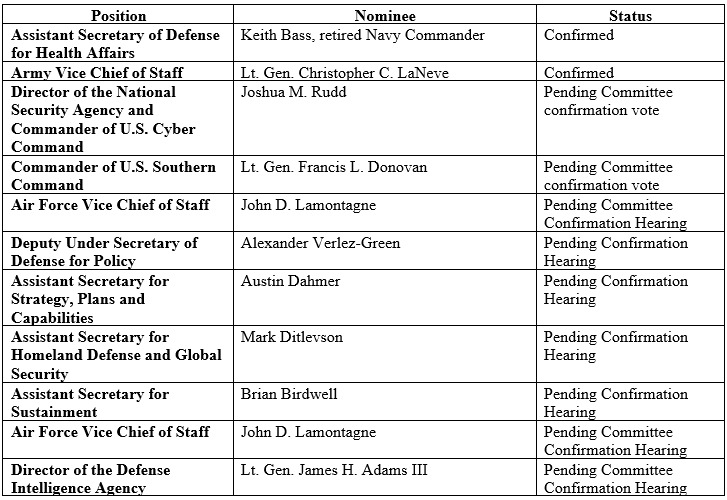
| | Department of War Nomination Tracker | |
Recommended Defense Articles
| | |
White House Golden Dome delays ‘frustrating’ to key lawmaker (Military Times 1/23)
“Rep. Jeff Crank believes in the ‘Golden Dome’ missile defense shield proposal — but worries that the U.S. risks missing its moment to pull it off as Congress awaits a blueprint from the White House. Crank, a Colorado Republican, launched the House Golden Dome Caucus last June with Rep. Dale Strong, R-Ala., saying the caucus would serve as an “educational clearinghouse” for lawmakers and staff seeking to understand the ambitious initiative and network better with the military and industry. He stressed that keeping to the ambitious game plan — that would have a prototype of the system ready by the end of 2028 — was critical to the success of the whole endeavor. ‘Golden Dome will only be successful if we meet President Trump’s timeline,’ Crank said in a statement at the time.”
FY26 defense bill boosts budget by $8B, largely bypassing last-minute $28B munitions request (Defense News 1/20)
“House and Senate appropriators have agreed on an $838.7 billion defense topline for fiscal 2026 in a bipartisan deal that would boost defense funds by $8.4 billion over the Pentagon’s request. But they declined to include tens of billions of dollars for additional requests made by the department in recent months. Since the Defense Department released its budget request last June, it identified more than $50 billion in what it said were additional funding needs.”
House Rejects Measure to Bar Military Force in Venezuela (The New York Times 1/22)
“The House on Thursday just barely defeated a resolution that would have barred President Trump from taking further military action in Venezuela without congressional approval, weeks after he ordered a raid there without consulting or winning approval from lawmakers. The measure failed in an unusual tie vote of 215 to 215, with two Republicans crossing party lines in favor. It was the third unsuccessful attempt in the House to rein in Mr. Trump’s war-making authority since his administration began striking boats in the Caribbean and Pacific oceans in September.”
Navy’s future fighter jet program revived in new funding bills (Defense One 1/20)
“Congressional appropriators have revived funding for the Navy’s F/A-XX program and lambasted the Defense Department for failing to award key development contracts for the service’s sixth-generation fighter jet. While the program was designated to get just $74 million by the National Defense Authorization Act signed into law last month, appropriators moved to give it another $897 million in a four-bill package, including the annual defense appropriations bill, on Tuesday.”
U.S. Weighs Complete Military Withdrawal From Syria (The Wall Street Journal 1/22)
“Washington is considering a complete withdrawal of American troops from Syria, U.S. officials said, as Syrian President Ahmed al-Sharaa moved to wrest control of the northeastern part of the country from an American-backed Kurdish-led militia. The move would end a decadelong American operation in Syria, which began in 2014 when former President Barack Obama intervened in the country’s civil war. It would come as Sharaa’s government has ordered the U.S. military’s longtime partner in the region, the Kurdish-led Syrian Democratic Forces, to disband after a lightning offensive over the weekend that led the militia group to all but collapse.”
Trump Seeks ‘Decisive’ Options for Iran as Assets Move Into Middle East (The Wall Street Journal 1/20)
“After pulling back from strikes on Iran last week, President Trump is still pressing aides for what he terms “decisive” military options, U.S. officials said, as Iran appears to have tightened its control of the country and targets protesters through a crackdown that has killed thousands. The discussions are happening while the U.S. sends an aircraft carrier and jet fighters to the Middle East. Those deployments may be the start of a broader buildup that would give Trump the firepower to strike Iran should he choose to use them.”
The U.S. Is Actively Seeking Regime Change in Cuba by the End of the Year (The Wall Street Journal 1/22)
“Emboldened by the U.S. ouster of Venezuelan President Nicolás Maduro, the Trump administration is searching for Cuban government insiders who can help cut a deal to push out the Communist regime by the end of the year, people familiar with the matter said. The Trump administration has assessed that Cuba’s economy is close to collapse and that the government has never been this fragile after losing a vital benefactor in Maduro, these people said. Officials don’t have a concrete plan to end the Communist government that has held power on the Caribbean island for almost seven decades, but they see Maduro’s capture and subsequent concessions from his allies left behind as a blueprint and a warning for Cuba, senior U.S. officials said.”
Op-Ed: “The National Commission on the Future of the Navy: The time is now” by Mackenzie Eaglen, Filemon Vela, and Benjamin Jensen (Breaking Defense 1/21)
“For the first time since the Second World War, the United States faces a peer naval rival able to challenge American control of the seas and global trade. The Chinese Communist Party has spent a generation building a fleet that can contest sea control and turn industrial scale into military power. Its rapid naval buildup, combined with dominance in commercial shipbuilding, is shifting the balance of power at sea and eroding US advantages… This moment demands a fundamental rethink of US maritime strategy, the fleets that support it, and the industrial base that underwrites military power.”
Army unveils new tank—five years early (Defense One 1/21)
“Car enthusiasts milling around the floor at the Detroit auto show this week will get the first public glimpse of the Army’s new main battle tank, as the service prepares to roll out its M1A1 Abrams replacement five years ahead of its original timeline. Rather than wait to field the vehicles until every last sensor and radio is determined, the Army cut the tank’s development time way down by getting the physical vehicle built and allowing the bells and whistles to be installed and upgraded as the technology evolves.”
Army expects to complete fielding of Dark Eagle hypersonic missile in ‘early 2026’ (DefenseScoop 1/21)
“After years of testing mishaps and schedule delays, the Army says it has begun the fielding process for its Long-Range Hypersonic Weapon (LRHW) system. Fielding activities for the missile, also known as Dark Eagle, began in December and are expected to wrap up in the next few months, an Army spokesperson told DefenseScoop on Tuesday. Once delivery of the entire battery is complete, Dark Eagle will be the United States’ first-ever operational hypersonic weapon system.”
Space Force leaders prep for FY27 budget jump, personnel increases (Breaking Defense 1/23)
“A trio of senior Space Force officers voiced optimism that the service would see a large growth in its budget and force strength starting in fiscal 2027 — with the expectation that a large chunk of the President Donald Trump’s planned $1.5 trillion defense budget will be coming their way. Indeed, Gen. Shawn Bratton, vice chief of space operations, said Thursday he believes the Space Force could very well double in size over the next decade.”
Trump Administration Pushes Out Key Officials Focused on China Tech Threat (The Wall Street Journal 1/23)
“The Trump administration pushed out two officials focused on neutralizing technological threats from China, people familiar with the matter said, in the latest dismissals of key personnel working on national-security issues tied to Beijing. The departures, from an office within the Commerce Department’s Bureau of Industry and Security, alarmed some U.S. officials and security hawks already concerned with what they described as the Trump administration’s softening stance toward China as trade talks between the two sides continue.”
| | | | |