Weekly Digest Number 37 - September 13, 2022 |
|
Welcome to the RWU Rail & Labor News! This news bulletin is produced and emailed out each Tuesday morning. We hope you find each week's news and information useful. If so, please share with co-workers, friends, and colleagues. If you like, you can sign them up to get all the news from RWU HERE. Or forward them the link. Note: If you read over this news bulletin each week, you will be sure to never miss the important news of what is going on in the railroad world from a worker's perspective!
|
|
(Editor's Note: While the NTSB investigates, rail workers are left to speculate as to exactly what happened that killed these fellow workers. The coming days will no doubt tell the story. Word on the street is that the rail did not shunt properly, that the crew entered the siding on a "diverging approach" signal, only to find rail cars in there. The cars should have shunted the track and provided a "restricting" signal at best, and they would be alive and well today. This is BIG fellow workers!) |
|
Two Workers Killed in Union Pacific Train Crash Near Salton Sea |
|
Two Union Pacific operators were killed early Thursday when their train crashed into parked freight cars near the Salton Sea, officials said.
The freight train had been traveling through a desolate stretch of desert next to Highway 111, which runs along the eastern coast of the Salton Sea. Around 3 a.m., the train pulled off the main railroad and onto a siding, said Susan Stevens, a spokesperson for Union Pacific.
As the train pulled onto the siding — an alternate railway typically used for trains to pull over to allow oncoming traffic to go by — it hit several parked rail cars, derailing the engine and seven of its cars, Stevens said.
Both operators, who had been ejected from the train, were declared dead at the crash scene. First responders with the city of Calipatria said they arrived to find the derailed locomotive and the wreckage of the four parked rail cars it had plowed through. Most of the tall shipping containers that the train was hauling remained intact.
An Amtrak passenger train arrived in the area a few minutes after the crash, but it was able to slow to a halt. "It definitely could've been worse," one Calipatria firefighter said.
The Imperial County coroner's office identified the two workers only as adult males, as officials worked to notify their next of kin. The National Transportation Safety Board sent a team to investigate the crash. Investigators were still determining what prompted the train's operators to head onto the siding before the crash and why the rail cars were parked there.
|
|
(Editor's Note: The article here is from labor activist and attorney Joe Burns, author of numerous books on labor and unions. He addressed the RWU Convention in Chicago this past June together with the President of the Association of Flight Attendants - AFA - Sarah Nelson.) |
|
The Federal Government Is Trying to Stop Railroad Workers From Striking |
|
Railroad workers bargaining for better pay and working conditions are at an impasse with their employers, causing the federal government to intervene to ward off a disruptive strike. But railworkers should be allowed to strike if and when they want to.
For months, 140,000 union railroad workers have been stuck at an impasse with their employers, who are united under the banner of the Association of American Railroads. The terms of the dispute should be familiar to most workers: attendance policy, staffing, and wage increases. Despite record profits, rail employers have cut staffing, placing enormous burdens on workers that aren’t reflected in their pay.
By all accounts, railworkers are in a militant mood. An attendance policy prompted rail unions to attempt to strike earlier this year. In July, 99 percent of union members who cast ballots voted to authorize another strike, prompting President Joe Biden to intervene in August.
In order to avert a strike, Biden appointed a presidential emergency board (PEB) to reach a compromise and settle the dispute. The PEB put some money into wages but predictably did little on the workers’ core workplace concerns. The rail unions are unenthusiastic about the PEB ruling, and the largest groups have not been willing to put the recommendations out for membership ratification. While bargaining continues, the unions will be eligible to strike on September 16, which is thirty days following the PEB recommendation.
That eligibility requirement is a term of the Railway Labor Act (RLA), passed in 1926, which regulates bargaining in the rail and airline industries. Even though the RLA protects the right to strike in words, politicians in both parties have used the legislation to strip railroad workers of that right in practice, often ramming settlements down the throats of striking workers.
Over the years, Congress has intervened several times to delay strikes and sometimes even impose terms on railroad workers. President Harry Truman threatened to have the Army run the railroads in 1950 during the Korean War. In the 1960s, President Johnson imposed a longer no-strike period on rail workers. President Barack Obama delayed a threatened strike in 2011.
Just hours into the last nationwide major rail strike in 1991, Congress passed legislation imposing the very contract workers rejected. The legislation required further bargaining but held that if no agreement was reached the terms of the PEB would be implemented, even though the unions had already rejected those terms.
Republicans and nearly all Democrats lined up to take away rail workers’ right to strike in 1991 — the final vote was 400 to 5.
|
|
(Editor's Note: All of the forces who so desperately wish to avoid a railroad strike focus on stopping the unions and the rail workers from initiating strike action. What they should of course be doing is demanding that the rail carriers meet the very modest and reasonable demands of the workforce. The rail carriers intransigence is what is behind this whole debacle.) |
|
Biden Administration Jumps into Rail, Union Talks Hoping to Avert Strike |
|
Labor Secretary Marty Walsh participated in a meeting Wednesday between the National Mediation Board, the country’s largest rail carriers and eight unions in hopes of preventing a strike, a DOL spokesperson confirmed to POLITICO.
The involvement of the NMB and now Walsh himself indicates how seriously the Biden administration is taking the threat of a railroad strike, which could come as soon as next week. It’s also a sign that contract negotiations between the employers and the organizations that represent their roughly 150,000 workers are not going as well as the White House may have hoped.
Negotiators will meet again with the NMB Thursday and Friday in hopes of reaching a tentative agreement before Sept. 16, when a so-called cooling-off period will end and unionized workers will have the option of walking off the job.
Such a work stoppage runs the risk of stymieing the U.S.’ supply chain at a point when the system is already strained, prices are historically high, and the peak season for agricultural commodities is just around the corner.
Thirteen unions representing U.S. railroad workers have spent years renegotiating their contracts with carriers represented by the National Carriers’ Conference Committee.
A Presidential Emergency Board of neutral arbitrators issued a report with its recommendations last month. Since then, most have already reached tentative agreements, a person familiar with the conversations said, though only five have been publicly announced.
“The railroads have been able to pick up some low-hanging fruit,” said a person close to the railroad unions. To some of the unions, “the size of the wage increase looks good, the bonuses look good — they’ll agree to that.”
But for the engineers and conductors unions there are still some major sticking points — mostly around work rules like paid leave, long hours and on-call policies. “And the railroads are really dug in,” said the source, speaking anonymously because he’s not authorized to comment on behalf of the unions.
|
|
(Editor's Note: RWU members Jeff Kurtz and Ron Kaminkow join the hosts to discuss the logistics of where we are at at this moment. NOTE: This was a livestream actually recorded September 2.) |
|
Is the U.S. Headed for a National Rail Strike? |
|
The rail industry is experiencing a self-induced crisis as a result of decades of cost-cutting, profit-maximizing executive decisions that have driven rail workers and the supply chain into the ground. In an attempt to mediate between the major freight rail companies and unions representing over 100,000 railroad workers, President Biden appointed a Presidential Emergency Board (PEB) to offer recommendations for resolving the ongoing contract disputes. But an overwhelming number of surveyed workers seem prepared to reject the PEB’s recommendations, and if the current contract dispute isn’t resolved the US could be headed towards its largest rail strike in decades.
In this recorded livestream, TRNN Editor-in-Chief Maximillian Alvarez and TRNN contributor and journalist Mel Buer co-host a livestream panel with current/former railroad workers and members of Railroad Workers United to discuss the looming possibility of a massive national rail strike.
|
|
(Editor's Note: It is always interesting to see how the "rail stakeholders" sound the alarm of the economic devastation that would result from a strike. The insinuation is of course that the "irresponsible" rail unions better not do this to "society". One could just as well say that the Class One carriers should act to decently to the unions since it is the carriers - not the unions - that are at the root of the problem that could lead to a shutdown.) |
|
Economic Impact from Freight Rail Strike Could Total $2B Per Day
Freight rail trade group, shippers concerned about impacts of potential strike
|
|
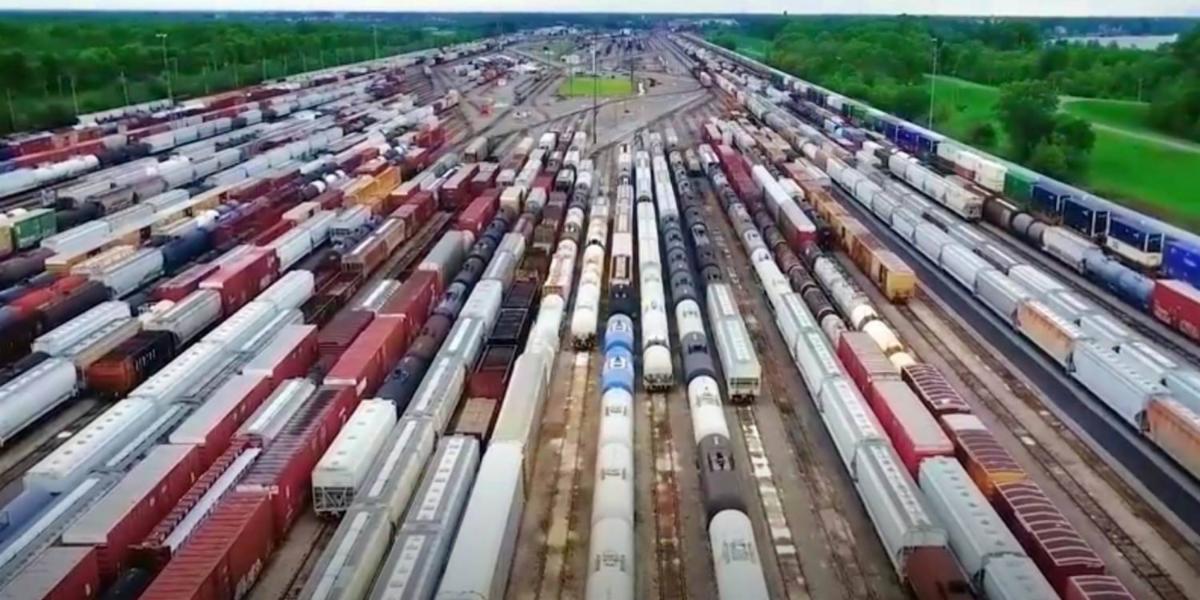
Rail stakeholders are concerned that a possible strike by some union members due to stalled contract negotiations could result in multibillion dollar economic impacts.
The Association of American Railroads estimates that a nationwide shutdown of rail operations could cost $2 billion in lost economic output each day, according to a report released Thursday. AAR reached its conclusions by updating data from a 1992 Federal Railroad Administration econometric study.
AAR, which represents freight and passenger railroads, also said a short-term switch to trucks or barges “would be costly and disruptive,” with an additional 467,000 long-haul trucks needed per day to handle the freight that would have otherwise gone on rail.
“Railroads operate in an intensely competitive transportation marketplace. Firms rarely rely exclusively on rail transportation,” the report said. “Over the long term, most firms that use rail transportation could modify their distribution patterns or production processes so they would not have to use railroads as much as they do today.
“For most of those firms, though, switching on short notice to trucks or barges, or changing their production processes to reduce or eliminate the need for rail service, would, at best, be extremely costly and disruptive. In many cases, it would be completely impractical,” AAR’s report continued.
A new labor deal for union members has been in the works since January 2020, but negotiations between the unions and the railroads had failed to progress. A federal mediation board took up the negotiations but released the parties from those efforts earlier this summer.
|
|
(Editor's Note: The full statement from SMART-TD and BLET is worth the read. It is surprisingly good, even if it does leave out so much of what we should be discussing. But at least they are standing firm.) |
|
Unions Blast Railroads’ Embargoes as Move to Force Congressional Action
Heads of SMART-TD, BLET say railroads ‘have no intention of reaching an agreement’
|
|
Leaders of the two major unions representing train crews have blasted the announcement by railroads that they would begin to embargo hazardous-material and other security-sensitive shipments as “corporate extortion” and “corporate terrorism” designed to force Congress to intervene in the current rail labor dispute.
Jeremy Ferguson, president of the Sheet Metal, Air, Rail, and Transportation Workers-Transportation Division (SMART-TD) and Dennis Pierce, president of the Brotherhood of Locomotive Engineers and Trainmen of the Teamsters Rail Conference, issued their statement Sunday. It follows announcements by the Association of American Railroads and several Class I roads that they would begin to embargo certain shipments, and that other forms of traffic could see disruptions as soon as Tuesday, to prepare for a possible shutdown. [see “Railroads begin embargoes …,” Trains News Wire, Sept. 9, 2022].
The current cooling-off period for negotiations ends at 12:01 a.m. EDT on Friday, Sept. 16, at which time unions can strike or can be locked out by railroads.
The railroads’ announcement came at the conclusion of three days of bargaining at the National Mediation Board. “It was abundantly clear from our negotiations over the past few days that the railroads show no intentions of reaching an agreement with our unions, but they cannot legally lock out our members until the end of the cooling-off period,” Ferguson and Pierce wrote. “Instead, they are locking out their customers beginning on Monday and further harming the supply chain in an effort to provoke congressional action.
“The railroads are using shippers, consumers, and the supply chain of our nation as pawns in an effort to get our unions to cave into their contract demands knowing that our members would never accept them. Our unions will not cave into these scare tactics, and Congress must not cave into what can only be described as corporate terrorism.”
|
|
(Editor's Note: The farce known as the "United Rail Unions" continues to implode. In fact the original "Coordinated Bargaining Coalition" of 10 unions was not real at all, ultimately proving toothless when put to the test. Apparently, there was nothing binding the affiliates together. A real bargaining coalition is committed to the principle that "an injury to one is an injury to all!"; that "united we stand, divided we fall"; that "no union settles until ALL settle." It should be abundantly clear to all rail workers now that we need a single powerful union of railroad workers now that the impotence of this "coalition" is on display for all to see. |
|
Three More Unions Reach Tentative Agreements with Railroads |
|
ARLINGTON, Va. —Three more unions have reached tentative agreements on new national labor agreements, the negotiating body for the railroads, the National Carriers’ Conference Committee, has announced.
The tentative agreements announced today (Sunday, Sept. 11), with the Brotherhood of Maintenance of Way Employes Division of the International Brotherhood of Teamsters; the International Brotherhood of Boilermakers: and the International Association of Sheet Metal, Air, Rail and Transportation Workers-Mechanical Department brings to eight the number of unions that will be taking deals to their members for ratification.
The Brotherhood of Maintenance of Way Employees website offers detailed information about the terms of its contract. National Division President Tony D. Cardwell says in a letter to members that he believes the agreement “that will substantially improve all BMWED members’ wages and working conditions, and it will put an end to the 65-year battle to bring BMWED members’ travel allowances and away-from-home expenses to a rationally based structure.”
As recently as Thursday, the maintenance-of-way union had singled out BNSF Railway
|
|
(Editor's Note: Our friend Max Alvarez from the Real News Network turns up on Public TV and chats about discontent in the workforce, including among railroad workers.) |
|
How American Workers Are Faring After Two Years of Pandemic Turmoil |
|
This Labor Day comes after some of the most tumultuous years in the history of the American worker, a pandemic rollercoaster have historically high unemployment, and now quite low unemployment numbers. Tonight, we look at what that means for workers themselves.
We invited some of you over Twitter to tell us if you feel secure in your jobs. In the answers, we saw stress and exhaustion, people who say they are struggling like this woman who said she is seeking to retire soon after years under pressure, or this one who said she's carrying more burden than she expected to at this age. But others told us they're enjoying working from home and finding satisfying opportunities.
To talk about this complicated moment, I'm joined by Maximillian Alvarez of The Real News Network, and host of the Working People podcast and Tsedal Neeley, professor at the Harvard Business School.
|
|
(Editor's Note: At a glance, this appears to simply be one more way that the AAR wishes to avoid regulation, cut costs, and facilitate the contracting out of rail jobs to non-union, non-railroad employers.) |
|
The Federal Railroad Administration (FRA) on Sept. 8 issued a Notice of Proposed Rulemaking to solicit comments on whether it should retain or remove a provision of the Risk Reduction Program (RRP) final rule, which took effect in 2020.
When the Rail Safety Improvement Act (RSIA) was enacted in 2008, Section 103 “directed the Secretary of Transportation (Secretary) to issue a regulation requiring Class I railroads, railroad carriers that provide intercity rail passenger or commuter rail passenger transportation (passenger railroads), and railroads with inadequate safety performance (ISP railroads) to develop, submit to the Secretary for review and approval, and implement a railroad safety risk reduction program,” FRA wrote in the Federal Register on Sept. 8. “Under sec. 20156(g), each railroad carrier required to submit a railroad safety risk reduction program must ‘consult with, employ good faith, and use its best efforts to reach agreement with, all of its directly affected employees, including any nonprofit employee labor organization representing a class or craft of directly affected employees of the railroad carrier, on the contents of the safety risk reduction program.’ The Secretary delegated the authority to conduct this rulemaking and implement the rule to the Federal Railroad Administrator.”
FRA published an RRP Notice of Proposed Rulemaking in 2015 and an RRP final rule on Feb. 18, 2020. “Railroads’ ongoing evaluation of their asset base and employee performance associated with operations and maintenance, under FRA regulations, can now follow a more uniform path of standardization toward further reducing risks and enhancing safety,” FRA said when the final rule was released.
RRP Rule Update Consideration
|
|
Strike Solidarity Is Popping Up Around the Country |
|
Statements of Support have come in to Railroad Workers United from a myriad of organizations - from unions to environmental organization and community groups - around the country. A few of them are listed below.
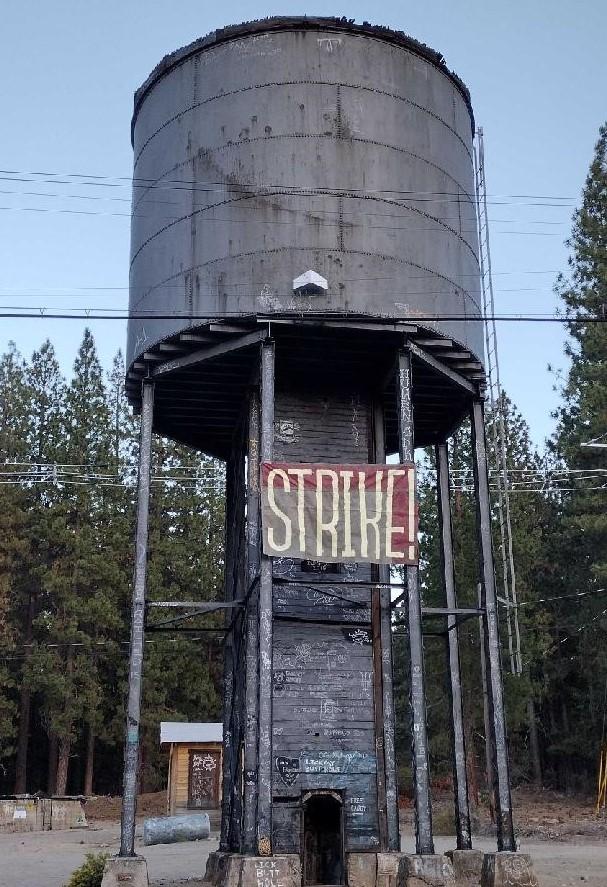
The home-made STRIKE! sign in the photo at Right is posted on a historic railroad water tower alongside the Union Pacific mainline in Northern California. The photo was emailed to RWU from an "anonymous anarchist supporter of railroad workers."
Rail workers have more support than they know among organized labor, various social movements, and the general population. It is time for our unions to reach out and build those bridges of solidarity!
|
|
(Editor's Note: Just about every shippers' group on the U.S. has complained vehemently in recent months/years about rail service provided by the Class One carriers. Even waste and recyclers...) |
|
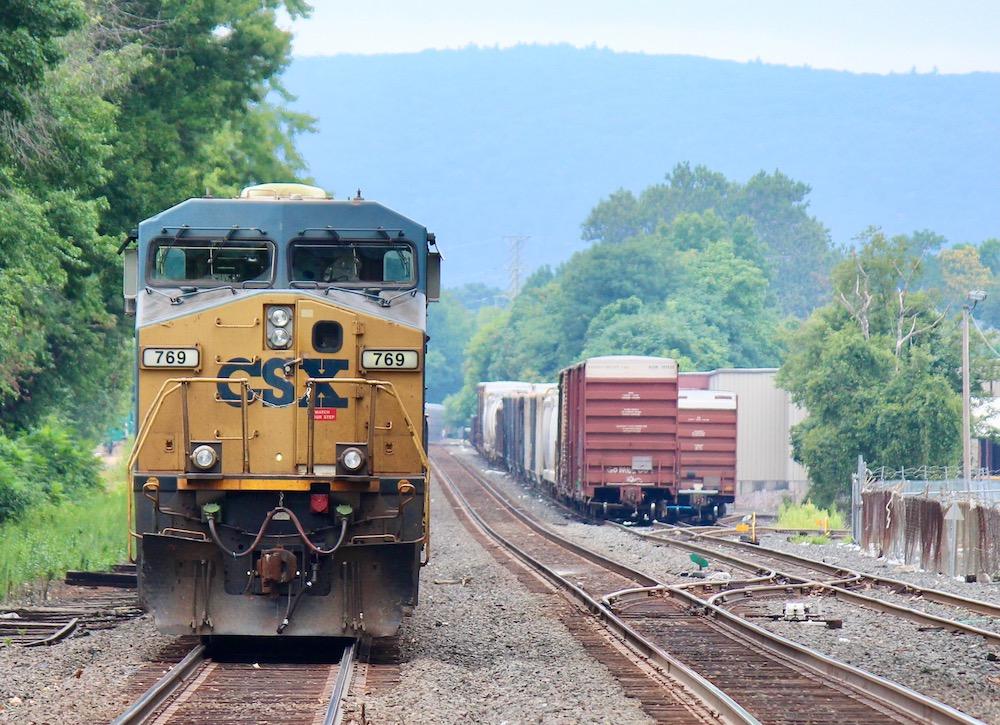
Waste Shippers Complain About CSX Service in the Northeast |
|
WASHINGTON — Waste shippers have complained to federal regulators regarding deteriorating service on CSX Transportation in the Northeast.
The National Waste & Recycling Association, a trade group representing 70% of the private sector’s waste and recycling market, told the Surface Transportation Board that its members prefer to reach commercial solutions with their rail carriers.
“However, the service issues that our member companies are raising indicate that the problem is a network problem affecting the entire northeast region of the country. For example, in Boston, NWRA members are unable to load rail cars due to ongoing service issues involving the delivery of rail cars. In the meantime, railcars loaded with waste are waiting to be moved out by the railroad. Another example, in Connecticut and New York, rail operations are being negatively impacted due to the excessive backlog of cars waiting to switch at CSX’s Selkirk Yard in Albany, N.Y.,” the group’s CEO, Darrell K. Smith, wrote in a Sept. 1 letter to the STB.
Other waste and recycling shippers are dealing with missed switches, longer transit times, unfilled car orders, and an inability to reach CSX customer service and operations employees, Smith says.
“All of these issues are serious service failures and the situation is growing more tenuous each day,” Smith wrote. He asked the STB to intervene.
CSX has been experiencing train crew shortages in the Northeast and particularly along the former Water Level Route in New York. In a system notice issued Tuesday, Sept. 6, CSX notified engineers and other employees that no personal leave days will be permitted in Selkirk, Syracuse, and Buffalo, N.Y., from Sept. 9 through Sept. 19.
|
|
(Editor's Note: And the derailments just keep coming ...) |
|
UP Train Derails in Arkansas |
|
JONESBORO, Ark. — Eleven cars of a Union Pacific train derailed early Tuesday morning, closing two streets in central Jonesboro, the Arkansas Democrat-Gazette reports.
The derailment occurred about 3:30 a.m., leading to a coal spill, but involved no hazardous materials. No injuries were reported. The Jonesboro Police Department reported on its Facebook page that the derailment led to the closure of Gee and Culberhouse streets, which cross the railroad tracks in the area of the derailment, and was likely to cause major delays.
A Union Pacific representative told the newspaper the cause of the derailment was under investigation.
|
|
|
|
|
|
|