Teaching & Leading with Intention

Bi-Weekly Insights from Research for Better Teaching

This series is designed for both teachers and instructional leaders—offering strategies you can apply directly in your classroom or use to support and coach others. Whether you’re setting up your own space or observing someone else’s, each edition will help you strengthen the conditions for powerful learning.

This edition is about Discipline—Finding the “Why” Before the “What”

Discipline challenges rarely begin with defiance. More often, they stem from confusion, unmet needs, unclear expectations, or a lack of connection. When teachers take time to diagnose the root causes of behavior—rather than reacting to what’s visible—they move from managing misbehavior to truly teaching self-regulation and responsibility.


In this issue, we’ll explore how skillful teachers use curiosity, reflection, and observation to uncover what’s really driving student behavior. By understanding the why, we can respond with strategies that teach, restore, and build trust instead of control.

Diagnosing Discipline—Find the Why Before the What

“All behavior has an origin or cause.”

The Skillful Teacher, Eighth Edition


Why It Matters:

Discipline challenges don’t always come from defiance or disrespect. Often, they stem from unmet needs, unclear expectations, or mismatches between instruction and student readiness. When we diagnose first—rather than jumping to conclusions or consequences—we open the door to solutions that actually work. Identifying the root cause helps us respond with precision, compassion, and skill.


Try This:

When a student is off-task, ask:

  • What might be causing this behavior?
  • Is this a motivation issue… or a clarity issue... or an attention and focus issue?
  • Could I adjust instruction, routines, or support?

Then check your response against this question: Am I trying to stop a behavior—or build a habit?


Small Shifts, Big Impact:

When we take time to investigate the why behind a behavior, we can make small, targeted shifts that prevent future disruptions and build stronger learning environments. Here are a few examples:


  • Instead of: Assuming a student is off-task because they don’t care
  • Try: Asking whether the instructions were clear or if they’re unsure how to begin
  • Root Cause: Unclear expectations or lack of confidence


  • Instead of: Punishing failure to follow routines.
  • Try: Re-teaching the routine using modeling and practice
  • Root Cause: Poorly taught expectations or routines


  • Instead of: Correcting behavior with sarcasm or frustration
  • Try: Using calm proximity and a quiet redirect
  • Root Cause: Student testing boundaries or seeking peer attention


  • Instead of: Jumping to judgment
  • Try: Asking yourself: “What’s this behavior trying to tell me?”
  • Root Cause: Unacknowledged emotions, boredom, or external factors


Each of these micro-adjustments helps shift discipline from reactive to reflective—and ultimately supports a culture of dignity, clarity, and growth.


For Instructional Leaders:

In coaching conversations, invite teachers to reflect using these questions:

  • What else might be going on for this student?
  • Have the expectations or routines been clearly taught and reinforced?
  • Could the cause lie in the environment, task design, or classroom climate?
  • Use the 12 causes as a framework to move from judgment to curiosity—and help teachers solve problems with precision.


Research Connection:

“Levin and Nolan (2014) stress the need for teachers to distinguish between misbehavior caused by unclear expectations and that which arises from other root causes.”

— The Skillful Teacher, 8th Edition, Chapter 10


Levin and Nolan (2014) underscore that effective discipline begins with diagnosis—identifying the cause before choosing the response. Misbehavior might stem from boredom, unclear expectations, confusion, or external factors. Without this insight, teachers risk overcorrecting or applying consequences that don’t address the real issue.


Rather than assuming students "won’t" behave, we ask what’s preventing them from doing so—and how instruction, environment, or relationships can change the outcome.


For more see Chapter 10, Discipline in The Skillful Teacher, 8th Edition

Featured Resource


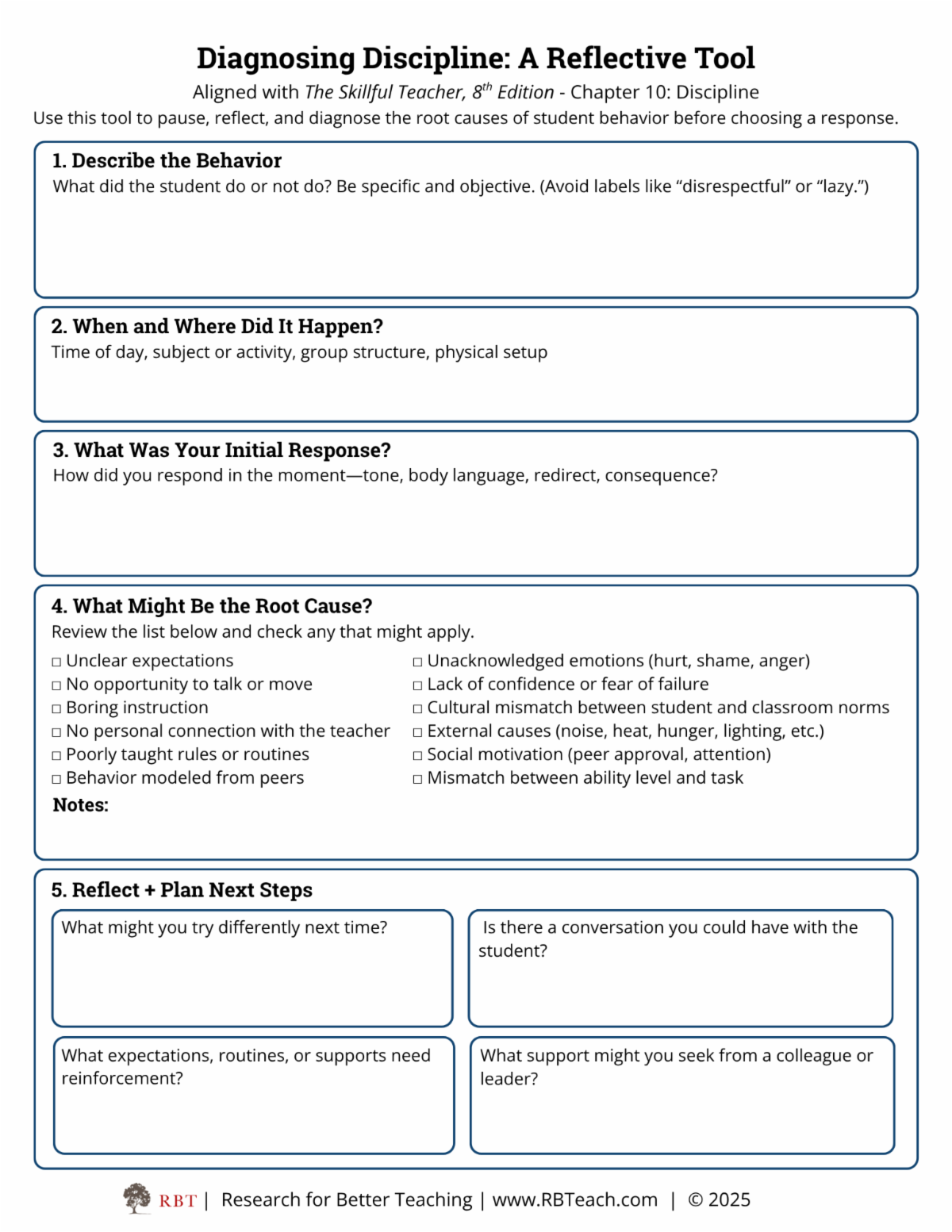
Featured Tool: Diagnosing Discipline: A Reflective Tool

When a student goes off-task, what’s really going on?


This planning and reflection tool helps teachers pause and look beneath the surface of disruptive behavior. Instead of reacting with assumptions, educators are guided to consider 12 common root causes—from unclear expectations to external distractions or emotional needs—based on The Skillful Teacher, 8th Edition.


Whether used individually, in coaching conversations, or during team reflection, this tool supports thoughtful, equity-centered discipline decisions that teach rather than punish.


Use it to:

  • Reflect on behavior patterns
  • Diagnose root causes using Exhibit 10.1
  • Adjust routines, instruction, or relationships
  • Plan meaningful next steps

“Our premise is that behavior problems have causes and that a teacher’s diagnostic skill makes a difference in how those causes are addressed.”

Grow Your Practice This Winter

Enrollment is now open for RBT’s Winter Open Courses!

Join us for high-impact professional learning designed to deepen teacher expertise, strengthen instructional leadership, and build lasting capacity in your school or district.


Studying Skillful Teaching

Hybrid


Instructor: Reena Freedman


In-Person Dates: 

Saturdays: January 10, January 24, & February 7

Time: 8:30am - 3:30pm EST

Location: 1 Acton Place, Acton, MA


Virtual Dates: 

Tuesdays: February 24, March 10, March 24, April 7, April 14, May 5

Time: 4:00pm - 6:30pm EST

Location : Zoom


Analyzing Teaching for Student Results In-Person

Instructors: Deb Reed & Kristen Palatt


In-Person Dates: January 21, February 11, March 12, March 26, April 15, April 30, May 14

Time: 8:30am - 3:30pm EST

Location: 1 Acton Place, Acton, MA


Women Leaders Program

Virtual


Instructor: Pia Durkin


Virtual Dates/Times: 

  • Thursday, January 15 - 12 - 4pm EST
  • Thursday, February 12 - 12- 2pm EST
  • Thursday, March 19 - 12 - 2pm EST
  • Thursday, April 9 - 12 - 2pm EST
  • Thursday, May 7 - 12 - 2pm EST


Plus two (2) 1-hour individual virtual coaching sessions to be arranged directly with the instructor.


Invite Your Colleagues


Help us spread the word about The Skillful Educator: Teaching & Leading with Intention.


Forward this to colleagues and share the sign-up link so others can join and grow alongside you!


Missed an issue of the newsletter? You can find archived copies here.


Facebook  X  Instagram  LinkedIn