Montana Beaver Working Group | | Our Mission: Connect people and share resources to elevate the vital role of beavers in Montana's ecosystems | | |
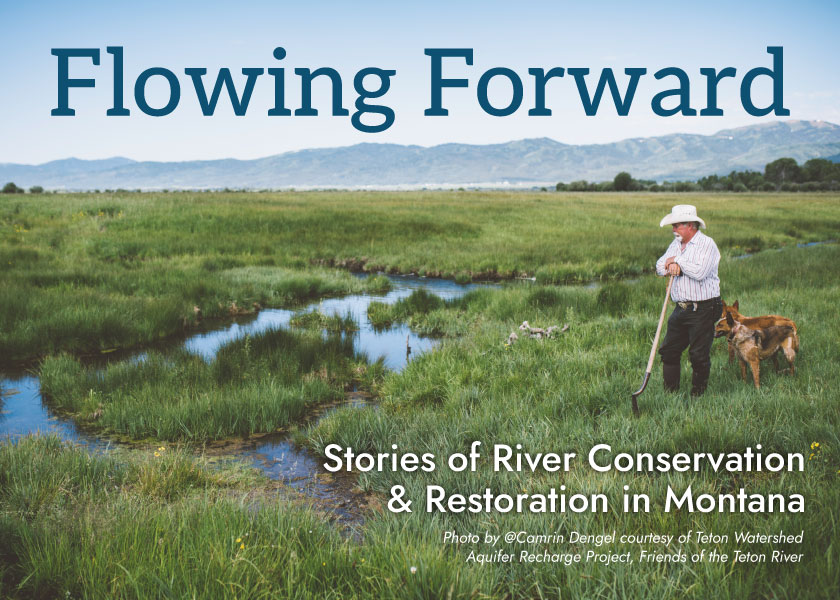
Flowing Forward: Stories of River Conservation & Restoration in Montana
A Conversation with Pedro Marques
"A thing is right," wrote the great ecologist, Aldo Leopold, "when it tends to preserve the integrity, stability, and beauty of the biotic community. It is wrong when it tends otherwise." Though central to Leopold's essay "The Land Ethic" in his 1949 book A Sand County Almanac, these words were quite overshadowed by the United States' rapid economic expansion in the wake of the World War II. But amidst this hustle to grow, the nation was still reeling from immense losses to its wildlife in the preceding centuries, when birds, beavers, carnivores, and so many more had been eclipsed from countless places they once knew. Today, Leopold's ethic remains even more vital than before, and his voice still help us to remember the wider land community of which we are one small part. And, thankfully, his wisdom resonates in Montana, including at Flowing Forward: Stories of River Restoration and Conservation in Montana. This October 28 film screening and discussion, which took place at the Roxy Theatre in Missoula, highlighted the inspiring watershed work of regional partners in three films (full films linked in white below):
Restoring Resilience: The Miller Creek Story (presented by the Clark Fork Coalition and the Missoula Conservation District); Working Water: Innovating Agriculture for a Resilient Future (presented by the Montana Department of Natural Resources and Conservation and the Montana Water Center); and Restoring the Headwaters (presented by Big Hole Watershed Committee).
To echo these achievements for the wider Montana Beaver Working Group, we reflected on the event in the following conversation with Big Hole Watershed Committee Executive Director Pedro Marques.
BWG: What does it take to create a masterful film like Restoring the Headwaters? Was there a moment in the process that brought you particular joy?
Pedro Marques: First, knowing we had a great project on our hands before contractors show up. That just takes years of experience and great partners. Second, a great videographer and storyteller. Tom Attwater came to us passionate about conservation and I loved how he used sound to connect people to place and created tension and emotion within the film. When I knew it would be great was the first time we saw the wildlife footage that came back from the guys he contracted. Truly world-class wildlife videographers.
Restoring the Headwaters showcases a big project, where bulldozers heave around tons of water, earth, and wood. You acknowledge that it can initially "look like a bomb went off" after such work. And yet, as Ben LaPorte says, "when we come back here in two or three years, if you're not trained up in this kind of stuff, you'd have no idea what the heck went on, you'd just look at it and say 'wow, that's beautiful.'" What guides your vision for what is right by the land?
In a word, Process. We had accurately diagnosed the site's major problem- disconnected hydrology. In fact, the first design drawings came back with a simple hardened fix for the headcuts. This would have saved the upstream wetland, but not address the existing degradation of the resource. It would have locked that system into place. We sent the plans back so that the project could re-establish hydrologic processes and actually Enhance the resource, not just save what was left. My Board is very clear on our need to steward and enhance our resources, it is not enough just to stop the degradation. Every time we do a project, we try to set the system up for a future of increasing resilience- that usually means hydrologic processes.
Flowing Forward brought river conservation and restoration practitioners together from around the state. How would you describe what it means to be a valuable individual contributor to a conservation movement much larger than yourself?
I feel proud and also a great sense of responsibilty to know my small part in this larger body of work. We are an ecosystem of people each working on our home ecosystems. Because the scope of my work is bounded by my watershed's geography, that helps define my role. I also came into a group with a track record of trust, which has allowed us to push the envelope with the restoration work we do, hopefully inspiring others in other landscapes. Its all tremendously gratifying and I learn more from others than anthing else!
Every project and partnership of this scale has an unsung hero (or many of them). Sometimes they never make it on the screen, or the grant report. Sometimes their inspiration never even enters project conversations. Is there an unsung hero you'd like to elevate and thank for their inspiration in this work?
Yes, the rancher whose land we worked on! Ranchers tend to not to toot their own horns or make big deals of things they do, so often times we have to do that for them. This project again teaches us that ranchers know their ground and ecological realities/limitations of where they live. We're now starting Phase II of this project, which will connect the entire Smith Springs system to the North Fork of the Big Hole, siphoning his massive ditch under a new, free-flowing channel. And Phase II was his idea, not ours! We'll just make it happen!
This project began with the observation that a headcut had substantially degraded a large peat wetland in the last 70 years. This project has done so much to reverse that harm, but with the restoration work done and the film crew gone, its particular moment in the spotlight may end. Meanwhile, the land, water, and life of this place will go on living. If you could send a short message to a Big Hole resident 70 years from now, what advice would you offer to help them respect the health of Smith-Sage Springs?
I feel confident that where we worked, the system will be in good shape. I'd tell the landowner 70 years from now, if they haven't already, to continue restoring the hydrology of that entire drainage and slow water down everywhere you can- sink it, spread it, soak it. The peat soils in that drainage are just begging to be saturated again! Then I'd ask them to make sure to keep cattle use of the area to a minimum and make sure they have offsite water to protect those wetlands.
| | |
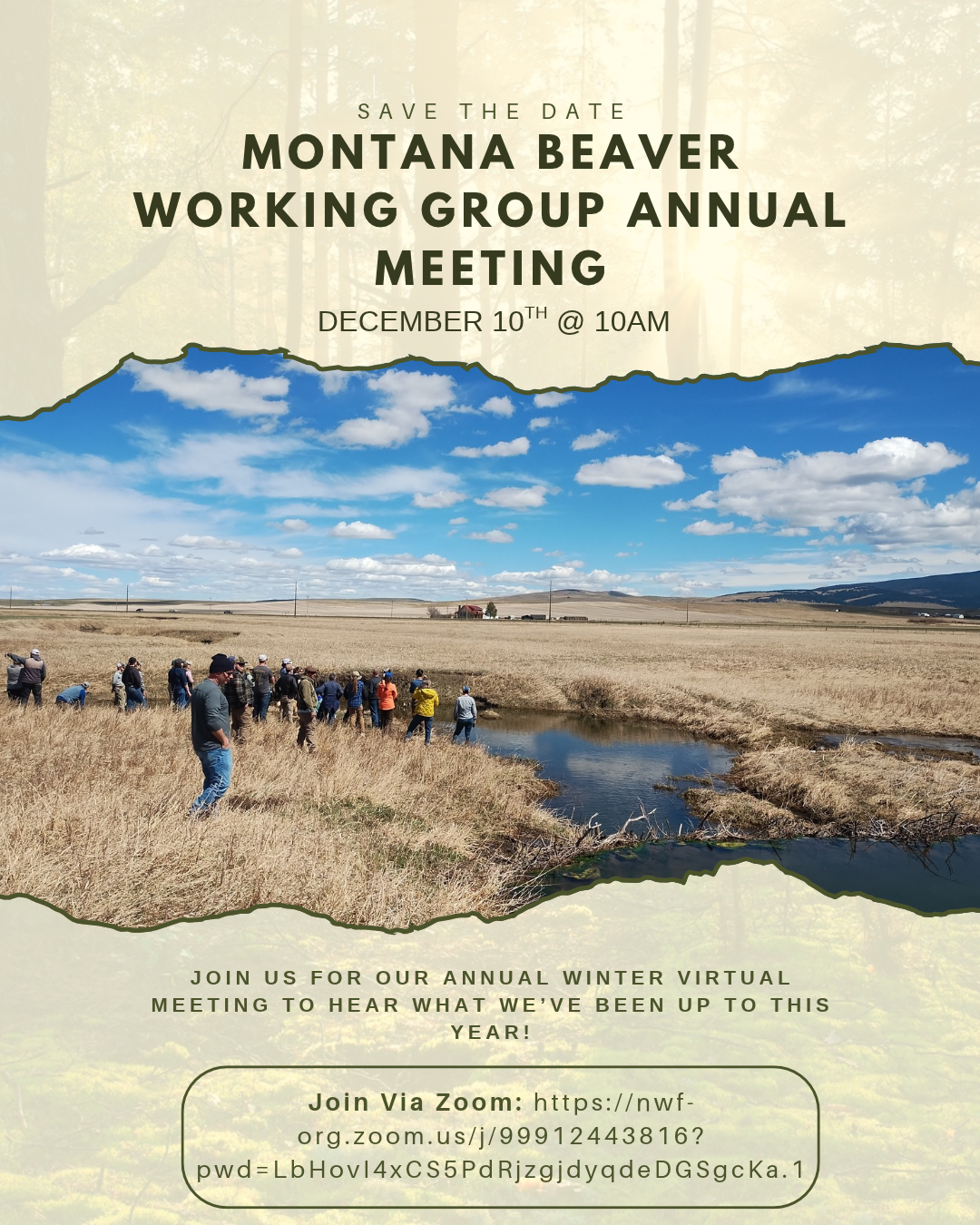
Montana Beaver Working Group - Winter Meeting
10am-12pm
December 10, 2026
Zoom
Please join us for the annual Winter Meeting of the Montana Beaver Working Group, which will convene from 10am-12pm on December 10, 2026 via Zoom. We have a great lineup of presenters to celebrate the many things the BWG has accomplished in 2026. Presentations will highlight the recently completed 2026-2029 Montana Beaver Action Plan, as well as updates from Montana Fish, Wildlife & Parks' new translocation program, the Montana Beaver Conflict Resolution Program, and partners around the state. You can join the event at this link, and we look forward to seeing you there!
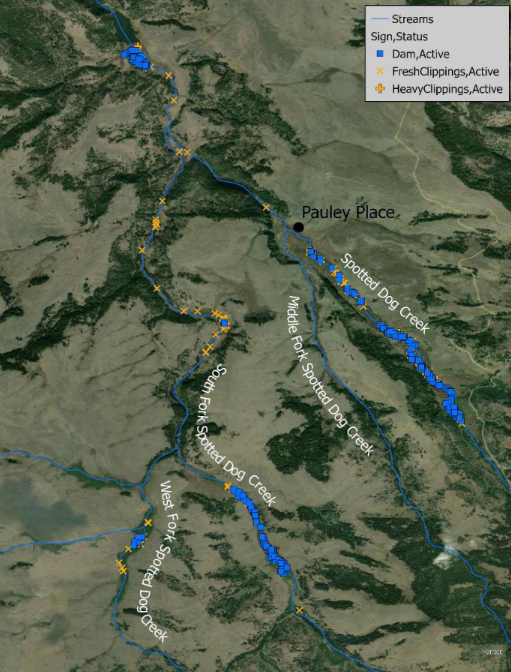
| | An overview map highlighting beaver activity in the drainages of the Spotted Dog Wildlife Management Area. Translocations from this fall provided solid support for the increasing dam activity in recent years. Images: Montana Fish, Wildlife & Parks | |
Spotted Dog Wildlife Management Area 2026 Beaver Transplant Overview
Montana Fish, Wildlife & Parks
November 2026
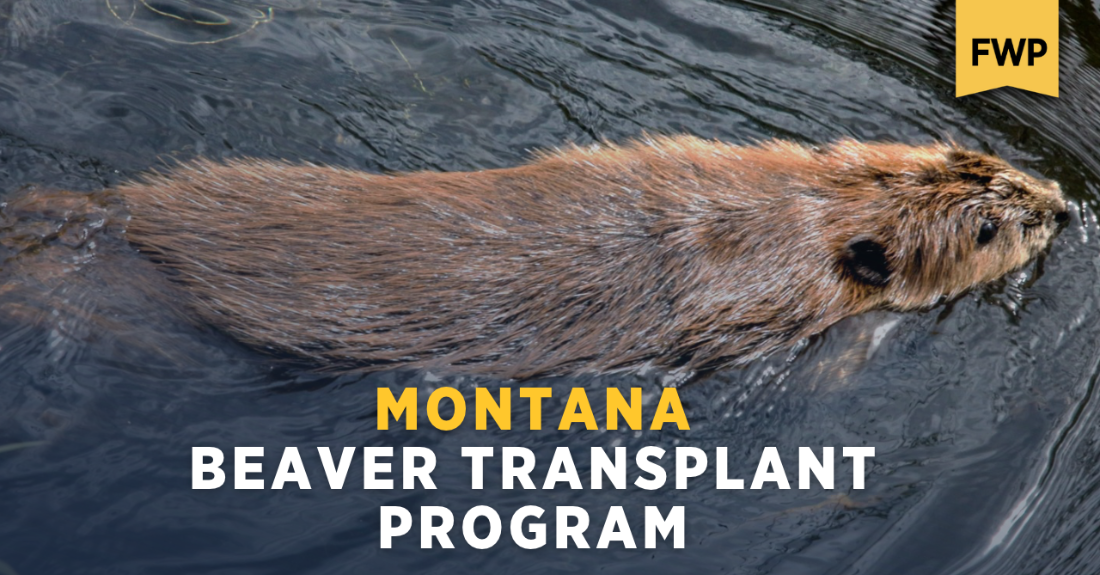
To explore how and why the Montana Beaver Transplant Program has emerged in our state, Montana Fish, Wildlife & Parks put together a wonderful new video. In the course of its five minutes, FWP's Region 2 Nongame Biologist Torrey Ritter describes how vital partners in habitat restoration and conflict resolution provided the context, purpose, and need for moving beavers back to their former watersheds. The video does an excellent job illustrating the translocation process and release, and you can view it here.
Ritter also reports that, as of November 12, all the beavers released at the three sites in 2026 are active and present. You can learn more from the site-specific notes below, and at the Beaver Working Group Winter Meeting (details above).
Main Stem of Spotted Dog Creek Release Site (2 adults)
• Surveys showed extensive beaver damming activity upstream and downstream of the release site.
• Trail cameras show that both released beavers are still in the area.
• It is difficult to tell which dams are being built/maintained by the released beavers versus other beavers in the drainage. There was a substantial increase in beaver activity overall in the main stem this year, so some of the beaver territories are difficult to separate from one another.
South Fork of Spotted Dog Creek Release Site (2 adults and 2 yearlings)
• Surveys showed that at least some (and possibly all) of these beavers are still in and around the release site.
• The beavers built on the pre-made dams a little bit, and used the pre-made lodge, but they did not have any substantial dams and no winter food cache when we surveyed the area.
• It is unclear if these beavers are going to overwinter at or near the release site. FWP will try to check on these beavers again before the first big snowfall.
West Fork of Spotted Dog Creek Release Site (2 adult, 2 yearling, and 1 kit)
• Surveys showed that at least some (and possibly all) of these beavers are still in and around the release site, though they moved downstream about 500 m to the lowest pond where a starter dam was built.
• The beavers repaired two very large old dam berms and built some smaller support dams around them. They built a small food cache in a new pond just below the main dam berm. It appears they are using an old lodge and some bank dens.
• It is unclear if these beavers will be able to overwinter at the site with such a small food cache, but again they may do a lot more work before the first big snow.
| | |
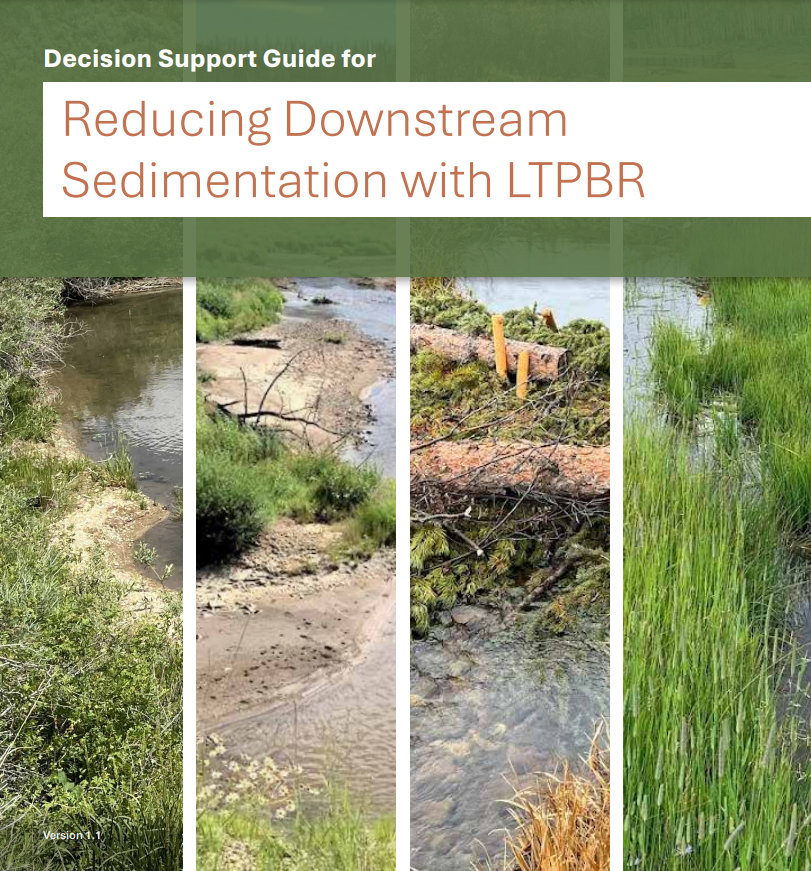
Decision Support Guide for Reducing Downstream Sedimentation with Low Tech Process Based Restoration
Caroline Nash (Rio Applied Science & Engineering) and Joel Sholtes (Wash Water Science & Engineering)
October 2026
Low-Tech Process-based Restoration (LTPBR) is a suite of interventions used to accomplish a broad set of ecosystem goals: floodplain reconnection, riparian vegetation recovery, beaver recolonization, and more. It is increasingly being used as a tool to protect downstream waterways from sedimentation (erosion and deposition of sediment), but there are few resources available to guide early decision-making as to whether that is an appropriate use. This guide addresses that need by answering one question: Is LTPBR likely to reduce downstream sedimentation from your site? By walking LTPBR project sponsors and managers through a series of screening questions related to a site, this guide links LTPBR actions with their short and long-term effectiveness in achieving sediment related outcomes. Users will be able to link restoration actions with geomorphic context and sedimentation processes to achieve a better understanding of where and how LTPBR can address sedimentation and its associated uncertainty. Read on here.
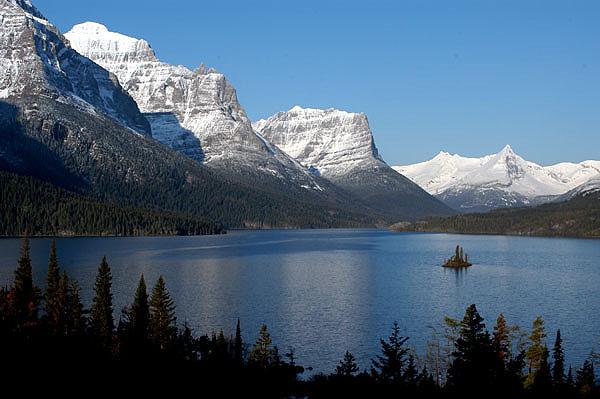
| | The beloved St. Mary's Lake and Wild Goose Island, near the location where a dead beaver infected with tularemia was found. Photo: Wikimedia Commons | | |
Beaver with Tularemia Documented in Glacier National Park
Flathead Beacon / Swedish Union of Agricultural Sciences
September / October 2026
Have you ever seen a Francisella tularensis walking around on one of your personal or professional adventures outside? Unless you had a microscope along with you, probably not. But in Glacier National Park, there have been indirect encounters with the effects of this bacterium, in two snowshoe hares and beavers. The disease caused by this bacterium is commonly known as tularemia, and it is a rare but highly infectious disease, often fatal for the rodents (especially muskrats and beavers) and lagomorphs (especially rabbits, and hares) it typically infects in North America. Through the bites of infected ticks or insects, contact with blood or tissue of infected animals, or the ingestion of infected food or water (including when aerosolized), humans can contract the disease as well, although our flu-like, feverish symptoms can often be reversed with prompt antibiotic treatments.
As it happens, Swedish researcher Lovisa Hokby happened to be completing her doctoral thesis this fall, in which she explored the potential role of beavers as a vector for increasing tularemia transmission. Her results suggested that beaver wetlands do not pose a greater risk for spread than wetlands without beavers, but that the prevalence of hares associated with infected waters may play a greater role in dispersal.
No matter the origins, tularemia deterrence is one of the reasons why Montana Fish, Wildlife & Parks conducts thorough pathological assessments of the species they translocate, and precaution is always advised where tularemia is found, especially in cases of finding inexplicably dead animals. You can learn more about the observations in Glacier National Park here, the Swedish research here, and the human health aspects from the CDC here.
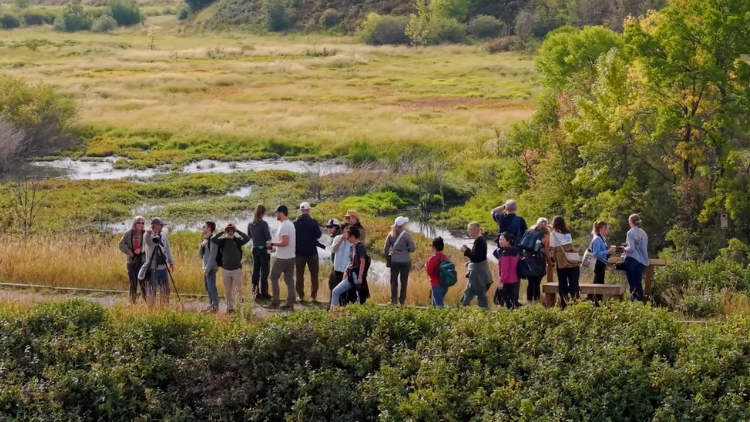
| The Indreland Audubon Wetland Preserve provides accessible opportunities for volunteers and visitors to observe, restore, maintain, monitor, and interpret a special habitat in the heart of Bozeman. Photo: Sacajawea Audubon Society | |
Nature's Engineers: How Beavers are Building a Bird Paradise at the Indreland Audubon Wetland Preserve
Frank M. Marchak
Bozeman Daily Chronicle
September 22, 2026
There's much to love in the wildlands around Bozeman, but there's also much awe to be had at the wild oasis within city limits. Gifted to the Sacajawea Audubon Society in 2018, the Indreland Audubon Wetland Preserve is a haven for both wildlife and people, as SAS Board Member Frank M. Marchak wonderfully describes in a recent article for the Bozeman Daily Chronicle. He rightly affirms the beaver's keystone role in helping make this place so dynamic, complex, and diverse, and he explores the fascinating ways that birds can serve as the storytellers of the successes the beavers have built. You can read Marchak's article here, and you can learn more about visiting, volunteering, or otherwise engaging with the Indreland Audubon Wetland Preserve here.
| | |
Senior Wetland Scientist
Pinyon Environmental, Inc.
Bozeman Daily Chronicle
DUE: September 22, 2026
Pinyon’s Bozeman, MT office is seeking a Senior Wetland Scientist to lead wetland, stream, and natural resource projects throughout Montana and the Rocky Mountain West. This role combines technical fieldwork, environmental permitting, restoration, and project management. This role will manage projects from planning through completion and work directly with clients, landowners, regulatory agencies, and Pinyon’s scientists and engineers. The position includes both office and fieldwork, with regular travel to project sites, including remote locations. Learn more and apply here.
| | |
Nongame and Wetlands Habitat Biologist
Montana Fish, Wildlife & Parks
Helena, MT (or other state offices; hybrid potential)
DUE: December 6, 2026
This position serves as the department’s expert on management and conservation of habitat for nongame species of greatest conservation need with a primary focus on wetland and riparian habitats that support a high percentage of Montana’s SGCN, and serves as a program coordinator for two habitat conservation programs. This position coordinates and collaborates with FWP staff, conservation groups, and land managers to prioritize, strategize, and conserve habitats for nongame SGCN. This position will have a primary emphasis on conserving and managing wetland and riparian habitats and secondary emphasis on forest habitats that support SGCN. This position will manage and administer both the Migratory Bird Wetlands Program and the Nongame Habitat Program. Program management will include managing applications and proposals, ranking projects for funding, establishing contracts and agreements, mapping and geospatial data management, maintaining program databases, managing program budgets, and writing reports summarizing accomplishments. The position is the primary liaison between the Wildlife Division’s Habitat and Nongame Bureaus, with the Wetland Protection Advisory Committee, and with regional FWP staff and partners implementing habitat projects to benefit nongame. As an agency expert in wetland-riparian habitat types and the habitat needs of nongame SGCN, the position may serve as the state’s wildlife representative on a variety of Montana, regional, or national advisory capacities. Learn more and apply here.
| | |
Please send photos, stories, upcoming events, opportunities, and other resources to:
Shelby Weigand - Riparian Connectivity Manager,
National Wildlife Federation
WeigandS@nwf.org
MT Beaver Working Group newsletters are posted online here.
| | | | |