Wednesday, May 20, 2026

ASSOCIATION NEWS

A Cautious Budget with Real Dairy Implications: Breaking Down the May Revision

Governor Newsom released his May Revision to the 2026-27 state budget yesterday, and while the headline number is a balanced $246.6 billion General Fund, the details matter for California dairy. The proposal restores funding for invasive pest detection, backfills Prop 12 implementation costs with General Fund dollars, and signals a major shift in how industrial hemp will be regulated in the state. At the same time, downward-revised cap-and-invest revenues mean tighter competition ahead for the Dairy Plus Program, LandFlex, and methane reduction dollars. Below is a rundown of what's in the May Revise for dairy, plus the broader budget context shaping negotiations through the June 15 deadline.


Invasive pest detection: $10.5 million General Fund to maintain pest detection activities targeting invasive fruit flies, which have been a serious and growing threat to California ag. This is a CDFA program run in partnership with USDA and County Agricultural Commissioners. Funding had been at risk; restoring it is a win.


Industrial Hemp Program transition: The Administration is proposing to shift the Industrial Hemp Program from state management to the federal USDA hemp program, with $8.4 million one-time General Fund to bridge the transition (offsetting lower-than-expected fee revenues). This is a significant policy change and worth tracking through the trailer bill — it changes who regulates industrial hemp in California going forward, which has implications for cattle composting and feed-related issues that have been on our radar.


Proposition 12 Animal Care Program: $7.9 million General Fund (including $2.8 million ongoing) for CDFA to implement Prop 12. CDFA has held off on setting the fees that were supposed to fund this program, citing ongoing legal challenges (including from the federal government). The state stepping in with General Fund to backfill the fee revenue is meaningful — it signals that the Administration expects the legal fights to continue and is preparing to absorb costs rather than impose fees on producers.


Cap-and-invest revenue: Greenhouse Gas Reduction Fund estimates were revised down from $3.8 billion to $3.4 billion in both 2025-26 and 2026-27. This matters because GGRF funds the Dairy Plus Program, LandFlex, vermifiltration, and the broader methane reduction portfolio. Less GGRF revenue means tighter competition for those dollars. The estimates also don't yet reflect pending CARB amendments that could move them further. We should expect dairy methane funding to be more contested than in past cycles.


Cap-and-trade reauthorization: Not in the May Revise itself. That fight remains on a separate legislative track, but the lower auction revenues sharpen the urgency.


No new state spending on the cattle composting / AB 411 implementation dispute. That fight remains administrative.


Governor's 2026-27 May Revision

Governor Newsom released his May Revision budget proposal yesterday.

  • On paper, it's a $246.6 billion General Fund budget (roughly $349 billion all funds) that zeros out the deficit for both 2026-27 and 2027-28 and cuts the projected 2028-29 operating gap by more than half.
  • Despite $16.5 billion more than the January projection — almost all of it from personal income tax tied to AI-driven tech capital gains.
  • The Governor’s plan shows zero appetite for big new ongoing spending, with some limited cuts to Medi-Cal programs and increases in budget reserves.
  • The Governor is signaling that the state is bracing for an AI/tech stock correction that could erase tens of billions, and for whatever damage the federal H.R. 1 does to state finances.
  • The forecast already bakes in a 13% drop in capital gains for tax year 2026, so he's treating the windfall as temporary and refusing to hand his successor a structural mess.


What this means

  • Defensive, reserve-heavy posture with almost no new ongoing programs (which also limits the Legislature’s ability to pass new large programs and mandates).
  • Significant Medi-Cal restructuring and outright cuts.
  • Three major revenue proposals that will dominate negotiations through June 15.
  • Legislative budget chairs are broadly on board with the cautious framing; expect fights only at the margins.


Key topline numbers

  • General Fund spending for 2026-27: $246.6 billion (flat versus the current year).
  • Total reserves and set-asides by end of 2026-27: roughly $39.6 billion.
  • Structural deficit: eliminated through July 2028; 2028-29 gap already cut in half from the January baseline.


What’s driving stronger revenues

The flip came from stronger-than-expected personal income tax receipts driven by surging capital gains in the tech/AI sector and looming IPOs.


  • The Administration is not treating this as permanent revenue — their own forecast already discounts a 13% drop in capital gains next year.
  • This signals a more disciplined approach to budgeting by parking the one-time money in reserves and avoiding the mistakes of past governors who spent it as if it would last forever.


New taxes proposed by the Governor

These will generate roughly $3.6 billion in 2026-27 and grow from there. They are the ones that will actually move the needle in the final budget.

  • Permanent corporate tax credit cap (begins tax year 2027): Limits larger companies to the greater of $5 million per company or 50% of tax liability while protecting small-business access. Hits tech, pharma, and big manufacturers hardest; preserves refundability features from the current temporary cap.
  • Sales tax on digital prewritten software and SaaS (effective January 1, 2027): Taxes electronically delivered software, whether it's downloaded or accessed via cloud. This one is the most administratively messy and will draw heavy industry pushback over definitions (custom vs. prewritten, mixed contracts, etc.).
  • Revised MCO tax (effective January 1, 2027): New structure designed to survive federal restrictions in H.R. 1. Keeps targeted rate increases for primary care, maternal care, and non-specialty mental health while offsetting General Fund Medi-Cal costs. Requires CMS approval; if it fails, the General Fund hit jumps by about $1.1 billion in the first year.


Next steps

Negotiations will now kickoff between the Governor, Senate and Assembly to pass the final budget by June 15.

  • The respective budget committees for Assembly and Senate will hold a large number of hearings in the coming weeks to make changes to the Governor’s proposal and add in Legislative priorities.
  • Generally, the Legislature plays a limited role in the process and is deferential to the Governor. With Governor Newsom leaving office this year, whether that pattern remains is a question.
 

STATE NEWS

June 3 Water Board Hearing Critical to the Future of Central Valley Dairies

By Paul Sousa, Director of Regulatory & Environmental Affairs


The Central Valley Regional Water Quality Control Board will hold an important meeting on June 3 at its offices located at 11020 Sun Center Drive, Suite 200, Rancho Cordova, CA 95670, near Sacramento. On the agenda is approval of the Modesto Management Zone Implementation Plan and amendments to water quality permits incorporating the Nitrate Control Program. This action is part of the CV-SALTS water quality compliance strategy that has been years in the making and will affect water quality permit holders throughout the Central Valley.


While the Regional Board is currently considering only the Modesto Management Zone Implementation Plan, this action will establish a template and precedent for other Priority 1 management zones, including those affecting dairies. This is especially important for producers in the Modesto Management Zone, but dairy producers in the Turlock, Chowchilla, Kings, Tule, and Kaweah groundwater subbasins should also pay close attention. Similar actions in those areas are expected to follow soon.


Parts of the CV-SALTS process are already underway in Priority 1 zones. Permit holders are already providing replacement drinking water to residents whose domestic wells have been impacted by nitrates. At this hearing, the Regional Board will consider the critical 35-year exception allowing dairies and irrigated agriculture additional time to achieve compliance with nitrate groundwater quality standards. This exception was a key component of the broader CV-SALTS agreement that made immediate drinking water solutions possible.


Some groups are now attempting to undermine agreements reached after more than a decade of stakeholder meetings and negotiations in which they actively participated. Dairy producers and others affected by this action should make it clear to the Regional Board that the 35-year exception remains essential for agriculture to continue developing and implementing workable long-term solutions to nitrate challenges while continuing to provide safe drinking water solutions today.


Dairy producers are encouraged to attend the meeting, either in person or remotely, and provide testimony regarding the importance of maintaining the 35-year exception. Dairies are actively working toward long-term groundwater quality improvements, but significant technical and economic challenges remain. Producers must balance crop nutrient needs with manure management and continue developing practical ways to export excess nitrogen from dairy operations. This largely depends on technologies and systems that convert manure into transportable solid forms that can be moved offsite or composted. There are also technologies that can denitrify excess nitrogen in liquid manure.


The Dairy Plus Program will provide the final round of funding for some of these technologies very soon. However, additional time is necessary for producers to identify, finance, and implement effective solutions on a broader scale while maintaining viable dairy operations.


WUD will provide the meeting agenda once it is posted on the Regional Water Board’s website: Central Valley Water Board Meeting Information


This meeting matters to every dairy producer in the Central Valley. The decisions made here will shape how nitrate regulation is implemented for years to come and will directly impact the future viability of dairy farming in our region. If dairy producers do not participate in this process, others could shape the outcome for us. Please consider attending the meeting and making your voice heard in support of maintaining the 35-year exception and workable pathways for compliance. If you have questions about the meeting or would like talking points for testimony, please contact me.


WUD Joins Inaugural California Water Plan 2028 Advisory Committee

Western United Dairies participated in the inaugural meeting of the California Water Plan 2028 Advisory Committee this past week, joining a diverse group of stakeholders convened by the Department of Water Resources to help shape the state's next long-range water planning effort.


Over two days, Advisory Committee members began what DWR is framing as a multi-year conversation about California's water future, with a particular focus on building a more resilient, reliable, and integrated approach to water planning for a hotter and more extreme climate. Discussions covered watershed-scale planning, long-term water reliability, technical analysis, and approaches to statewide public engagement.


WUD CEO Anja Raudabaugh joined the Advisory Committee to ensure California's number one agricultural commodity is helping drive, not just react to, the state's next generation of water planning. Dairy producers manage water at a scale and complexity few other sectors can match, and that expertise is central to getting the plan right. The Committee is expected to meet several more times in the months ahead, with the next two meeting dates anticipated to be finalized by the end of this month.


Meeting materials, including video recordings, slide decks, and handouts, are available on the California Water Plan website. A formal meeting summary will be circulated in the coming weeks. We'll continue to keep members updated as the Advisory Committee's work progresses and as opportunities for broader dairy industry input emerge.


MARKET UPDATE

Spot nonfat dry milk continued step down from recent all-time highs. But the market remains in historically high territory. Reports indicate prod-uct is beginning to appear, though not in big enough quantities to send prices tumbling below the $2.20s just yet.

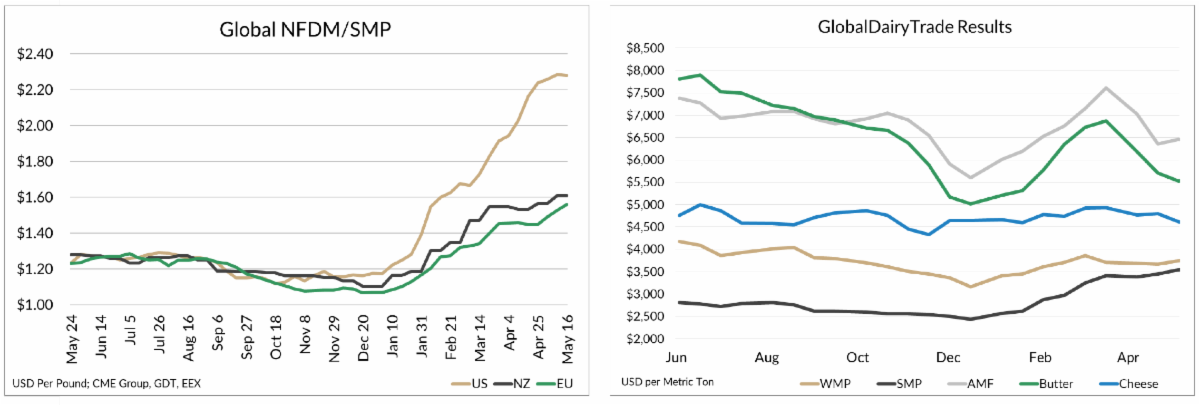
  • At this week’s Global Dairy Trade event, skim milk powder ticked up 0.1% to $1.61 per pound and whole milk powder rose 0.8% to $1.71. Butter lifted 2.7% to $2.57 per pound and cheddar dipped 1.1% to $2.07 per pound.


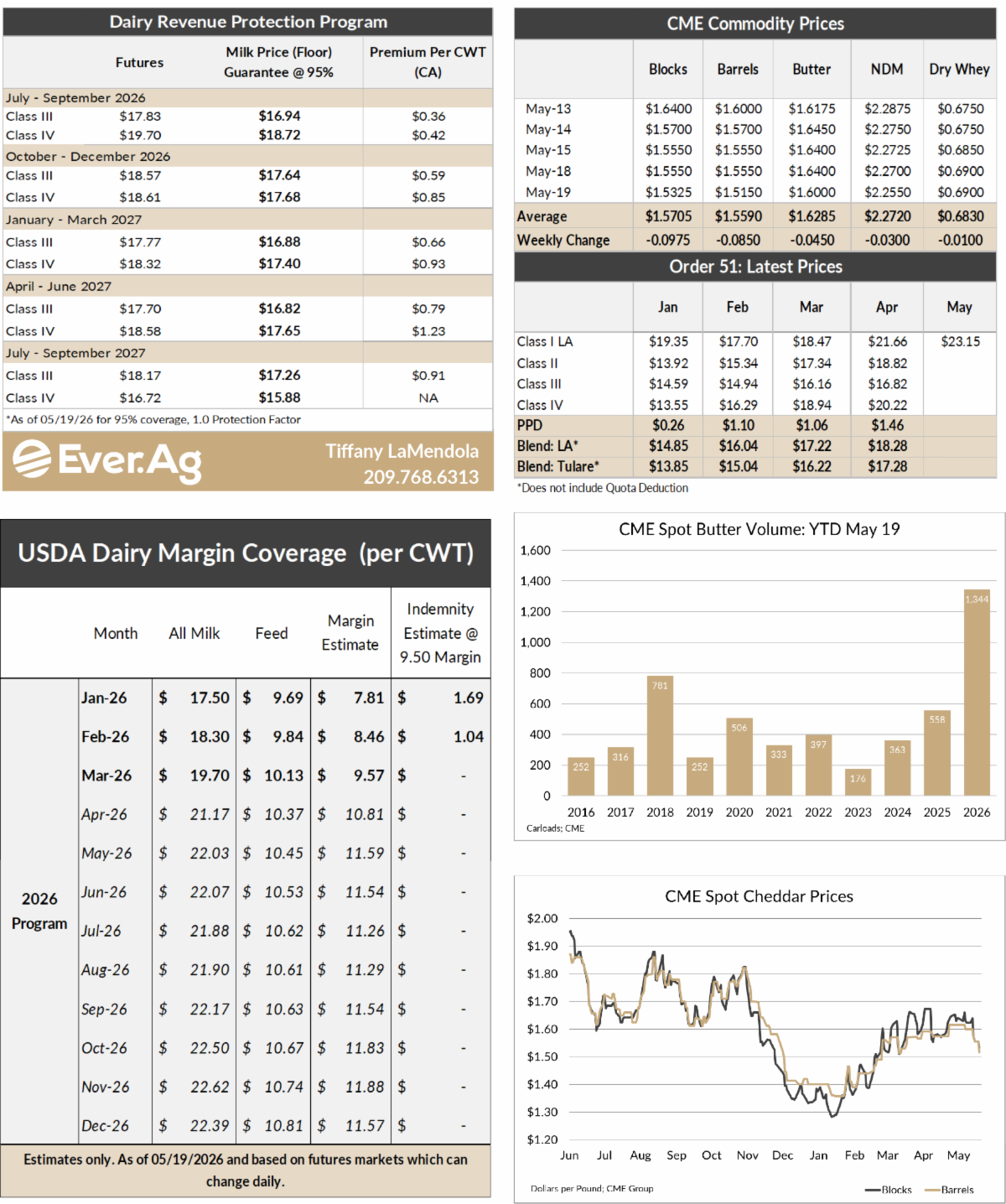
  • The CME butter market seems happy to ping-pong in a range from the mid-$1.50s to the mid-$1.60s. There’s still a lot of butterfat, providing plenty of cream to keep butter churns running. Trading volume remains very heavy in Chicago, with almost 100 loads changing hands for the week ending May 15. Year-to-date, 1,344 lots traded compared to 558 loads this time last year.


  • After being rangebound for weeks, spot blocks slipped below $1.55 per pound for the first time since March. Export demand is still healthy, and while restaurant traffic is choppy, restaurant demand for cheese hasn’t fallen apart. Still, reports indicate there’s plenty of cheese for those who are looking for it.
  • Grain markets paid close attention to the meeting between President Trump and China’s President Xi. Last week, no concrete news on trade deals sent both corn and soybeans tumbling. But on Monday, the White House announced China would buy $17 billion of US agricultural products in 2026, 2027 and 2028. That’s in addition to its earlier commitment to buy US soybeans.


  • On Friday, USDA will release its April Milk Production and Cold Storage reports. That data should provide dairy markets with more direction heading into June.


THANK YOU TO OUR CURRENT SPONSORS


Facebook  Instagram  LinkedIn  Web