Ready to Showcase Your Expertise? Submit Your Proposal by Dec 15!
Rock the Stage at USDLA 2027: Call for Proposals
In 2027, the United States Distance Learning Association celebrates 40 years of advancing and supporting distance education, and we’re inviting educators, innovators, researchers, practitioners, and leaders to help shape this milestone conference that will take place June 21–24, 2027, in Cleveland, Ohio, home of the Rock & Roll Hall of Fame. Presenters may propose sessions for either the onsite or virtual conference experience.
Priority topics include:
Instructional Design & Innovation
Accessibility & Digital Inclusion
Public Policy & Advocacy
K–12 Distance Instruction
Artificial Intelligence in Education
Gamification & Immersive Learning
Proposals are welcomed from professionals working across higher education, K–12, corporate training, telehealth, government, military, and other distance and digital learning environments. Concurrent sessions are 45 minutes, with opportunities to request additional time for immersive activities. First-time presenters are encouraged to submit!
Proposal Deadline: December 15, 2026, at 11:59 p.m. ET
Acceptance Notifications: January 15, 2027
Onsite Conference: June 21–24, 2027 | Cleveland, Ohio
Virtual Conference: June 2027 | Dates forthcoming
This is your opportunity to share what you’re learning, showcase innovative practices, engage colleagues, and contribute to the next chapter of distance and digital learning.
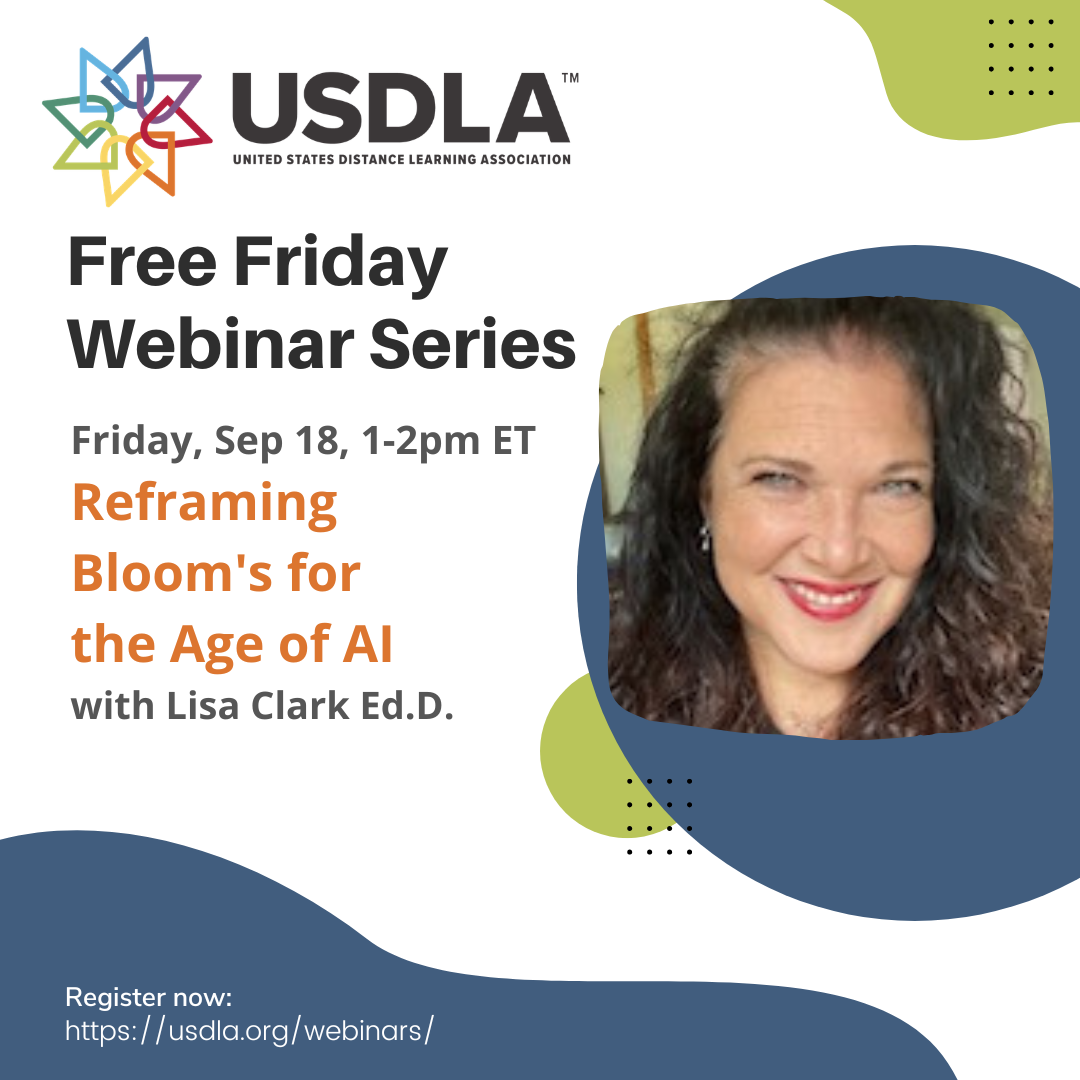
Presenter: Lisa Clark, Ed.D., Associate Vice President, Academic Transformation, Anthology, Inc.
Artificial intelligence is rapidly transforming the skills students need and the way educators design learning. Traditional Bloom’s Taxonomy, while foundational, no longer fully addresses the cognitive and ethical challenges of an AI-driven world. This session introduces a reframed Bloom’s Taxonomy that expands beyond Create to include a new Transform layer, empowering learners to apply knowledge for real-world change and social impact.
Drawing from the newly published white paper Reframing Bloom’s for the Age of AI, this session will demonstrate how institutions can move from fear to framework, using AI not as a threat but as a catalyst for deeper learning. Attendees will explore practical applications of the taxonomy and examine strategies to embed AI literacy, foster critical thinking, and cultivate adaptability across disciplines.
Join us to discover how reframing Bloom’s can help your institution strengthen pedagogy, support faculty innovation, and prepare future-ready graduates.
In order to ensure you receive important notifications such as membership renewals, please be sure to have your IT department whitelist these addresses:
This will help to ensure that emails don't get trapped in your SPAM folder or get returned as undeliverable. Please ensure your IT department whitelists these addresses. If you are using your personal email address, please add these addresses to your contacts or safe senders list.
About United States Distance Learning Association (USDLA)
Formed in 1987, USDLA is a 501(c)3 non-profit association formed in 1987. Our weekly newsletters reach more than 100,000 people globally, including our members and sponsors working in industries including pre-K-12 education, homeschooling, higher education, continuing education, corporate, military, government, and telehealth. Our mission is to promote the development and application of distance learning for education, training, advocacy, and networking: USDLA.org
In addition, USDLA has provided consulting and certification services to a diverse range of institutions, proving that its flexible model scales across different sectors:
Public Universities: University of Central Florida, University of Wisconsin-Stout.
HBCUs: Morgan State University, Bethune-Cookman University.
Private & Specialized Colleges: Berkeley College, Central State University (Ohio), Landmark College (specializing in neurodiversity).
Community Colleges: Various systems, including the Kentucky community college system.
The core philosophy remains that no two engagements are alike, as the solutions must be as unique as the institutional goals they are designed to meet.