|
Ironmaking in 18th Century Prince William County
Written by: Mary Kitiyakara, Senior Librarian, RELIC
| | |
By 1737, Maryland and Virginia produced 91% of the approximately 2,329 tons of pig iron shipped from the colonies to England. The major exports at that time were tobacco, grains, and iron. The Tayloe family played a significant role in the manufacturing of iron not only in Prince William County, but also as an export to Great Britain.
Despite the 1750 Iron Act, which was one of the British Trade and Navigation Acts passed to reduce the competition of the growing iron industry in the American colonies by restricting the building of furnaces and production of finished goods, the iron industry continued to grow, but not without challenges in resources and an unsustainable technology.
| The Process of Making Pig Iron | | | | |
Four major elements, in very large quantities, were needed before an iron furnace could be built: land with a dense forest, iron ore, limestone or oyster shell, and water. To create pig iron, which was the type of iron purchased during the American Revolution, it required approximately ½ an acre of forest to make enough charcoal to produce a ton of pig iron, and the average annual production was 400 tons.
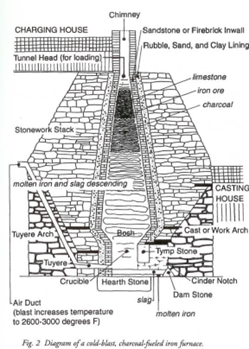
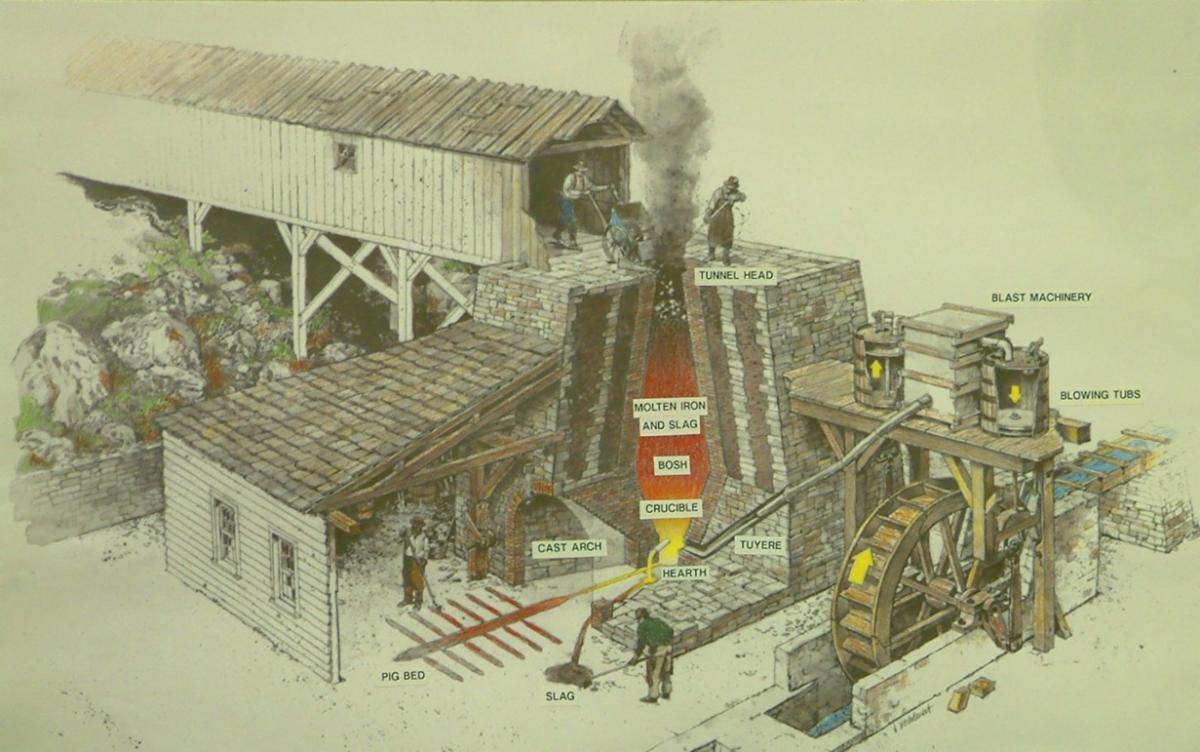
In the diagram, a blast furnace, which was about 25 feet high and 25 feet across, required three tons of iron ore and 300 bushels of charcoal every 24 hours, or as long as it was running (Survey, page 2). The ore needed to be dug up locally or imported from Maryland. Trees needed to be felled and burned for charcoal. Workers, mostly skilled or semi-skilled enslaved people, loaded the material in alternating layers of charcoal, ore, and limestone or oyster shells.
| | |
To melt the ore, they used a water mill to power the bellows to maintain a steady, high temperature (Kamoie, page 15).
Next, the melted ore went to the hearth and was purified to remove the non-metallic material by adding a fluxing agent; the byproduct was called slag. The molten iron was then channeled into a series of molds on the casting house floor to make pigs. The name came from the E-shaped molds, which resembled pigs suckling from a sow.
| | | The Neabsco Furnace and the American Revolution | | According to Laura C. Kamoie, the author of the book “Neabsco and Occoquan: The Tayloe Family Iron Plantations, 1730-1830,” during the years of 1770-1774 and 1777-1778, the two ironworks, Neabsco and Occoquan, together, only produced 583 tons of pig iron and, in 1771, none were produced. By 1770, the Neabsco furnace had been in operation for 40 years, and the Occoquan for 15, and they shared the same natural resources and supplies, which depleted production. Plus, repairs and parts replacement costs led to a significant loss in production. | | | | |
In September 1775, Tayloe began supplying James Hunter’s Fredericksburg Rappahannock Forge “with a sufficiency of Pig Iron.” Hunter focused his forging activities on the manufacturing of arms and munitions before and during the Revolution (Kamoie, page 46).
| | |
Taylor produced military equipment on behalf of the American cause and was paid 705.8.3 pounds for “sundry cannon Ball, plank, and Pigg Iron furnished for the Navy in Portsmouth” in June of 1776. He supplied the Prince William County militia with “sundry tools” in 1778. Tayloe received £1000 for his pig iron in 1782 (Kamoie, page 46).
There were also challenges, such as the loss of vessels due to the British entering Chesapeake Bay and seizing vessels loaded with various types of supplies, weapons, and much-needed iron ore from Maryland. The loss of enslaved people escaping to British ships, and the extreme damage to the Chesapeake Bay area during the late 1770s, especially in 1781, which went on for six months and left three million pounds sterling damage (Kamoie, page 47).
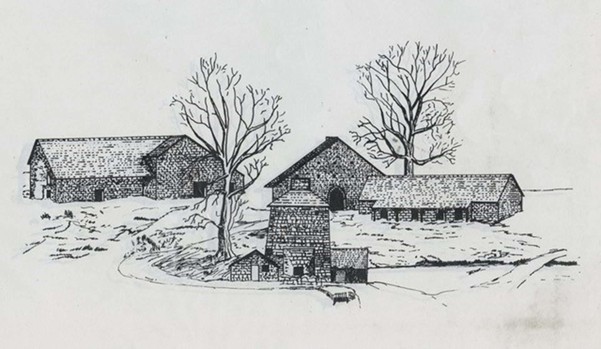
John Tayloe II died in 1779, and the Neabsco Ironworks came to an end in 1805, with John Tayloe III selling off a third of the Neabsco land, and the rest that he could not sell, not for a lack of trying, he converted to agriculture, such as wheat, grain, and corn. The enslaved workers also had to adapt to the change from ironworking to agriculture. There are remnants of the Neabsco Ironworks barely visible throughout the overgrown forested area near Neabsco Creek.
Works Cited
Laura Croghan Kamoie. “Neabsco and Occoquan: The Tayloe Family Iron Plantations, 1730-1830.” Prince William County, Prince William Historical Commission, 2003, pp. 7, 15–21.
“Neabsco Iron Works Site.” Virginia Historic Landmarks Commission, https://eservice.pwcgov.org/library/digitallibrary/hsdw/N_Folder/NeabscoIronWorkSite76-0265/pdfs/NeabscoIronWorkSite76-0265SurvA.pdf.
“Protecting British Trade and Manufacture.” UK Parliament, https://www.parliament.uk/about/living-heritage/transformingsociety/tradeindustry/importexport/overview/protectingbritishtrade/.
Picture 1: Schenawolf, Harry. “Iron Forge in Colonial America,” Revolutionary War Journal, 6 Sept. 2016, https://revolutionarywarjournal.com/iron-forge-in-colonial-america/.
Picture 2: "Ironmaking: Artist’s Rendering of a Cutaway of an Iron Furnace." National Parks Service, https://www.nps.gov/hamp/learn/historyculture/ironmaking.htm.
Picture 3: MacGregor, Rick. "Hunter’s Iron Works." ca 2000, https://encyclopediavirginia.org/hunters-iron-works/. Architectural Drawing.
| | | | Access Video on Demand provides tens of thousands of educational videos, including content from PBS, the BBC, National Geographic, and many other content providers. | | |
Summer Reading
All Ages
June 15–August 16
“Unearth a Story” during Summer Reading, featuring 350+ free programs for all ages. Sign up, track your reading, and earn a free book to keep after reading 500 minutes.
| | | |
Researching Free People of Color in NC and VA: 1800-1865–Perspectives of a Revolution VA250 Lecture Series: Central
Adults
Saturday, June 6, 1:00 p.m.
Join Renate Y. Sanders for a presentation that establishes a framework for documenting Free People of Color in Virginia and North Carolina prior to 1865. Registration required.
| | | |
Genealogy 101: Finding Your Ancestors: Central
Adults
Saturday, June 13, 11:00 a.m.
Summer is the time for family get-togethers and reunions, where you will trade information and memorabilia with other family members. Let RELIC help you compile it and learn more. Registration required.
| | | |
Rippon Lodge Historic Site Presentation: Potomac
All Ages
Monday, June 15, 1:00 p.m.
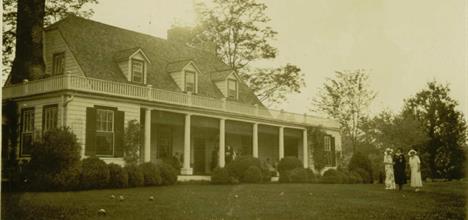
Join the Prince William County Office of Historic Preservation as they discuss the importance of Rippon Lodge and its ties to Colonial Virginia.
| | Photo by Historic Preservation | | |
The Colonial Republic of Pirates–Perspectives of a Revolution VA250 Virtual Series: Virtual
Adults
Wednesday, June 24, 1:00 p.m.
Blackbeard, Calico Jack, Anne Bonny, Mary Read, and a cast of thousands established the first Democratic Republic in the New World, reveling in their freedom and ability to wage warfare as professional thieves. Learn about the Colonial Republic of Pirates from Ed Moore, historian and journalist, from the Maritime Museum in Newport News. Registration required.
| | | |
Podcast Discussion Group: Virtual
Adults
Thursday, June 25, 7:00 p.m.
Join us this month as we discuss Noble Blood (Episodes 10-17). Author Dana Schwartz explores the stories of some of history’s most fascinating royals: the tyrants and the tragic, the murderers and the murdered, and everyone in between. Registration required.
| | | |
Digital Preservation Workshop: Potomac
Adults
Saturday, June 27, 11:00 a.m.–4:00 p.m.
Bring your photos, VHS, and film to digitize and preserve your family memories. Registration required. Click the link to read more about each project to determine how long your project may take. For questions, email libRELIC@pwcgov.org.
| | |
|
Start your historical journey here. RELIC's email newsletter highlights upcoming free events and happenings. Genealogy and local Virginia history are our specialties as a service provided by Prince William Public Libraries (PWPL). You can always find more about us on RELIC's webpage.
RELIC service is available in-person at Central Library (8601 Mathis Avenue, Manassas, VA 20110), by email at librelic@pwcgov.org, and by phone at 703–792–8380.
Hours of Operation
Monday–Wednesday: 10:00 a.m.–8:00 p.m.
Thursday–Friday: 10:00 a.m.–5:00 p.m.
First and Third Saturdays: 10:00 a.m.–5:00 p.m.
Closed Sunday
Due to a staff shortage, RELIC is not always staffed during the above hours. However, the room is available, and service desk staff or substitutes can often help. Please call ahead for staffed hours if you need RELIC staff to be present.
Ask the Tree Hunter
If you wish to make an appointment with Darlene Hunter, RELIC Tree Hunter, please email librelic@pwcgov.org or call 703–792–8380.
| | | | | | |