News and information to help journalists serve the public and stay safe.
|
|
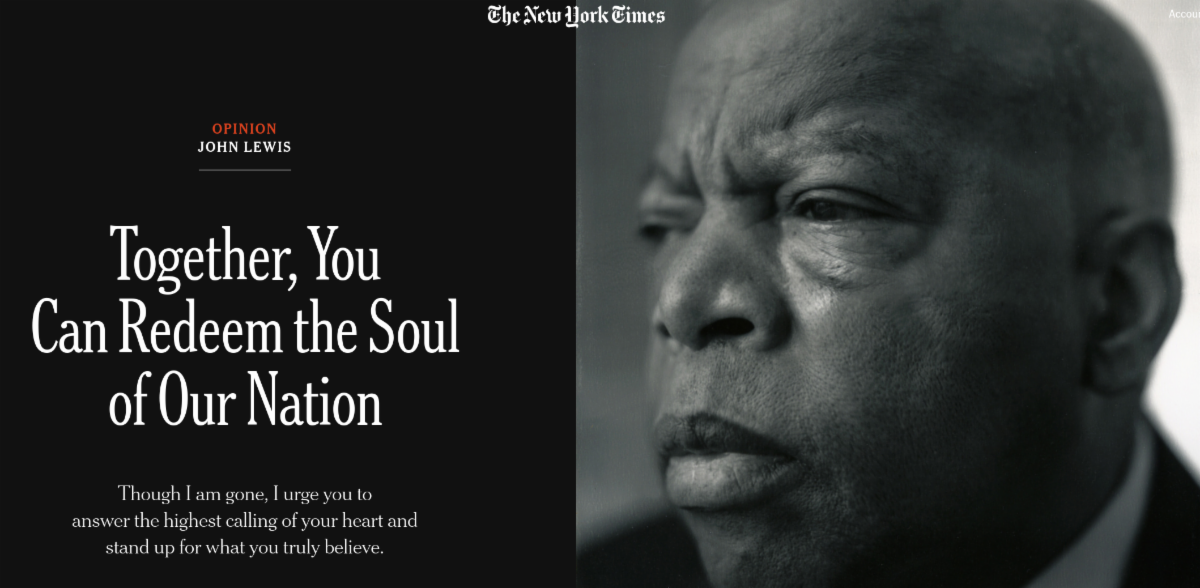
“John Lewis, civil rights icon,
sent me an essay
shortly before he died of cancer on July 17. He wanted to deliver a final message to the nation and asked that we publish it on the occasion of his funeral,”
writes New York Times Editorial Page Editor Kathleen Kingsbury
. “His aide read me an early draft over the phone, and I couldn't help tearing up, thinking of the grief I knew would soon arrive for those who loved him. … As the editing went on, I heard Mr. Lewis received his last rites. I woke up each morning afraid we’d run out of time. But
the text was finalized
the night before he died.”
|
|
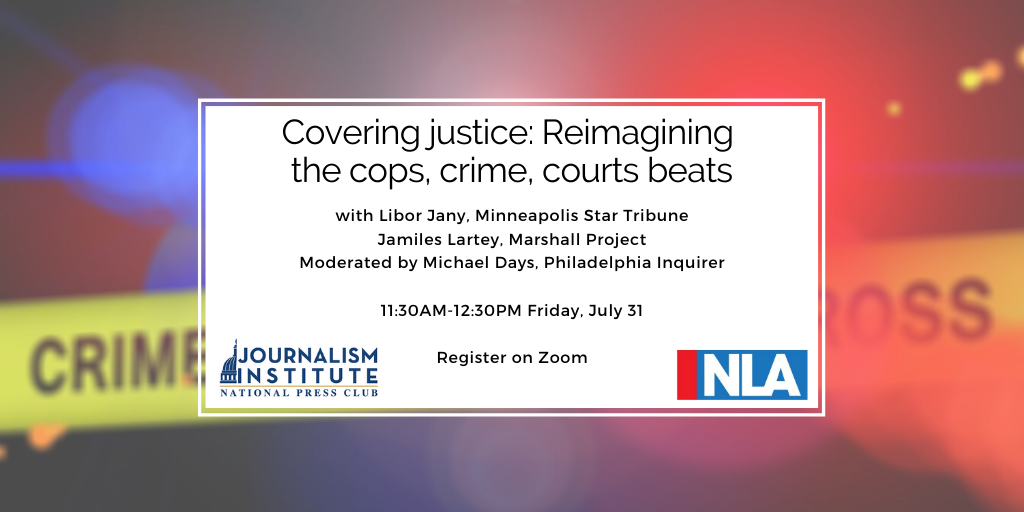
Join moderator
Michael Days
of the Philadelphia Inquirer,
Libor Jany
of the Minneapolis Star Tribune, and
Jamiles Lartey
of the Marshall Project for a conversation with practical suggestions for “Covering Justice: Reimagining the cops, crime, courts beats.”
Registration is now open
for this program co-hosted by the National Press Club Journalism Institute and the News Leaders Association, on July 31, from 11:30 a.m.-12:30 p.m. EDT.
The conversation will help journalists and the public understand:
- Daily decisions newsrooms could make differently, including the use of suspect descriptions, mug shots or coded language like ‘unarmed black man’
- Short-term considerations, for example eliminating the crime blotter, explaining how police are funded or what it means to ‘abolish’ or ‘defund’ police'
- Long-term questions of who the audience is for justice coverage, whose authority we seek/trust, how we can re-envision routines and what we should be tracking & investigating.
|
|
The Washington Post this week adopted the Associated Press’ decision to capitalize Black as a racial identifier, with a twist. It also will capitalize White — a change the AP and other news organizations have declined to embrace.
“In American history, many White Europeans who entered the country during times of mass migration were the targets of racial and ethnic discrimination,”
The Post said in its announcement
Wednesday. “These diverse ethnicities were eventually assimilated into the collective group that has had its own cultural and historical impact on the nation. As such,
White should be represented with a capital W
.”
The decision drew a quick reaction on social media and on the comments section of
The WashPost PR Blog
. Critics of the decision generally fell into three camps:
- There is no need to capitalize either because the country does not need to be categorized along racial lines.
- Capitalized white is a self-identifier for white supremacists; by using “White,” the newspaper is acknowledging that racist construct.
- White people do not have their own shared cultural identity because they comprise people of Anglo-Saxon descent, northern and southern Europeans, Jews and Middle Easterners.
But the idea of capitalizing white has been endorsed by the National Association of Black Journalists and by the
Diversity Style Guide
.
NABJ “believes it is important to capitalize ‘Black’ when referring to (and out of respect for) the Black diaspora,”
NABJ said in a statement
in June. “NABJ also recommends that whenever a color is used to appropriately describe race then it should be capitalized, including White and Brown.”
The
Diversity Style Guide states
: “After much research and consideration, the editor of The Diversity Style Guide elected to capitalize Black and White when used in a racial context, but most would say it's not incorrect to lowercase those words.”
In an
opinion piece
in The Post last week, historian
Nell Irvin Painter
endorsed capitalizing the W, arguing that white people should not be able to pretend they are racially neutral.
“In terms of racial identity, white Americans have had the choice of being something vague, something unraced and separate from race,” she wrote. “A capitalized ‘White’ challenges that freedom, by unmasking ‘Whiteness’ as an American racial identity as historically important as ‘Blackness’ — which it certainly is.
“No longer should white people be allowed the comfort of this racial invisibility; they should have to see themselves as raced. Being racialized makes white people squirm, so let’s racialize them with that capital W.”
The National Press Club Journalism Institute uses an uppercase B for Black when the word is being used in a racial, ethnic or cultural sense, and we continue to consider related language issues. Please
let us know your thoughts
.
|
|
Fake news isn’t new. But the Internet provides a unique environment for misinformation that it just might take an intelligence officer to understand.
In the new book
TRUE OR FALSE
, former CIA analyst and disinformation expert
Cindy Otis
dissects the long history of fake news. She offers strategies she learned during her tenure at the CIA for how to recognize misinformation and overcome our own information biases.
Otis
left the CIA
in 2017 — shortly after the Intelligence Community released a declassified assessment showing that Russia interfered in the 2016 U.S. presidential election. Since then,
she’s written
extensively on politics and the dangers of information as a weapon.
“Those pushing false information, whether it’s individuals, governments or groups, have long relied on narratives that stoke strong emotions,” Otis said.
The Journalism Institute reached out to Otis by email to find out what journalists can learn from her debut book.
What inspired you to write a book on the history of fake news?
Otis
: After it became public knowledge that Russia interfered in the 2016 US presidential election, I watched a sort of collective panic unfold across the country and a couple of worrying trends begin — namely, a fear from average information consumers that they no longer could trust things like the media, their government, and other sources of information. People were also looking for answers about how to figure out and analyze what they were seeing on all of their different information and social media feeds each day. I wrote TRUE OR FALSE in response to both things. It's a history of disinformation and fake news to demonstrate how the problem has been and lessons we can learn as a result, and it's also a guide, a step-by-step action plan to help people make sure they're not falling for and/or amplifying false or misleading content.
What was the biggest surprise from your research?
Otis
: I think the thing that surprised me the most was just how much my own understanding of certain historical events was the outcome of false information spread at the time. One of the examples I talk about in my book, and it's kind of a fun one, is the supposed mass, national hysteria caused by Orson Welles's War of the Worlds radio broadcast in 1938. I had read newspaper archives and even more recent books that had talked about the national panic it had caused when he and a team of voice actors reenacted an alien invasion, but in further research learned it didn't actually happen that way.
|
|
|
Government records belong to the public, but journalists often face delays and redactions that make it difficult to get the information they need to inform the public about significant issues. Against the backdrop of the COVID-19 pandemic, it’s more important than ever for journalists to be strategic when they are seeking government records.
Panelists
Miranda Spivack
, journalism fellow at the Brechner Center for Freedom of Information at the University of Florida, and
Mark Walker
, FOIA coordinator in The New York Times’ Washington Bureau, will cover strategies and approaches to requesting and obtaining public records using the Freedom of Information Act and state open records laws.
|
|
The National Press Club Journalism Institute is spotlighting
the next generation of journalists
, students who graduated from college or Master’s programs this spring into
a challenging job market
. We hope they’ll meet future bosses and colleagues here, who will reach out and support them in building journalism’s future together.
School
:
Northern Kentucky University
Location
:
Highland Heights, KY
What's been your best moment in journalism?
Mitten
: I think my most impactful moment as a journalist so far was pushing out several stories to our student body about how to stay safe during the
COVID-19 pandemic
. It was important information that reached a lot of people and helped them avoid being infected.
What's the wackiest story you've worked on?
Mitten
: I think the wackiest story I wrote was about the time that a
2,000-year-old mummy
made a pit-stop at our campus to be sent through a
state-of-the-art X-ray machine
in our new medical building. It's not every day you get to see an artifact from the year 100 A.D.
|
|
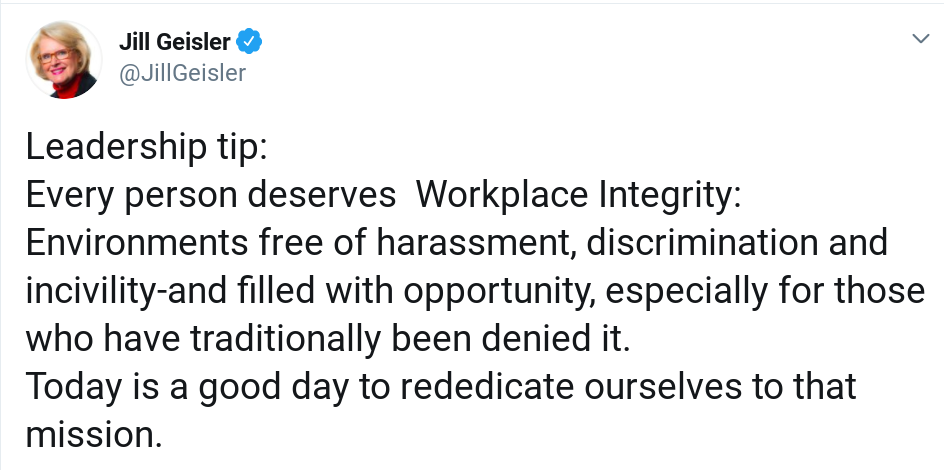
Acting on that mission requires moving beyond what’s legal and doing what’s ethical every day in your organization by using critical thinking skills, having courageous conversations, and building a culture of trust and respect. Learn more about how
the Power Shift project can help
.
Advice from
Jill Geisler
, Bill Plante Chair in Leadership & Media Integrity, Loyola University Chicago, Freedom Forum Fellow in Women’s Leadership
|
|
|
You. Are. Exhausted. So why haven’t you scheduled your paid time off?
If a long vacation seems out of reach, consider taking several long weekends or a mid-week day off.
Here’s how you can break away at your comfort level for traveling now.
|
|
A recap
in our newsletter of Wednesday’s National Press Club Journalism Institute virtual program on opinion writing misquoted Los Angeles Times editorial page editor Sewell Chan. Chan said students of color comprise a majority of the Los Angeles school system. We regret the error.
|
|
This newsletter is written & edited by the National Press Club Journalism Institute staff: Beth Francesco, Holly Butcher Grant, Jim Kuhnhenn, and Julie Moos.
Send us your questions and suggestions
for topics to cover.
|
|
|
|
|
|
|