Summer 2026 Vermillion River Watershed News | |
|
- What's new in the 2026-2035 Vermillion River Watershed Management Plan
- State finds PFAS in Vermillion River fish tissue, advises reduced consumption
- CAC visits North Creek culverts targeted for replacement/repair
- Newest CAC members bring strong conservation backgrounds
- WBIF stormwater improvements in Hastings, Lakeville
- Storm drain stenciling: Fun for families and friends
- Groundwater conservation pays off big in Lakeville
- Now is a great time to plan for fall conservation practices on the farm
- Upcoming events
| |
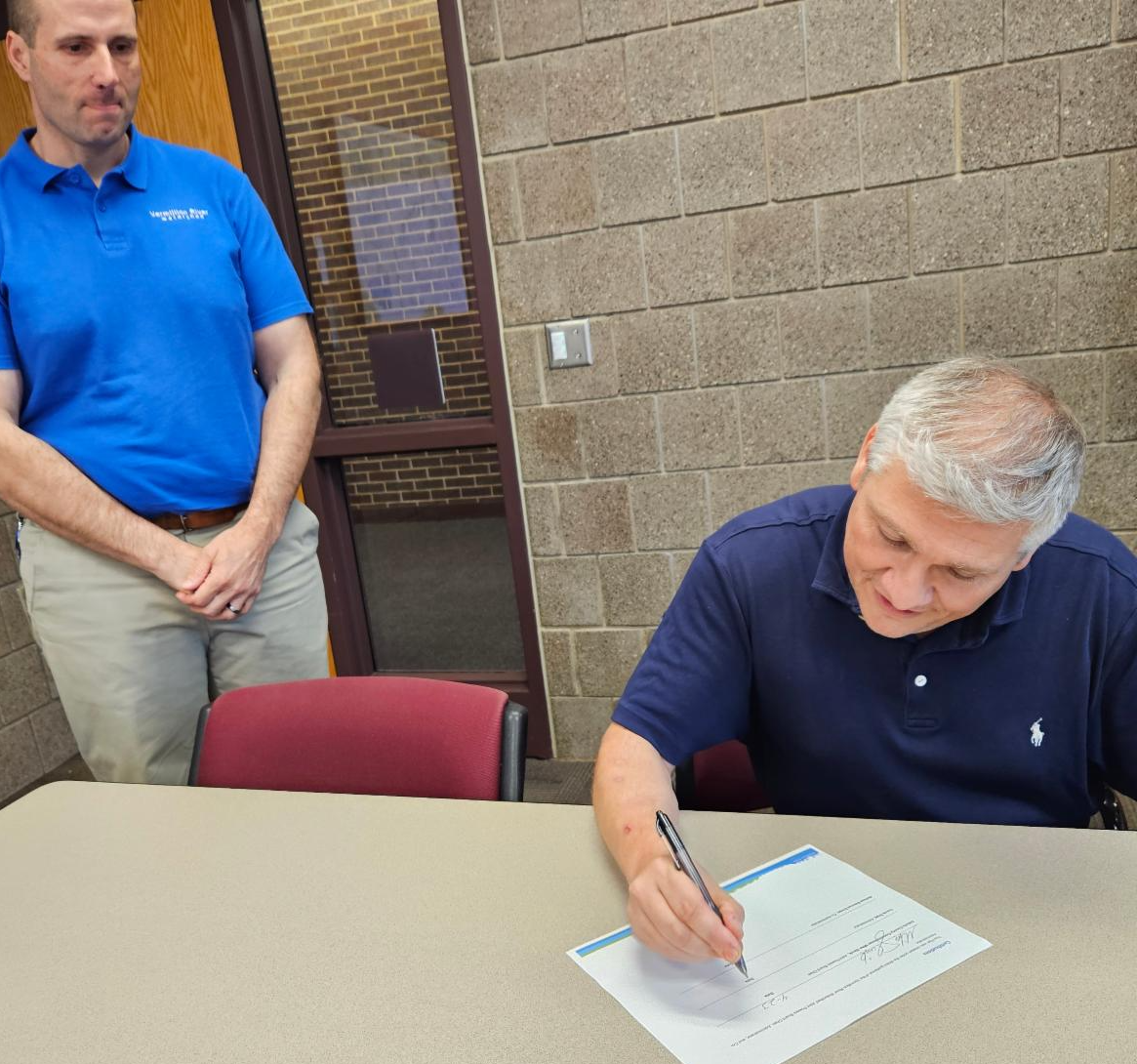
| Above: Dakota County Commissioner Mike Slavik (right, seated), 2026 Vermillion River Watershed Joint Powers Board Chair, signs the certifications page of the 2026-2035 WMP, as VRWJPO Administrator Travis Thiel (left) looks on. | |
|
What's new in the 2026-2035 Vermillion River Watershed Management Plan
After nearly three years of development, the Vermillion River Watershed Joint Powers Organization (VRWJPO) formally adopted the 2026-2035 Vermillion River Watershed Management Plan (WMP) on April 22, 2026. It's our third-generation WMP and lays out our priority Issues, Goals, Objectives, and Actions for the next ten years. Thank you to all who contributed ideas, concerns, and comments that helped us shape the Plan.
This WMP has a different look from past plan documents. It uses colors and icons to designate Issue Categories and provides clear Action item designations. This makes it easier to follow the document's structure and measure progress toward our Goals.
Now, cities and townships in the watershed must update their Local Water Management Plans (LWMPs) and other local controls to conform with the VRWJPO Standards, which have had several updates from the 2016-2025 WMP. The VRWJPO will review and approve LWMPs within 60 days of receipt.
The 2026-2035 WMP is public on the VRWJPO website.
| |
| |
State finds PFAS in Vermillion River fish, advises reduced consumption
Recent Vermillion River fish tissue testing by state agencies discovered levels of per- and polyfluoroalkyl substances (PFAS, or "forever chemicals") that may have impacts on human health. The Minnesota Department of Health (MDH) responded by issuing the following consumption guidelines for fish caught from anywhere in the Vermillion River and tributaries upstream of the Hastings Dam.
- Sensitive populations: For all fish species, do not eat
Includes: children under 15; girls, women, and people age 15 or older who may become pregnant, are pregnant, breastfeeding, or plan to breastfeed.
- All others: Eat only up to 1 serving a month of one fish species
Includes: people not planning to become pregnant; boys and men age 15 or older.
Complete MDH guidelines can be found here.
| |
|
Newest CAC members bring strong conservation backgrounds
Two VRWJPO residents have joined the CAC in 2026 - Alex Franzen (Marshan Township) and Tom Sauer (Lakeville). Let's get to know them.
| |
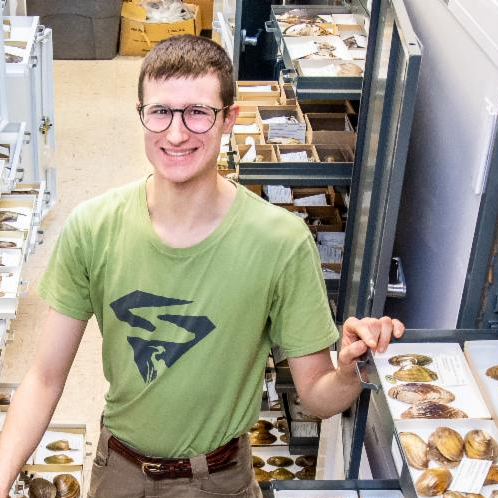
Alex Franzen
Originally from Hastings, Alex attended the University of Minnesota for his Bachelor's degree in Fisheries and Wildlife. He then went on to receive a Doctorate in Ecology and Evolutionary Biology from the University of Oklahoma, where he studied endangered freshwater mollusks. Having spent much of his youth exploring streams and studying the critters that live in and around them, Alex remains motivated to increase state and local collective knowledge of freshwater ecosystems to better protect them, incorporating consequences of habitat alteration and climate change. He joined the CAC to help support the Vermillion River as a healthy ecosystem, and to stay informed about management of the unique Vermillion River system.
| |
|
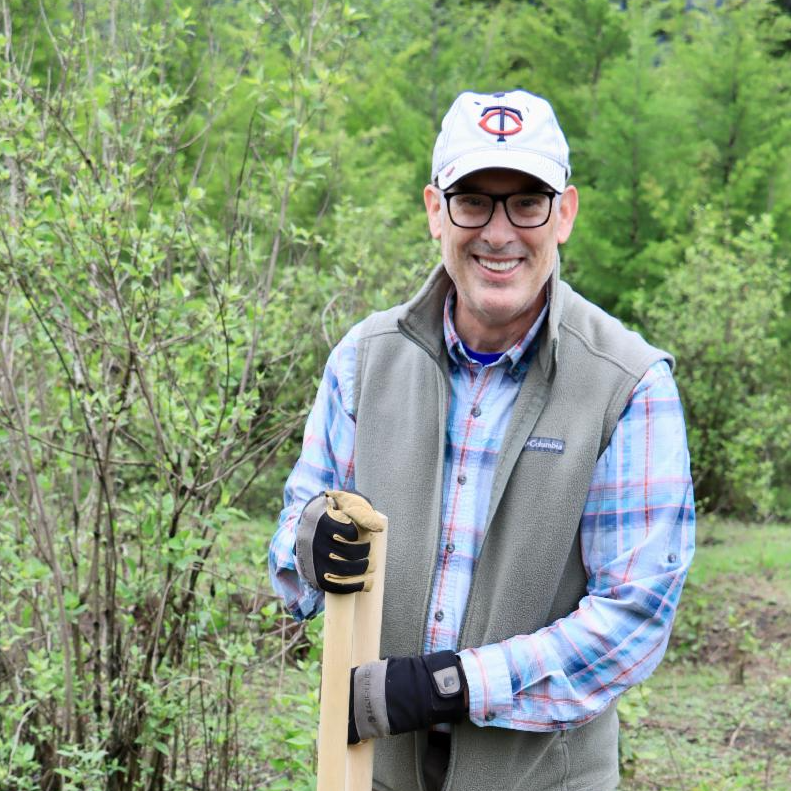
Tom Sauer
Tom was raised on a farm in Murray County in southwest Minnesota. After university education in Wisconsin, he spent 29 years as a soil scientist with the United States Department of Agriculture (USDA). Following retirement from his research position in 2022, Tom now works part-time for a non-profit on contract from the USDA Natural Resources Conservation Service in the area of forest soil health. He is married with a son in the U.S. Air Force and a daughter who is a recent University of Minnesota graduate. When not working on soil health, Tom enjoys gardening, woodworking, and reading.
| |
|  |
Community Advisory Committee visits North Creek culverts targeted for replacement and repair
The Vermillion River Watershed Community Advisory Committee (CAC) took a field trip during their May 13 meeting to visit two of three stream crossings to be improved in an upcoming project in the cities of Empire and Farmington. The two crossings are just north of the intersection of Minnesota Highway 3 and Dakota County Rd. 66, near the confluence of North Creek, Middle Creek, and the Vermillion River Mainstem.
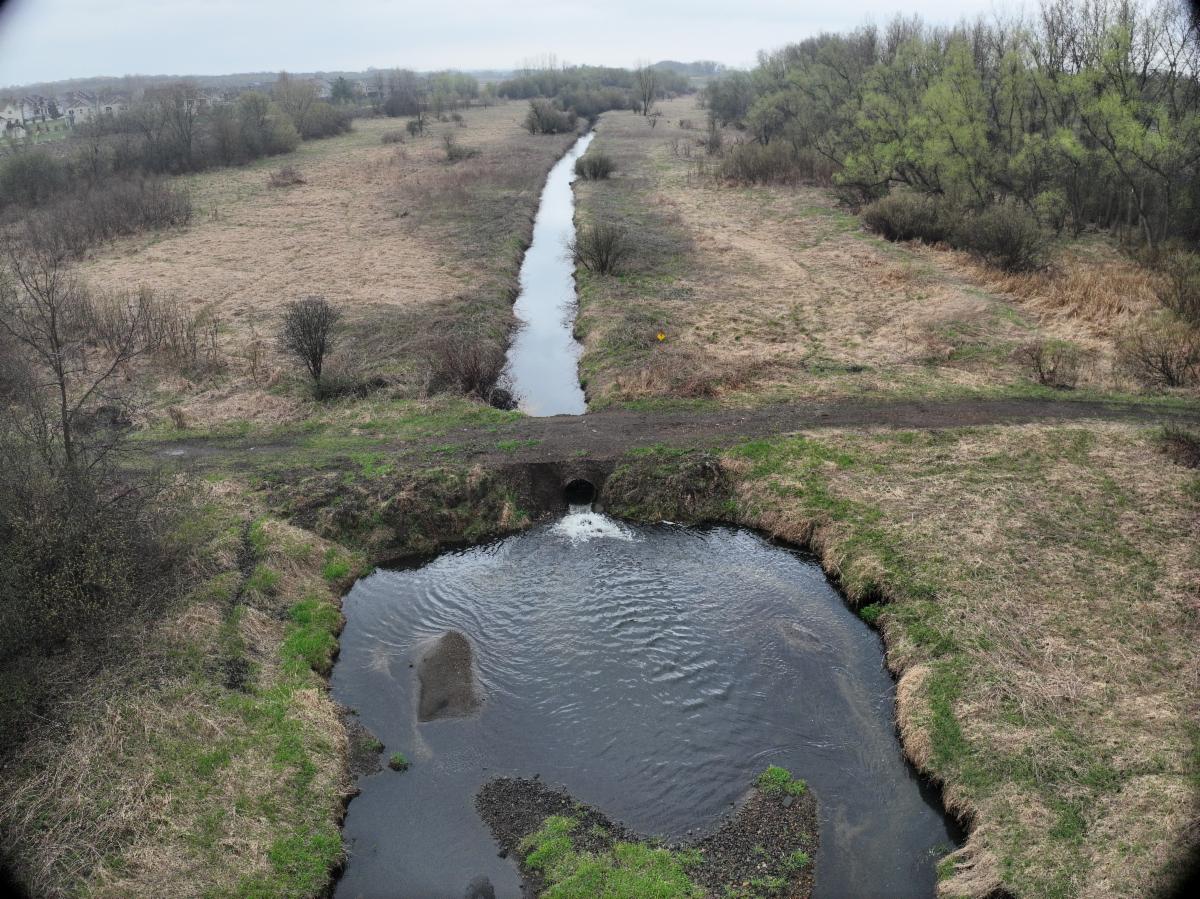
Staff explained how the culverts conveying stream drainage are perched and undersized, blocking fish passage, disrupting habitat, and causing erosion that leads to poor water quality. A geomorphic assessment in the early 2010s identified these problem areas for potential restoration efforts. The VRWJPO was awarded Conservation Partners Legacy (CPL) grants totaling $864,155 from the Department of Natural Resources in 2024 for this project and has been working with local stakeholders to implement the improvements. Committee members came away more engaged with the VRWJPO's on-the-ground work.
Learn more about this project on our website. Construction is planned for later this year.
If this kind of field trip sounds like fun to you, consider joining the CAC!
| |
Above: An April 2026 drone image of a culvert slated for replacement in the VRWJPO project. The channel has been eroded and overwidened as a result of the undersized culvert, something the CAC witnessed up close. |
WBIF stormwater improvements in Lakeville, Hastings
In other project news, two stormwater treatment projects funded by Watershed-Based Implementation Funding (WBIF) are happening this summer:
In Lakeville, the VRWJPO and City will be installing a hydrodynamic separator (HDS) on Firelight Way, just east of Greenridge Park across Flagstaff Ave. An HDS is a device within a storm sewer system that uses cyclonic forces to remove sediment pollution from stormwater runoff before it reaches surface waterbodies. It's estimated that this device will reduce stormwater runoff sediment pollution reaching North Creek by an average of 1,868 lbs. per year.
In Hastings, an infiltration basin will be installed on City-owned property near the Lower Vermillion River Mainstem at the intersection of 15th St. and Bailly St. The basin will provide stormwater treatment to a 43-acre drainage area, filtering out excess sediment and phosphorus from stormwater runoff via vegetation and filter soil media before it can reach the River. Estimated pollutant reductions are 2.9 tons/year of sediment and 9.1 lbs./year of total phosphorus.
The CPL and WBIF grants are funded through the Minnesota Clean Water, Land, and Legacy Amendment approved by voters in 2008. Read more about it here.
| |
| | Storm drain stenciling: Fun for families and friends | |
| |
If you've adopted a storm drain, you've probably heard that the water going down the pipes isn't going to a treatment plant. Stormwater runoff often contains pollutants like fertilizer, grass clippings, pet waste, and anything else you might find on the street. It's headed for local streams and lakes, and eventually, the Vermillion and Mississippi Rivers. If we keep pollutants out of the drain in the first place, that's a win! Adopt your drain today and clean it regularly.
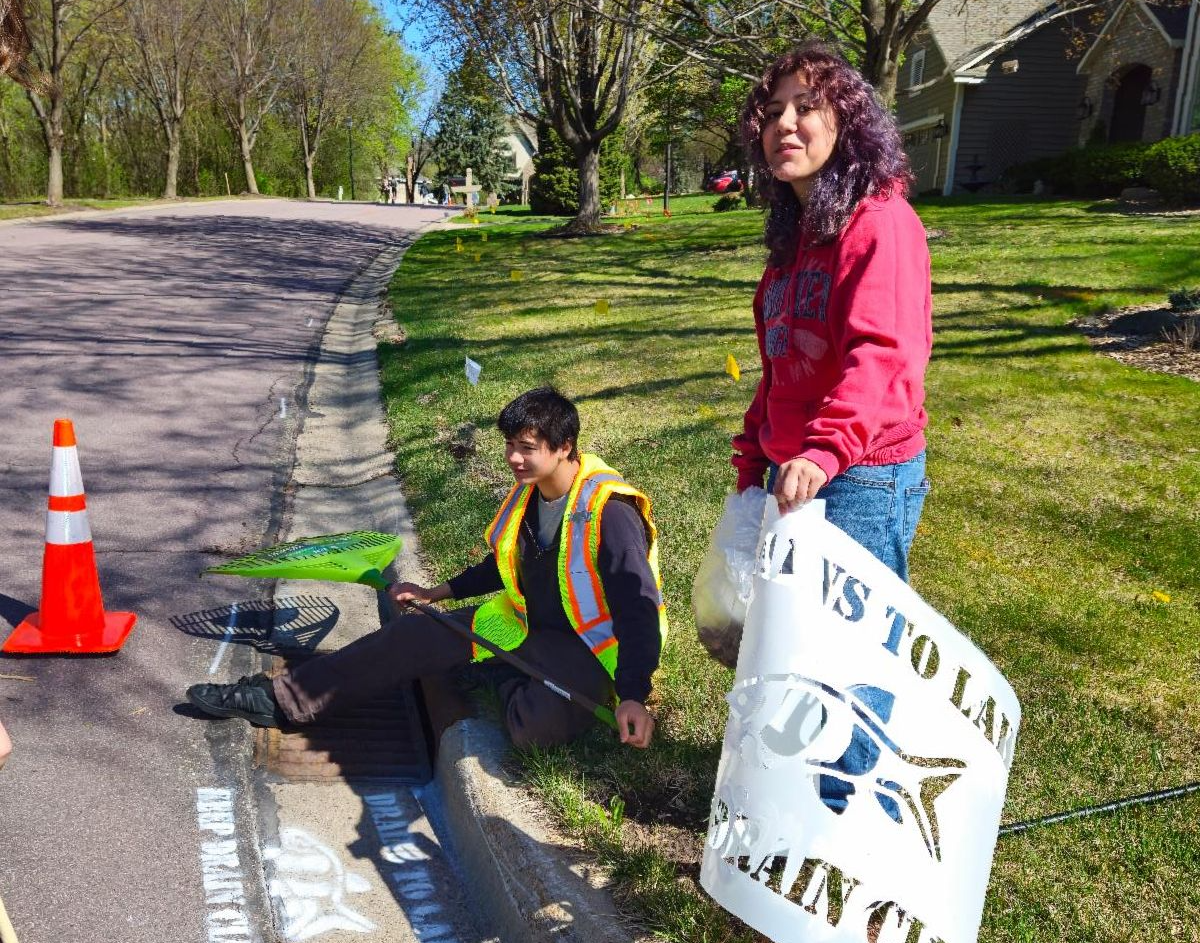
That's not all you can do. Amplify your impact by stenciling storm drains - spread the message that they drain to lakes and streams and must be kept clean. You can borrow storm drain stencils from us!
We have three 3 ft. x 2 ft. stencils at our office, with the following words, respectively:
- Drains to Vermillion River - Keep Drain Clean
- Drains to Lake - Keep Drain Clean
- Drains to Creek - Keep Drain Clean
We can also provide white spray paint, reflective vests, and traffic cones for safety while you stencil, as well as maps of your area's storm drain network.
It's best to have a few other people with you while you clean and stencil your storm drains - make it an activity for families, friends, lake associations, clubs, co-workers, or any other group of people. Consider applying for a VRWJPO Stewardship Grant if your organization wants to host a big drain event.
Request a kit by clicking the button below!
| |
| Now is a great time to plan for fall soil health on the farm | |
|
If you're a farmer, you may be still recovering from spring planting. But it's never too early to think about what to do when the crop's out of the ground.
Agricultural conservation practices, such as cover crops and reduced tillage, help keep soil in place, increase farm productivity and profitability, and protect nearby habitat and water quality. Whether you raise field corn and soybeans, canning crops like sweet corn or peas, or graze livestock on pastures, our soil and water conservation districts (SWCDs) are ready to assist you with implementing soil health practices on your land.
Many of these activities are best completed in the fall, so plan ahead now.
In Dakota County, visit www.dakotaswcd.org, call 651-480-7777, or email swcd@co.dakota.mn.us to ask about soil health assistance.
In Scott County, visit www.scottswcd.org, call (952) 492-5425, or email info@scottswcd.org.
| |
|
Groundwater sustainability efforts pay off in Lakeville
| |
|
The Vermillion River relies on a steady groundwater supply. Aquifers feed cold, clean water into the River and tributaries from below the surface, a big part of creating habitat for the trout populations the watershed is known for. Residents rely on groundwater for drinking and household use - it's neither free of charge nor infinitely available.
Lawn irrigation can put a strain on municipal water systems when it's managed inefficiently. One way VRWJPO promoted groundwater conservation practices was working with cities to conduct irrigation system audits at homeowners' associations (HOAs) between 2018 and 2023. Following comprehensive on-site system inspections, the 24 total participating HOAs received tailored recommendations for irrigation efficiency improvements, leading to significant reductions in water usage and lower costs to residents.
Recently, we heard from a 2021 audit participant. Bellante Townhome HOA, northwest of Lake Marion, said that they've cut their annual water bill from $30,000 prior to the audit down to $13,000 in 2025. That's more than a 50% decrease in water use.
If you look on a GIS map, you might notice that Bellante's 13 acres are not within the political boundaries of the VRWJPO (though very close). Groundwater doesn't follow the same watershed boundaries we set on the surface, however. Water conservation efforts both inside and outside the VRWJPO support a healthy river system.
| |
| | |
Sunday, June 7 - VRWJPO at Dakota County Take a Kid Fishing Day, 12-3 p.m., Thompson County Park, West St. Paul
Tuesday, June 9 - Dakota SWCD Landscaping for Clean Water Introductory Class, 6 p.m., Rosemount Public Works Campus
Thursday, June 25 - Vermillion River Watershed Joint Powers Board Meeting, 1 p.m., Dakota County Extension and Conservation Center, Farmington
Tuesday, July 7 - VRWJPO at City of Hastings Party in the Park, 5:30 p.m., Levee Park, Hastings
Thursday, July 23 - VRWJPB Meeting, 1 p.m, Dakota County Extension and Conservation Center
August 10-16 - VRWJPO at Dakota County Fair, Fairgrounds, Farmington
| | | | |