Rail & Labor News from RWU
| | Weekly Digest Number 8 - February 24, 2026 | | Welcome to the RWU Rail & Labor News! This news bulletin is produced and emailed out each Tuesday morning. We hope you find each week's news and information useful. If so, please share with co-workers, friends, and colleagues. If you like, you can sign them up to get all the news from RWU HERE. Or forward them the link. Got a hot tip? Please forward the article and a link to raillabornews@gmail.com. Note: If you read over this news bulletin each week, you will be sure to never miss the important news of what is going on in the railroad world from a worker's perspective! | | THIS WEEK'S RAIL AND LABOR NEWS | | Editor's Note: The railroads of this nation were built by working hands to serve the public good, not to be carved into empires of private control. When power over vast stretches of the national rail network is concentrated into fewer corporate hands, it is not efficiency being pursued.. it is dominance. Every mile of track that restricts passenger movement or community access in the name of consolidation is a mile taken from the people who built, maintain, and depend upon it. The question before regulators is not whether this merger is profitable, but whether it is just. And if it diminishes public mobility, worker stability, or community lifelines, then it is not progress, it is dispossession. | |
|
Transportation for America / February 13th
The proposed Union Pacific–Norfolk Southern merger could reshape America’s rail network for generations. Mergers between major freight railroads often trigger service cuts or track closures, changes that could reduce passenger train service for communities that rely on rail. As regulators push back on an incomplete filing, these potential impacts underscore why passenger rail and the communities it serves must remain central to the review.
For many Americans, passenger rail is more than just transportation. It connects families, enables workers to reach their jobs, and links small towns to the broader economy. A proposed merger between Union Pacific and Norfolk Southern would consolidate freight control over vast portions of the rail network, giving a single operator power over passenger rail access, reliability, and future expansion. If left unchecked, this multibillion-dollar deal could reshape the national rail network in ways that undermine mobility and economic opportunity for the communities that rely on it most. Protecting and strengthening passenger rail must remain a central focus as regulators review this historic consolidation.
| |
| Editor's Note: The nation’s passenger railroad stands as a public trust, built through generations of labor and sustained by the people who depend on it every day. Plans to fracture Amtrak into separate corporate bodies place distance between public responsibility and the system that carries millions across this country. Workers, passengers, and communities understand what follows when essential rail functions are carved into pieces and governed through layered corporate control. The rails that bind this nation together require unified stewardship, clear accountability, and protection from private extraction. Any restructuring that weakens public authority over passenger rail invites a transfer of power away from the people who built and sustain it. | |
|
Rail Passengers / February 19th
The Federal Railroad Administration (FRA) has revealed that it is directing Amtrak to undertake a dramatic organizational restructuring, breaking itself into three distinct operational entities within an umbrella holding company, focusing on operations, rolling stock management and leasing, and infrastructure management and construction. The FRA teased the restructuring at an event held by the American Association of State Highway and Transportation Officials Council on Rail Transportation last week. Additionally, Bloomberg covered expressions of concern from a leading labor organization that the potential restructuring could lead to the eventual privatization of Amtrak’s operations.
Rail Passengers has received an initial briefing on the proposed restructuring from FRA officials, with more in depth briefings scheduled. The outline of the proposal, which will presumably be fleshed out through a public process over the coming months, involves the National Railroad Passenger Corporation (NRPC), currently doing business as Amtrak, acting as a holding company for three distinct and separate subsidiaries: an infrastructure management entity, a rolling stock management entity, and an operational entity.
| |
| Editor's Note: A coast to coast freight empire stands poised once again before federal authority, asking permission to gather still more power over the arteries of national commerce. The Surface Transportation Board now faces a decision that will shape who truly governs the movement of goods, workers, and communities across this country. When rail systems consolidate at this scale, the consequences are carried by the people who operate the trains and the regions whose economies depend upon fair access to the rails. Working railroaders and the public deserve more than technical compliance with filing requirements. They deserve a system governed with full regard for human livelihoods, regional stability, and the shared infrastructure their labor has sustained for generations. | |
|
Progressive Railroading / February 17th
Union Pacific Railroad and Norfolk Southern Railway informed the Surface Transportation Board today that they anticipate filing a revised application on April 30 for their proposed merger.
The Class Is had to let the STB know by today whether they would revise their proposal calling for UP to acquire NS and combine their operations into one coast-to-coast freight railroad. The railroads filed their initial application with the STB on Dec. 19, 2025; they announced their plan to merge in late July 2025.
On Jan. 16, the STB unanimously ruled that the application was incomplete because it did not include certain information that's required under the board's regulations. The decision was based solely on the incompleteness of the application and is not an indication of how the board might ultimately assess any future revised application, STB members said last month in a press release.
| |
| Editor's Note: The opposition to the proposed UP-NS continues to build from all quarters - labor and industry, shippers and passengers, Republicans and Democrats, and from the rail industry itself. Please see the RWU Campaign Page for listings of organizations, unions, corporations, politicians and others who are opposed. Want to get involved in the fight? Contact RWU at info@railroadworkersunited.org | |
Trains Magazine / February 17th
Top legal officials in seven Republican states are asking the U.S. Department of Justice to scrutinize the proposed Union Pacific-Norfolk Southern merger.
The group of state attorneys general led by Montana’s Austin Knudsen claim that the east-west consolidation will stifle competition and increase costs for Americans.
The coalition in a letter asks Acting Assistant Attorney General Omeed Assefi to review the proposed merger to provide additional analysis as the Surface Transportation Board evaluates the transaction. The STB has the sole authority to approve or reject the $85 billion deal, but the Justice Department’s Antitrust Division weighs in on rail mergers in filings with the railroad regulator.
Union Pacific plans to file an updated merger application with the STB on April 30.
| | Editor's Note: Labor does not pause for holidays, and the nation continues to move because working people report for duty while others gather at home. Time given on days meant for rest, remembrance, and family carries a real human cost that demands fair recognition. The Holiday Pay Act affirms a simple principle that railroaders and working people have long understood.. sacrifice deserves meaningful compensation. Those who keep trains moving through every calendar date sustain commerce, connection, and national continuity through their labor. Public policy should honor that service with pay that reflects the value of time surrendered and lives disrupted. | |
|
Trains Magazine / February 18th
Several rail unions are among organizations that have announced support for the Holiday Pay Act, a bill introduced last week by U.S. Sen. Ruben Gallego (D-Ariz.) that would require employers to pay time and a half for working federal holidays.
“Many Americans are working holidays because they need the money and giving up precious time with family and loved ones to do so,” Gallego said in a press release. “They deserve to be fairly compensated for their sacrifice. The Holiday Pay Act ensures hardworking people are rewarded for the extra hours they put in – raising paychecks and making life a little easier for those who keep our country running.”
Full text of the bill is available here. The federal government currently observes 11 annual holidays: New Year’s Day; Martin Luther King Jr.’s birthday; President’s Day; Memorial Day; Juneteenth; Independence Day; Labor Day; Columbus Day; Veterans Day; Thanksgiving Day; and Christmas Day.
| |
| Editor's Note: The movement against the UP-NS merger continues to grow every week. Great to see agriculture and ranching interests questioning the wisdom of the merger, knowing that for them it will only mean fewer transportation options, more monopolistic pricing and lousy service from the Class Onne rail carriers. And why do they believe this? From the experinece of previous rail mergers! | |
Montana Free Press / February 16th
Last month, the host of the “Montana Talks” morning radio show spent a 10-minute segment interviewing a BNSF Railway official about the company’s opposition to a proposed merger between two rival railroads. To even the most well-informed listener, the segment may have been the first time they heard about the plan to combine the railroads, Union Pacific and Norfolk Southern, into a coast-to-coast behemoth spanning more than 50,000 miles of track and 43 states. If approved by federal regulators, it would be the largest railroad in America by tens of thousands of miles.
The proposed merger has drawn attention from businesses and Montana’s congressional delegation in Washington, D.C., who have signed letters urging regulators to proceed with caution and conduct a “rigorous and comprehensive review.” With elected leaders expressing concern here in Montana, one would think Union Pacific and Norfolk Southern are major players in the state. They’re not. In fact, more than 90% of Montana’s railways are controlled by one company: BNSF.
| | Editor's Note: When a railroader is injured on the job, the courtroom becomes one of the few places where the weight of human labor is measured against corporate responsibility. A jury’s decision in this case reflects more than compensation for a single worker. It reflects the value of safety in the confined spaces where railroaders spend their working lives and the risks they carry every shift. Every cab, every yard, every mile of track is shaped by the expectation that a worker will return home whole. When that expectation is broken, accountability must follow with full force and full measure. The dignity and protection of those who operate the nation’s rail system stand above convenience, cost cutting, and neglect. | |
|
Daily Inter Lake / February 18th
A Cascade County District Court jury this month awarded a Columbia Falls man more than $2.3 million in a personal injury lawsuit against railroad conglomerate BNSF.
Michael Grimes, a longtime locomotive engineer at BNSF's Whitefish facility, was navigating a cramped train cab on Dec. 14, 2022, when he fell and hit his head. Conductor Timothy Baier discovered his coworker sprawled across the floor a few moments later.
“My first concern, I thought he was dead,” Baier said in a deposition. “I thought he was laying on the floor dead. Maybe a heart attack or something was what I initially thought.”
| |
| Editor's Note: Fascinating to see China forge ahead with the world's "most difficult" railway project (among their countless other rail exploits in recent decades) while in the U.S., our passenger rail system limps along and we simply cannot complete a route up the relatively flat San Juaquin Valley. As the saying goes, "You gotta wanna." And their are so many wealthy and powerful forces - economic and political - allied against the development of passenger rail in this country who DO NOT WANT passenger rail to succeed. | |
Azertac / February 19th
The world’s “most difficult” railway project is taking shape in rugged southwestern China, according to South China Morning Post.
The line connecting Dali and border town Ruili in Yunnan province is the first to cut through the Hengduan Mountains, traversing some of the world’s most complex geological and topographical terrains.
Running along the country’s southwestern frontier for about 330km (205 miles), the railway is expected to boost China’s links with Southeast Asia.
The line is being built in two sections: Dali to Baoshan, and Baoshan to Ruili, a county-level city that serves as a major border crossing with Myanmar.
| | Editor's Note: What a difference 6 months can make! Last Fall, UP CEO Jim Vena headed to the White House, and came away with an endorsement by the President for the proposed UP-NS merger. Here we are in February and we see major pillars of the MAGA community revolting. Last week, 40 members of the "America First" caucus of Congress expressed their opposition to the merger. Now, right-winning talk show hosts are weighing in in opposition as well. Whether you are a Democrat or Republican, working class or middle class, urban or rural, union or non-union, you should be opposed to this merger. More than half of rail labor is opposed. We urge the rest of rail labor to likewise get on this train and stand in opposition! | |
Gateway Pundit / February 19th
President Trump’s economic vision has centered on a simple but powerful idea, make life more affordable for American families by restoring competition, strengthening supply chains, and putting domestic production first.
That vision depends on markets that are dynamic and competitive, not dominated by a handful of massive players with the power to dictate terms.
That is why the proposed merger between two of the nation’s largest railroad companies, Union Pacific and Norfolk Southern, deserves serious scrutiny and ultimately should be denied.
At first glance, a railroad merger may sound like an obscure issue far removed from kitchen-table concerns. It is anything but. Railroads are one of the most critical arteries of the American economy.
| | Editor's Note: Despite all of the hurdles to developing passenger rail transportation in the U.S., most new startup inter-city or "commuter" services launches in the past few decades have been resounding success stories. Sadly, a multiplicity of factors combined to cripple and ultimately bring an end to the ill-fated North Star Commuter Service in Minnesota. | |
Minn Post / February 19th
One early 2026 casualty: the quiet demise of the Northstar commuter rail, a doomed 40-mile commuter rail service from downtown Minneapolis to Big Lake, about two-thirds of the way to the city of St. Cloud.
Unless you lived along U.S. Highway 10 and worked in downtown Minneapolis, it was a hard service to love. Because of initial design flaws and service shortfalls, it never attracted steady ridership. After the COVID upended travel assumptions, the service entered a “doom spiral” of service cuts and ridership losses.
This underwhelming history involved partisan politics, difficult geography and other problems. It again illustrates the daunting challenge of rail transportation in the U.S. We are a country with a terrible track record over the last century, much to our detriment.
| | Editor's Note: Unfortunately, the news media is not privy to what REALLY happened that evening on Donner Pass. According to unnamed sources, Amtrak Trains #6 was routed up the Number 2 track to Emigrant Gap (just miles from where the famed streamliner, City of San Francisco, got stuck in the snow in 1952) which had yet to be plowed! Why such an irresponsible and reckless decision was made is unknow at this time. Did UP need to get its freight trains moving? Was the UP plow crew subject to work overtime? Just what in the hell would inspire anyone to use a fully loaded passenger train as a snow plow in the midst of a massive snow storm?! Of course the train became overwhelmed by the unplowed track and ground to a halt just shy of Immigrant Gap, unable to go forward or backwards, delaying the train - and the entire railroad - for 10 hours or more, to say nothing of endangering the lives of of all passengers and crew on board. Utterly Pathetic! | |
2 News Nevada / February 20th
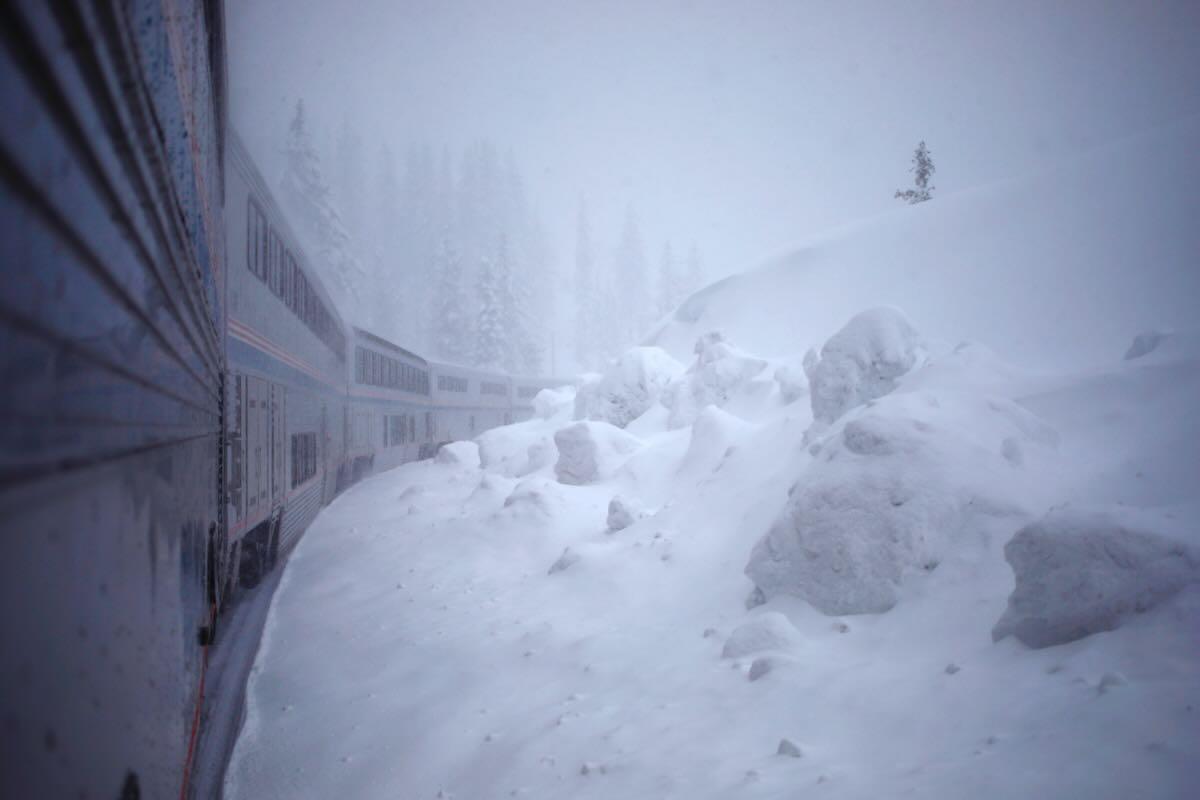
A Chicago-bound Amtrak train got temporarily stuck east of Colfax last night due to severe weather.
It happened as Train 6 was traveling from Emeryville to Chicago.
Crews cleared snow from the tracks before a recovery locomotive arrived to help the train continue on its route.
Amtrak says passengers have been given regular updates as well as snacks and water onboard.
| | Editor's Note: See Editor's Note above. Ironically - and unremarked - the westbound counterpart, Amtrak Train #6, had recently traversed the area and suffered no delay in the deep snow because it had run down the recently plowed Number 1 track. Why Union Pacific decided to run a fully loaded passenger train from Gold Run to Emigrant Gap in deep snow, still falling heavily, up a steep grade of up to 2.5%, on a Restricting Signal, without any assistance from flangers or plows, is the 24 million dollar question. Playing Russian roulette with train crews and passengers is a dangerous game. Safety First? We think not! | |
Trains Magazine / February 20th
The eastbound California Zephyr arrived in Truckee today (Feb. 20) just after 1 a.m. Pacific Time, 11 hours late. But it won the battle against massive snowdrifts that had shut down parallel Interstate 80 through the Sierra Nevada mountains.
Televised news reports like this one described multiple I-80 closures throughout a week that saw trapped cross-country skiers lose their lives in an avalanche. But they almost never mentioned that Union Pacific track crews kept the route open for its freight trains and the Zephyr despite the conditions.
Thursday afternoon’s train no. 6 had departed Colfax, Calif., two hours late. Westbound counterpart no. 5 had been running an hour behind schedule leaving Truckee and lost two hours heading though the increasingly heavy snow as I-80 was being closed to all traffic. Status reports from Amtrak and other sources indicate that the eastbound’s lead locomotive stalled out on the climb between Colfax and Truckee.
| | NEWS FROM AROUND THE LABOR MOVEMENT | | Each week, RWU includes a few articles about advances and developments in the larger labor movement that are of interest to railroad workers. Got an artcile to submit for possible inclusion next week? Email it along to raillabornews@gmail.com. Thank you! | | Editor's Note: The Teamsters Union has its hands full with this latest announcement from parcel giant UPS. The name of the game in the transportation industry - like all others - is automate, consolidate, and contract out. This is exactly what the Union Pacific - Norfolk Southern Merger is all about. If it goes through, look for job losses in the years that follow from Teamster affiliates - rail unions BLET ad BMWED - which to their credit, have come out opposed to the merger. | |
Freight Waves / February 17th
The biggest parcel carrier in the country is shrinking its network faster than anyone expected — and now we know exactly where the cuts are falling.
Court documents filed in connection with a Teamsters lawsuit reveal the specific locations UPS plans to shutter in the first half of 2026: 22 package sortation centers with union employees across 18 states, including Dallas, Miami, Baltimore, and Atlanta. CFO Brian Dykes confirmed on the January earnings call that a couple dozen facilities would close and 30,000 jobs would be eliminated. These aren't satellite offices — they're major nodes in the UPS package network, and their closure will reshape parcel routing across the country.
The closures are part of a restructuring plan internally called "Network of the Future." The numbers tell the story of just how aggressive it is: last year alone, UPS eliminated 48,000 operational jobs (including 15,000 seasonal positions), shuttered 93 leased and owned distribution centers, and saved $3.5 billion. The five-year target is up to 200 facility closures and $3 billion in annual savings by 2028.
| | Editor's Note: While this is certainly good news, it is not nearly enough. To get back to where we were just a few decades ago at this rate will take years. We need a NEW labor movement, one that is brought about by a mass uprising like in the 1930s, when workers across the board signed up for union membership, struck for recognition, occupied factories, and defied the authorities. We need innovation, new tactics, action and leadership. Like the old conservative AFL unions of a hundred years ago, today's bureaucracy is in fact a bulwark against the mass organizing we so desperately need. and top-down unions are Time for a change in our existing unions! | |
The Guardian / February 18th
The number of workers covered under union contracts increased to a 16-year high in 2025, despite ongoing attempts by the Trump administration to wipe out collective bargaining agreements for tens of thousands of federal workers, according to new data from the Bureau of Labor Statistics.
About 16.5 million workers were covered by a union contract in 2025, up from 16 million in 2024 and the highest level since 2009. The increase stems from workers joining unions as members – 14.7 million US workers were union members in 2025, up from 14.2 million workers in 2024.
The percentage of all workers in the US covered by a union contracts ticked up to 11.2% in 2025, compared with 11.1% in 2024. Union membership increased from 9.9% in 2024 to 10% in 2025.
| | Editor's Note: A number of rail unions have signed on in support of this important Bill. Just three short years ago, rail workers came very close to a national strike over this issue, as 85% of rails at that time had traditionally had NO sick time at all. Thanks to the efforts of working railroaders who pushed the envelope, the years that followed saw sick leave provisions won by most unions on the Class One railroads, but they are limited in scope. This legislation - if adopted - would solidify those gains, near doubling the number of days that were won in 2023 and 2024 through on-property collective bargaining agreements. | | |
Bernie Sanders / February 12th
Sen. Bernie Sanders (I-Vt.), Ranking Member of the Senate Health, Education, Labor, and Pensions (HELP) Committee, and Rep. Rosa DeLauro (D-Conn.), today introduced legislation that would ensure the United States finally joins virtually every other major country on Earth in guaranteeing paid sick leave to its workers.
“It is an international embarrassment that the United States of America remains the only major country on Earth not to guarantee paid sick days to workers. Working together, we must end that embarrassment,” Sanders said. “It’s not radical to ensure that every worker in America receives the paid sick days that they need. What’s radical is that we have corporations in America making billions in profits, denying paid leave to working moms and dads when their kids get sick. That’s radical.”
“Federal law does not guarantee working Americans a single paid sick day,” DeLauro said. “No one should face the impossible choice of either caring for their health or keeping their paycheck, especially during the current cost of living crisis.
| | WEEKLY DERAILMENT DEPARTMENT | | Each Tuesday in this news bulletin, RWU does our best to present a picture of what has been happening over the course of the previous week in terms of derailments in North America, and investigation determinations of previous accidents. NOTE: This list is by no means comprehensive. Smaller and less consequential mishaps are generally not reported here. If the wreck results in injury or fatality, or is especially damaging/extreme, a full article will appear as a feature in the dozen or so rail articles above. Know of a train wreck? Please feel free to forward a link to raillabornews@gmail.com for possible inclusion next week. Thanks! |
| | | |