|
Market Navigator for the Month Ending October 31, 2025
Presented by Austin Fearon
Markets continued their rally in October, driven by improving fundamentals and supportive monetary policy. Falling short-term interest rates and stronger-than-expected earnings growth supported the rally amid delayed economic updates. Looking forward, risks remain but economic growth and market appreciation remain the most likely path.
1. Beyond the Headlines: Stock Rally Hits Six-Month Mark
2. Federal Reserve and Rates: Fed Continues Rate Cuts in October
3. Economic Report Updates: Inflation Rises as Reports Delayed
4. Looking Ahead: Cautious Optimism Despite Political Uncertainty
Beyond the Headlines: Stock Rally Hits Six-Month Mark
October was another positive month for markets, as the S&P 500, Dow Jones, and Nasdaq all posted solid returns. The S&P 500 gained 2.34 percent while the Dow was up 2.59 percent. The technology-heavy Nasdaq led the way with a 4.72 percent gain. This now marks six straight months with positive stock market performance, which is an impressive result despite the rising uncertainty in October.
These positive results were driven in part by improving fundamentals. We’re roughly two-thirds of the way through third-quarter earnings season, and so far, so good for U.S. companies. Per Bloomberg Intelligence, the average earnings growth rate for the S&P 500 is 12.98 percent. This is well above analyst estimates of 7.35 percent at the start of earnings season. Since fundamentals ultimately drive long-term market performance, this was an encouraging development for investors.
Technical factors were supportive as well for stocks. All three major indices spent the entire month well above their respective 200-day moving averages. The 200-day moving average is a widely tracked technical signal, as prolonged breaks above or below this level can indicate shifting investor sentiment for an index.
International stocks were also up in October. The MSCI EAFE Index gained 1.18 percent for the month. Emerging markets did even better as the MSCI Emerging Markets Index rose 4.19 percent. Technical factors were supportive for both indices during the month.
Federal Reserve and Rates: Fed Continues Rate Cuts in October
Bond returns were positive as well in October, driven in part by a 25 basis point rate cut at the conclusion of the Federal Reserve’s October meeting. This now marks two consecutive meetings with rate cuts, and further cuts are expected in early 2026.
The 10-year Treasury yield fell from 4.16 percent at the end of September to 4.11 percent at the end of October while short-term rates fell even further. The Bloomberg Aggregate Bond Index gained 0.62 percent during the month.
High-yield fixed income was also positive, with the Bloomberg U.S. Corporate High-Yield Index gaining 0.16 percent in October. High-yield credit spreads ended the month little changed.
Economic Report Updates: Inflation Rises as Reports Delayed
There were only a handful of economic updates that were released during the month, as the ongoing government shutdown has caused delays for several critical updates. With that being said, we did receive a few reports of note.
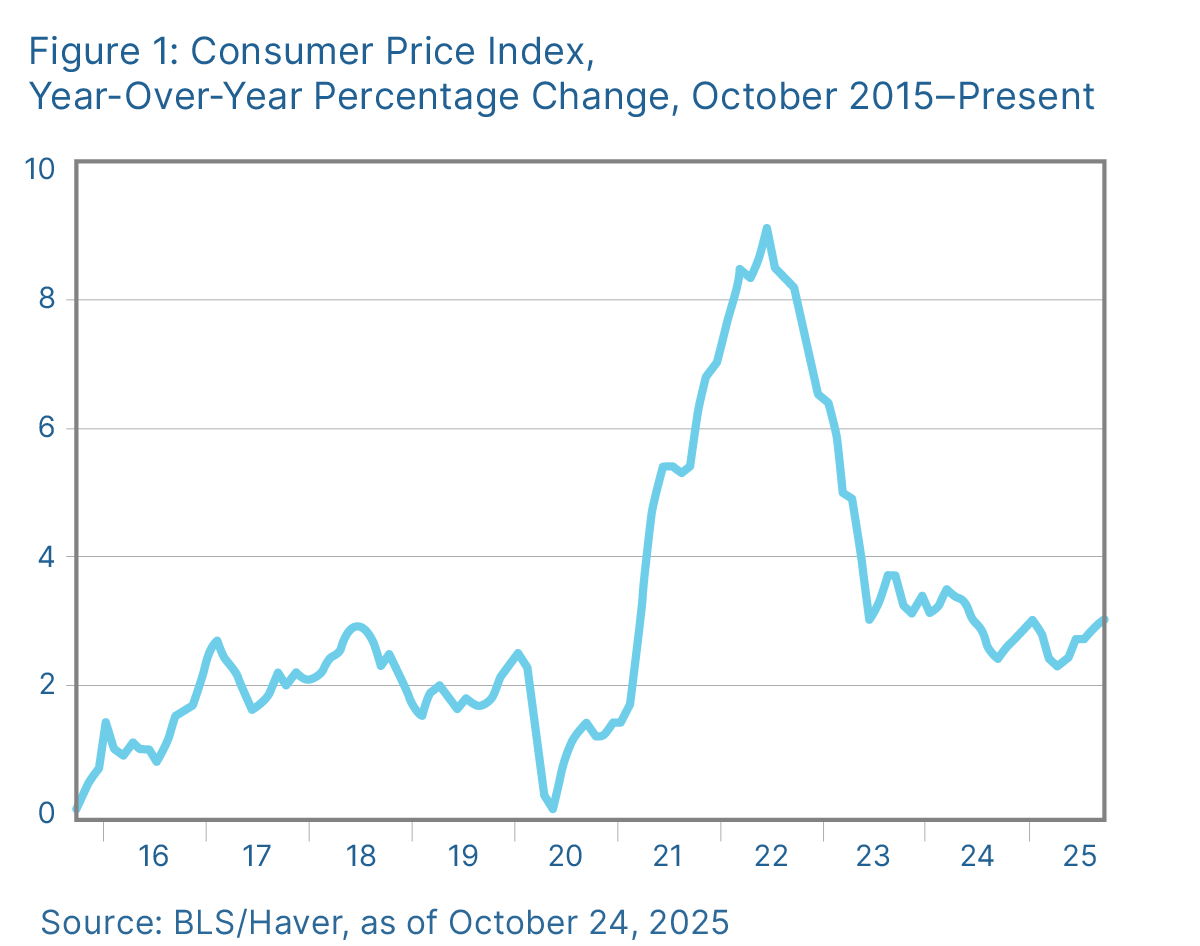
The September Consumer Price Index report was initially delayed but was released later in the month. On a year-over-year basis, consumer inflation rose to 3 percent in September. As seen in Figure 1, inflation has remained above the Fed’s 2 percent target throughout the year and has been steadily trending up over recent months. While the continued rise in inflation was not enough to keep the Fed from cutting interest rates at its October meeting, this will be a key area to monitor ahead given the Fed’s dual mandate to maintain stable prices and maximize employment.
|