News and information to help journalists serve the public and stay safe.
|
|
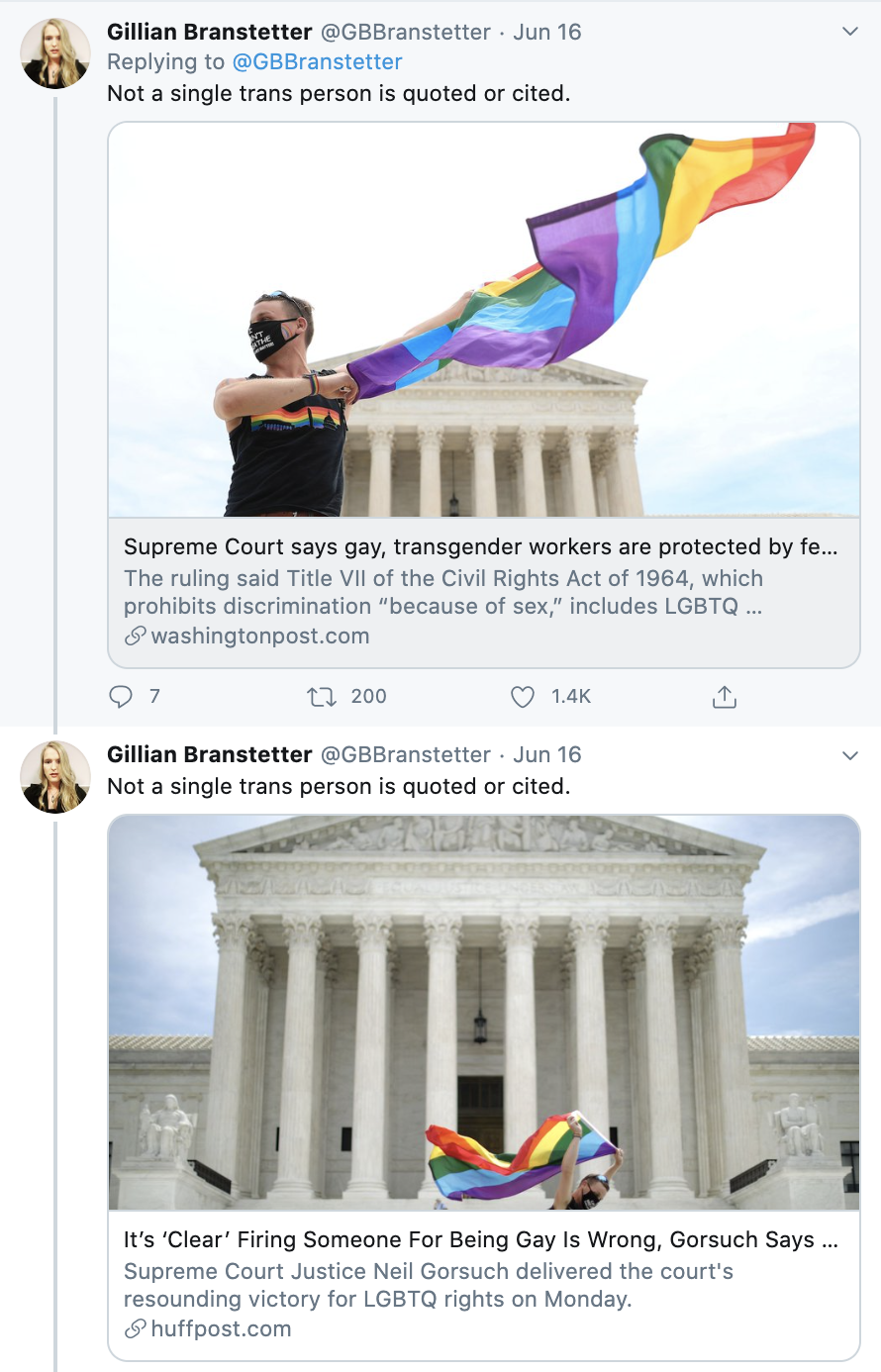
The Supreme Court’s landmark ruling protecting LGBTQ+ workers received widespread coverage in the media Monday. But the reporting largely lacked transgender sources, as
Gillian Branstetter
pointed out in a
Twitter thread
Tuesday.
This is another facet of many newsrooms’ failures to provide
inclusive journalism
, two experts say.
“I don't imagine it would have taken a great deal of work to find trans people to speak on this matter,” Branstetter said in a phone interview with the Institute. “Trans people are speaking out for ourselves. It's infantilizing to be ignored, particularly in a story that directly impacts us.”
We reached out to Branstetter, who is a media manager at the National Women’s Law Center, as well as
Elliott Kozuch
, press secretary at the Human Rights Campaign, for their insights on how newsrooms can do better.
Why do you think the mainstream media mostly neglected to include quotes from transgender people when covering the Supreme Court decision this week?
Branstetter
: When you look at the legacy outlets and top-line political stories, trans people are consistently erased or ignored — often because we don't have the institutional power that attracts a lot of attention. But this is the most important legal victory in the history of transgender rights. It is the culmination of nearly a century of advocacy. The media often pretends that they discovered trans people in 2014 when they put us on the cover of Time. But in fact, we are legal scholars, we are lawyers, including two lawyers who argued in these cases.
If you were writing a story about one person you would go and find that person. So the idea that because we're a small subset of the population and don't quite have the institutional powers as an excuse is faulty in the extreme. Because we are telling our stories, we really just need reporters to listen.
Kozuch
: Aimee Stephens, the brave plaintiff in the Supreme Court case decided this week, did not live to see the outcome of her case. Yet, she did everything she could in her life to ensure that the rights of transgender workers to be themselves at work would be granted to all of us.
This is how many transgender and non-binary people in America live our lives. We fight for equality and justice that we may not live to see — in a world that often refuses to see us. But we move forward with the hope and faith that one day, a transgender child growing up in America will have the same opportunities as a cisgender child.
Even today, transgender people often go unseen or ignored in media, in part because of this very legacy of erasure. However, there are countless transgender lawyers (including ones who worked on these Supreme Court cases), transgender advocates and transgender people whose lives have changed for the better by this decision. If you’re reporting on this case, consider the transgender people who got us to this point, those who are moving us beyond it and the every-day transgender Americans who are finally seeing themselves reflected in federal law.
Branstetter
published guidelines for covering transgender people with accuracy and sensitivity.
Kozuch
spoke with the Institute earlier this month on ways to improve LGBTQ coverage with every story.
|
|
Bill Plante Chair in Leadership & Media Integrity, Loyola University Chicago
Freedom Forum Fellow in Women’s Leadership
What does “paying your dues” mean in your newsroom, especially when it comes to hiring and promotions?
It’s customarily shorthand for “becoming qualified.”
- For the job.
- For the cool assignment.
- For advancement.
But here’s a very troubling truth: When people create job descriptions and hiring criteria - supposedly objective standards - they’re influenced by personal experiences. Managers view their beliefs and behaviors as a baseline measuring stick.
- “I had to move halfway across the country to a small market to get my start in the business.”
- “I didn’t become a really good writer until I was five years into my beat.”
- “Nobody sent me for database training, so I taught myself.”
- “I would never have dreamed of asking for a promotion when I was in the job for only a year.”
- “I worked on my days off to get the edge on big stories and never put in for overtime.”
- “I didn’t socialize with my competitors; my goal was to beat them.”
People with the power to stamp “paid” on dues often reserve it for people who remind them of themselves.
Think of the implications for diversity.
What happens when our self-image is reflected in the job qualifications we establish? How we interview. How we choose winners, runners-up, and losers.
“After carefully transcribing and analyzing her interviews and field notes from observations in the firm, Rivera determined that, by the time a candidate had made it through the relevant resume screenings and landed an interview, her evaluation was not necessarily based on ‘maximizing skill—finding the person who was absolutely best at the soft or the hard dimensions of the job,’ as Rivera puts it. Rather, the most common mechanism by which a candidate was evaluated was her similarity to her interviewer.”
Newsrooms reckoning with their failure to diversify have plenty of work to do.
How about a candid, critical look at what “paying your dues” really means on your watch?
What’s dated? What’s damaging to people? What’s built on a heaping pile of privilege?
It’s going to be an uncomfortable exercise.
That’s the point.
|
|
|
The foundation of good design begins with shape, order and emphasis.
We’re sharing portions of the presentation, taught by the Journalism Institute’s senior director
Beth Francesco
. Today, we recap design foundations.
Hierarchy + Emphasis
Good design hierarchy helps visually tell the viewer where to look first and then influences the order in which they take in information. Consider it as ranking the elements from most important to least important.
Proximity + Grouping
Grouping related elements organizes content and portrays relationships among elements, helping a reader easily digest the information.
Alignment
Aligning text or other visual elements provides order, balance and intention.
Contrast
Contrast creates a visual distinction between two elements (or sets of elements). Contrast is attractive to the eye, helps organize information, improves legibility, and creates interest within a design so not all your elements look the same.
Negative Space
Negative space is the “empty space” in a design that does not contain content. Using negative space effectively will give the elements in your design room to breathe and will help keep the focus on your “point of emphasis” or message.
Repetition/Similarity
Using elements that have similar characteristics can create consistency within a design. This can be effective in creating an impactful dominant image made up of smaller, less impactful images (hierarchy).
Balance
Placing elements in a way that distributes the visual weight equally in the design and ensures the viewer’s eye easily moves from one element to the next. In the graphic shown, note that while there are two elements on the right, they are of equal size and weight to the single image on the left.
|
|
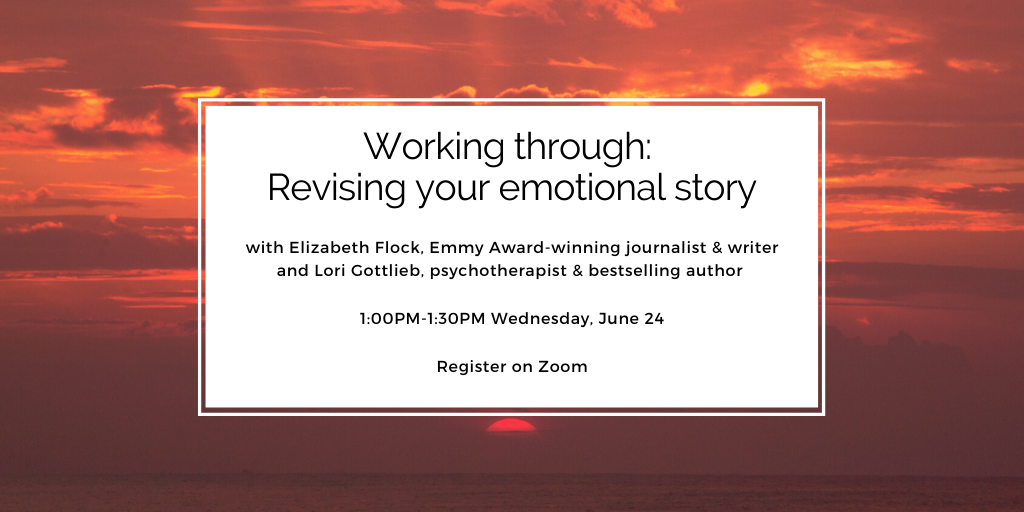
Many journalists are covering a physical and mental health crisis while they also may be struggling to cope themselves. This conversation will examine how to work through this moment, by looking at the stories we’re telling ourselves about it, how these stories affect our emotional lives, and consequently, the stories we are reporting and writing.
|
|
The National Press Club Journalism Institute is spotlighting
the next generation of journalists
, students graduating from college or Master’s programs this spring into
a challenging job market
, in hopes they’ll meet future bosses and colleagues here who will reach out and support them in building journalism’s future together.
School
:
American University
Location
:
Washington, D.C.
Student media
: Editor-in-chief,
AWOL
What's been your best moment in journalism?
Weiss
: I wrote a lot over the last four years, but my best moment in journalism was handing the reins of my publication over to the new editors-in-chief. There is nothing more rewarding for a journalist, and for a leader, than the feeling of confidence that the people replacing you are as committed to the mission as you are. I feel a great sense of pride in knowing that the publication I worked so hard to maintain is in such good hands. I hope that I inspired my younger colleagues to keep digging deep and telling important stories.
If you could meet any journalist and ask for her/his advice, who would it be and why?
Weiss
: If I could sit down with
Marie Colvin
right now, I would probably first ask her how she got her nerves of steel. War journalism (and honestly any other type of journalism) requires serious mental fortitude, and I would really just want to know how she balanced the stress of working in a dangerous environment while still doing powerful reporting.
|
|
This newsletter is written & edited by the National Press Club Journalism Institute staff: Beth Francesco, Holly Butcher Grant, Jim Kuhnhenn, and Julie Moos.
Send us your questions and suggestions
for topics to cover.
|
|
|
|
|
|
|