THEY SWAM IN KINGSTON’S DRINKING WATER


Back in September, we told you how the Sawkill went from Esopus floodplain farms to mills and tanneries. Earlier this month, 25 of you came to the Historical Society of Woodstock to hear the rest from Ulster County Historian Eddie Moran and Woodstock Town Historian Richard Heppner. The best story of the afternoon was one we hadn’t told you.


Cooper Lake sits in Woodstock, and its water feeds the Sawkill on the way down toward Kingston. In the 1890s, Kingston went looking for a backup to its water supply at Zena. It leased the lake’s water rights from William Cooper and his neighbors, raised the dam, and piped in Mink Hollow stream for good measure. Nobody asked Woodstock. When the city drained the lake to clean it, the Kingston Argus reported that “the shores were literally covered by dead fish.” A sawmill owner sued when the dam cut the creek too low to run his mill, and won.


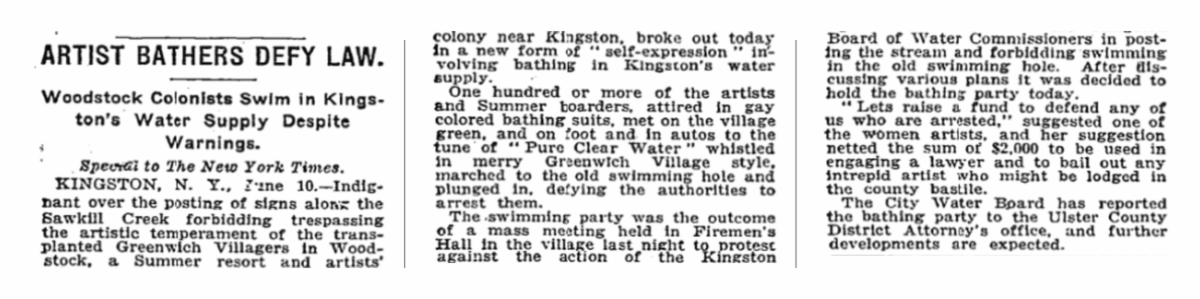
The fight simmered for about 25 years. In June 1922, after Kingston’s Board of Water Commissioners posted signs along the Sawkill forbidding trespassing and swimming in the old swimming hole, Woodstock held a mass meeting at Firemen’s Hall. The next morning, more than 100 artists and summer boarders in “gay colored bathing suits” met on the village green, marched to the swimming hole near the golf course bridge whistling “Pure Clear Water,” and got in. They had already raised $2,000 to hire a lawyer and to bail out “any intrepid artist who might be lodged in the county bastile.” The Kingston Freeman reported that they “swam or ‘paddled’ or just ‘washed’ according to temperament, age or degree of cleanliness in the drinking water of the city of Kingston, thereby asserting their ‘rights’ to trespass on the property of the city and pollute the water supply of 27,000 people.” Its editor added, “Cleanliness is next to Godliness. It is next, not first.” Woodstock’s health officer, Dr. Downer, accused Kingston of “stealing the rights of the people.” The Water Board reported the bathers to the district attorney, and the city called for another injunction. The Woodstock Town Board took the swimmers’ side.


Woodstock kept swimming. The tension eased slowly, and a pipeline from Cooper Lake straight to Zena, bypassing the Sawkill, eventually “abated the concerns of most.” Richard ends his own account on Woodstock’s vigilance over its natural resources: “Maybe it’s in the water.”


Thank you to Eddie, Richard, and the Historical Society of Woodstock.


Read Richard on Woodstock’s water →

Robert Angeloch, Sawkill at Zena, 1976. Color serigraph. Angeloch was born in 1922, the year of the swim-in. WAAM.

MAPPING THE SAWKILL, AT WAAM


On Saturday, November 7, from 1 to 3 pm, Woodstock’s Drinking Water Source Protection Program will present How Is the Sawkill? Part 1 at the Woodstock Artists Association & Museum, 28 Tinker Street. The program covers where Woodstock’s drinking water comes from and what’s being done to protect it. It’s part of Jen Zackin’s Mapping the Sawkill Watershed exhibition, on view now through November 29. No RSVP needed, artist bathing optional.


About the project →

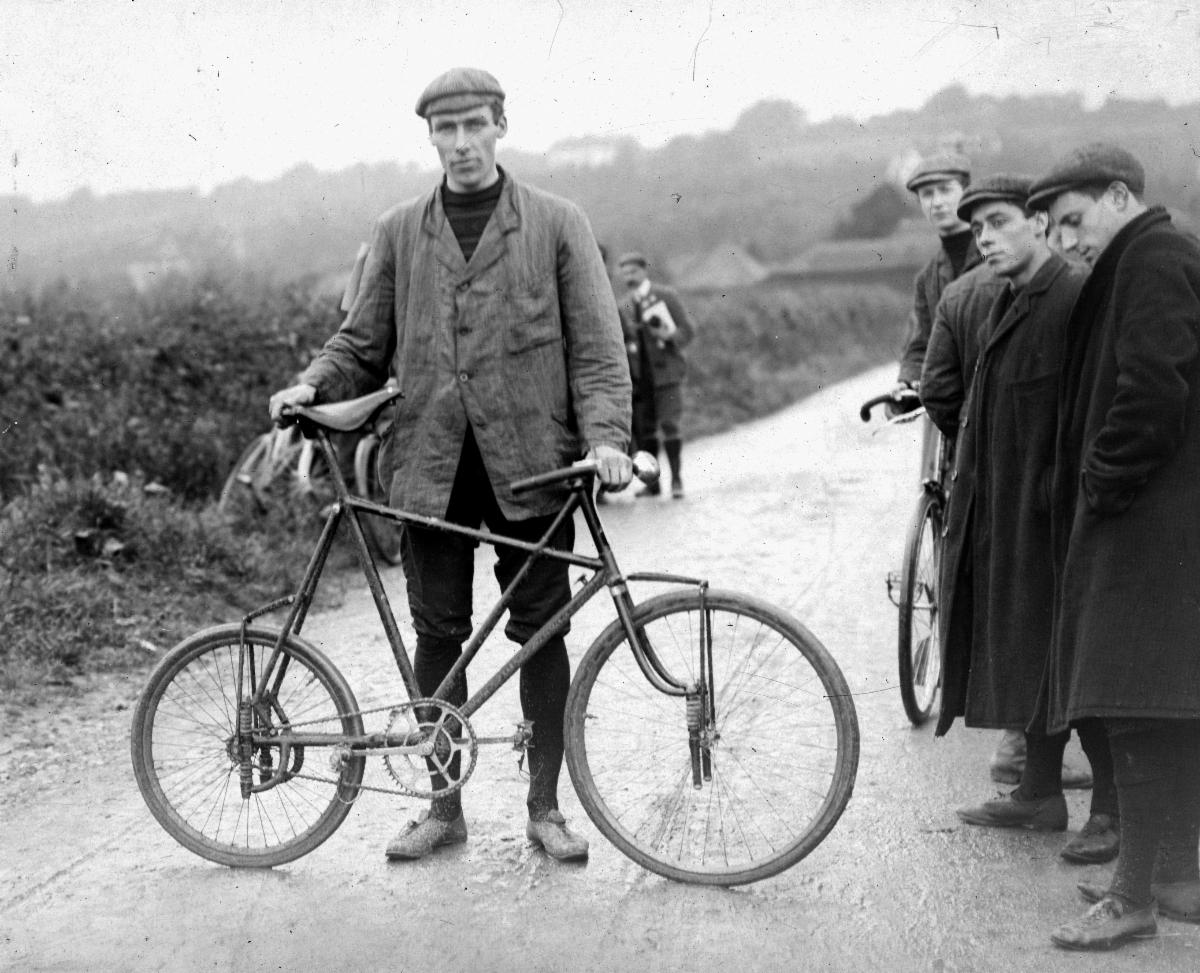
Built for rough roads around 1900: springs front and back, and a bigger front wheel than rear, a setup riders now call a ‘mullet.’ Giggle Hollow’s old logging roads are smoother now. Courtesy Mountain Bike Hall of Fame.

NEW MOUNTAIN BIKE TRAILS AT GIGGLE HOLLOW


The Catskills have a new place to ride. Farther up Route 28 from the Ashokan Rail Trail, the DEC has finished an 11.5-mile trail network on the Giggle Hollow parcel of Shandaken Wild Forest, and seven of those miles are new singletrack built for mountain bikes. The main event is a three-mile continuous downhill through banked turns. The trails are rated beginner to intermediate, so you don’t have to be especially brave (but you probably have to be somewhat brave). The other 4.5 miles follow old logging roads, and the whole network is open to hikers and cross-country skiers too. Start at the Lost Clove trailhead on Lost Clove Road, or from the Pine Hill Day Use Area at Belleayre Beach.


More riding is on the way. The planned Shandaken Rail Trail, which WLC supported in a 2025 letter for the county’s grant application, will run 2.6 miles along the old Ulster & Delaware line from Highmount to Belleayre Beach, right where Giggle Hollow begins.


DEC’s records say the land was once called Giggleus Hollow, and a man named Augustus Guigou built a tannery there in 1831. Whether that’s where the name came from, nobody seems to know. What I do know is Giggleus would be a beautiful name for a baby boy.


Trail info →

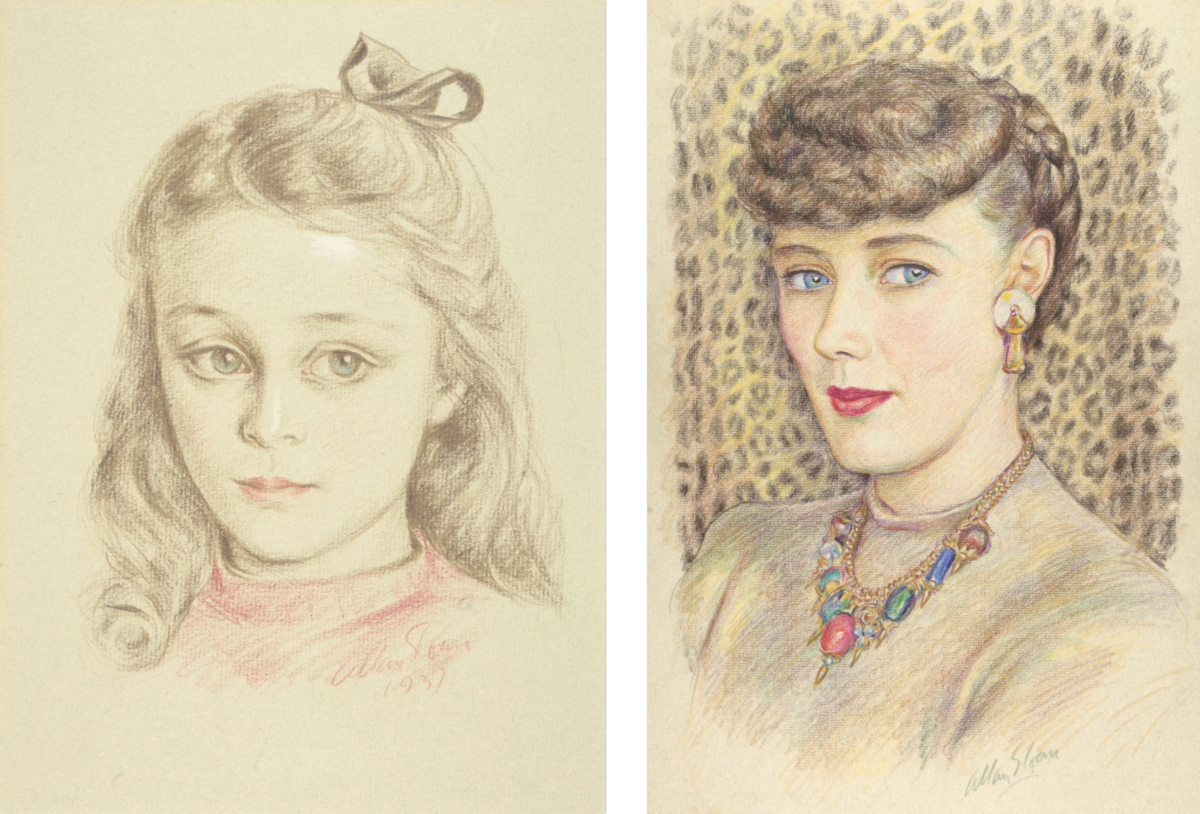
Allan Edward Sloan, Woodstock Child, 1937 (left), and Rosalyn D’Albis, 1940s (right). Pastel. WAAM.

SLOAN GORGE, 28 YEARS ON


Twenty-eight years ago this week, Allan Edward Sloan and his family gave WLC the gorge that now carries his name.


Sloan grew up in Cleveland, where he skipped school to ride the streetcar out of town and sketch. He came to Woodstock’s art colony in the 1920s. No word on whether he was among the artist bathers in 1922, but he’d have been 19 and in the right line of work. During the Depression, he drew children’s portraits in pastel from a studio inside Saks Fifth Avenue, at about $75 a sitting. After World War II he settled into a farmhouse with a view of Overlook Mountain, where he painted the landscapes around him until he died in 1999.


The gorge’s rocks are the remains of the Catskill Delta, a river delta that covered this region some 375 million years ago. The canyon itself is much younger. It was cut about 14,000 years ago, when meltwater from the retreating glaciers came through as a whitewater torrent. Most days now, the stream at the bottom is barely there. Along the 1.5 miles of trail you’ll pass cliffs, a rock passage called the Chimney, and the plaque to Sloan, set on bluestone left from two quarries worked there in the early 20th century. Go before the last leaves come down.


Visit Sloan Gorge →

HELP GROW ISRAEL WITTMAN SANCTUARY: AN UPDATE


We’re more than 60 percent of the way to our $100,000 goal to protect the wetland next to Israel Wittman Sanctuary. Thank you. Help us close the gap.


Give to the wetland →

If someone sent you this, you can get your own! If you got it from us, forward it to a friend in Kingston.

Your donations help us continue our work to protect and preserve open lands, forests, water resources, scenic areas and historic sites in Woodstock and the eastern Catskills.


ï»żWith environmental groups large and small facing unique challenges, we need your support now more than ever. Every dollar makes a difference.


Support WLC today with a financial gift and consider adding us to your estate plan.

Our EIN number is 22-2950482.

2025 Environmental Organization - 1st Place

2026 Environmental Organization - 1st Place

2026 Environmental Advocate/Activist - Andy Mossey, 1st Place

Facebook  Instagram  Youtube