|
"The Dirt"
A Resource for Local Conservation
| |
"Lawn to Meadow" Conversion | | |
|
Grant funding and technical assistance available for lawn conversion projects!
Pennsylvania Association of Conservation Districts was awarded a $100,000 Community Conservation Partnerships Program Grant from the PA Department of Conservation and Natural Resources (DCNR) to offer Lawn Conversion training and mini-grants to Pennsylvania’s Conservation Districts. The lawn conversion program will help the Commonwealth achieve a goal of planting 5,000 acres of upland forest and 5,000 acres of meadow by 2025.
In Pennsylvania alone, there are over 2 million acres of mowed grass that is providing little to no environmental benefit. Turf requires weekly maintenance, provides little habitat for birds, pollinators or wildlife, and can lead to runoff of herbicides, fertilizers and sediment from soil erosion. An alternative to mowed turf grass is a native meadow, which provides many benefits, environmentally, aesthetically and recreationally. Once established, native meadows require minimal maintenance, and their deep root systems create a dense soil structure, reducing erosion. Meadows provide idyllic habitat for a variety of species, from birds and wildlife to pollinators, and meadow vegetation provides food and shelter for numerous beneficial species. Furthermore, after the first couple years of the perennial species establishing, meadows require practically no maintenance. A mowed grass lawn can be converted into a beautiful meadow, to provide numerous benefits.
Demonstration Workshop:
Abby Reiter, Ag Conservation Specialist
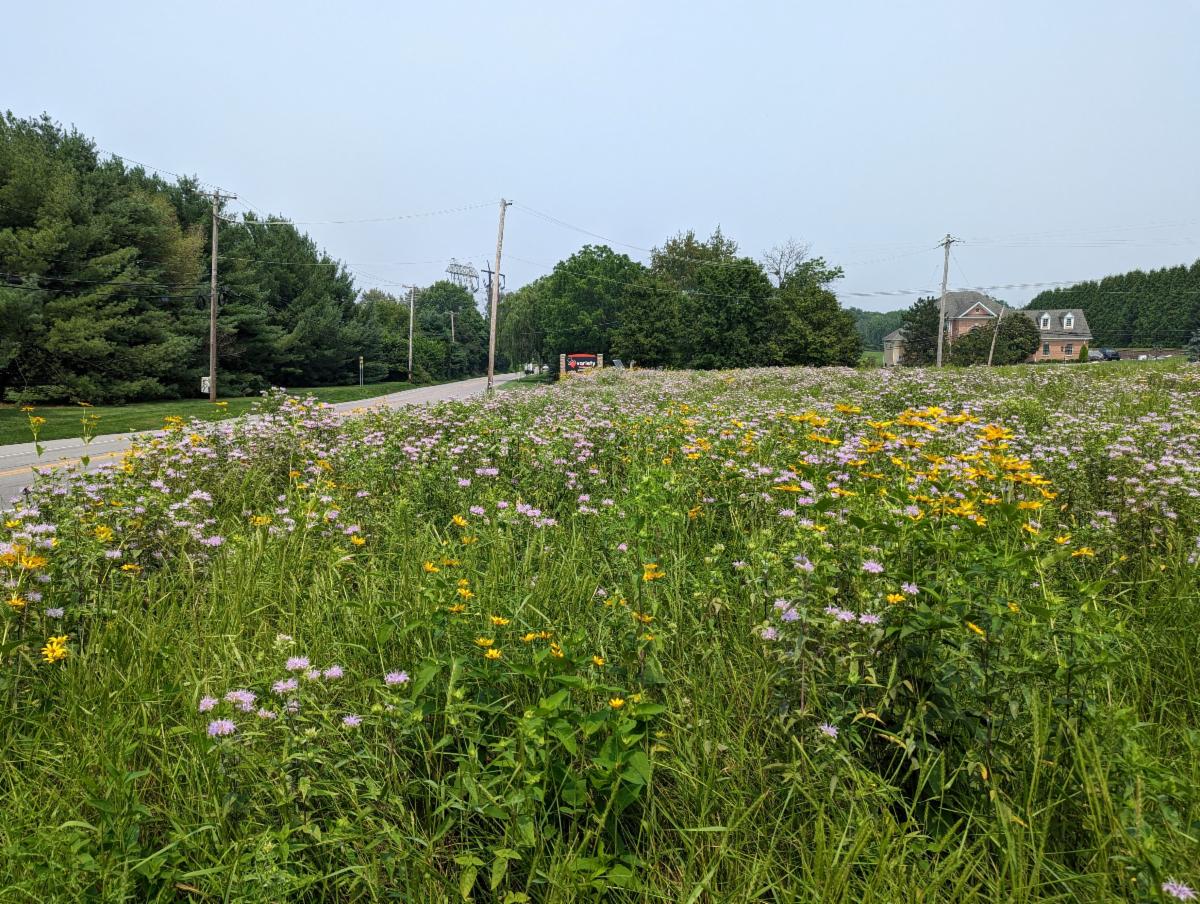
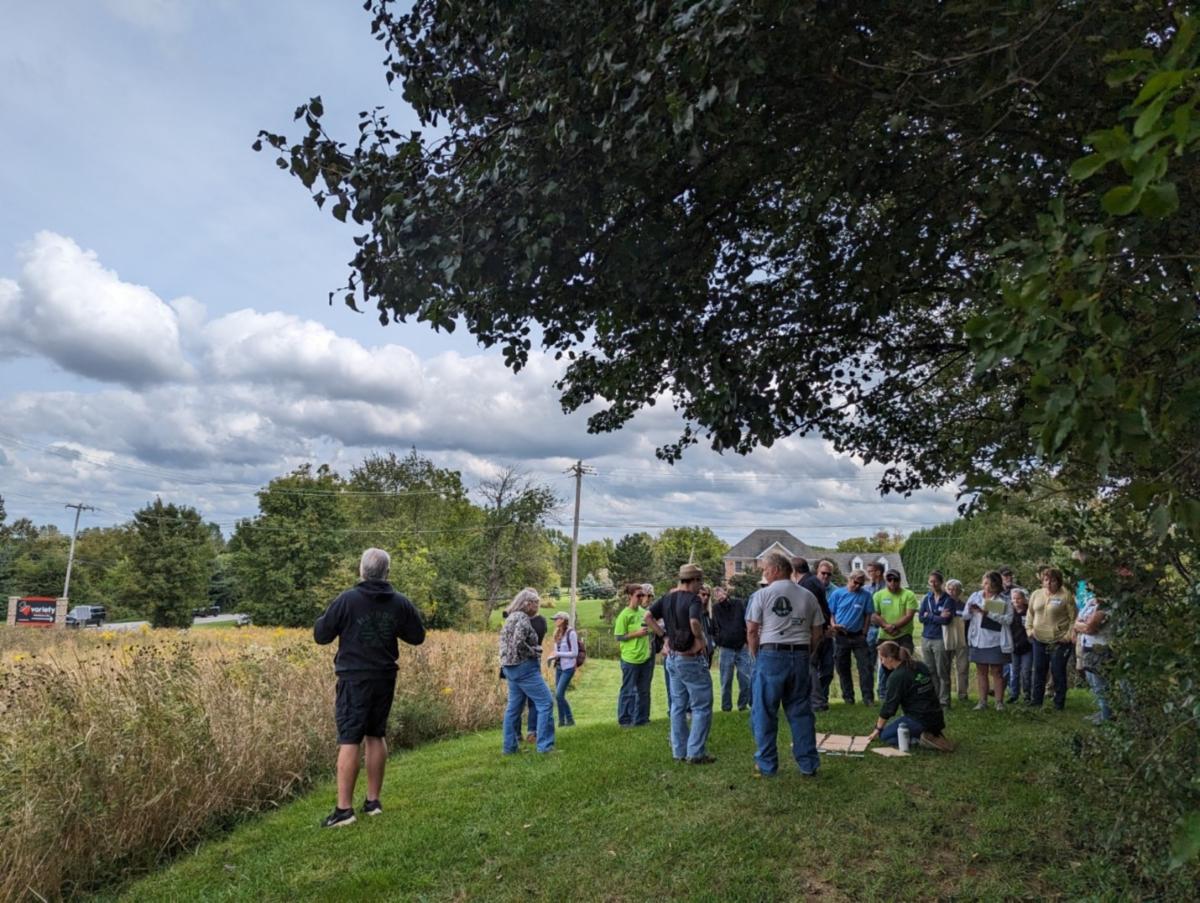
On Friday September 22nd, in partnership with the Variety Club – Children’s Charity of the Delaware Valley, Montgomery County Conservation District held a “Native Meadow and Riparian Buffer Showcase”. This event toured a native meadow and two riparian plantings. The meadow planting, shown above, was completed as a demonstration planting using funding from Pennsylvania Association of Conservation Districts, Inc. through a grant from the Pennsylvania Department of Environmental Protection under Section 319 of the Clean Water Act, administered by the U.S. Environmental Protection Agency. The riparian plantings were both completed through funding from the TreeVitalize Watersheds (now “Trees for Watersheds”) grant program. The partnership between MCCD and the Variety Club - Children’s Charity of the Delaware Valley has been ongoing since 2019 with the meadow planting taking place in Fall 2019 and riparian plantings installed in Fall 2020 and Fall 2021. There were approximately 40 people in attendance at the event, coming from many organizations and groups but all coming together in their interest for environmental conservation projects. If interested in the Meadow Conservation grant program, please reach out to Brian Vadino, Watershed Specialist at MCCD 610-489-4506 x15
|  | | |
|
Brian Vadino, Watershed Specialist
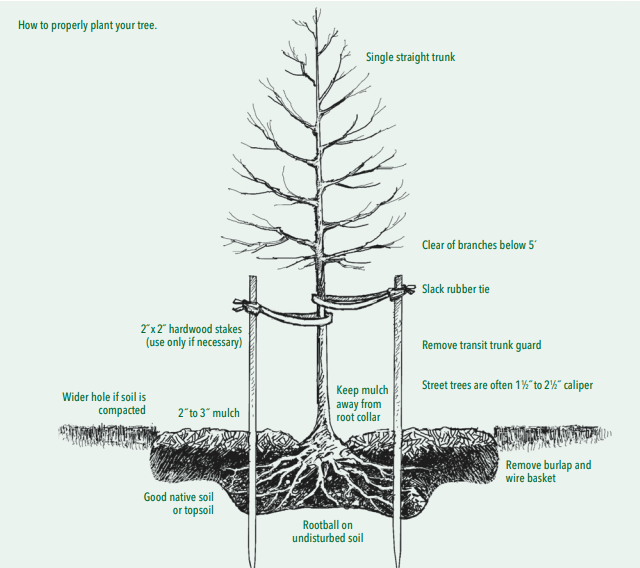
Fall is a great time to plant trees! Studies have shown that trees and forests provide an extensive list of environmental, economic, and social/community benefits. Some of these benefits include (but are not limited to) reducing water and air pollution, reducing erosion, providing wildlife habitat, reducing “heat island” effect, reducing noise pollution, providing renewable forest products, increasing property values, providing passive recreation opportunities, and relieving stress.
Environmental, human induced and site-related stressors can affect tree establishment and long-term health. Environmental threats can include drought, heat, wind, fire, insect pests, disease, deer browsing and antler rubbing. Human induced stressors might include soil compaction, incorrect planting, incorrect mulching (“mulch volcanoes” for example), injuries from construction, string trimmer and/or lawnmower strikes, incorrect pruning, exposure to de-icing salts, and exposure to pet urine. Site related stressors may include (but may not be limited to) adverse physical and chemical soil conditions.
Informational resources are available to assist landowners, organizations, contractors, communities, and other audiences in using proper tree selection, planting, and maintenance practices to increase survivorship and improve overall success. Some of these include (but are not limited to) the following tools/resources made available by the following federal and state agencies, academic institutions, organizations, and partnerships:
-
Arbor Day Foundation: Trees Planting Guide at arborday.org
- Pennsylvania Department of Conservation and Natural Resources: Urban and Community Forestry (pa.gov)
- Penn State Extension tree selection and planting resources
- Penn State Extension soil testing
- TreeVitalize Guide for Tree Selection, Planting and Care
- United States Department of Agriculture Natural Resources Conservation Service: Web Soil Survey - Home (usda.gov)
Selecting appropriate trees for your site, considering stressors that can affect your trees and/or tree planting projects, and utilizing the best available information can help save valuable time, energy, and money toward successful tree establishment and growth. Taking a thoughtful approach during project planning, planting and maintenance activities can help ensure that your trees provide as many environmental, economic, and social/community benefits as possible.
Photo credit: TreeVitalize Guide for Tree Selection, Planting and Care
| |
 | |
Gary Kulp, PE, District Engineer
We all know water flows downhill, but can it flow uphill? The short answer is “yes!” There is an equation that shows how: Bernoulli’s Equation
The equation quantifies three types of energy in fluid flow, sometimes known as different “heads” (elevation head, velocity head, and pressure head). The term "head" is used by engineers in reference to pressure. It is a reference to the height, typically in feet, of a column of water that a given pressure will support. Each of the energies possessed by a fluid can be expressed in terms of head. The elevation head represents the potential energy of a fluid due to its elevation above a reference level. The velocity head represents the kinetic energy of the fluid; it is the height in feet that a flowing fluid would rise in a column if all of its kinetic energy were converted to potential energy. The pressure head represents the flow energy of a column of fluid whose weight is equivalent to the pressure of the fluid. The sum of the elevation head, velocity head, and pressure head of a fluid is called the total head.
So, what does this have to do with water flowing uphill? Simply stated, even if the elevation head is negative (uphill), as long as there is enough positive velocity and pressure head to overcome the negative elevation head, water will continue to flow uphill!
References
| | |
Breaking Down PFAS – the "Forever Chemicals" | |
|
Elise Eggert-Crowe, PE, District Engineer
What are PFAS?
Per- and polyfluoralkyl substances, also called PFAS, are a group of widely used synthetic (man-made) chemicals that have been used since the 1940s. PFOA (perfluorooctanoic acid) and PFOS (perfluorooctane sulfonic acid) are the most commonly studied PFAS, but there are thousands of chemicals that are considered PFAS. Common uses of PFAS include food packaging, non-stick cookware, water-repellent clothing, carpet, cosmetics, firefighting foams, metal plating, semiconductor coatings, aviation fluids, and many more. 1, 2
Forever Chemicals:
PFAS can be found in air, soil, water, and fish. The chemicals have stable, strong bonds, which also means they breakdown very slowly in the environment. Due to their persistent nature, PFAS are often referred to as “forever chemicals,” or as “indestructible.” Given the wide range of uses in everyday products and the slow breakdown of the chemicals, exposure to PFAS is essentially unavoidable. Studies have shown that even very low levels of exposure have negative health and environmental impacts, including adverse impacts to thyroid, liver, kidney, and fertility. 3,4
PFAS Regulation:
In 2023, the PADEP’s Safe Drinking Water Program published the PFAS MCL Rule in the PA Bulletin, establishing MCLs of 14.0 ppt and 18.0 ppt (parts per trillion, also expressed as ng/L) for PFOA and PFOS, respectively.5 The MCL values published in the PA Bulletin automatically became effective as groundwater and soil medium specific concentrations (MSCs) found at 25 PA. Code Chapter 250.6 Inclusion in 25 PA. Code Chapter 250 is relevant to the identification of hazardous pollutants for the Chapter 102 NPDES program. Also in 2023, the USEPA proposed establishing Maximum Contaminant Level (MCL) in the National Primary Drinking Water Regulations (NPDWR) for six PFAS in drinking water, including limits of 4.0 ppt for both PFOA and PFAS. 7
PFAS, PFAS Everywhere:
A recent study, the USGS, in collaboration with the PA DEP and Susquehanna River Basin Commission, sampled 161 Pennsylvania streams that are protected for the use of potable water for PFAS, which was detected in 76% of sampled streams. The study contemplated the cause of PFAS contamination, finding that maximum concentrations occurred near military bases, water pollution control facilities, electronic equipment manufacturing facilities, and petroleum refining. The highest concentrations of PFOA and PFOS were detected in Valley Creek (Valley Forge), followed by Neshaminy Creek (Langhorne) and Wissahickon Creek (Fort Washington). Other local waterways with detection above proposed 2023 USEPA MCLs include Wissahickon Creek (at mouth in Philadelphia), Schuylkill River (at Falls Bridge in Philadelphia, and Pottstown), Perkiomen Creek (at Arcola in Collegeville). The USGS chemist and primary author of the study noted that, “The findings can be used by industry permitted facilities and government regulatory agencies to determine the best practices that mitigate surface water contamination and potential exposure to humans, as well as aquatic species residing in the surface waters.” 4, 8
References
| | | | |