| | |
POLICY & ADVOCACY UPDATE
Issue #57, 23 October 2025
| | | |
- Short Term Rental Accommodation advocacy update
- Government urged to not put some industries above others
- Chef shortages downgraded by JSA in annual assessment
- Reducing the barriers to growth in Agri-tourism
- Hotel performance in September 2025
- Overseas arrivals for August 2025
- Accommodation share of tourism nights June 2025
| |
Short Term Rental Accommodation advocacy update
In the last month there has been a range of activities relating to our advocacy over short term rental accommodation. As a basis for this advocacy, the AA National Board last month updated our STRA policy to strengthen options for the federal government to act including the opportunity to treat STRA differently for tax and negative gearing purposes. The updated policy also seeks consistency in the definition of STRA to ensure it does not include business models in frequent use by AA members. Earlier this month, CEO James Goodwin attended a boardroom meeting with Hon Kristy McBain, Minister for Regional Development, Territories and Local Government who expressed a strong interest in improving regulation of STRA. Her view is informed by the experience of South Coast NSW which is within her electorate. Minister McBain was concerned at the rise in multi property hosts and hosts who don't live in the communities. She has seen how it can distort housing supply in regional, coastal and high tourism regions and as a former Mayor she also understands the difficulties of regulating and enforcing a range of issues including noise. The Minister also agrees with our position that levies are not effective as they are just passed on to the customer.
NSW STRA stakeholders such as the STR Association, AirBNB and others met with AA NSW and Tourism Council NSW specifically on STRA regulation. It is clear that they would be comfortable with a levy of 3-4% on all accommodation and oppose any caps on the number of days STRA can be offered. AA is opposed to any levy, particularly one that would be imposed on our members, and we believe a cap on days in far more likely to encourage investors to return their properties to the long-term rental market. Complaints continue to be lodged against AirBNB properties, including the most recent example from Queensland where a host has used photos stolen from the website of one of our members, and displaying them as representative of their AirBNB property. AirBNB has initially wiped its hands of the problem, but AA will be taking the complaint further.
| | |
Government urged to not put some industries above others
In our latest joint AHA/AA submission on apprenticeships, we pushed back strongly on the government's intention to further narrow the number of occupations and industries prioritsed for apprenticeship funding, arguing that such prioritisation works against industries such as hospitality and retail. Even though the hospitality industry adds over $63 billion to the economy, occupations in our industry were assessed as not being included in the government's economic and social priorities by the apprenticeship review panel that reported to government last year. If the government takes up that recommendation, the current $5000 commencement incentive for employing an apprentice chef will be lost, in the same way as we have already lost employer incentives for hospitality traineeships. This would further decimate food trades apprenticeship numbers and exacerbate the shortage of chefs. In the submission, we also argued that it was a strong policy of previous Labor Governments that skills development and post-secondary qualifications were important across all industries.
| | |
Chef shortages downgraded by JSA in annual assessment
Coinciding with our current extension consultations of chef shortages, it was very frustrating to see in the latest Occupation Shortage List issued by Jobs & Skills Australia last week that the occupation of chef had been downgraded from national shortage to regional shortage, and in most cases it was identified as regional shortage except for the NT and ACT. This assessment was matched by that of the new occupation of Senior Chef which includes executive chefs, sous chefs and head chefs. All of our discussions with members is at odds with this assessment by JSA and we will be meeting with them next week to discuss. Newly defined occupations under the recently released occupational standards system by the ABS known as OSCA were also assessed by JSA for the first time. Sommelier was assessed as not in shortage except for the NT. All of the hospitality supervisory positions were also assessed as not in shortage except for the NT, and in the case of the front office supervisory, also in shortage in WA. JSA in large part bases their assessments on job vacancies in the occupation and how quickly it takes to fill the position. As we have explained to them in the past, managerial and supervisory positions often have to be filled in order for the venue operations to continue but that does not mean that the person recruited for the position has the necessary skills and experience. As JSA makes recommendations on which occupations should be available for migration sponsorship, their shortage assessment has real implications. For the review of the CSOL migration list for this year, this latest shortage assessment should not impact chefs and hotel managers but may impact senior chefs and supervisors as they are new. This will be another important point of discussion with JSA next week.
| |
Reducing the barriers to growth in Agri-tourism
In an extensive joint submission by the AHA and AA to a parliamentary joint committee for trade and investment on regional growth, we strongly supported the economic growth potential of agri-tourism in the regions. However, we highlighted that this growth would be inhibited unless key policy issues are addressed. Highest on that list is that agri-tourism requires skilled chefs, as dining is a major component of agri-tourism. This put migration and skills development top of the list of potential barriers unless outcomes can be improved. In addition, it was important to boost the funding for Tourism Australia, address aviation pricing and competition as this particularly impacts the regions, as well as the housing shortage for hospitality staff, where action on Short Term Rental Accommodation was important.
| | |
Hotel performance in September
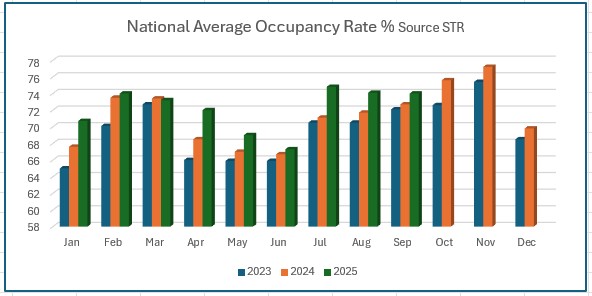
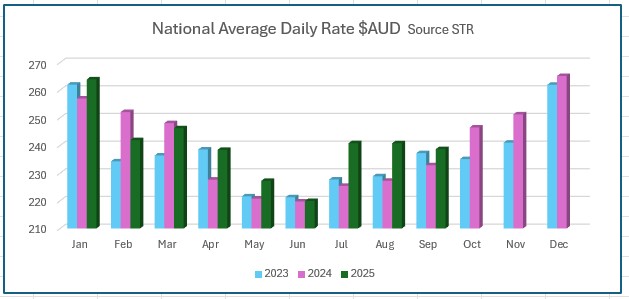
The latest STR accommodation data released for September 2025 continued the improving trend in both occupancy and average daily rate, with Queensland again the only state to see a fall in average occupancy for September compared to last year although their ADR improvement remains strong. The average occupancy in the month of September across Australia was 74.0% compared with 72.4% in 2024, and the Average Daily Rate was up 2.9% to $238.70 compared with $231.86 in August 2024. Revenue per available room in September 2025 was $176.68, a rise of 5.2% from $167.89 in 2024. Occupancy rates for September 2025 saw the highest rises in Northern Territory and South Australia, followed by NSW and Victoria, with ADR increases highest in NT, followed by WA and then Queensland. In the year to September 2025, Australia's average occupancy rate was 72.2% compared to 70.1% for the previous year, and the ADR average was up 2.5% to $239.83. New Zealand for the second month in a row saw and increase in occupancy and also a rise in ADR in September 2025 with occupancy 66.5% this year compared to 61.6% last year, and ADR up by 3.6% to NZD213.82 compared to last year.
Preliminary capital city STR data for the month to 18th of October shows that hotel performance remained relatively strong for capital cities compared to the previous corresponding period last year except for a drop in occupancy in Brisbane. Perth is a stand-out performer In October so far. Sydney had another good month with a 6.2% improvement in occupancy to 84.2%, and ADR rose by 10% to $307.19 compared to the corresponding period in 2024. Melbourne's occupancy rose 4.8% to 77.3%, and ADR up 1.2% to $221.94; Brisbane occupancy was down 2.9% to 77.5%, but ADR was again up by 4.4% to $257.77; Adelaide occupancy up by 4.3% to 78.1% and ADR up 1.2% to $206.09; Perth occupancy up 7.8% to 90.1% and ADR very strongly up 23.3% to $283.90; Hobart occupancy up 4.6% to 82.7% and ADR up 8.6% to $227.11; Darwin occupancy strongly up 12.1% to 66.4% and ADR up 0.8% to $177.83; Canberra occupancy 6.0% to 80.2% and ADR up 2.5% to $208.53; and Gold Coast occupancy up 1.6% to 78.9% and ADR up 3.5% to $313.19.
The graphs below show the average occupancy rates and ADR across Australia since January 2023.
| |
| | |
3 things for you to do today to support the industry's jobs and careers platform eeger.com.au:
- Register on eeger to build your employer profile
-
Follow eeger on LinkedIn to stay in touch
- List your job vacancies on the site that has been developed for industry by industry
| | | | |
Overseas arrivals for Augst 2025 - growth trend continues
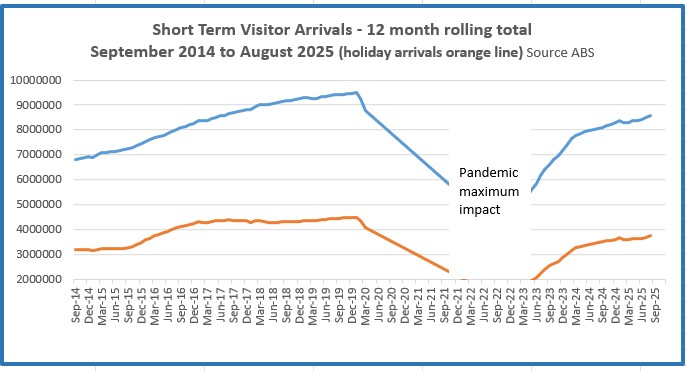
According to the ABS data released last week, there was a solid increase of 14.3% in short-term visitor arrivals in August 2025 to 753,320 compared to the same month last year. The arrival number is now only 4.5% below pre-COVID, when 789,200 short term visitors arrived in Australia in August 2019. The stronger improvement was affirmed by comments from the Department of Home Affairs at a visitor economy meeting last month that tourist visa numbers were stronger this July and August compared to last year. New Zealand was the largest source country in August 2025, accounting for 15.0% of all short-term visitor arrivals. NZ was followed by China and a welcome return of Japanese tourists coming in third with 60,610 visitors, hopefully reflecting the successful launch of Chapter 2 of the Come and Say G'Day campaign in China and Japan. This correlation is reinforced by a strong increase in holiday arrivals - up 18.6% compared to August 2024 on the back of a 16.3% increase in July coinciding with the Lions tour. Of the top ten origin countries, the UK, South Korea, India and Taiwan all had arrivals greater than August 2019, with Japanese arrivals close to the 2019 figures.
The 12-month rolling total arrivals tell a more useful story, illustrating the recent improvement as well as the difference with pre-COVID visitors, particularly for holidaymakers. In the 12 months to August 2025, there were 8,581,160 arrivals up by 6.6% on the year to August 2024. As the graph below shows, you need to go back to 2017 to see a similar yearly total (excluding all of the COVID-impacted years). The graph below shows rolling 12-month totals for total short-term arrivals and holiday arrivals.
| |
Accommodation share of tourism nights June 2025
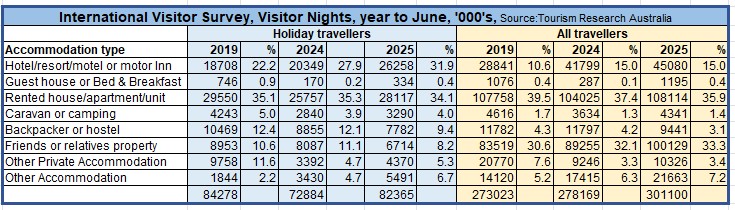
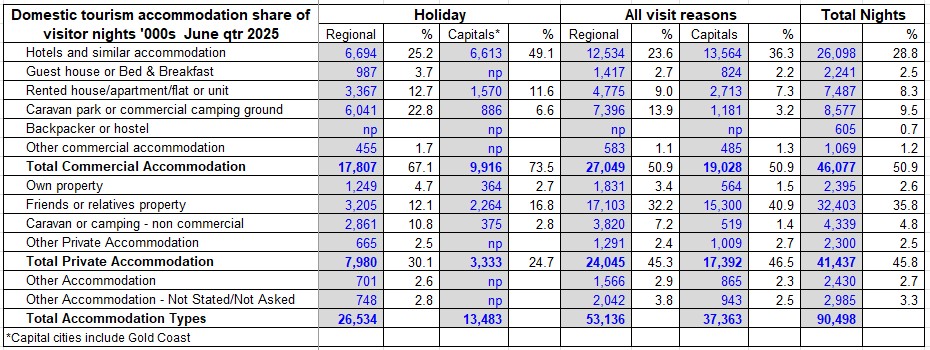
Headline results from the international visitor survey and domestic tourism data, shared in advocacy update #55 indicated that for the year to June 2025, international visitor spend in Australia was $37.5 billion, 18% up on 2024 levels, but that in the June quarter 2025, Australian residents took 27.6 million domestic overnight trips (up 2%) and spent $21.9 billion, which was down 3% on the previous June quarter. The tables below breakdown the number of international and domestic visitor nights according to accommodation share. These results help to explain rising average occupancy across Australia despite a rise in supply and the fact that holiday travellers have not yet returned to pre-pandemic levels. In 2019, the hotel share of nights was only 22.2%, but by 2025, it is 31.9%. Of those travelling for any reason, 15%, or 45 million, nights were spent in a hotel, compared to only 10.1%, or 28.8 million nights in 2019.
With the change in the collection of domestic tourism data by Tourism Research Australia, there is still no meaningful comparisons year on year. The June quarter data shows that almost 29% of all domestic tourism nights and almost half of all capital city nights spent by holiday travellers were in a hotel, resort or motel.
| | |
Drop me an email at policy@accommodationaustralia.org or give me a call on 0418 277 919 if you have any national policy issue that you think AA should be following up. If you know an AA member who is not receiving this advocacy report but wants to, then encourage them to email me and we can add them to the distribution list. Back issues of the fortnightly advocacy updates can be found here.
Kind Regards
Jenny Lambert OAM
National Policy Director
Accommodation Australia
| | | | |