|
|
L.A. Breast Chronicles
2022 in Review
2023 in Preview
January 1, 2023
|
|
Happy New Year!
It's been awhile since the last installment of L.A. Breast Chronicles, but it's not because there haven't been newsworthy events. In the summary below, you'll see a list of many of the academic and educational activities I've been up to in 2022 as well as a partial list of those that are planned for 2023. Links have been included for items where additional content is available.
|
|
2022 In Review
Co-founded: XpediteMD, Inc., a digital health company that created software to improve the efficiency and quality of cancer care. www.xpeditemd.com
Opened clinical trial: Cryoablation as Minimally Invasive Alternative to Surgery for Managing Ductal Carcinoma in situ. (NCT05218044)
Opened clinical trial: MarginProbe 2.0 Data Collection Protocol. (NCT05377229)
Opened clinical trial: Improving Efficiency of Breast Cancer Care Via Expedited Authorization: An Intermountain Healthcare Nevada Quality Improvement Initiative
Moderated: The John Wayne Critical Issues in Breast Cancer Forum: Breast Cancer Post-COVID at the 23 Annual Meeting of the American Society of Breast Surgeons
Moderated: Lymphatic Surgery: Practical Tips on Axillary Reverse Mapping and S-LYMPHA Webinar for the American Society of Breast Surgeons
Conducted: A quality improvement initiative at Intermountain Healthcare Nevada to evaluate use of XpediteMD software, which reduced breast cancer treatment delays by 55%!
Presented: Opportunities for Cryoablation in Breast Cancer Treatment. 3rd International Symposium on Minimal Treatment and Breast Imaging
Presented: Reducing Delays of Breast Cancer Care Using An Innovative Digital Health Platform at the San Antonio Breast Cancer Symposium
Co-presented: Germline Testing Results in Patients with Genomic Tumor Profiling at the San Antonio Breast Cancer Symposium. (See below)
Co-presented: Racial/Ethnic Groups Have Different Rates of Pathogenic Variants in Common Cancer Genes at the San Antonio Breast Cancer Symposium. (See below)
Co-presented: Germline Testing Results in Patients with Genomic Tumor Profiling Genomic testing and Ki-67 Percentage: Two puzzle pieces being undervalued in breast cancer treatment at the San Antonio Breast Cancer Symposium. (See below)
And more…
|
|
2023 In Review
Directing: The Sam and Grace Carvajal Comprehensive Breast Center at Adventist Health Glendale (anticipated to open in March 2023)
Publishing: Reducing Delays of Breast Cancer Care Using an Innovative Digital Health Platform
Publishing: Breast Cancer Cryoablation: Practical Guidelines for Patients and Physicians
Expanding: XpediteMD, Inc., a digital health company that created software to improve the efficiency and quality of cancer care (Role: CEO)
Opening clinical trial: Multi-center Prospective Non-randomized Two-Arm Clinical Trial Evaluating Cryoablation for the Treatment of Stage I Invasive Breast Cancer in Lieu of Surgical Resection
Continuing clinical trial: Cryoablation as Minimally Invasive Alternative to Surgery for Managing Ductal Carcinoma in situ. (NCT05218044)
Continuing clinical trial: MarginProbe 2.0 Data Collection Protocol (NCT05377229)
And more…
|
|
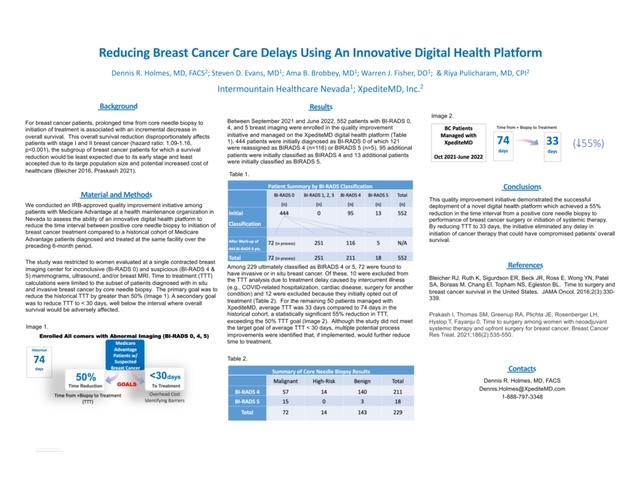
(P1-05-02) Reducing Delays of Breast Cancer Care Using An Innovative Digital Health Platform
Dennis R. Holmes, MD - Dennis R. Holmes, MD, Inc
Riya Pulicharam, MD - XpediteMD, Inc
Background: For breast cancer patients, prolonged time from core needle biopsy to initiation of treatment is associated with an incremental decrease in overall survival. This overall survival reduction disproportionately affects patients with stage I and II breast cancer (hazard ratio: 1.09-1.16, p< 0.001), the subgroup of breast cancer patients for which a survival reduction would be least expected due to its early stage and least accepted due to its large population size and potential increased cost of healthcare.
Materials and Methods: We conducted an IRB-approved quality improvement initiative among patients with Medicare Advantage at a large integrated healthcare organization in Nevada to assess the ability of an innovative digital health platform to reduce the time interval between positive core needle biopsy to initiation of breast cancer treatment compared to a historical cohort of Medicare Advantage patients diagnosed and treated at the same facility over the preceding 6-month period. The study was restricted to women evaluated at a single contracted breast imaging center for inconclusive (Bi-RADS 0) and suspicious (BI-RADS 4 & 5) mammograms, ultrasound, and/or breast MRI. Time to treatment (TTT) calculations were limited to the subset of patients diagnosed with in situ and invasive breast cancer by core needle biopsy. The primary goal was to reduce the historical TTT by greater than 50%. A secondary goal was to reduce TTT to < 30 days, well below the interval where overall survival would be adversely affected.
Results: Between September 2021 and April 2022, 552 patients with BI-RADS 0, 4, and 5 breast imaging were enrolled in the quality improvement initiative and managed on the XpediteMD digital health platform. 208 patients were designated as BI-RADS 4 or 5 (i.e., suspicious imaging findings), all of whom ultimately underwent a diagnostic core needle biopsy. Of these, 75 patients were found to have invasive or in situ breast cancer and were subsequently referred to surgery or medical oncology where treatment was initiated. Among these patients, average TTT was 32 days with use of the digital health platform compared to 74 days in the historical cohort, a statistically significant 57% reduction in TTT, exceeding the 50% TTT goal. Although the study did not meet the target goal of average TTT < 30 days from needle biopsy to initiation of treatment, failure to achieve this goal was largely attributable to 3 patients who elected to delay cancer therapy for personal or health reasons. Excluding these 3 patients would have yielded an average TTT of 28.75 days, which is within our < 30-day goal.
Conclusions: This quality improvement initiative demonstrated the successful deployment of a novel digital health platform which achieved a 57% reduction in the time interval from a positive core needle biopsy to performance of breast cancer surgery or initiation of systemic therapy. By reducing TTT to 32 days, the initiative eliminated any delay in initiation of cancer therapy that could have compromised patients’ overall survival.
|
|
(P6-02-09) Racial/Ethnic Groups Have Different Rates of Pathogenic Variants in Common Cancer Genes
Background: Racial/ethnic disparities have been well-documented in access to cancer screening and treatment, as well as treatment outcomes. Less is known regarding the yield of genetic pathogenic variants (PVs) in non-white populations.
Methods: Patient data was obtained from the Informed Genetics Annotated Patient Registry (iGAP), an IRB-approved multi-center longitudinal, observational study, in which 2148 patients self-declared race/ethnicity and underwent germline genetic testing at any lab. Analyses were limited to 24 cancer susceptibility genes (ATM, BARD1, BRCA1, BRCA2, BRIP1, CDH1, CHEK2, NBN, PALB2, PTEN, STK11, TP53, APC, BMPR1A, CDK4, EPCAM, MLH1, MSH2, MSH6, MUTYH, PMS2, RAD51C, RAD51D, SMAD4), 21 of which have clinical management guidelines from the NCCN (excluding NBN, BARD1, CDK4).1 Descriptive statistics were used to assess and compare data from these populations and germline genetic testing results.
Results: The Registry included 2148 patients, 1662 (77.37%) with a personal history and 1536 (71.51%) with a family history of cancer. The patients were 74.39% White, 6.33% Hispanic, 5.59% African/Black, 5.03% Asian, 1.63% Other, 1.35% Ashkenazi, and 5.68% Unknown. The overall germline PV rate in the cohort was 0.1089 PVs/patient tested, with 234 PVs detected in 227 patients.
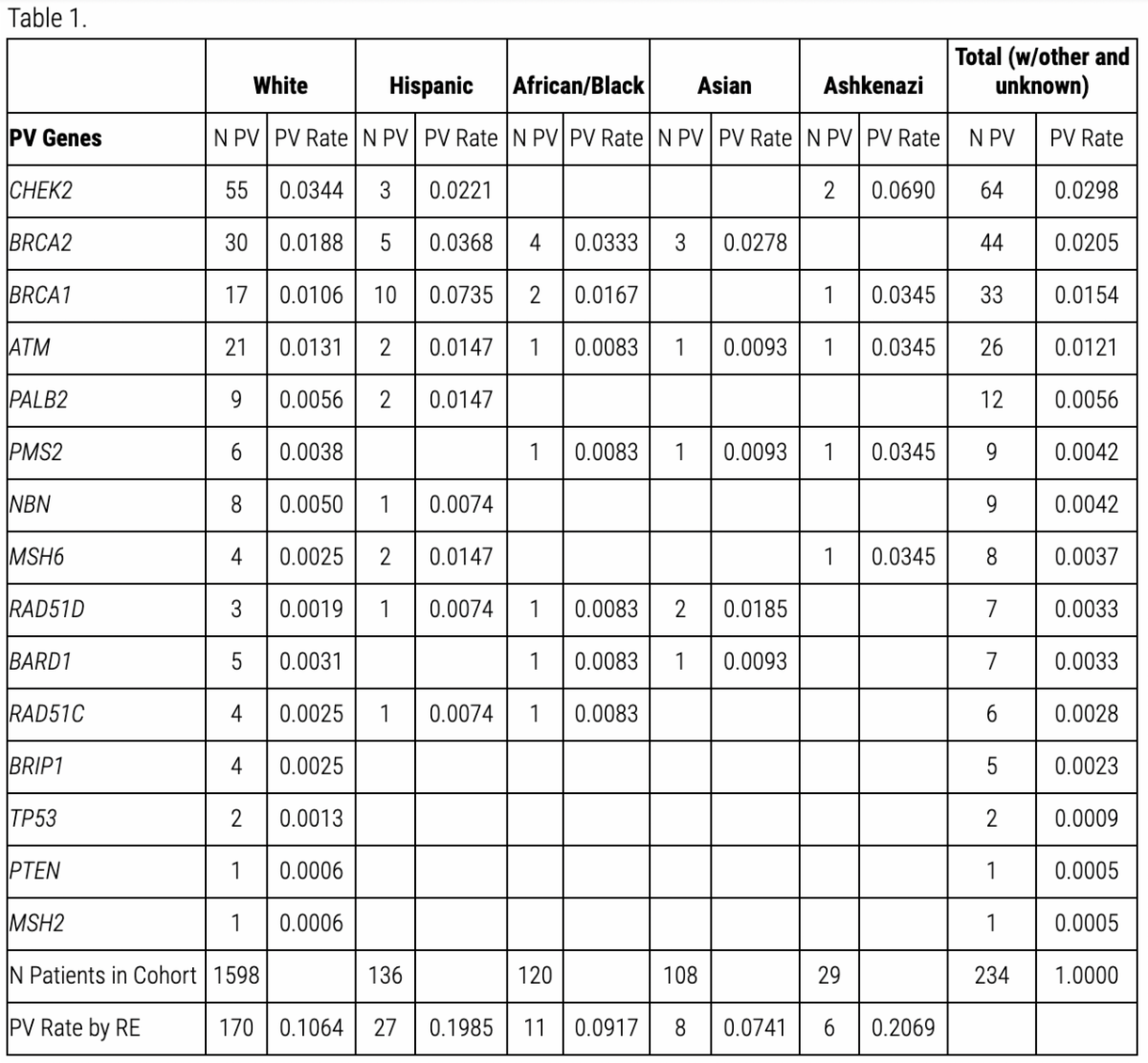
The PV rate among racial/ethnic groups were as follows: White 170/1598 (0.1064), Asian 8/108 (0.0741), Hispanic 27/136 (0.1985), African/Black 11/120 (0.0917), Ashkenazi 6/29 (0.2069). In patients self-reporting as Hispanic, the PV rate was similar to PV rate in those self-reporting as Ashkenazi, and significantly higher (p=0.00027) than PV rate in those of other self-reported race/ethnicity. Gene level PV rates are shown in Table 1.
Conclusions: Those who reported being Hispanic had an increased overall PV rate. This could be due to the greater representation of Hispanics from New Mexico who may have Ashkenazi ethnicity. Further studies are needed to understand whether these differences are a result of disparate access to testing, true population differences, lack of data in non-White populations skewing variant classification or other factors.
|
|
(P3-05-43) Germline Testing Results in Patients with Genomic Tumor Profiling
Background: With the rise of genomic testing, more clinicians are using panels to understand the genetic profile of breast cancer to help aid in clinical management. However, little is known about the relationship between the results of genomic tests and the likelihood of identifying an underlying germline variant, and how this should integrate into clinical decision making.
Methods: Data was obtained from the Informed Genetics Annotated Patient Registry (iGAP), an IRB-approved, multi-centered longitudinal registry designed to capture biomarker test results and their impact on treatment practices and outcomes. Two genomic tumor profiling tests were studied - MammaPrint recurrence risk and Blueprint molecular subtypes, including Luminal type A, Luminal type B, Basal, and HER 2 type. Of the 3400 patients currently enrolled in the registry, 528 have been diagnosed with breast cancer and underwent tumor profiling by both MammaPrint and BluePrint as well as germline genetic testing, including analyses of 24 cancer susceptibility genes (ATM, BARD1, BRCA1, BRCA2, BRIP1, CDH1, CHEK2, NBN, PALB2, PTEN, STK11, TP53, APC, BMPR1A, CDK4, EPCAM, MLH1, MSH2, MSH6, MUTYH, PMS2, RAD51C, RAD51D, SMAD4). Differences in positive germline variant rates were tested for with two-sided, Chi-Square tests using the prop.test function in R.
Results: 231 (44.17%) were classified as High-Risk for recurrence on MammaPrint, with a 0.13 PVs detected per patient tested (positive germline variant (PV) Rate), 269 (51.34%) were identified as having a Low-Risk, with a 0.0849 PV rate, and 23 (4.4%) Ultra-Low-Risk, with a 0.0455 PV rate. There is not a significant difference between the High-Risk and Low-Risk for recurrence (p=0.09).
45 (8.54%) Basal molecular subtype identified by BluePrint panel, with a 0.1778 PV rate, 292 (55.41%) classified as Luminal A type, with a 0.0819 PV rate, 171 (32.45%) Luminal B with 0.1078 PV rate, and 13 (2.47%) HER2 Type with 0.07 PV rate. There was a significant difference between Basal and Luminal A PV rates (p=0.042), but no other statistically significant differences were found.
Conclusions: Patients with a Basal molecular subtype have a significantly higher likelihood of having a germline pathogenic variant compared to Luminal A subtype. There was a trend that did not reach statistical significance for MammaPrint High Risk to have a higher likelihood of germline pathogenic result compared to MammaPrint Low Risk. This data adds another parameter for germline testing in those breast cancer patients who fall outside of current NCCN testing criteria.
|
|
(P3-05-44) Genomic testing and Ki-67 Percentage: Two puzzle pieces being undervalued in breast cancer treatment
Background: Genetic resources are underutilized when it comes to being incorporated into a breast cancer patient's treatment, but that isn't the only piece being overlooked. The Ki-67 proliferation index expressed (Ki-67%) is an established marker of tumor proliferation and aggressive behavior. We hypothesized that Ki-67% could have increased clinical utility when correlated with genomic testing results.
Methods: Data was obtained from the Informed Genetics Annotated Patient Registry (iGAP), an IRB-approved, multi-center longitudinal registry designed to capture biomarker test results and their impact on treatment practices and outcomes. Tumor grades and Ki-67% were taken from patient pathology reports. The average Ki-67% was then calculated and compared for each tumor grade, MammaPrint genomic recurrence risk category (ultra low risk, low risk, and high risk), and Blueprint molecular subtype (Luminal type A, Luminal type B, Basal, and HER 2 type). ANOVA statistical analysis was performed for significance values.
Results: Of 3102 patients enrolled in the iGAP Registry, 733 were diagnosed with breast cancer and had available tumor grade and Ki-67% data. Among these patients, 357 had genomic recurrence risk (MammaPrint) and 220 genomic molecular subtyping (BluePrint) reports. As expected, tumor grades were significantly positively correlated with Ki-67% (p< 0.0001 between all 3 tumor grade groups). Average Ki-67% in each genomic recurrence risk revealed a significant difference between Low Risk (14%, range 1-70%) and High Risk (36%, range 1-95%, p< 0.0001). Among the genomic molecular subtypes, there were significant differences in Ki-67% between Basal (avg 69%, 17-95%) and Luminal type A (avg 13%, 1-70%, p< 0.0001)) and all other subtypes, while Luminal type B (avg 24%, 1-80%) and HER 2 (avg 38%, 29-45%) were not significantly different from each other (p=0.2817), but still significantly different to all other subtypes.
Conclusion: From these results, we can deduce that molecular subtype correlates with, but is clinically distinct from, Ki-67 proliferation index. These results also indicate that molecular subtype correlates with higher tumor grades, possibly due to increased cell proliferation. Achieving truly personalized clinical decision making requires utilizing multiple modalities and biomarkers, integrating the results into management.
|
|
Join Us For Our Next Breast Cancer Q & A Webinar
Join us for another breast cancer Q&A this upcoming Saturday, January 21 from 12:00-1:30 pm PST where you can ask your questions LIVE.
Dr. Holmes will be taking general questions regarding breast cancer cryoablation, surgery, radiation, and more.
|
|
|
|
Dennis R. Holmes, MD, FACS
Breast Cancer Surgeon and Researcher
Editor, L.A. Breast Chronicles
Patient Appointments: 1-800-203-5515
Adventist Health Glendale Physicians Medical Terrace
1505 Wilson Terrace, Suite 150
Glendale, CA 91206
www.drholmesmd.com
|
|
|
|
|
|
|