ISSUE 77 | August 23, 2022 | |
Weekly highlights for the Manufacturing community.
Subscribe to get this newsletter in your inbox each Tuesday.
| |
 | |
New Chip Could Make Treating Metastatic Cancer Easier and Faster
Cancer spreads via circulating tumor cells (CTCs) that travel through the blood to other organs, and they are nearly impossible to track. Now, researchers at the Georgia Institute of Technology have found a detection method that could revolutionize cancer treatment by showing how cancers metastasize and what stage they are. This could lead to earlier and more targeted treatment, beginning with a simple blood test. When a tumor starts metastasizing, it sheds its cell into the blood. An individual cell often doesn’t survive the bloodstream on its own, but clusters of cells are much more robust and can travel to other organs, effectively pushing the cancer to a metastatic state. CTCs have proven difficult to study, let alone treat. Blood contains billions of cells per milliliter, and only a handful of those cells would be CTCs in a patient with metastatic cancer. Such intense filtration has been inaccessible using conventional lab methods. Most traditional filtration is too aggressive and would break the cluster back into single cells and ruin the ability to study the effect of a cluster. “That’s what got engineers like me interested in this because we are really good at creating sensors, or small devices that actually do sensitive analysis,” said School of Electrical and Computer Engineering Associate Professor Fatih Sarioglu. “We started developing technologies to catch these precious cells to help manage cancer better.” Read more at Semiconductor Digest
| |
Lignin Additive Boosts Properties of Carbon Fiber, Recyclable Plastics
The second most abundant biopolymer on Earth, lignin has understandably captured the interest of researchers over the years as a potential renewable component of polymers. The most recent innovation comes from Washington University in St. Louis, where lignin-related research may lead to even stronger, lighter carbon fiber as well as plastics with a smaller environmental footprint. Lignin provides rigidity and structure to plant tissues, but until recently it was largely considered industrial waste beyond its botanical function. That is changing. Back in 2016, the first commercial-scale plant to extract lignin was built in Alberta, Canada, with the goal of replacing fossil-fuel sourced petrochemicals. More recently, a research consortium in Japan developed thermoset composite materials that incorporate lignin in automotive components. The research at Washington University involves chemically altering lignin so that it can be used as a precursor for an enhanced form of carbon fiber. It reportedly could also enable the development of recyclable plastics with improved properties. By altering some of lignin’s properties, Joshua Yuan, professor and chair of the Department of Energy, Environmental & Chemical Engineering, and his team created High Molecular Weight Esterified Linkage Lignin (HiMWELL). They combined it with polyacrylonitrile (PAN) to formulate the precursor. Read more at Plastics Today
| |  |
|
|
3 Super Cool 3D-printed Tools, Gadgets
When the first 3D printers were developed in the 1980s, the primary applications were for research and development. But nobody could have imagined all the useful, exciting, and quirky things that would be created with the technology years later. From prosthetic applications to fun pop culture items, the possibilities are endless. In the spirit of discovering what impressive and funny things humanity can do with a little imagination and the right technology, below are three of the coolest items and tools ever 3D printed. Plastic Cast That Heals Broken Bones Perhaps one of the best concepts for medical use came to light thanks to the efforts of designer Deniz Karasahin in 2014. It is a 3D-printed cast equipped with a low-intensity pulsed ultrasound system. The system helps bones heal 40-80% faster. This is not the first application of a 3D-printed tool to help people. In fact, companies are actively working to expand this use case and improve the quality of life for people with injuries and disabilities, such as designing devices that make kitchen tasks more accessible. Game of Thrones Dragon Lamp Fan of the show or not, the dragons in Game of Thrones are definitely awesome. So, imagine the sales for an Etsy seller that crafted a creative dragon lamp. The 3D-printed dragon breathes “fire,” which comprises the light-up part of the lamp. Creative, fun, and worth every penny! Read more at Thomas
| |
|
Innovation and Automation at DHL Supply Chain
In January 2018, DHL Supply Chain deployed six autonomous mobile robots (AMR) from Locus Robotics in an 18,000-square-foot area in a facility handling medical devices. Long considered one of the most innovative of the world’s third-party logistics (3PL) providers, DHL Supply Chain understood a lot was still to be learned from an immature technology, but it wanted to get ahead of the curve and its competition. Fast forward, and DHL recently announced it has deployed more than 2,000 Locus bots in North America and has surpassed 100 million units picked across more than a dozen North American facilities. There have been a lot of learnings along the way. The same organization is now tackling autonomous lift trucks. As it did with AMRs, DHL Supply Chain is starting small, with a fleet of nine autonomous lift trucks (Crown Equipment) in an 800,000-square-foot facility in Findlay, Ohio. As with the AMRs, the initial application is limited to a portion of the 800,000-square-foot facility and is managing a select group of mid- to slow-moving SKUs. The application is also measured, limited to the putaway and retrieval of pallets from double-deep pallet rack going up six locations. Read more at MMH
| |
|
Amorepacific Develops World’s First Chip-less Wireless Electronic Skin Enabled by Semiconductors
Amorepacific, a South Korean beauty and cosmetics conglomerate, in collaboration with Professor Kim Jeehwan at MIT, has developed the world’s first chip-less wireless wearable electronic skin (e-skin) that is sweatproof and can continuously monitor skin changes over long periods of time. The academic value and significance of this co-development are underscored by the publication of the research results in the prestigious journal Science, under the title of “Chip-less wireless electronic skins enabled by epitaxial freestanding compound semiconductors.” The result follows four years of joint research between Professor Kim’s engineering research team at MIT and researchers at Amorepacific’s R&I Center in Korea. The key outcome is the development of a conformable e-skin in the form of a breathable patch which is enabled by epitaxial freestanding compound semiconductors. The patches are patterned with artificial human sweat ducts to ensure that sweat permeates through to prevent skin irritation and keep the patch from falling off. The ultra-thin patches are also the world’s first to support skin monitoring and data transmission without requiring integrated circuit chips or batteries. Read more at Semiconductor Digest
| |
|
The Cognitive Shortcut That Clouds Decision-Making
Meetings are as effective over Zoom as they are face-to-face. A four-day workweek makes employees more productive. Few complaints means customers are happy. Innovation requires disruption. Business leaders regularly confront these and similar claims. But what makes people believe that they are true? And, more critically, how do such claims affect strategic decisions? We live in a time of unprecedented access to information that’s available anytime and anywhere. Even when we don’t actively seek out opinions, reviews, and social media posts, we are constantly subjected to them. Simply processing all of this information is difficult enough, but there’s another, more serious problem: Not all of it is accurate, and some is outright false. Even more worrying is that when inaccurate or wrong information is repeated, an illusion of truth occurs: People believe repeated information to be true — even when it is not. Read more at CIO
| |
|
Explosive Robot Growth Expected, New DIY Robot Tech Emerges
A recent study released by PMMI, Automation World’s parent organization, indicates that 84 percent of consumer packaged goods companies now use robots somewhere on their production lines, and this number is expected to rise to 93 percent in the next five years. And deployment of collaborative robots, also known as cobots, is also expected to see strong growth, with use more than doubling from 27 percent this year to 57 percent in 2027. Respondents to the PMMI research say improvements in robot functionality, such as vision, self-learning, and artificial intelligence are spurring manufacturers to purchase and use more robots in processing and packaging applications. Read more at Automation World.
| |
|
Google Demos Snack-Fetching Robots
Google is one step closer to realizing its goal of a robotic helper, with a prototype of the robot working around its offices bringing snacks and drinks to workers. The mechanical assistant combines the physical capabilities of robots with the social and language skills of virtual chatbots to create an assistant that can understand and respond to requests, as well as determine the most efficient way of completing a task within their capabilities. The bots break down a requested task into smaller steps and determine the most appropriate and time-saving means of achieving it. The robot also features audio and visual sensors to allow it to autonomously navigate a space and identify items and areas applicable to a command. The robots’ language capabilities were developed using a variety of sites including Wikipedia and social media, allowing them to interpret voice commands and respond accordingly. Read more at IOT World Today
| |
|
Renewable-Energy Powered Storage System Slashes Roto-Molder’s Fuel Costs and GHG Emissions
A novel thermal energy storage system powered by renewable energy is substantially cutting greenhouse gas (GHG) emissions during the rotational molding of polyethylene water tanks. Fortlev, which makes water storage solutions including tanks, pipes, and connectors, is using a Brenmiller Energy bGen Thermal Energy Storage (TES) unit at its production facility in Anápolis, Brazil. The 1-MWh bGen unit uses renewable biomass instead of natural gas to heat the air for Fortlev’s roto-molding process. This lowers fuel costs for the process by 75% and cuts associated GHG emissions by about 800 metric tons a year. The bGen combines thermal storage, heat exchange, and steam generation in one unit. Crushed rocks inside the unit are heated to more than 600°C, then store that heat for minutes, hours, or days until required. The bGen can be charged not only by biomass, flue gas, or recovered heat, but also by electricity. Brenmiller said its method stores and converts energy more efficiently than battery-based energy storage technologies. Next, Fortlev and Brenmiller Energy are planning to install 60 bGen units at the facility for further emissions reductions. Read more at Plastics Today
| |
|
When Prioritizing Diversity as a Hiring Manager, Don't Overlook Diversity of Thought
Prioritizing diversity in the workplace leads to increased innovation, better decision-making, greater revenue, and competitive advantage. But as organizations look to advance their diversity and inclusion (D&I) efforts, many are overlooking the importance of diversity of thought. What Is Diversity of Thought? Diversity of thought refers to the different opinions, perspectives, thought processes, and mindsets that would ideally be found within an organization’s workforce and are ultimately integral to its success. By prioritizing diversity of thought, hiring organizations acknowledge that different perspectives are valuable and important and accept that there are many ways to drive innovation and approach challenges. Before delving deeper into some of the benefits of diversity of thought, it’s important to note that advancements in this area should not be thought of as a replacement or alternative to other diversity efforts in the workplace. Hiring organizations must continue to invest in D&I initiatives that consider people from all marginalized backgrounds. In fact, diversity of thought is often a natural by-product of ensuring people of every race, ethnicity, religion, gender, sexuality, ability, and socio-economic background are provided with equal opportunities. Read more at Thomas
| |
|
10 red flags to watch for when hiring
The time it takes to carefully vet a new IT pro pales in comparison to the lost hours spent trying to rehabilitate a new hire that can’t or won’t fit in with their team. And while some signs that a bad hire is ahead are obvious, some are more subtle. We tapped IT leaders and recruiters with decades of experience hiring tech talent to find out what makes them think twice during the interview process. Among their top concerns: candidates who appear to be going through the motions, suggesting their interests aren’t aligned with the company. Practiced responses are also a worry, multiple IT leaders said, along with expectations from the candidate that appear to change dramatically through the process — a problem that’s on the rise. Read more at CIO
| |
|
If You’re Not Sure You Want to Hand Your Business Down to Your Kids, Here Are Other Options
Deciding on a succession plan that’s right for your business takes careful consideration. Many business owners devote themselves to running a successful family business with the hope of one day passing it on to their partner or children. But before assuming this is the right decision for you, you’ll need to evaluate your individual circumstances and weigh the pros and cons of various options. After all, no two businesses — or children! — are the same. Should You Hand Your Business Down to Your Partner or Kids? Handing down the family business to your partner or children might seem like the obvious choice. After all, a key incentive for starting a business in the first place is the idea that you will be leaving behind a meaningful legacy in your family name. Understandably, you’d want your partner or children to share that passion, and it’s also comforting to know that you could be providing financial security to your descendants for many years to come. Before making the final decision, however, it’s important to ask yourself the following questions. Read More at Thomas
| |
|
Family Businesses Rarely Transfer to the Next Generation — Here's Why It Matters
Many U.S. private company owners dream that someday their children will want to take over the business, then successfully grow it to new levels, thus preserving the family's financial and reputational legacy that took years of scrimping and hard work to build. For most, it truly is a dream, as relatively few prosperous businesses transfer to family members. While reliable data is elusive, one study indicated that of those which do — variously estimated to be 10-30% — less than two-thirds of them survive the second generation under the same company name and ownership, and only 13% of successful family businesses last through three generations before being sold outside the family, merged, or closed. Women May Help Intra-family Succession Will the number of intra-family transfers increase with an ever-building pool of women asserting a desire to take over the family business? Since women have steadily progressed from workforce participants to founders over the decades, it would seem reasonable to assume that more qualified women will express interest in controlling their family’s business. Reportedly, about 25% of family businesses are now run by a female president or CEO. Perhaps that will be around 50% in another decade. Read more at Thomas
| |
|
Baker Hughes Acquisition of Quest Integrity Expands Asset Inspection Solutions for the Energy and Industrial Sectors
Baker Hughes has announced an agreement to acquire Quest Integrity, a subsidiary of Team, Inc Quest Integrity is a global player in the development and delivery of technology-enabled reliability management and asset inspection solutions across the pipeline, refining, petrochemical and power generation sectors. Quest Integrity complements Baker Hughes’ Asset Inspection Solutions existing asset integrity offerings and will support customers with the delivery of actionable insights on a broader range of industrial infrastructure. Baker Hughes’ asset integrity solutions include pipeline inspection services that detect, characterize, locate and size anomalies in the wall of a pipeline that might potentially compromise its integrity. Quest Integrity’s technology will help to expand this capability to support “difficult-to-inspect” pipelines where the construction or operation of the line does not allow for conventional inline inspection methods to yield reliable results. The acquisition includes Quest Integrity’s Invista and Furnace Tube Inspection (FTIS) technology. Invista enables new inspection capability that extends across pipelines, marine loading lines, petrochemical, chemical, refining, power, utility and other industrial segments and facilities, such as airports. FTIS technology applies the same principles to enable the inspection of heater coils, a critical component in furnaces, detecting issues with corrosion and deformation for customers in the petrochemical and refining industries. Read more at ARC Advisory Group
| |
|
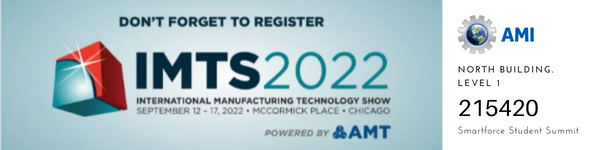
International Manufacturing Technology Show - September 12 - 17, 2022 - McCormick Place, Chicago IL. _ IMTS – The International Manufacturing Technology Show is the leading global marketplace to connect buyers and sellers of manufacturing equipment, products, and software through exhibitions, events, and partnerships to advance the industry and its businesses. More information here.
Advanced Design for Additive Manufacturing Course - September 28 - 30, 2022 - Youngstown, Ohio - In partnership with American Makes Producing unique and optimized designs is a key differentiator for additive manufacturing, compared to conventional manufacturing. This course provides foundational information, special methods and approaches to design, and hands-on practice.
Topics covered in this three-day course include consolidating many parts into one, topology optimization, and lattice/mesh structures. The course includes considerations for metal, polymer, and composite materials, the creation of custom parts, and reducing the need for time-consuming and expensive support materials. Presentations and hands-on exercises cover these and many other topics. Learn More and Register Here
MakeMore Manufacturing Summit - October 12 & 13, 2022 - Orlando, FL
Join us as we hear from organizations and manufacturers who are finding ways to bring more talent to the manufacturing sector. Take part in important conversations. Help strengthen the manufacturing sector in Florida. Don't miss it!
| |
Share The Manufacturing News Consolidator with your network | |
|
Enterprise adoption of smartNICs faces challenges
Growth in hyperscaler data centers and processor-intensive enterprise workloads, such as high-performance computing (HPC) and AI, is set to drive broadscale adoption of SmartNICs. The Ethernet controller and adapter market will grow from $3.2 billion in 2021 to $5 billion in 2026, with smartNICs contributing significantly to the growth, according to Dell’Oro Group. In addition, server network connectivity will transition to higher speeds, according to the research firm, which predicts 100 Gbps and higher-speed ports will account for 44% of the shipments in five years. Read more at Network World
| |
|
Spotlight on Sustainability and Carbon-Neutral Production with Green Innovation Zone at ACHEMA 2022
The 26th UN Climate Change Conference (COP26) on 31 October – 13 November 2021 in Glasgow, Scotland reaffirmed the targets of the 2015 Paris Agreement: Limiting the increase in the global average temperature to well below 2°C and pursuing efforts to limit the temperature increase to 1.5°C. Achieving these goals will require rapid, drastic, and sustained reductions of global greenhouse gas emissions, including reducing carbon dioxide emissions by 45 percent by 2030 (relative to 2010 level), as well as substantial reductions in other greenhouse gases. At the same time, heavy investment in power generation and energy are required to meet the challenges of a growing demand for electrical energy and rising energy prices due to geopolitical issues. The majority of these investments rely on natural resources, which are finite and impact the environment adversely. One of the best strategies to curtail the situation is avoiding wasting energy and increasing energy efficiency. Read more at ARC Advisory Group
| |
|
Aflac virtualizes the customer enrollment experience
At the outset of the pandemic, Aflac’s independent agent/franchise business looked to be a dead duck. The traditional in-person process of insurance agents meeting with prospective customers to discuss policies, sign paperwork, and load it into the company’s client/server system came to a complete halt. While Aflac’s other major division, its business-to-business insurance line, was relatively unaffected by the pandemic, its independent agents hung in the balance, just as the publicly traded company was undertaking a transformational journey to the cloud. “Because we are an insurance company, what we are is a promise on a piece of paper,” says then-CIO Richard Gilbert. “We had launched a large user-centric, customer-focused transformation with the technology projects we were doing, but then the pandemic hit and changed everything for us.” Read more at CIO
| |
|
Tesla Autopilot Probe Moves to Next Level
Tesla is facing further scrutiny from U.S. auto safety regulators over its Autopilot advanced driver assistance system. The National Highway Traffic Safety Administration (NHTSA) has sent the automaker a nine-page letter seeking information on a number of issues following the escalation of an investigation earlier this year into a series of collisions with first responder vehicles. The probe has been upgraded to an Engineering Analysis, which is normally considered the last stage of the investigation process before the agency decides whether a recall is required. That could affect up to 830,000 Teslas on American roads. One particular area of interest highlighted in the new letter is the performance of Tesla’s camera-based driver monitoring system, which can detect if a driver is not paying attention and send them alerts when the tech is engaged. (Despite its name, Autopilot requires the driver to be ready to take control at all times.) Read more at IOT World Today
| |
|
Mēris Botnet Likely Strikes Again in Attack Google Stopped
Google detected and stopped one of the largest distributed denial-of-service incidents yet in a likely sighting of the Mēris botnet. Google is not releasing the identity of the victim, whose web servers faced a barrage of 46 million https requests per second. The peak volume of malicious traffic was 76 % larger than the previously reported record for https attacks in a Mēris botnet incident detected only two months ago by Cloudflare (see: Cloudflare Mitigates Record HTTPS DDoS Attack). The attack lasted for more than an hour. Google likens the incident to "receiving all the daily requests to Wikipedia in just 10 seconds." Wikipedia is one of the most-visited websites. The abnormally high volume of malicious traffic originated from 5,256 source IPs from across 132 countries, and Brazil, India, Russia and Indonesia made up 31% of the total traffic, Google says. Nearly one-quarter of the source IPs came from Tor exit nodes although the request volume amounted to just 3% of the attack traffic. Read more at Gov Info Security
| |
|
Wrapping up productivity and protection
Producing and finishing metal products takes manufacturing expertise to ensure a high-quality product, but finished goods still need to be packaged and protected for shipment, which can be critical for powder-coated metal parts that need careful wrapping and palletizing to guard against damage. For Oregon Powder Coating, a regional supplier of powder coating and sandblasting services, wrapping and palletizing finished goods was becoming a time-consuming, labor-intensive process that the Tangent, Ore., based company wanted to automate. The company’s staff of 16 employees serves a range of automotive, agricultural and other customers. As the company’s production volume of powder-coated metal parts and other finished products increased so did the demands on its packaging department. An average of 30 pallet loads per day needs to be wrapped and secured for delivery on the company’s fleet of box trucks. Read more at MMH
| |
|
To Address Labor Shortages, Manufacturers Must Become Talent Creators
Our nation is facing a dire shortage of manufacturing workers. The National Association of Manufacturers forecasts that by 2030, the United States could have 2.1 million unfilled manufacturing jobs. A March 2022 survey from Deloitte and the Manufacturing Institute found that nearly half of manufacturing executives said they have had to turn down business opportunities because they lacked enough workers. We’re not going to grow our way out of this problem. As baby boomers retire and millennials reach middle age, the Congressional Budget Office predicts that the American labor force will grow by less than 0.2% per year through 2031. As America renews its promise of investing in infrastructure, it is vital that we build pipelines to fill these jobs. To meet their employment needs, manufacturing companies must become talent creators. Operating under the old model of talent consumption isn’t an option when there simply aren’t enough workers, skilled or otherwise, to hire. Because hiring is expensive, it makes financial sense to invest in models that let companies harvest the rewards of growing their own talent. Read more at Industry Week
| |
|
How the scarcity of truckers hurts manufacturing (and how to fix the problem)
According to the American Trucking Associations (ATA), at current trends the driver shortage could surpass 160,000 by 2030. ATA estimates that, in the next decade, the industry will have to recruit nearly a million new drivers into the industry to replace drivers exiting the field due to retirements, driver burn-out, compensation and poor benefits. These are the challenges facing transportation executives in securing a robust driver pool. However, the challenge of driver shortages does not end with the trucking industry. Rather, the scarcity of drivers directly affects the larger manufacturing sector. Read More at Smart Industry
| |
|
Teaming Up with the Machines: How Can Machine Learning Improve Logistics?
Logistics operations function within an incredibly complex web — suppliers, clients, middlemen, financiers — and depend on everyone providing their supplies, materials, and goods on time. When timing isn’t aligned, the entire web is immediately behind the eight-ball. As logistics continues on a path of digitization, third-party logistics suppliers (3PLs) are considering the incorporation of machine learning (ML) to help manage the monstrous task of tracking an entire supply chain and keeping processes on schedule. Read more at Thomas
| |
|
What are virtual routers and how can they lead to virtual data centers?
OK, you’re a CIO and when you go down to the data center, you see racks of routers, each with a maze of cabling. When you hear “virtual routers” you think of all of that gone, replaced by mystical router instances floating about somewhere in the ether, and you smile. Or you’re a CFO who gets a bill for hundreds of branch routers, each picking your pocket on service charges and maybe software licenses. You hear “virtual routers” and think of all those little hands going out of your pocket, and you smile. Read more at Network World
| |
|
Yokogawa Launches OpreX IT/OT Security Operations Center Service
okogawa Electric Corporation announced the launch of OpreX IT/OT Security Operations Center (IT/OT SOC) service. This new addition to the OpreX Safety and Security family is a centrally managed service based on people (service organization), processes, and technology. Targeted primarily at industrial enterprises, this service was developed by Yokogawa to improve the security of IT and OT networks by detecting, analyzing, and enabling a quick and effective response to cybersecurity incidents from anywhere in the world. Monitoring in real-time for cybersecurity threats to networks and IT/OT infrastructure offers customers comprehensive protection that mitigates both operational and business downtime and eases the task of IT/OT asset management. IT/OT SOC is a security monitoring service that uses next-generation Security Information and Event Management (SIEM), which is fast, scalable, and unified. The service uses various cyber threat intelligence (CTI) and machine learning (ML) tools to collect event logs from customers' IT/OT devices to detect cyber-attacks, unauthorized accesses, and infiltration by malware. It provides a wide range of analysis, consulting, and managed services with next-generation SOC architecture. Read more at ARC Advisory Group
| |
|
The rise of the data lakehouse: A new era of data value
With 65 million vaccine doses to administer at the height of the COVID-19 pandemic, Luigi Guadagno, vice president of pharmacy renewal and healthcare platform technology at Walgreens, needed to know where to send them. To find out, he queried Walgreens’ data lakehouse, implemented with Databricks technology on Microsoft Azure. “We leveraged the lakehouse to understand the moment,” he says. For Guadagno, the need to match vaccine availability with patient demand came at the right moment, technologically speaking. The giant pharmaceutical chain had put its lakehouse in place to address just such challenges in its quest, to, as Guadagno puts it, “To get the right product in the right place for the right patient.” Read more at CIO
| |
|
The Complexity of Managing Medical Device Security Risk
The tens of thousands of very specialized types of medical devices used in clinical settings contain multitudes of diverse architectures and systems. That myriad of technical specifications adds to the complexity healthcare organizations and manufacturers face in managing cybersecurity risk, says Phil Englert, director of medical device security at the Health Information Sharing and Analysis Center. "It's very difficult for organizations to understand and quantify where the risks lie, how to put programs in place and how to approach this," he says. But those challenges are not faced only by the healthcare entities that use these devices, he says. "It's also the manufacturers themselves - especially the large ones that have multiple product lines that are distinctively different from each other. It's difficult to say, 'This set of controls will work ubiquitously across these technologies,'" he says. Read more at Gov Info Security
| |
|
Why every IT leader should avoid ‘best practices’
The nonsense was tucked away in a PowerPoint slide, as so much nonsense is. “We’ll help you institute best practices, followed by a program of continuous improvement,” the offending bullet said. Now, I’m willing to shrug at a bit of harmless puffery from time to time. And maybe this puffery was harmless. But I don’t think so. Read more at CIO
| |
|
AWS (sort of) brings private 5G to market
AWS says its private 5G managed service is now available – however, it currently only supports 4G LTE and doesn’t yet support 5G. With AWS Private 5G, which was previewed last November, customers will be able to specify where they want to build a mobile network and its capacity, and AWS will deliver and maintain the small-cell radio units, servers, 5G-core and RAN software, and SIM cards. The idea is to let enterprises quickly procure, deploy, and scale their own private 5G mobile networks without having to acquire, integrate, and maintain hardware and software from multiple third-party vendors. “This cool new service lets you design and deploy your own private mobile network in a matter of days,” wrote Jeff Barr, chief evangelist for AWS, in a blog about the now available service. But he also stated: “The private mobile network makes use of CBRS spectrum. It supports 4G LTE (Long Term Evolution) today, and will support 5G in the future.” Read more at Network World
| |
|
Kollmorgen forms collaboration with Vanderlande
Vanderlande has selected Kollmorgen NDC Solutions as a technology and service partner for their automated guided vehicle (AGV) applications. Based on Toyota Material Handling forklifts equipped with the Kollmorgen NDC Solutions technology, Vanderlande aims to strengthen and grow their portfolio of complete logistic and warehouse solutions. Vanderlande is a market-leading, global partner for future-proof logistic process automation in the warehousing, airports and parcel sectors. Its extensive portfolio of integrated solutions – innovative systems, intelligent software and life-cycle services – results in the realization of fast, reliable and efficient automation technology. Read more at MMH
| |
|
Three reasons to monitor automation, analytics, AI and AR trends
As consumers and businesses prepare to spend on next-gen or smart-gen factory solutions, the Industry 4.0 market will skyrocket. According to a recent Transparency Market Research report, the global Industry 4.0 market is estimated to register growth at a CAGR of 26.7% and eventually be valued at US $1 Trn by 2031. IoT, similarly, is growing via increases in smart devices, and IIoT figures to increase significantly with the greater rollout of 5G networks. Quicker speeds courtesy of 5G will enable industrial facilities to become even more interconnected and unified in the future. A race is on in the background in the manufacturing space to ensure companies develop digital-transformation strategies to enhance their connections in the right way. From a plant floor, specifically, new algorithms and artificial intelligence are needed to better enable businesses to run more efficiently, understand their consumers, and deliver production for greater profitability. Read more at Smart Industry
| |
This newsletter is brought to you by Advanced Manufacturing International, Inc.
Please contact us if you would like to add your news to "The Consolidator."
| |
Advanced Manufacturing International is an SMM-first non-profit organization striving to accelerate the digital transformation of small to medium-sized manufacturers with simple, secure, and ultra-low-cost solutions. If you are interested in accelerating the digital transformation of small-to-medium-sized manufacturers please contact us and subscribe to our newsletter. Learn more about AMI.
| | | | | |