e-Newsletter | July 16, 2021 |
|
Eben Bradbury Returns to His (Second) Bride
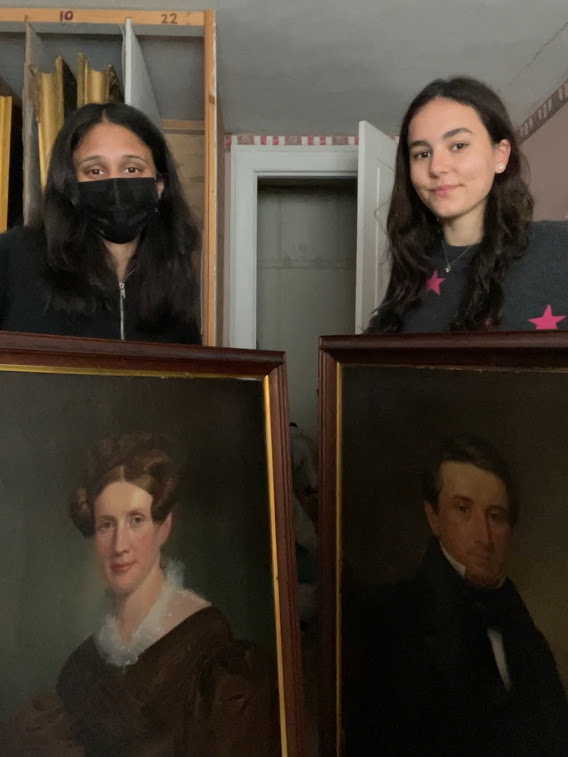
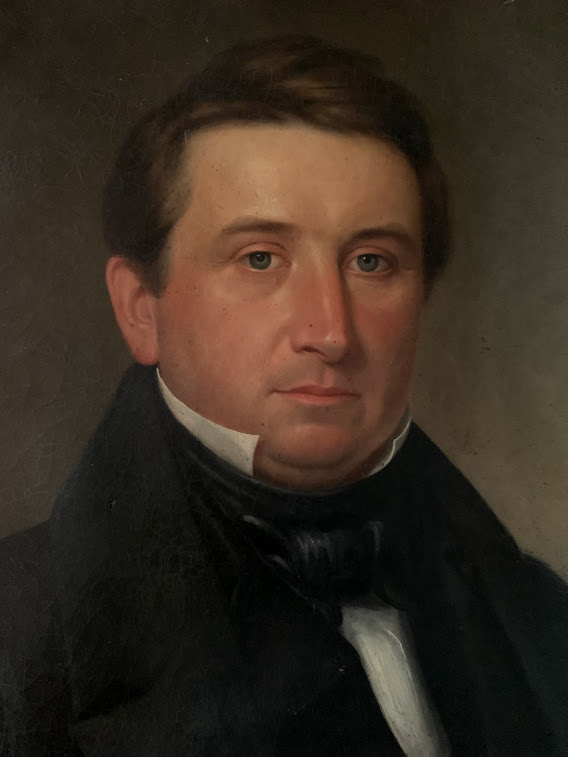
On Monday, July 12, the 1832 portrait of Ebenezer Bradbury rejoined the portrait of his wife, Mary Tappan Bradbury, commissioned in honor of their marriage. Eben and Mary are old friends of the Museum of Old Newbury and its new Executive Director, Bethany Groff Dorau, but for very different reasons. Eben is best represented at MOON by the silver he made with his father as Theophilus Bradbury and Son. Dorau spent years researching the family while writing her book, “A Newburyport Marine,” about the death of his namesake and great-grandson, killed in World War I. The following is an edited excerpt from her book.
|
|
The Interns, Aleah and Olivia, students at the Governor's Academy in Byfield, pose with Mary and Eben. And be sure to look for their Tuesday Facebook Takeovers by following the MOON's page here: https://www.facebook.com/newburyhist/. From the collections of the Museum of Old Newbury.
|
|
The first of the four Eben Bradburys was born to Theophilus and Lois Pillsbury, on July 31, 1793, his name carefully recorded in the birth register amongst the Knight and Lunt and Swett and Peirce babies of that year. Newburyport was still overwhelmingly populated by the heirs of the first settlers at the end of the eighteenth century. Family connections in Newburyport ran deep.
This first Eben was his father’s oldest son and was soon brought into the family business. Theophilus and Eben Bradbury went into the silversmithing business by 1815, offering to their fellow townsfolk an intoxicating array of goods bearing the distinctive eagle and Indian mark of Bradbury and Son. The Newburyport Herald advertised “soup, sauce and cream ladles, table and tea spoons, sugar basins, tea pots, cream pots and pitchers. . . of their own manufacture.”
Trade was brisk, and at the end of the year, twenty-two-year-old Eben wed nineteen-year-old Nancy Merrill, who had been born in Newburyport, but had moved with her family to Frankfort, Maine on the Penobscot River. One year later to the day, on December 10, 1816, Nancy gave birth to the couple’s first child, a son who they named after his father.
Babies followed nearly every year after, eight of them in thirteen years. Four of these babies, three boys and a girl, did not survive their first full year. Nancy Merrill Bradbury never recovered from the last birth, a baby girl named Anna Mary who lived for less than two months. She died at home on January 13, 1832, age thirty-five.
|
|
Ebenezer Bradbury (1793-1864) portrait upon arrival at the museum. From the collections of the Museum of Old Newbury. |
|
Eben Jr. was fifteen when his mother died, the eldest of the four children who had survived infancy. Within five months, his father married again, this time choosing his first cousin, thirty-three-year-old Mary Tappan, with whom he would have an additional ten children, six of whom survived to adulthood.
The broad span of his parenting years allowed Eben an unusual relationship with his children – he began early on to correspond with his eldest son as an equal, sending Eben Jr. a letter from Pennsylvania in 1837 (Eben Jr. was eighteen), asking him to return to Newburyport from his mother’s family in Frankfort to host his uncle, and remarking that “the infants,” Eben Jr.’s new half-siblings, “both have intermissions of the ‘Summer Complaint.’ ”
The elder Eben did not last long as a silversmith, preferring instead to follow in the footsteps of his great-uncle, the noted jurist Theophilus, who served as a Congressman from Massachusetts during the tumultuous years that followed American’s independence.
|
|
Eben began in local politics, advocating for public education and serving on town committees while building a machining business on Fair Street. He sold this business in 1826, and for two decades between 1828 and 1848, he was in and out of state legislature as the state representative from Newburyport. By 1845, he was a member of the executive council, and in 1847, he was the Massachusetts Speaker of the House of Representatives. The peak of his legislative success came in 1849, when he was appointed state treasurer, though the process was grueling.
A January 4, 1849, letter to Eben Jr. offers insight into the machinations of state government and the uncertainty of his position, and also into the intimacy shared with his son. “Sargent (his opponent) and friends have been actively at work, and instead of being at home yesterday…I should have been here (in Boston) setting things right. I have missed the support of numbers of mutual friends merely by his or his friends’ first applications.”
He closed the letter with a gloomy assessment of his chances. “If I fail, as I probably shall, it will prove that I am a political Jonah, and that my friends had better make no more attempts to stem the adverse tide against me. I am very affectionately your father, EB.”
Despite his assurance of failure, Eben Bradbury was made state treasurer, a position that he held for the two years that his Whig party held power, and he moved to Newton with his large family to shorten his considerable commute. In the 1850 census, fifty-seven-year-old Eben had eight children at home in Newton, ranging in age from seven to seventeen.
Ebenezer’s second son, John Merrill Bradbury, then a grammar schoolteacher in Newburyport, was his father’s eyes and ears in town. In a February 1847 letter to his father at the State House in Boston, John Merrill Bradbury urged him to pay attention to the “relief of the Irish,” as it had widespread support in Newburyport, and wondered about his father’s feelings on a proposed annexation of lands still belonging to Newbury.
John Merrill Bradbury and his father and brother also shared an interest in their family lineage, and he asked his father to “drop in (to a shop on Court Street) sometime when you are at leisure and see if he has any engraved charts or forms or blanks on which family ascendants or descendants can be exhibited.”
The Bradbury Memorial, a family history and genealogical record, and one of the resources available to researchers at the Museum of Old Newbury, grew out of John Merrill Bradbury’s early explorations into his family’s long history.
Ebenezer and Mary Bradbury moved back to Salisbury in November 1861, and it was there on June 19, 1864, Eben died suddenly of a heart attack. He was seventy years old, and “greatly lamented by a large circle of friends.”
|
|
Woman on the MOON
An Elephant Walks into a Bar...a blog by Bethany Groff Dorau
My dad is an unapologetic punster.
A recent favorite, since you asked?
A Roman Centurion walks into a bar, holds up two fingers, and gets five beers.
But it was my mom who, welcoming me home from a long day at work, took one look at my anxious face and said, “How do you eat an elephant?” Expecting a joke, I sighed. “One bite at a time,” she said.
The recorded history of Old Newbury is vast, complex, contested, overwhelming. The list of things that I know nothing about is elephantine. So I make lists of “bites.”
Learn the difference between a brig and a brigantine (call Graham at Lowell’s Boat Shop). Find out when 123 Water Street was built (look up the property in the Massachusetts Cultural Resource Information System (MACRIS), find nothing, look for pictures, find nothing, look at fire insurance maps, find nothing, realize a full deed chain search is needed, take a deep breath and put that bite aside for now). Identify the most likely place of worship for a Lutheran (not Orthodox) Lithuanian family in Newburyport to worship in the early 20th century (First Parish Church of Newbury, turns out). You get the idea.
The beautiful thing about history to me is that it is, in a sense, unknowable, though I intend to spend my entire life nibbling away at it. We are constantly choosing what should be saved and studied. We, the storytellers, writers, collectors and archivists, have always made decisions about which lives matter more. These decisions are based on bias, love, status, experience, ignorance, interest, conscious and subconscious desires, dreams, fears…
Years ago, I developed an unexpected friendship with an older woman who had grown up as a servant of sorts in a large household. Both of her parents exchanged room and board for their labor, and though it was never explicitly stated, the children were aware of their status. I asked her how she and her siblings experienced growing up in that environment. She snorted. “We were all raised by different people,” she said, then went on to explain that each of her siblings had very different memories based on their age, personality, sensitivity, friendships.
Her eldest sister, a teenager during the Great Depression, told me that she never felt any different from their neighbors as everyone seemed to be struggling. My friend, a decade younger, felt like she lived in a different world than her friends, and went to great lengths to avoid inviting anyone over to her house. Both of these experiences are authentic and valuable, windows on a family, on humanity. The nuance would be lost if only one sister was heard. And yet, we are so often limited to the curated records kept by the select few.
So why bother? Why try so hard to know the unknowable? Why try to eat the elephant? For me, the answer lies in the depth of understanding that we can bring to the place we live and love so much.
We can populate this place with people, separated from us only by time. We can walk down Federal Street, fuzzy up our eyes and see a dirt road, an old jail, horses and barefoot children and tenements.
We can follow it back to before 1789 when it was King Street (back when we had a king!), before that to farm lots and then back to trails to the water, to rocks and trees.
For me, there is another layer. I am sixteen, desperately in love with a boy who lives on Beck Street. We meet in the café in Jabberwocky Books and then we walk around the neighborhood. I have added the distant past to my own remembered experience of that place, and I am exponentially richer for it.
As I sit down at my desk to slog through another sheaf of research requests, I am reminded of another bit of advice, this one from my great-aunt. “One swallow doesn’t make a summer.” In other words, don’t leap to conclusions. Leave yourself open to new information, new perspectives and new evidence. And I learn to take advice, especially from mom.
Note: I am a vegetarian. No elephants were harmed in the writing of this piece.
|
|
2021 Garden Tour Gallery – Part 4
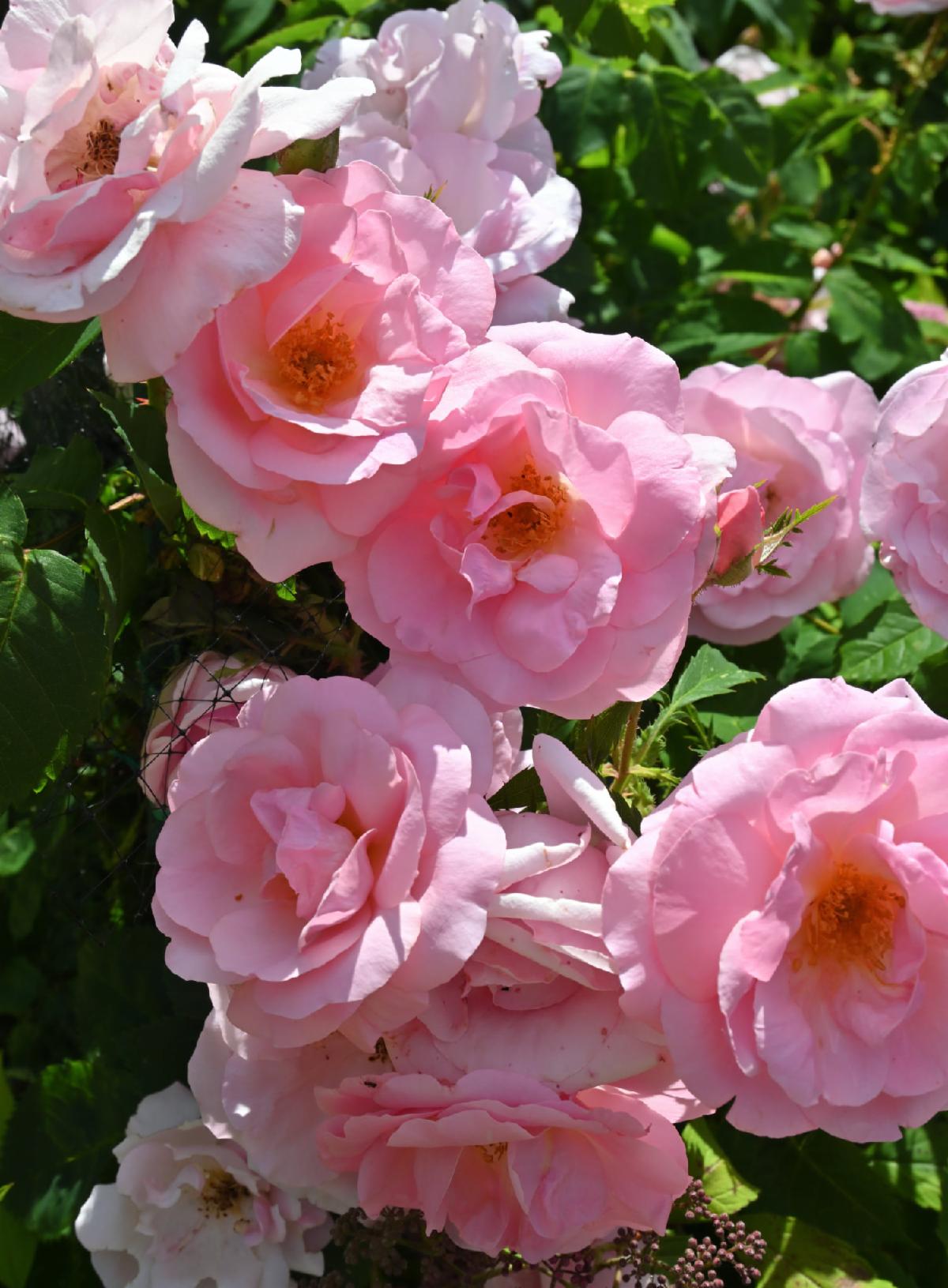
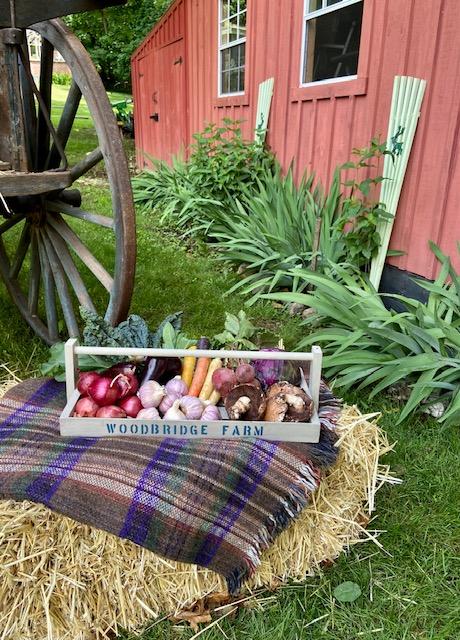
Some of the fabulous images sent in by attendees to this year's 42nd Annual Garden Tour. Many more to come! Do you have a few? Send along (with your name and the town you live in) and you could be eligible for free Garden Tour tickets next year.
|
|
Photo by Bob Watts, Newburyport. |
|
Photo by Sally Chandler, Amesbury. |
|
Learn about upcoming programs, register, find Zoom links and catch up on previous presentations here. All of our virtual programs are free, however donations are gratefully accepted to help defray speaker fees.
|
|
Martin Johnson Heade and the New England Landscape
Martin Johnson Heade (1819-1904) was a prolific painter of landscapes, still life and exotic portraits of tropical birds and flowers. Perhaps most iconic, are his salt marsh paintings of New England centered around Newbury's Great Marsh.
Colleene Fesko, an appraiser on the hit PBS television series Antiques Roadshow since its inception 25 years ago, will explore Heade's work beyond his associations with the Hudson River School of artists and discuss him as a Luminist painter, placing his salt marsh paintings and seascapes in the context of his own oeuvre and that of his contemporaries.
|
|
Puzzle Me This...
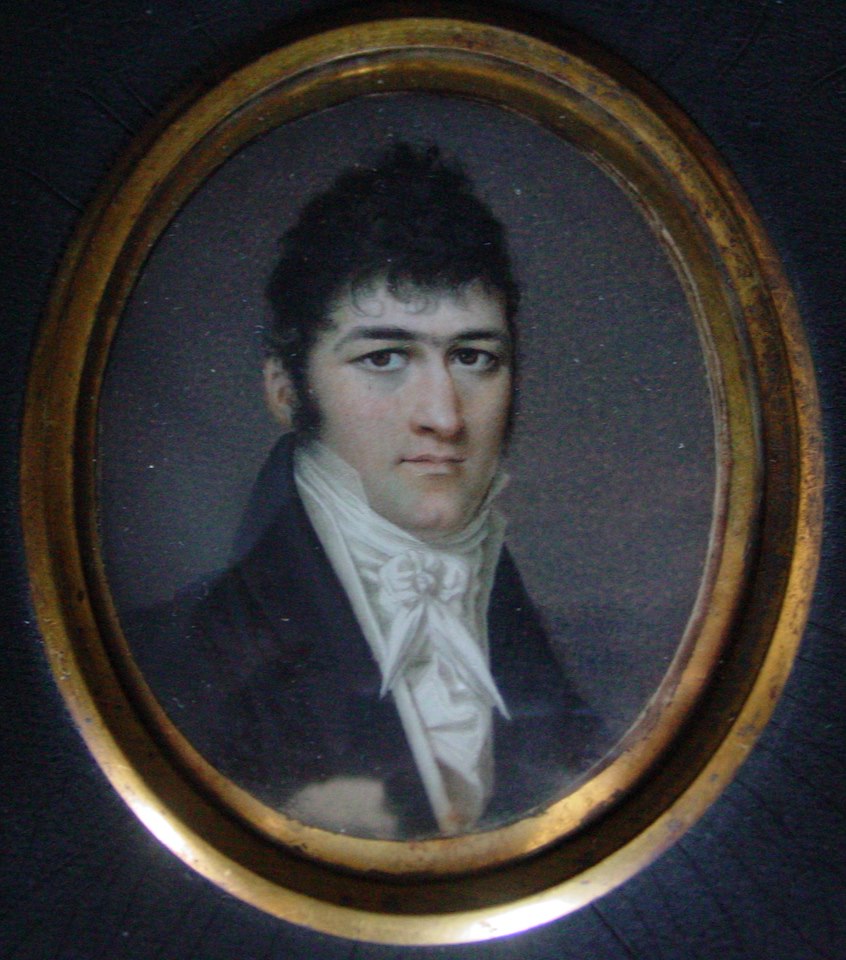
Miniature watercolor portrait on ivory of Captain Benjamin Harrod (1784 - after 1831) painted in 1809 and signed "By Lander."
Harrod, a prominent shipmaster, was one of eleven children of Benjamin and Mary Harrod, In 1825 he married Mary Anne Wheelwright. The Harrod family maintained a pew at Old South Church for 131 years.
From the collections of the Museum of Old Newbury. Gift of Francis Benjamin.
Click on image to begin puzzle.
|
|
Something is Always Cooking at the Museum
Is there anything a moist rotisserie chicken can't do? Jane M. Volpone's take is easy to make and, served with a side salad, is the ideal quick summer meal.
Crunchy Chicken Casserole
1/4 cup butter
1/2 cup flour
1 14-ounce can chicken broth
1 cup cooked, diced chicken
Topping:
3/4 cup crushed corn flakes
1/4 cup melted butter
Melt butter in saucepan over medium heat. Add flour and stir. Add chicken broth; cook 5-10 minutes to thicken. Add chicken and pour into a 1- to 2-quart casserole dish. Mix topping ingredients together and sprinkle over chicken mixture. Bake at 350ºF, uncovered, for 10 minutes. Cover and cook for an additional 20 minutes. Serves 3-4.
|
|
During this difficult period of COVID-19, we rely on your support more than ever. We continue to develop new, online programs for you to enjoy and keep us connected and look forward to in-person events as protocols for safety loosen. We hope, if you are able, that you will consider a donation to the museum. Thank you for your continued support.
|
|
Museum e-Newsletter made possible through the
generosity of our sponsors:
|
|
|
Museum of Old Newbury
98 High Street
Newburyport, MA 01950
978-462-2681
|
|
|
|
|
|
|
|