Rail Workers Weekly News Digest
Number 20 - August 6th, 2019
|
|
Below is a series of articles compiled over the previous week.
They are of interest to railroad workers.
_____________________________________________
|
|
2019-20 Article 1
PSR NEWS
Rail service is at an all-time low, shippers tell House committee
Dive Brief:
- Precision-scheduled railroading (PSR) is driving discord between railroads and their customers, a roundtable of rail shippers told the U.S. House of Representatives Subcommittee on Railroads, Pipelines and Hazardous Materials Thursday.
- Reduced headcount, service changes without notice, fewer yards in operation, insufficient locomotives, increased demurrage and accessorial charges — all on top of higher rates, drove several shippers to remark that though railroad profitability is climbing, service is at an all-time low.
- "They may claim that PSR improves service but our experience and that of many other shippers has been the opposite," said Emily Regis, fuels resource administrator for the Arizona Electric Power Cooperative, speaking on behalf of the Freight Rail Customer Alliance. Regis and the other speakers called for more involvement from the Surface Transportation Board (STB) and members of Congress in providing structure to help shippers in disputes about rates and fees related to PSR. Read more ....
|
|
2019-20 Article 2
Kentucky Miners Are Camped Out on Railroad Tracks, Blocking a Coal Train, Demanding Their Stolen Wages
(Editors note: Miners and other workers have traditionally used such direct action tactics to win what they might never win by regulation, legislation or litigation. It is how unions were built !)
Harlan County, Kentucky, is probably best known for the hard-fought strikes in its coal mines in the 1930s and 1970s. Today the remaining mines are nonunion. But evidently the local spirit of militancy and solidarity is still kicking.
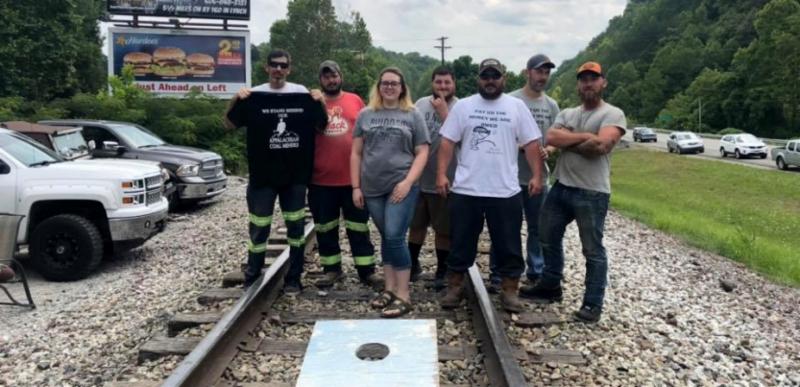
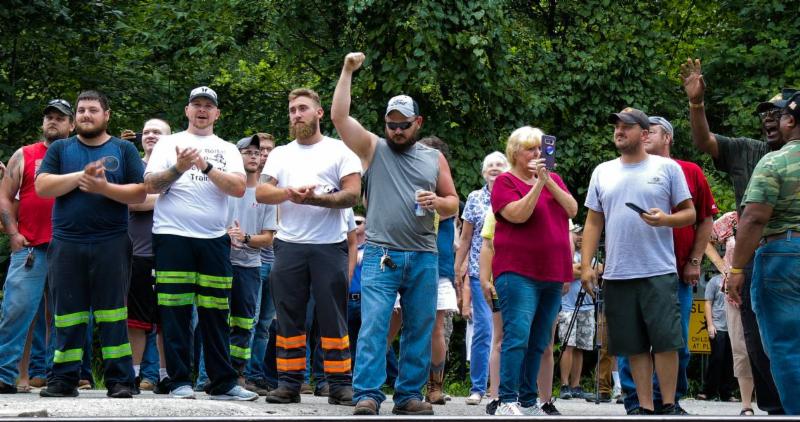
For three days now, miners and their families have occupied a railroad track, blocking a train that’s loaded up with coal that these workers dug out of the earth and never got paid for.
Word spread quickly July 29 that someone was loading up the train to move. A few laid-off miners headed down to the site to find out what was going on, and it didn’t take long to decide they weren’t going to let this train go anywhere.but bottom line, they want their wages for the work they already did.
Miners say the county police came by, asked everyone to stay off the tracks, said as long as the protests stayed civil there wouldn’t be any trouble—and departed. Since then miners, their spouses, their kids, and their supporters have maintained a constant presence at the tracks. The numbers have fluctuated, with up to 100 people gathered at times, and a few stalwarts sticking it out through the nights.
Read more ...
|
|
2019-20 Article 3
Why BNSF is bucking the PSR trend and adding logistics centers
In contrast to the majority of Class I railroads shedding lines and closing yards under the precision-scheduled railroading (PSR) philosophy, BNSF is adding logistics centers to serve customers in metropolitan areas as part of a
$3.57 billion capital expenditure program
for 2019.
The railroad, wholly owned by Warren Buffett's Berkshire Hathaway, has escaped some of the financial market pressure to improve the company's operating ratio (OR) that has driven the other railroads to adopt the strategy, albeit at different levels. You could say the PSR motto is "less is more." Shippers say it's more like "
less is less
." Meanwhile, BNSF might say, "more is more.”
|
|
2019-20 Article 4
The Safe Freight Act (HR 1734) Now Has 100 Co-Sponsors
I’m happy to announce that we secured our 100
th
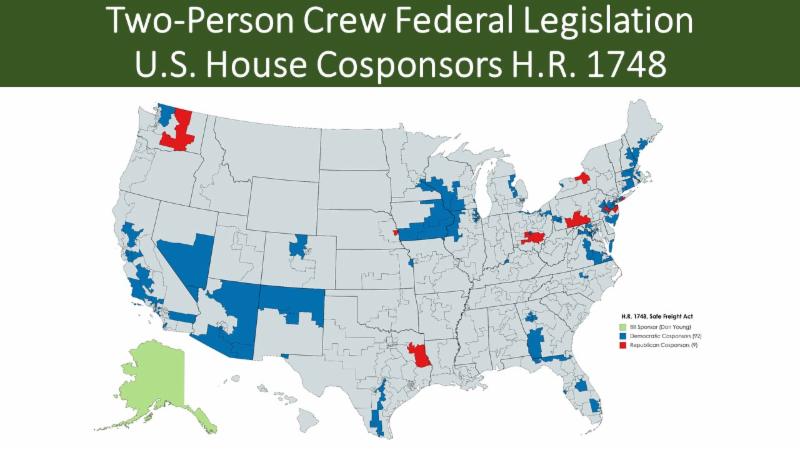
co-sponsor for H.R. 1748, the Safe Freight Act, which would require a crew of two people on all freight trains. To put it in perspective, by hitting 100 cosponsors today, this is eight months quicker than our last effort in 2017/2018.
With the Federal Railroad Administration’s recent ruling on crew size, it is now more important than ever that we pass a federal law requiring every train in America have a minimum of two crew members. Those two crew members must be a federally certified conductor and a federally certified locomotive engineer. The Safe Freight Act (in the House, H.R. 1748 and in the Senate, S. 1979) is the right prescription to ensure rail safety for both rail workers and the public alike.
This did not happen by accident - we made it to 100 cosponsors (currently 90 Democrats and 10 Republicans) because of members and retirees like you. Bottom line - member contact works. But the job is not done. Besides securing more cosponsors in the U.S. House, we need the same strong effort for the companion bill in the U.S. Senate.
As I wind my time down as National Legislative Director, I want to take this time to thank all of our members who emailed, called and met with their Member of Congress about this issue. We could not have gotten to 100 cosponsors without your assistance and we need to keep pressing on if we are to ultimately succeed.
In solidarity,
John Risch
National Legislative Director
SMART Transportation Division
|
|
2019-20 Article 5
FRA: Batory - PTC is 90 percent installed, but 'significant work' remains
Positive train control
(PTC) systems were in operation on nearly 90 percent of the route miles subject to the federal mandate as of June, but the rail industry still has "significant work" to do before fully implementing the safety technology by 2020's end, Federal Railroad Administrator Ronald Batory told a Senate committee yesterday.
As of June 30, PTC was operating on 87 percent of the 58,000 route miles subject to the federal PTC mandate, based on preliminary reports the railroads file with the Federal Railroad Administration (FRA). That represented a 4 percent increase from the first quarter, Batory told the Senate Committee on Commerce, Science and Transportation, which held the hearing to receive a PTC status report.
In addition, railroads are testing PTC systems in revenue service demonstration (RSD) on at least 718 route miles as of June 30.
"Nonetheless, railroads must still complete significant work to full implement their PTC systems by Dec. 31, 2020, especially with respect to activating PTC systems on the remaining required main lines and achieving the necessary interoperability with their tenant railroads," Batory said in his prepared statement to the committee.
Read more ...
|
|
2019-20 Article 6
U.S. railr
oads log another weekly traffic decline
U.S. rail traffic dipped 4.4 percent to 534,498 carloads and intermodal units in the week ending July 27 compared with the same week a year ago, according to
Association of American Railroads
(AAR) data.
U.S. railroads logged 261,706 carloads, down 3.5 percent, and 272,792 intermodal containers and trailers, down 5.3 percent.
Three of the 10 carload commodity groups that AAR tracks on a weekly basis registered increases for the week. They were nonmetallic minerals, up 2,381 carloads to 38,326; miscellaneous, up 880 carloads to 10,399; and petroleum and petroleum products, up 500 carloads to 12,642.
Commodity groups that registered decreases during the week included coal, down 6,517 carloads to 81,255; grain, down 1,812 carloads to 22,342; and forest products, down 1,576 carloads to 9,490.
Read more ...
|
|
2019-20 Article 7
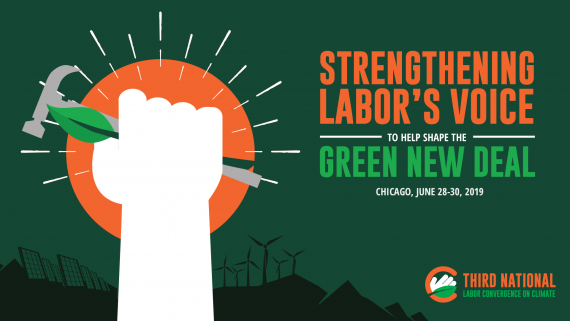
Special Issue on the Third National Labor Convergence on Climate
(Editor's Note: As an affiliate member, RWU was represented at this labor conference).
With over 250 participants hailing from 86 different union locals, 9 national and international unions, 7 labor councils and state federations, 23 labor support organizations and networks, 2 worker centers and 33 ally organizations, this Convergence was our largest ever.
People came from 25 states, the District of Columbia and British Columbia, Canada. It was a powerful and productive event that highlighted the growing strength and incredible potential of our labor-climate movement, as well as fundamental challenges we face to build the movement we need to guarantee a climate-safe future.
Today unions are no longer locked into resistance to action; indeed, some have already endorsed the Green New Deal. One dynamic new leader, [Sara] Nelson, the president of the Association of Flight Attendants, explained that the climate crisis was already harming her members through increased turbulence, on-the-job injuries, and lost income through rising weather delays. “The Green New Deal is the moonshot of our time,” she declared forcefully, “We cannot allow the idea that labor is opposed to addressing climate change to continue to exist.”
Read more ...
|
|
2019-20 Article 8
Blackjewel Bankruptcy Could Set Off Ripple Effects For Freight Rail
(Editor's Note: As the coal industry continues to decline, leaving devastated communities and families in its wake, it's time for workers and unions to demand a "Green New Deal" to ensure that these displaced
workers do not unfairly shoulder the burden).
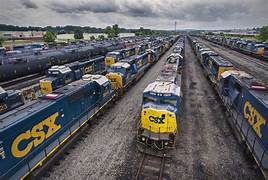
The bankruptcy of private coal company Blackjewel could result in ripple effects across the freight rail industry. There was an immediate impact. On July 29, frustrated coal miners began blocking a
CSX
train in response to Blackjewel's stalled mine operations and weeks without pay.
However, Blackjewel's bankruptcy also reminded the broader industrial sector of the vulnerability of U.S. coal production overall, particularly so for western U.S. coal production. That's because Blackjewel not only owns Central Appalachian mines but two of the biggest mines in the Powder River Basin (PRB). As a result, one lingering question will be how and if western rail movements will be affected by a possible slow decline in western coal production, just as CSX and Norfolk Southern
were affected by declines in Appalachian coal production.
Blackjewel, which has assets in Wyoming and the Central Appalachian coal-producing states of Kentucky and West Virginia, declared Chapter 11 bankruptcy on July 1, according to filings submitted to the U.S. Bankruptcy Court for the Southern District of West Virginia.
Read More ...
|
|
Railroad Workers United
Solidarity -- Unity -- Democracy
|
|
|
|
|
|
|