IDRA's Knowledge is Power is a national resource for educators and advocates to help you do your work for equity and excellence in education in the midst of classroom censorship policies.
In this edition…
- Georgia Assembly Approves Classroom Censorship
- Using Textured Teaching in the Culturally Sustaining Classroom
- The Power of Student Activism Today Draws from 50 Years Ago
- Advocacy Tools
|
|
Georgia Assembly Approves Classroom Censorship |
|
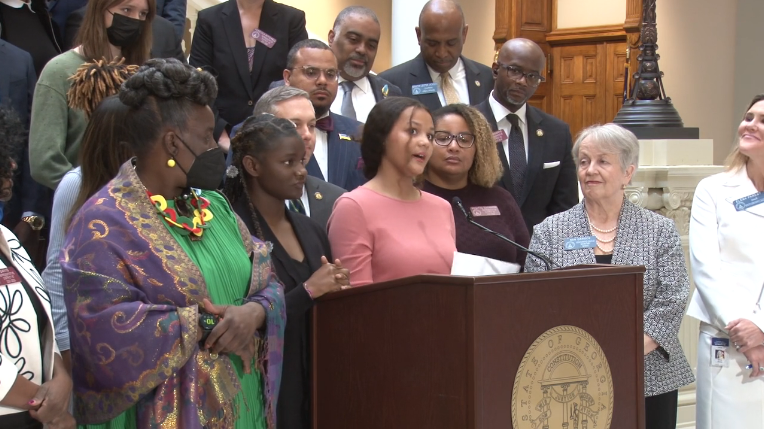
Georgia became another of many southern states to pass legislation that will censor public school classrooms. House Bill 1084 defines a list of eight theories, including the idea that “the United States is fundamentally racist” as “divisive concepts,” and prohibits any teaching that advocates these concepts.
The bill goes a step beyond affecting what students can access in their classrooms by limiting the types of training and professional development that the state certifying agency, the Professional Standards Commission, can require of any teachers, counselors or administrators.
|
|
HB 1084 faced significant opposition from legislators and community advocates, including students, parents, educators and IDRA. This opposition directly influenced the bill’s significant revision between initial filing and final passage.
Opposing legislators voiced concerns that the concepts were broad and overly vague. Advocates expanded on this concern explaining that the ambiguity of the concepts makes them difficult to interpret and would lead to a chilling effect on truthful discussion around race and systemic racism in classrooms. The ultimate effect being that students’ access to diverse, accurate curriculum will be obstructed making them less equipped to navigate the increasingly diverse world.
HB 1084 passed on the final day of the session in a shocking deviation from legislative decorum. With less than 30 minutes until midnight, Republican legislators in the House amended the bill with language that directly targets transgender students and their ability to participate in interscholastic athletics. The amendment establishes that any authority over interscholastic sports must have an oversight committee made up of 10 members appointed by various elected officials and school-related bodies. The amendment further gives this committee the power to decide whether trans girls should be allowed to participate in athletics designated for girls. Historically this decision is left to local districts. Despite strong vocal opposition from inside and outside of the chamber, the bill passed along party lines.
Still, the final language in both the original bill and its amendment is significantly less harmful than its initial form. There is speculation that the use of the word gender in the language – and the specific focus on girls’ sports – makes it susceptible to litigation. In the meantime, we will continue to collaborate with our partners to focus on the policies that will be developed to comply with this new law and work to reduce its potential damage for our students.
|
|
Using Textured Teaching in the Culturally Sustaining Classroom |
|
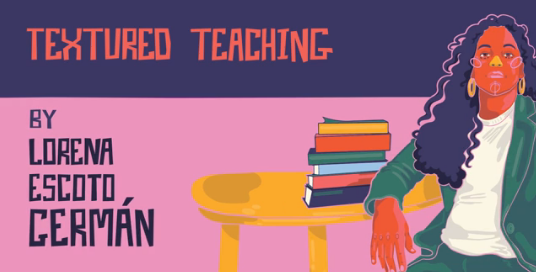
by Dr. Stephanie Garcia & Dr. Lizdelia Piñón
|
|
The strategies are designed for engaging all students, welcoming their whole selves while integrating social justice throughout middle and high school learning. The framework has four components (“traits”) that we outline below.
Student-driven and community-centered teaching focuses on students, supports them, includes them and is driven by them. There is power in community, land and culture. Escoto Germán presents ideas for building rapport with students, sustaining relationships and considering the community in which we teach. One example mentioned is “Smash It” (pg. 28) in which students write on a piece of paper what they are most bothered about in their community. They then all smash their papers into a pile. And as a class, they sort through the papers and come to a consensus on one topic to address together.
Interdisciplinary teaching involves research-based exercises and discussions of historical context and making connections. It also involves integrating with other content areas for deep analysis. One example is to “find ways to supplement the core text with information that challenges students further than they thought the texts could go” (pg. 56). This can done in an interdisciplinary form of artwork, theatrics, mathematical data or statistics, etc.
Experiential teaching is physical and sensorial which makes it highly engaging and memorable. The guidebook provides ideas for experiential strategies for comprehension and analysis as well as some cautions about what not to do in practice. The five senses are a powerful way to approach experiential learning. It also makes the text memorable and allows for critical and close reading in deep ways. An example of an experiential lesson is titled, “How to Incorporate Hip-Hop into the ELA Classroom.”
Flexible teaching is humanizing for both teachers and students and allows for relationships and empathy to enter the space. An example the guidebook gives is to allow students to help create their own assessments so they feel like learning is a partnership.
As you can see, textured teaching is “what we do and how we do it” (pg. xv). Lorena Escoto Germán’s guidebook goes into great detail on strategies to help develop cultural proficiency and the skills needed to navigate the world and deconstruct harmful social practices in our society.
|
|
Check out our Padlet where we have gathered many of the book’s available resources and videos of her speaking, so that educators may access it easier.
|
|
|
The Power of Student Activism Today Draws from 50 Years Ago |
|
by Aurelio M. Montemayor, M.Ed.
|
|
Families are reeling from the harsh blows of the pandemic and its impact on students’ academic growth. Compounding this are cultural attacks on curriculum and instruction and the burnout of our teachers.
At a time when students most need our care, we still see educators (regardless of ethnicity or race) seeing students through a deficit lens with assumptions that certain students aren’t college material or that their home language interferes with learning English or that families don’t care about the education of their children – none of which is supported by research. The harm of past prejudice and discrimination is inherited by the administrator who states, “I succeeded without bilingual education and so should these children.”
In such environments, Angela Valenzuela documented in Subtractive Schooling: U.S.-Mexican Youth and the Politics of Caring, that second and third generation Chicanitos are still worse off than children of recent immigrants. Institutional and social biases nurture deep roots in children who have no memory of a wonderful, Spanish-speaking culture and are immersed in, and imposed by, an English-speaking middle-class culture.
|
|
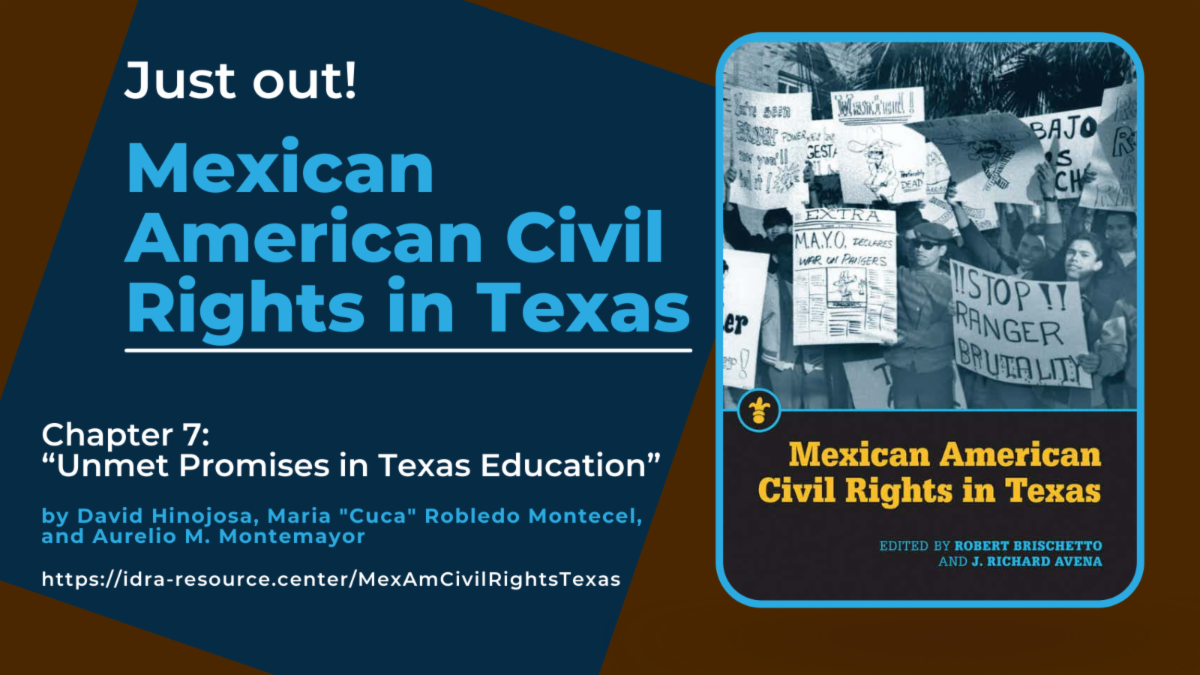
I spoke recently at a conference celebrating 50 years of Latino studies at the University of Texas at Austin. I discussed the chapter, “Unmet Promises in Texas Education,” that I co-wrote with Dr. María "Cuca" Robledo Montecel and David Hinojosa for the new book, Mexican American Civil Rights in Texas: 1968-2018.
We reflected on the student walkouts in the late 1960s and early 1970s that modeled the power of student voice to improve education. High school students across Texas protested the forbidding of speaking Spanish in school, the lack of Mexican American history and literature, unfair school funding and many other discriminatory practices.
Similarly, students today are speaking out calling for strong education that does not whitewash history. As we have been sharing in Knowledge is Power over time, students are protesting against book bans, testifying for inclusive curriculum, documenting for state leaders their experiences with racial discrimination in school and researching peers’ mental health during COVID-19 closures.
We must act with courage seeking and encouraging student voices. Strategic collective action led by our youth can transform our schools into the safe places of learning, honoring all histories and cultures and facilitating the learning and academic achievement all children. We must listen!
|
|
|
|
Guide to Texas Classroom Censorship Bill |
IDRA’s detailed guide of the Texas law (Senate Bill 3) contains our analysis and interpretation for how components of the law affect teachers and school personnel and what this means for continuing to teach the truth in schools. Educators should still consult with their district administration for local policies and procedures related to instruction, curriculum and school activities. |
|
Lessons Learned from our Classroom Censorship Advocacy |
We actively opposed classroom censorship policies, including leading a large coalition in Texas, participating in national strategy meetings, and working with partners to oppose bills filed in Georgia. As our fellow advocacy organizations continue to fight against classroom censorship in their states and communities, our hope is that the lessons we learned and tools we used in our advocacy can help support others' inclusive, community-centered work. |
|
|
|
|
Building Supportive Schools from the Ground Up |
IDRA's report highlights how school districts can use federal funds to invest in strategies that ensure culturally-sustaining schools for all students. The strategies were identified during IDRA’s community sessions with young people, families, advocates and other education experts. |
|
|
|
IDRA is an independent, non-profit organization whose mission is to achieve equal educational opportunity through strong public schools that prepare all students to access and succeed in college. |
|
|
|
|
|
|
|
|
|