|
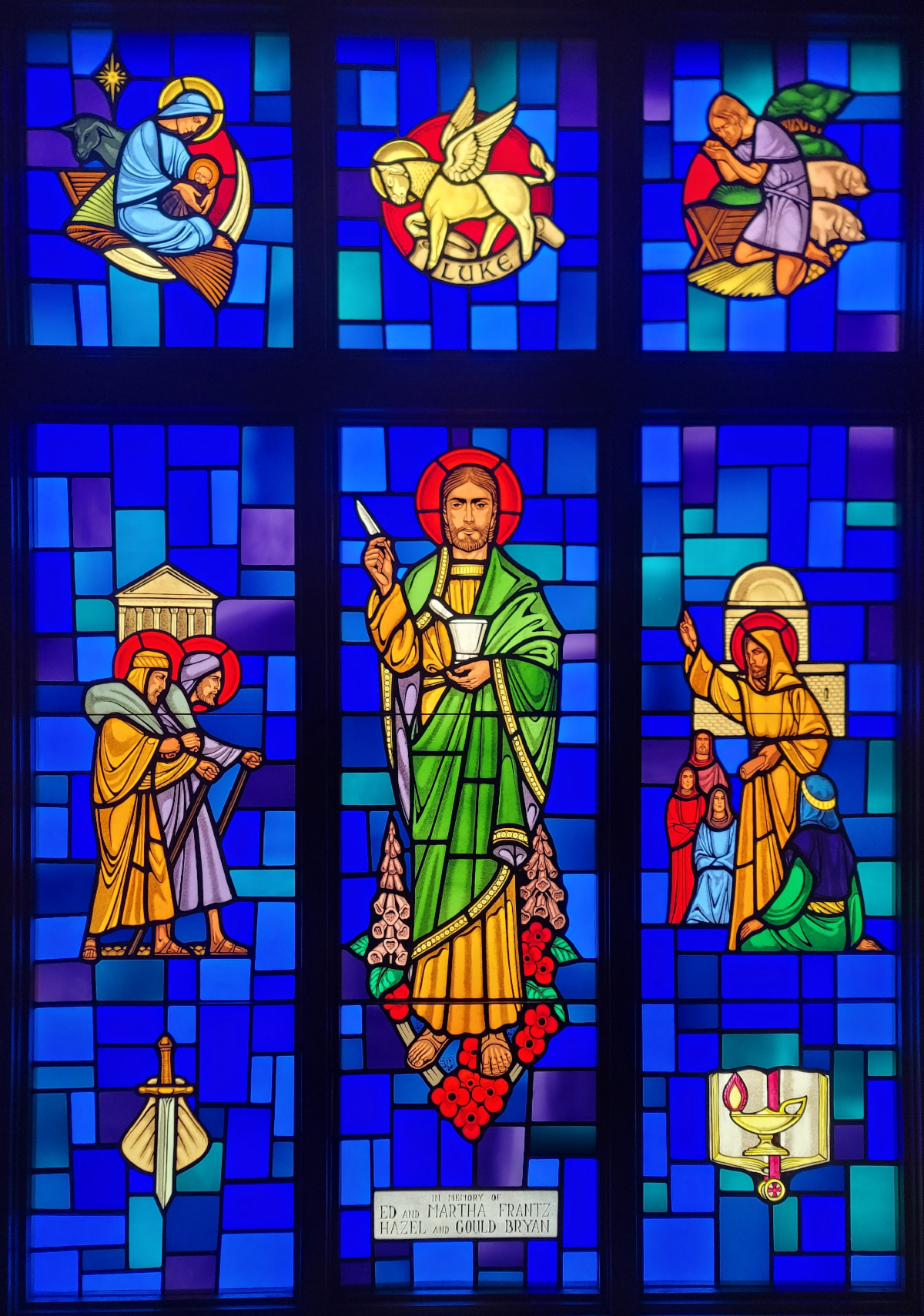
This Sunday, we’re celebrating Luke, our patron saint. The liturgical color is red, as is traditional for martyrs, apostles, and evangelists, and it’s always fun to join in our celebration by wearing red.
I was going to write a short biography of Luke, but when I looked at the one in Lesser Feasts and Fasts, I realized that there the only thing I could add or subtract were two small footnotes. From Lesser Feasts and Fasts, 2022:
According to tradition, Luke was a physician, and one of Paul’s fellow missionaries in the early spread of Christianity throughout the Roman world. He has been identified as the writer of both the Gospel that bears his name, and its sequel, the Acts of the Apostles.
Luke seems to have either been a Gentile or a Hellenistic Jew and, like the other New Testament writers, he wrote in Greek, so that Gentiles might learn about the Lord whose life and deeds so impressed him. In the first chapter of his Gospel, he makes clear that he is offering authentic information about Jesus’ birth, ministry, death, and resurrection, as it had been handed down to him from those who had firsthand knowledge.
Only Luke provides the very familiar stories of the annunciation to Mary, of her visit to Elizabeth, of the child in the manger, the angelic host appearing to shepherds, and the meeting with the aged Simeon. Luke also includes in his work six miracles* and eighteen parables** not recorded in the other Gospels. In Acts he tells about the coming of the Holy Spirit, the struggles of the apostles and their triumphs over persecution, of their preaching of the Good News, and of the conversion and baptism of other disciples, who would extend the church in future years.
Luke was with Paul apparently until the latter’s martyrdom in Rome. What happened to Luke after Paul’s death is unknown, but early tradition has it that he wrote his Gospel in Greece, and that he died at the age of eighty-four in Boeotia. Gregory of Nazianzus says that Luke was martyred, but this testimony is not corroborated by other sources. In the fourth century, the Emperor Constantius ordered the relics of Luke to be removed from Boeotia to Constantinople, where they could be venerated by pilgrims.
According to Orthodox Christian tradition, Luke was also the first iconographer. He is traditionally regarded as the patron saint of artists and physicians.
I hope you’ll join us on Sunday as we celebrate our patron, Luke the Evangelist, and this wonderful community that bears his name.
Yours in Christ,
Justin
_____
* In case you're curious like I am: The miraculous catch of fish (5:1–11), raising the widow’s son at Nain (7:11–17), healing a crippled woman (13:10–17), healing a man with dropsy (14:1–6), cleansing ten lepers (17:11–19), healing the servant’s ear (22:50–51).
** This list was surprisingly hard to compile, perhaps because exactly what constitutes a parable is a matter of some debate. Regardless, the parables unique to Luke are those of the: two debtors (7:40-43), good Samaritan (10:29-37), friend at midnight (11:5-8), rich fool (12:13-21), watchful servants (12:35-40), wise and foolish servants (12:42-48), barren tree (13:1-9), place of honor (14:7-14), great feast (14:16-24), cost of discipleship (14:28-33), lost sheep (15:3-7), lost coin (15:8-10), prodigal son (15:11-32), shrewd manager (16:1-12), rich man and Lazarus (16:19-31), master and his servant (17:7-10), persistent widow (18:1-8), Pharisee and the tax collector (18:9-14). Whew!
Yours in Christ,
Justin
|