Calling Exhibitors and Sponsors!
|
|
MSA is seeking sponsors for this year's Annual Meeting! If you know of a vendor who would be interested in exhibiting at or sponsoring MSA 2020, or if you are interested yourself, we encourage you to view our
sponsorship opportunities webpage
and send it to your contact.
|
|
|
Abstract Submission Portal &
Meeting Registration Opening Soon
Stay tuned and check the
MSA 2020 webpage
for all updates! An email with abstract submission and meeting registration links will be distributed in early February.
|
|
|
Greetings! I hope your New Year is off to a fabulous start. In Wisconsin the semester’s in full swing and I’m feeling by turns crushed and excited by experiments, teaching, ongoing faculty searches, and service as your President!
I’m writing very specifically to communicate with membership about the structure of MSA, its committees, and the documents that serve as instructions for the running of our Society: our Constitution, By-Laws, and the Manual of Operations.
Committees of MSA.
Committee membership and participation in leadership are vital to our Society, and the contributions of our committees, and committee members and chairs, are truly outstanding. But did you know that we have an enormous number of committees, some with a long history of not being filled? It’s true: if every committee described in our current By-Laws were at capacity, I estimate our committee roster would number around 175 people. Our annual meeting attendance is around 300 people. Having more than half of our attendees serving on committees may sound alright, but in practice, it’s tough to manage. Being an academic is already an exercise in managed chaos and finding people to serve on committees to ensure proper committee function is challenging. And I’d argue there’s nothing more unsettling than joining a committee that then does very little. Having so much energy directed at managing committees may also detract from our focus on science and our ability to effectively engage with groups outside MSA, for example, granting agencies or AAAS. Various committee and other positions described in our By-Laws appear archaic and need to be revised or eliminated. For example, the By-Laws require a Society Representative to the “American Mushroom Institute (AMI)”. If you conduct a Google search of AMI you’ll find it’s a real organization and does work that would click with many MSA members. But despite our great commitment to Society history, it’s been really challenging to find anyone who remembers what the role of our AMI Society Representative is and what the representative used to do on behalf of...[continue reading via the button below].
|
|
Introducing Amy Rossman: MSA Book Review Editor
|
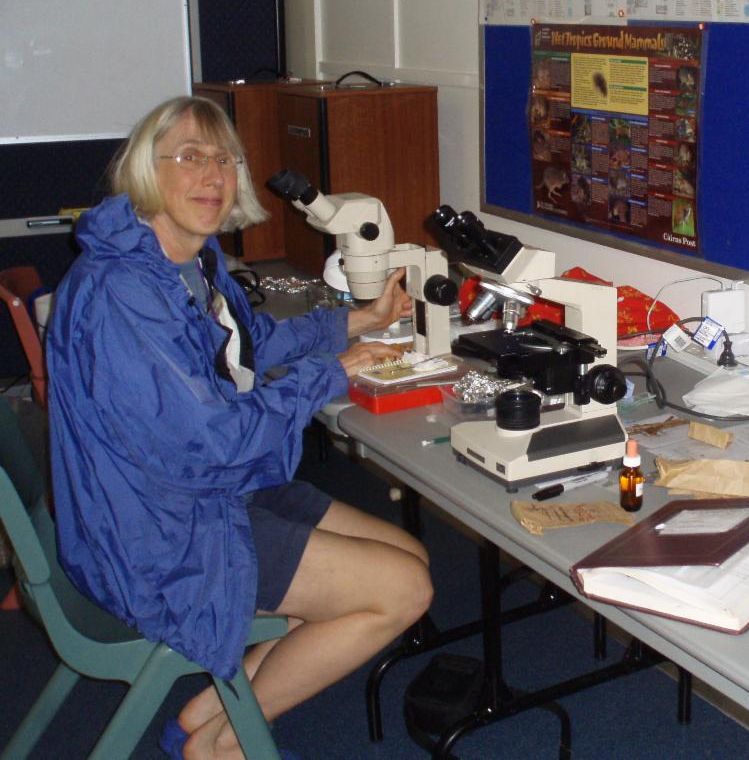
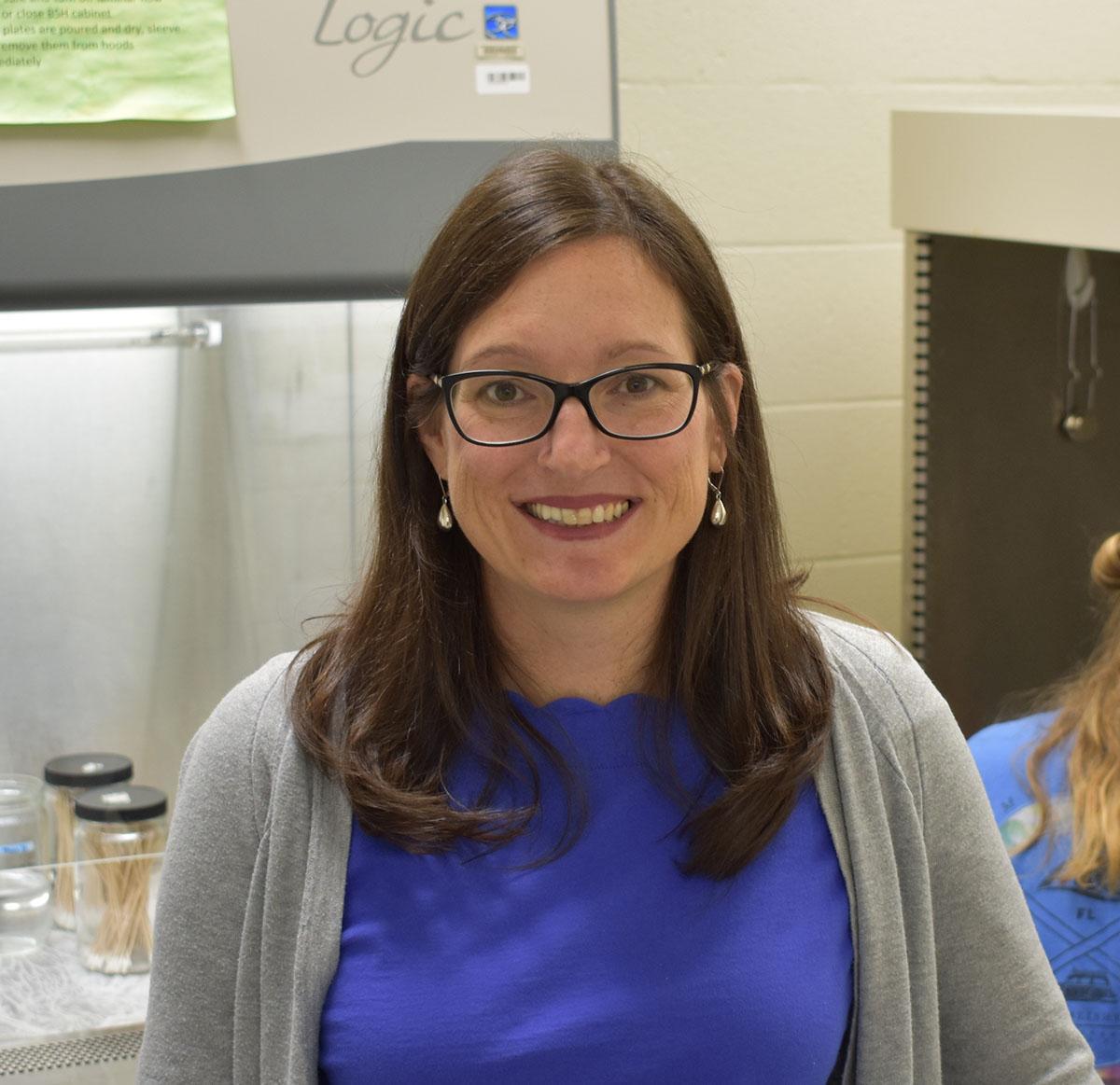
Amy Rossman, now retired, has returned as the MSA book review editor. She served in that capacity some years ago, as well as serving as the Research Leader of the USDA-ARS Mycology Laboratory (under various names) and Director of the U.S. National Fungus Collections, both still in existence. As book review editor, she enjoyed getting the word out on excellent books about fungi. If you know of books that you would like to review, let her know so she can write the publisher, who will send you a copy. Amy remarks, "As a retiree I’m busier than ever, especially hiking in the glorious forests of Oregon, but I’ll do my best to bug you about getting those reviews to me on time!"
|
|
Review submitted by
Matthew Smith
, Associate Professor, University of Florida, Gainesville, Florida.
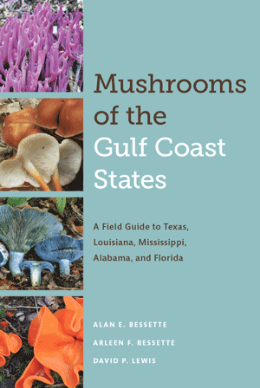
Bessette, A.E., A.R. Bessette. D.P. Lewis. 2019. Mushrooms of the Gulf Coast States: A Field Guide to Texas, Louisiana, Mississippi, Alabama and Florida. University of Texas Press. $39.95
In 2011 I moved to the University of Florida in Gainesville, Florida, to start a job as an assistant professor in fungal biology. I had visited Florida only one time prior to 2011; I visited DisneyWorld and the Kennedy Space Center with my grandmother when I was a junior in high school. I remember feeling like a steamed dumpling due to the intense heat and humidity of August in Orlando.
Moving to Gainesville was my first REAL experience with the Gulf Coast region. Both the seasonality and the fungi were baffling to me. Unlike the restrained and sensible collecting season of California where I grew up where fruiting is typically restrained to the cool, wet months from....
|
|
|
Review submitted by
Steve Carpenter
, President Emeritus, Pacific Analytical Laboratory, Inc., Philomath, Oregon.
Agaricus of North America. Richard W. Kerrigan
Memoirs of the New York Botanical Garden, Volume 114, 2016. xviii + 573 p. NYBG Press, Bronx, NY. ISBN 978-0-89327-536-5. ISSN 0077-8931
$127.99, member price $115.19
In my opinion, publication of
Agaricus of North America
represents a watershed moment in mycological taxonomic publications. It is extensive, provides a taxonomic philosophy, implements a balance of genomic and traditional kinds of information, is extremely well organized, and includes important historical information. In a few short pages, this review cannot do it justice.
“There is no single guide, technical reference, or monograph to
Agaricus
in North America, nor to any of our three countries here, nor, with few....
|
|
Review submitted by
Jim Trappe
, USFS Forestry Sciences Laboratory, Corvallis, Oregon.
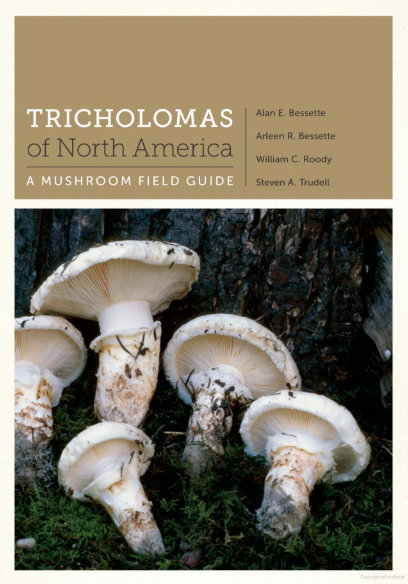
Tricholomas of North America.
A Mushroom Field Guide
. 2013. Alan E. Bessette, Arlene R. Bessette, William C. Roody, Steven A. Trudell. University of Texas Press, Austin,TX.
http://utpress.utexas.edu/
. ISBN: 978-0-292-74233-8 (pbk . : alk. paper). Printed in China. 208 pp. Price (Paper) $29.95.
The name
Tricholoma
was proposed by Elias Fries, the Swedish mycologist known as the “Father of Mycology”, for a ”tribe” of mushrooms in 1821. That name was elevated to the rank of genus in 1857, as discussed by the authors of the book under review here. Team Bessette, Alan and Arlene, plus co-authors Bill Roody and Steve Trudell, have courageously taken on the challenge of producing a field guide to the North American species of
Tricholoma
;
no one else has done that, so far as I know. I use the term....
|
|
|
In Memoriam: Samuel J. Mazzer
|
|
April 8, 1934 - September 21, 2019
Written by Jean Lodge, December 16, 2019
Dr. Samuel J. Mazzer (April 8, 1934 — September 21, 2019) was a former MSA member. He was a Professor of Biology for 27 years at Kent State University beginning in 1970, following a stint as a Visiting Assistant Professor at the University of Wisconsin-Eau Claire. He received his Ph.D. in botany from the University of Michigan with Alexander H. Smith. He is mostly known for his research on Entolomataceae, including a monograph on the genus,
Pouzarella
. In retirement, he founded Wetland Systems, Inc., a wetlands consulting firm.
|
|
In Memoriam: Doug Eveleigh
|
|
December 6, 1933 - December 30, 2019
Written by J.W. Bennett, January 13, 2020
(Photo to the left: Douglas E. Eveleigh studying lichens on gravestones in Nantucket, Massachusetts.)
Douglas E. Eveleigh, an emeritus Distinguished Professor at Rutgers University, died on Dec. 30, 2019 of complications of a glioblastoma. Born in West Croydon, Surrey, England, in the United Kingdom on December 6, 1933, Dr. Eveleigh earned a B.Sc. in Botany at the University of London, UK, in 1956 and a Ph.D. in Mycology from the University of Exeter, UK, in 1959. While at the University of Exeter, he studied under G.C. Ainsworth who nurtured Doug’s love for the study of fungi and also for history of science.
After receiving his Ph.D., Doug worked at both the Canadian National Research Council and the U.S. Army Laboratories in Natick, Massachusetts, before joining the faculty of Rutgers, The State University of New Jersey, in 1970. He served on the Rutgers faculty for 45 years, where he retired as a Distinguished Professor, holding an endowed chair in the Department of Biochemistry and Microbiology at the Rutgers School of Biological and Environmental Sciences. During his lifetime, he worked on numerous successful projects, but is best remembered for his research on enzymes from the soil fungus
Trichoderma
. His cellulose-degrading fungal strains and their descendants continue to be used in industrial fermentation around the world.
In addition to his laboratory research, Prof. Eveleigh loved to study the history of microbiology and was influential in forming the Milestones in Microbiology program of the American Society for Microbiology, and in getting the state of New Jersey to name a state microbe. He was an exceptionally fine teacher who taught over 6000 undergraduate students and trained over 50 Ph.D. and M.S. students.
Doug is survived by his wife of 57 years, Linda; their sons Chris and Rob; and grandchildren Douglas and William. He is mourned by hundreds of former and current students, coworkers, and friends.
In lieu of flowers a one-time contribution can be sent to Douglas Eveleigh Endowed Graduate Travel Award, Rutgers University Foundation, P.O. Box 193, New Brunswick, NJ 08903-0193. A memorial service will be held in the Kirkpatrick Chapel on the Rutgers campus, in New Brunswick, NJ, on March 29, 2020 at 2:30pm.
|
|
May 22, 1930 - November 29, 2019
Written by Meredith Blackwell, December 16, 2019
Ian Kenneth Ross, Professor Emeritus, University of California, Santa Barbara, died November 29, 2019. Ian, born in London, England, in 1930, received his undergraduate degree from George Washington University, Washington, DC, and his Ph.D. from McGill University in Montreal with Charles Wilson. He spent several years at Yale before moving to Santa Barbara in 1964. He had broad interests in physiology and development of slime molds and filamentous fungi, especially
Coprinus congregatus
. Ian was active in the Mycological Society of America and was awarded the Weston Award for Teaching Excellence in 1987 and the Distinguished Mycologist Award in 1999. In addition to his devoted graduate students, Ian trained many undergraduates for which he received the Chancellor’s Award for Excellence in Undergraduate Research Mentoring. A department colleague said that Ian was a fabulous colleague, always interested in others’ research, as well as his own. He continued to be a presence in the department even after his retirement in 2001.
|
|
Submitted by Ron Petersen, University of Tennessee, Knoxville
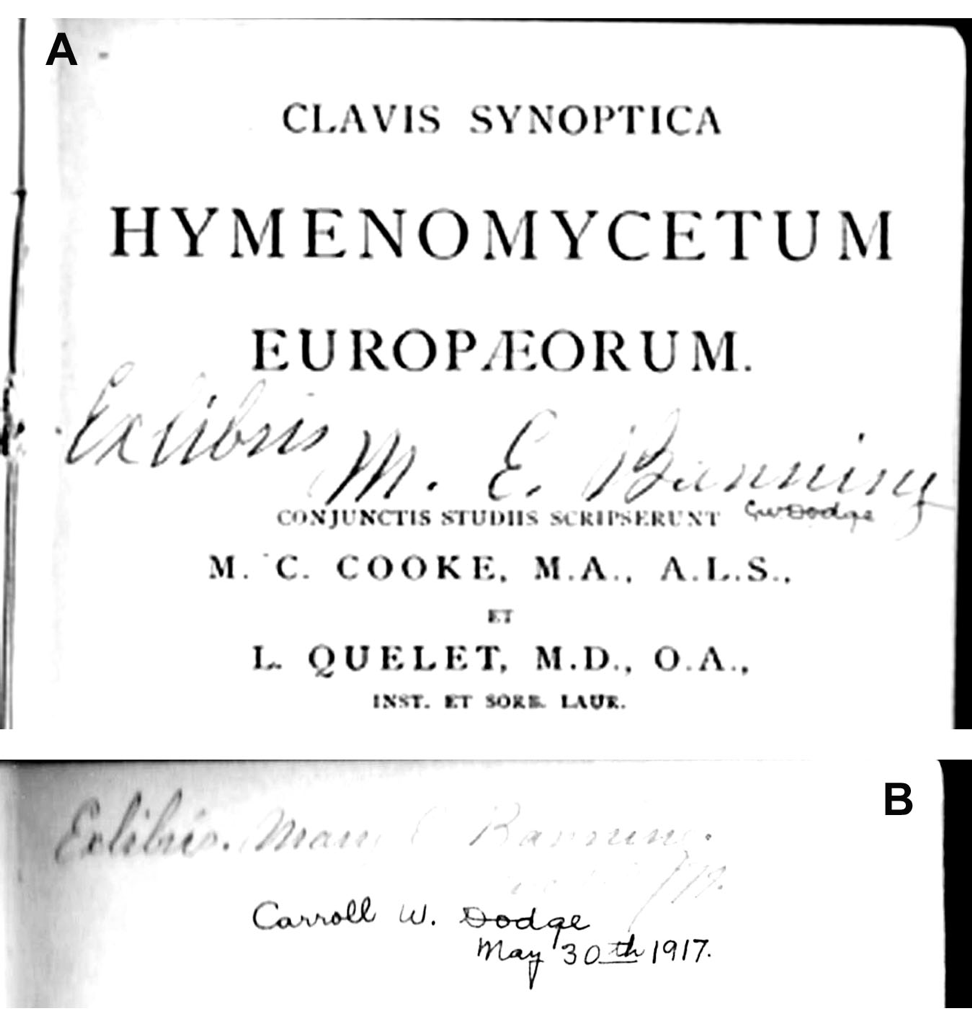
A few days ago, rummaging around in my library, I came upon a small book, very fragile now: Cooke, MC & L Quelet. 1878.
Clavis synoptica Hymenomycetum Europæorum
. Hardwicke & Bogue, London. 240 pp. + catalogue of books by Hardwicke & Bogue. 4 × 6 3/8” (10 x 16 cm). This rather obscure volume drew my attention, thought to be momentary, until the title page woke me up. In handwriting, inscriptions on two pages announced themselves:
Inscriptions on the title page (Fig. 1A):
Ex libris M.E. Banning (large and bold)
C.W. Dodge (minute)
Inscriptions on the first page of text (Fig. 1B):
Ex libris Mary E. Banning Aug 15
th
1879 (also large but not so bold)
Caroll W. Dodge May 30
th
1917. (not quite so minute)
---------------------------
Two aspects of this discovery are interesting: one deals with the book itself, the other with Mary E. Banning. (Caroll W. Dodge will wait for another time.) Concerning the
Clavis
,....
|
|
Executive Vice President's Report
|
|
Happy New Year to all of my MSA colleagues and wishing you the best for 2020!
MSA awards nominations and applications are due February 15. You can find out more about the variety of numerous awards we bestow, and how to apply or nominate your mycology colleagues here:
https://msafungi.org/msa-awards-chart
/
.
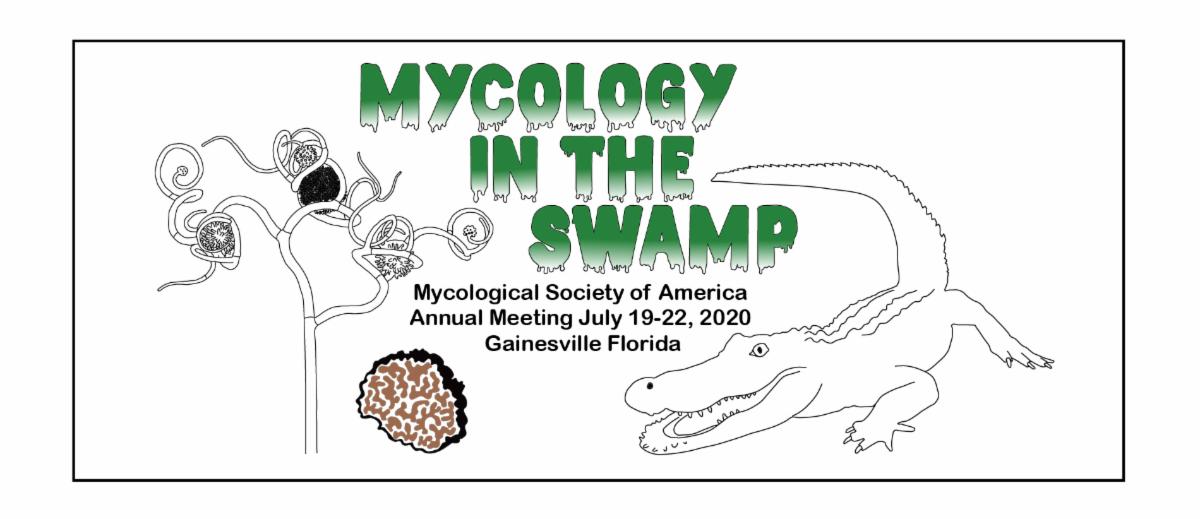
We look forward to the meeting next year in Gainesville, Florida (July 20-24, see meeting announcements
https://msafungi.org/2020-annual-meeting/
). The abstract submission and registration portals will be opening soon.
Council Business
: The Midyear Executive Council Meeting is set for February 8, 2020, and a call for midyear reports was sent out to Committee Chairs and Officers. The minutes of the 2019 Council Meeting in Minneapolis, Minnesota, are available here:
https://msafungi.org/msa-meeting-minutes-and-reports/
. Seven email polls were sent out to Council and approved since my September column:
Poll 2019-14
—Approval of the Karling Annual Lecture Committee candidates;
Poll 2019-15
—Approval of the MSA Diversity Statement;
Poll 2019-16
—Request for Emeritus Member Status for Albert P. Torzilli;
Poll 2019-17
—Request for Emeritus Member Status for Lori M. Carris;
Poll 2019-18
—MSA Sponsorship of Year of Plant Health at $2,500 level;
Poll 2019-19
—Mycologia Executive Editor Nomination of Rosa Mouriño;
Poll 2020-01
—
Mycologia
Associate Editor Nomination of Alfredo Justo.
Member Deaths:
Carlene “Cardy” Raper (Sept 5, 2019), Jos Wessels (Nov 1, 2019), Stanley J. Hughes (Nov 7, 2019), Ian K. Ross (Nov 29, 2019), Douglas E. Eveleigh (December 30, 2019).
New Members
: I would like to extend a warm welcome to the following new members who joined MSA after the last annual meeting and since my September column. Their membership will be formally approved at the 2020 Annual Business Meeting in Gainesville, Florida:
Japan:
Takamichi Orihara
Mexico:
Valeria Flores
Netherlands:
Menno W. Boomsluiter
Nigeria:
Onyeka Onyolu
United States:
Wayne Anable, Dylan Baldassari, Arleen Bessette, Alan Bessette, Thea Chesney, Quinton Cromeens, Frankie K. Crutcher, Cheng Gao, Will Hendricks, Robert Martin, Maria Morrow, Ethan V. Murdock, Eduard Pinkevitch, Prasanth P. Prabhu, Ashton Reece, Sue Urban
2020 Membership Renewal:
Renewal notices have been sent. Membership dues will remain the same in 2020. We now have auto-renewal and multiyear renewal options available. Please contact me with any suggestions, complaints, or feedback on the membership renewal process.
To increase membership and involvement in the MSA, it is important to recommend the Society to amateur and professional colleagues, and particularly to students and postdoctoral associates who are interested in fungi. MSA members include pathologists, geneticists, systematists, ecologists, and those people who just want to know more about the fascinating world of fungi.
Please help us get the word out! Signing up is easy––just follow the links on the membership page (
https://msafungi.org/join-or-renew/
). Please feel free to contact our MSA Membership Coordinator, Cori VanGalder, at
msafungi@reesgroupinc.com
if you have questions about renewing or new memberships.
|
|
REMINDER — MSA Directory Update
: Have you checked your information in the MSA directory recently? Now is a good time to make sure your address, phone, and email are current. The MSA relies almost entirely on email to bring you timely information on MSA news, awards, elections, meetings, and other activities. To ensure that you receive MSA blast emails and
Inoculum
, and so your colleagues can keep in touch, please check the accuracy of your contact information in the online directory. This can be accessed via our website (
https://msafungi.org/
). Look for the membership menu option and drop down to “Member Login”. Once you log in, you will see your profile with options such as “edit profile”, “my directory profile”, and “email subscriptions”. If you need assistance with updating your membership information, please contact our MSA Membership Coordinator, Cori VanGalder, at
msafungi@reesgroupinc.com
.
Please feel free to contact me about MSA business or with any other questions you have about the Society.
Respectfully submitted,
MSA Executive Vice President
|
|
Updates from the Diversity Committee
|
|
Submitted by Geromy Moore
In the past year, through generous donations, the MSA has been steadily raising money for a new “MSA Diversity Award”. The purpose of the award is to encourage greater participation in MSA from students and scientists who belong to traditionally underrepresented groups in STEMM. Award funding will be for an applicant who actively promotes diversity in one of several ways, such as presenting one’s mycological work at conferences specializing in the recruitment and retention of underrepresented students (e.g., Advancing Chicanos/Hispanics & Native Americans in Science [SACNAS] or OUTinSTEM). Other worthy causes include facilitating resources for young scholars interested in a career in mycology, such as scholars associated with the National Conference for College Women Student Leaders, or supporting interactions with students and faculty in tribal colleges or historically black colleges and universities with the goal of promoting mycology. MSA Diversity Award funds are approaching an amount capable of supporting awards. Thank you to those who have donated so far! We are still accepting donations for the MSA’s Diversity Award, so if the purpose of this award resonates with you on a personal level, please consider making a donation. Make your donations by selecting the fund option, “MSA Diversity Award” in the
donation form on our website
,
hosted by our secure payment portal through Wild Apricot.
|
|
MSA Joins the Societies Consortium on Sexual Harassment in STEMM
|
|
Submitted by Geromy Moore
This year, the MSA joined over 100 other scientific societies to address all forms of harassment in STEMM. The Societies Consortium (SC) is an entity that promotes anti-harassment policies and procedures, so that every member of its participating societies feels protected, valued, and heard. The MSA is actively participating in SC functions, and is adopting its recommendations for Rules of Behavior at future meetings and meeting-related socials. Starting in Gainesville, there will be posters that define MSA's shared ideals with the SC as they relate to promoting anti-harassment in STEM and addressing/reporting incidences of harassment. There will be “Safe Mycology” buttons available to wear proudly in support of a scientific gathering that is free of harassment in any form, and there will be specially trained “Myco Allies” who: (1) will intervene during situations of overt harassment; (2) who will serve as resources for anti-harassment information; and (3) will actively advocate for harassment victims. If you are interested in learning more about the SC, please follow
this link
to obtain more information. Anyone who has already received anti-harassment training and would like to serve the MSA as a Myco Ally at future meetings, please reach out to the MSA Diversity and Inclusion Committee Chair, Geromy Moore (
geromy.moore@usda.gov
) to volunteer. There may also be opportunities to obtain Myco Ally training ahead of the 2020 Meeting in Gainesville, so please stay tuned for training information.
|
|
MSA Special Topics Award Winners
|
|
Congratulations to the 2019 MSA Special Topics Award Winners! Please take a moment to review the biographies of the 2019 winners. There will not be any Special Topics Awards granted for the 2020 year.
|
|
More MSA News and Announcements
|
|
Call for Papers! Special Issue Regarding Animal-Associated Fungi
The Executive Editors of MSA's flagship journal
, Mycologia,
have supported a proposal for a special issue about animal-associated fungi. We are tentatively targeting Mycologia 112 (6) for this special issue, to be published November/December 2020. In order to make this publication deadline, we need all papers to be accepted after all rounds of review by May 2020. To meet this deadline, papers should be submitted and into the review process as soon as possible. If you are interested in contributing to this special issue, please get in touch with
Dr. Danny Haelewaters
and/or
Dr. Matt Kasson
for details. Manuscripts for the special issue should be submitted through the
usual online submission portal
(select "Special Issue: Animal-Associated Fungi" under the Additional Information tab).
|
|
Op-ed Written by Past Chairs, Danny Haelewaters and Adriana Romero-Olivares, of the Diversity & Inclusion Committee is Published in
Massive Science.
At the 11th International Mycological Congress held in Puerto Rico in July 2018, the MSA Diversity & Inclusion Committee
organized a Diversity Symposium to cover unconscious biases and how to address them, present the results of the MSA Diversity Survey, highlight some personal experiences of underrepresented groups in mycology, and raise awareness to challenges faced by people in the sciences who identify as LGBT+ and/or gender non-conforming. As preparation for the symposium, an anonymous online survey was conducted to gather and summarize opinions and experiences of members of the LGBT+ and gender non-conforming scientific community. Following up on the responses from both the online survey and the MSA Diversity Survey, Danny Haelewaters and Adriana Romero-Olivares—both past Chairs of the Diversity & Inclusion Committee—wrote an op-ed, which was published in
Massive Science
. In their article, a number of potential changes are presented that could be implemented in making the academic environment a more inclusive community.
|
|
2020 Westerdijk Spring Symposium: Rise of the Fungi (April 23-24, 2020)
Changing climate patterns have severe impact on quality of life. Global change also affects fungal ecology and pathology, with new diseases emerging of plants, humans, and animals. To highlight the importance of human, animal, and plant health in a global perspective, a special symposium with leading scientists is planned to address how global and climate change impact on fungi, specifically those involved with plant and human diseases, as well as food and forest security. Special sessions address plant health and climate change, food security, human health, fungal applications in industry, fungal ecology, and genomics. This meeting also addresses new developments on fungal taxonomy, such as the inclusion of Digital Sequence Information (DSI) under the Nagoya Protocol, and the naming of environmental sequences (dark taxa). Furthermore, to create more public awareness and engagement for these new challenges, a special public engagement meeting on fungal catastrophes has been organized, which precedes the Rise of the Fungi symposium.
For full program information, information about the Public Evening, "Fungal Catastrophes," and information regarding venues and registration pricing,
please view the full pdf here
or contact
Pedro Crous
.
|
|
2020 Emerging Public Policy Leadership Award Applications- AIBS
The 2020 AIBS Emerging Public Policy Leadership Award recognizes graduate students working at the interface of science and public policy. Winners receive free participation to policy and communications training program, a trip to Washington, DC, a chance to meet with lawmakers, and a one-year AIBS membership.
Apply now
!
|
|
Thank you to all who have donated to MSA funds since our last publication of
Inoculum
!
|
|
Donald T. Wicklow
David & Esther McLaughlin
T. Mitchell
D. Jean Lodge
S. Bartnicki-Garcia
Gary Samuels
John Haines
Joseph G. Hancock, Jr.
|
|
Thomas C. Harrington
Gregory Mueller
Kostya Nakazny
David Yohalem
Steve Trudell
Daniel Luoma
Maren Klich
Fred M. Rhoades
Timothy J. Baroni
|
|
|
We Want to See Your Fungal Photos!
|
|
|
|
Your fungal photo could be featured as the header for the next issue of
Inoculum!
MSA is calling for your photos! Chosen photos will appear in future issues of
Inoculum
. Submit your photos along with your name and any text you'd like to accompany the image (optional) using the button on the left!
The header for this issue of
Inoclum
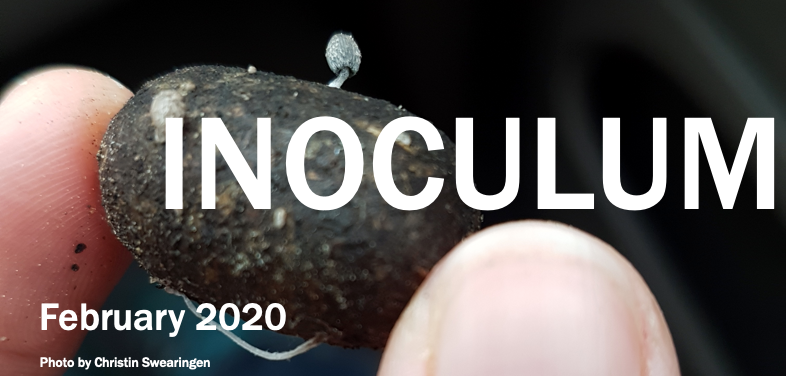
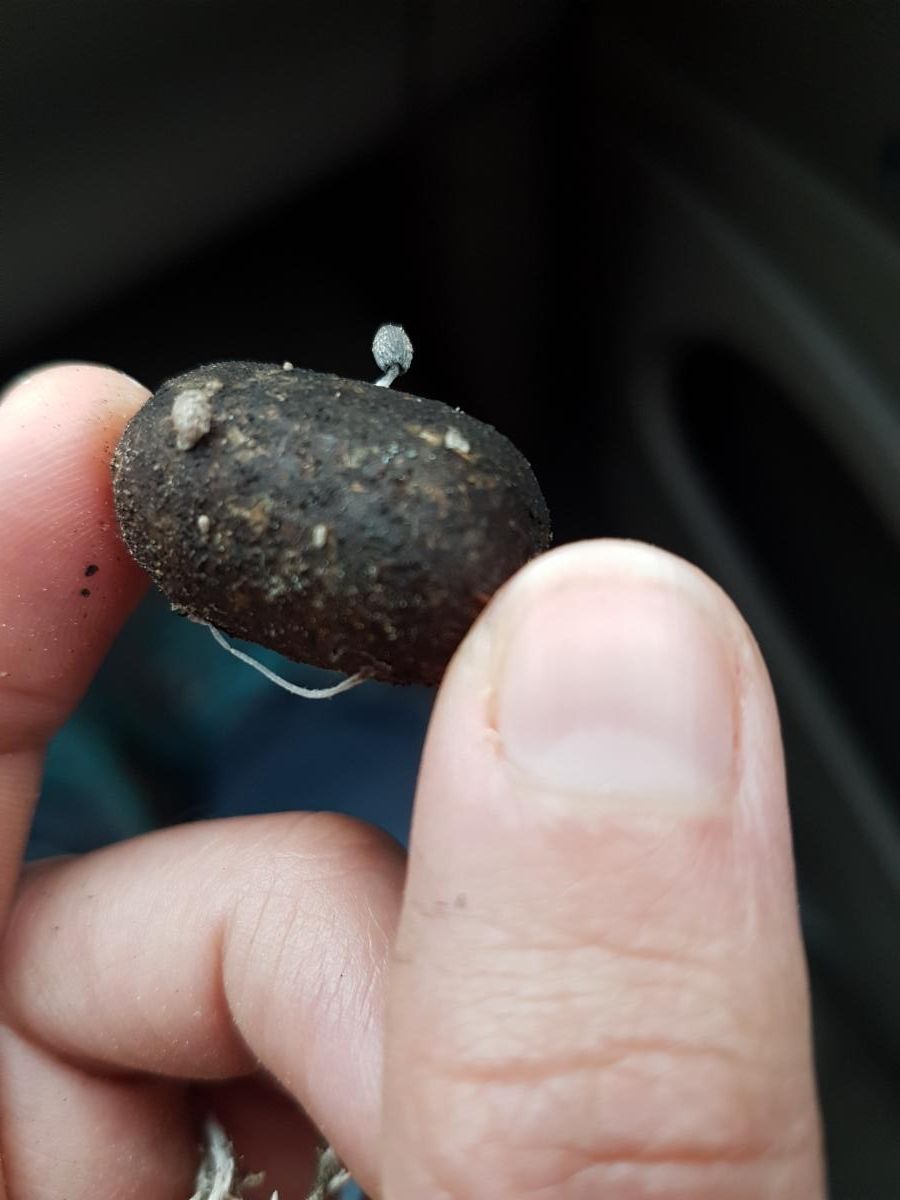
was submitted by Christin Swearingen. The photo is of Coprinus sensu lato growing on a moose nugget in Galena, Alaska.
Thank you for submitting your photo, Christin!
|
|
Note:
The
Inoculum
interim editors are Anne Pringle (
apringle2@wisc.edu
) and Chris Schardl (
chris.schardl@uky.edu
). Please feel free to contact us with comments or articles for future issues.
|
|
The Mycological Society of America |
(608) 441-1060 | 2424 American Ln. Madison, WI, 53704 |
MSAfungi.org
|
|
|
|
|
|
|