|
|
|
Connecting
April 25, 2024
Click here for sound of the Teletype
| |
|
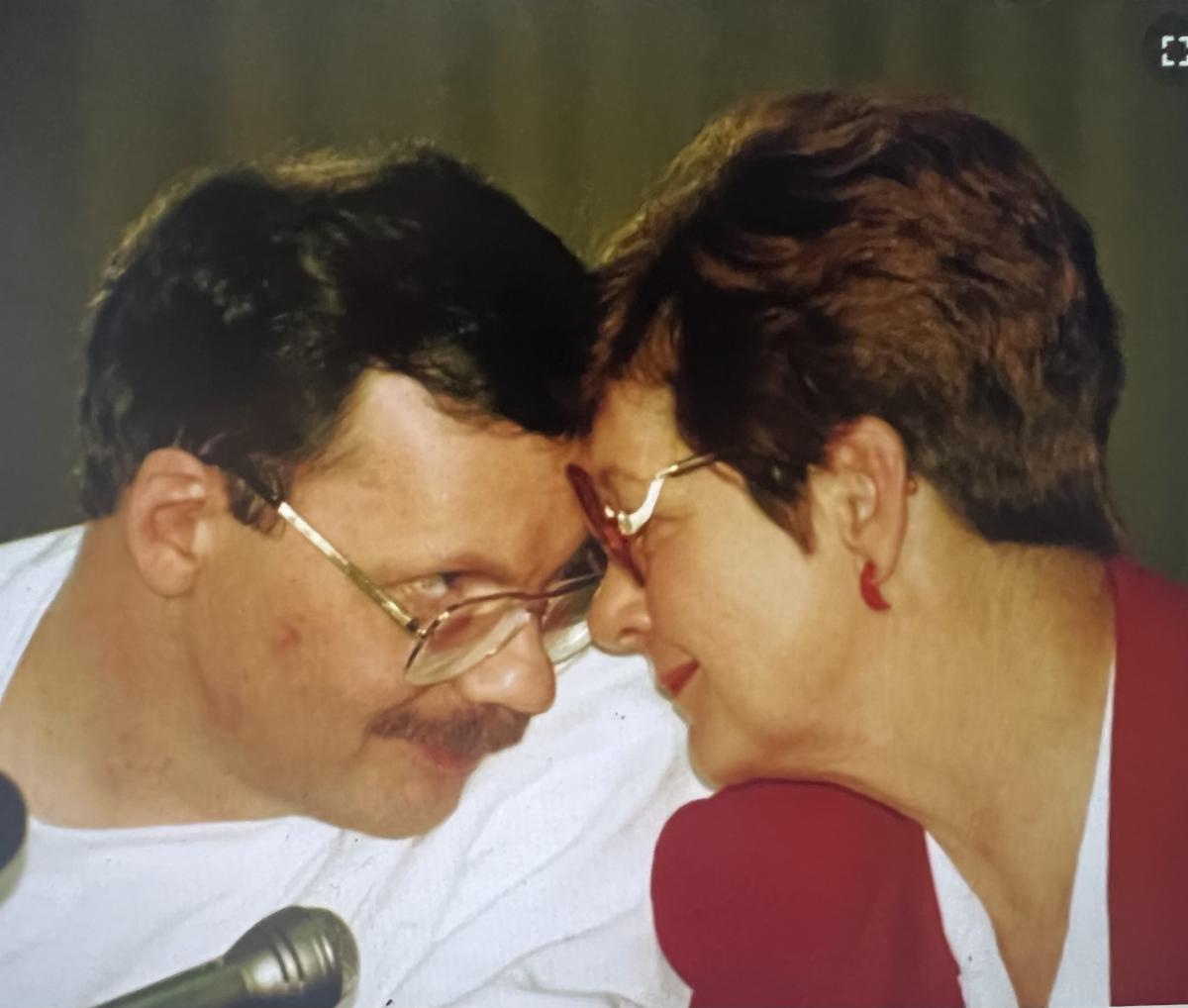
FILE - Former U.S. hostage Terry Anderson, left, and his sister Peggy Say at a Dec. 6, 1991, news conference in Wiesbaden, Germany, just two days after he was released. (Doug Mills / Associated Press)
Colleagues,
Good Thursday morning on this April 25, 2024,
“I did what I had to do as his sister.”
In 10 words, that’s how Peggy Say summed up her tireless efforts on behalf of her brother Terry Anderson over the nearly seven years of captivity of the Associated Press chief Middle East correspondent.
Many words have appeared in Connecting – and in media around the world – since Terry died Sunday at his home in Greenwood Lake, N.Y., at the age of 76. Peggy died nine years earlier, in 2015, at the age of 74.
Today’s Connecting brings you memories of her efforts on behalf of her brother – efforts well worth remembering before the news cycle closes on Terry’s death and moves on to the next story.
“In a very short time, she made herself into a national figure as the family face of long and frustrating efforts to win freedom for her brother,” said Louis D. Boccardi, who was president of The Associated Press at the time. “She never took ‘no’ for an answer.”
In its story on Peggy’s death, The New York Times wrote:
…Ms. Say wrapped the nation in a figurative yellow ribbon of remembrance, making her brother a symbol of what began to seem like a lost cause.
She rallied his fellow journalists, ordinary Americans, humanitarian groups and world figures, including President Ronald Reagan, Pope John Paul II, Mother Teresa and Yasir Arafat, the Palestinian leader.
All the while, she withstood invective from critics who accused Mr. Anderson of leaving himself vulnerable to the vagaries of civil war in Lebanon, and who warned that Ms. Say’s public lobbying on his behalf jeopardized delicate private diplomacy and prolonged his captivity.
Four years before her death, Say published a book - Forgotten: A Sister's Struggle to Save Terry Anderson, America's Longest-Held Hostage. It was written by her and Peter Knobler.
So we lead with the AP story on her life, written from the time she died. If you would like to offer any thoughts or memories, they would be welcomed.
Here’s to a great day – be safe, stay healthy, live it to your fullest.
Paul
Peggy Say, who advocated for release of hostage Terry Anderson, dies
| |
|
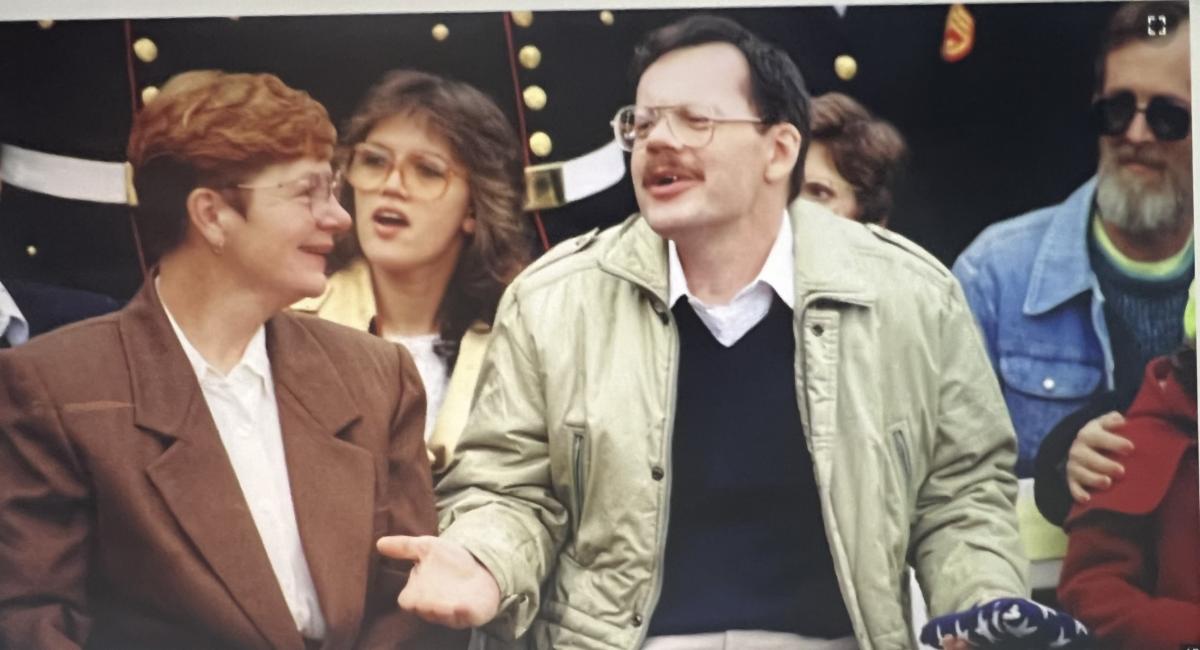
In this Dec. 12, 1991, file photo, former U.S. hostage Terry Anderson holds an American flag presented to him while sitting with his sister Peggy Say during a ceremony in his honor at Dulles International Airport in Virginia, just days after being released by his captors in Beirut. AP Photo/Greg Gibson.
By ERIK SCHELZIG, Associated Press
Dec. 24, 2015
NASHVILLE, Tenn. - Peggy Say, who spent nearly seven years on a tireless quest for the release of her brother, journalist Terry Anderson, and fellow hostages from kidnappers in Lebanon, died Wednesday. She was 74.
Anderson, the chief Middle East correspondent for The Associated Press when he was abducted from the streets of Beirut in 1985 in the midst of the country’s civil war, said his sister died Wednesday after a long illness. She had been living in Cookeville, about 70 miles east of Nashville, Tenn.
The family lived in Albion, Orleans County, and Batavia when Say and Anderson were growing up, and Say was living in the Batavia area when her brother was in captivity. She was a tireless advocate for him, and appeared regularly in Rochester and national news reports related to him.
A self-described housewife, Say quickly became her brother’s most prominent public champion, keeping his fate and that of the other hostages in Lebanon in the public eye as the years went by.
“We were allowed a radio from time to time, and we did hear about her efforts and the efforts of other hostages’ families on the radio, and of course it was always a great comfort,” said Anderson, who was held by the pro-Iranian Shiite Muslim militant faction Islamic Jihad for 2,545 days.
In a 1990 interview, Say told the Democrat and Chronicle she was optimistic her brother and other hostages held in Lebanon would be released soon. "Everyone is working toward the resolution of the hostage situation," she said. "This is not passive. It is active work to bring it to an end."
She made sure the issue was never far from the public eye.
"Even on slow days, I'll get a dozen telephone calls," she said in 1990. "There is never a day when I am not involved in this in some way."
A historical marker in Albion that notes Terry Anderson grew up in that Orleans County community.
Anderson was released on Dec. 4, 1991. He was the longest held of 92 foreigners abducted during civil war. Most were ultimately freed. Eleven died or were killed in captivity.
Former AP President Lou Boccardi remembered Say as a “remarkable woman” and a relentless advocate.
“In a very short time, she made herself into a national figure as the family face of long and frustrating efforts to win freedom for her brother,” Boccardi said in an email. “She never took ‘no’ for an answer.”
Say moved to the western Kentucky town of Cadiz to find more privacy for herself and husband, David, in 1988. He died in 2012.
Say’s activism wasn’t without critics. Some Washington officials at the time contended that her vocal approach prolonged the hostages’ captivity by compromising behind-the-scenes efforts to free them.
She was dismissive of those arguments.
“I did what I had to do as his sister,” she said on the eve of her brother’s release in 1991. “I don’t think the United Nations would ever have intervened if we had not kept the plight of Terry and other people alive.”
| |
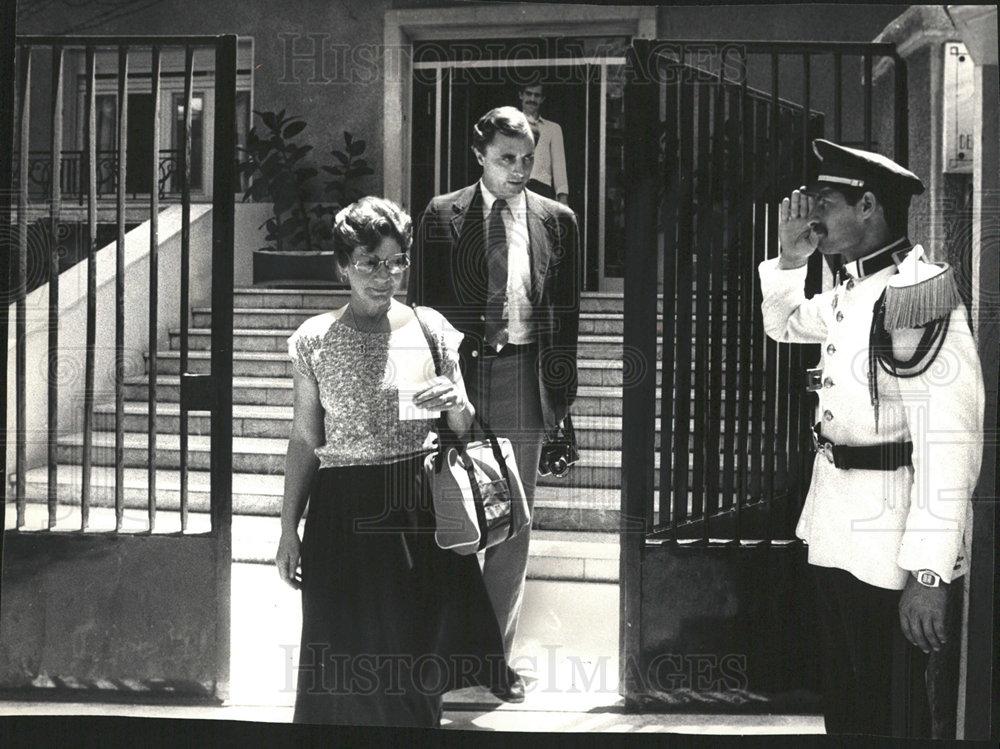
Peggy Say in Damascus, Syria, at the foreign ministry in 1986. Behind her is AP Washington bureau chief Chuck Lewis, who traveled with her to persuade leaders in the Middle East to intercede on behalf of Terry Anderson. AP Photo | |
|
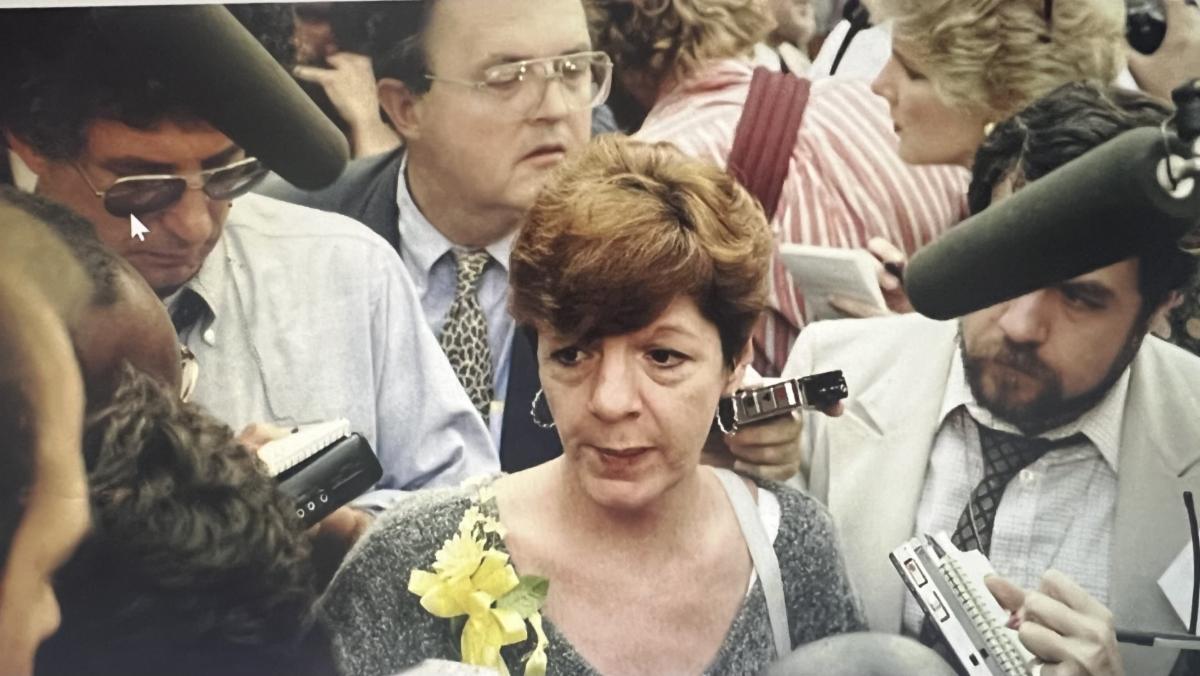
FILE - In this Sept. 20, 1985, file photo, Peggy Say, sister of hostage Terry Anderson, the AP chief Middle East correspondent, meets with reporters outside the White House in Washington after a meeting among hostage family members, Vice President George Bush, and National Security Advisor Robert McFarlane. (AP Photo/Ron Edmonds, File)
She believed it was the U.N.’s intervention that eventually won freedom for the final American hostages.
Anderson said Wednesday that one of the first things his sister asked him about upon his release was whether her activism had caused him to be held longer. He said he didn’t believe that to be the case.
“I told her that I was pleased with what she had done for a number of reasons,” he said. “One, was to give us hope when we heard about it. And two, that it gave the families a sense that they were actively engaged in trying to do something.”
Say met periodically with then-U.N. Secretary-General Javier Perez de Cuellar. Her travels put her face to face with Pope John Paul II, Palestinian leader Yasser Arafat, the president of Greece, Syria’s foreign minister and an associate of notorious terrorist Abu Nidal.
Her efforts, which were supported by the AP, were marked with disappointments along the way.
In 1985, President Ronald Reagan ruled out negotiating with terrorists. But then she saw the United States cut a deal with hijackers of a TWA jet in Beirut to free their prisoners.
One chance for freeing Anderson was a secret attempt by the Reagan administration to reach out to Iran. But those efforts fell apart when details came to light of a larger scheme to secretly sell arms to Iran and use the proceeds to pay for illegal U.S. support for the Nicaraguan rebels, an episode that became known as the Iran-Contra scandal.
“The worst time for all of us was after the Iran-Contra scandal,” Say said in 1991. “People were blaming us, the hostage families, for pushing the administration into it.”
Anderson, who recently retired from teaching journalism at the University of Florida, said he credits his sister’s prominent role in helping keep the hostages alive.
“Remember these were very bad guys,” he said. “They could easily have killed us, but they didn’t. They let us go.”
Anderson said his sister later moved to Cookeville and had retired after working on behalf of victims of domestic violence.
In addition to Anderson and two other siblings, Anderson said that Say is survived by daughter Melody Smith, son Edward Langendorfer and several grandchildren.
Includes reporting by staff writer Meaghan M. McDermott.
Click here for link to this story.
Your memories of JL Schmidt
| |
|
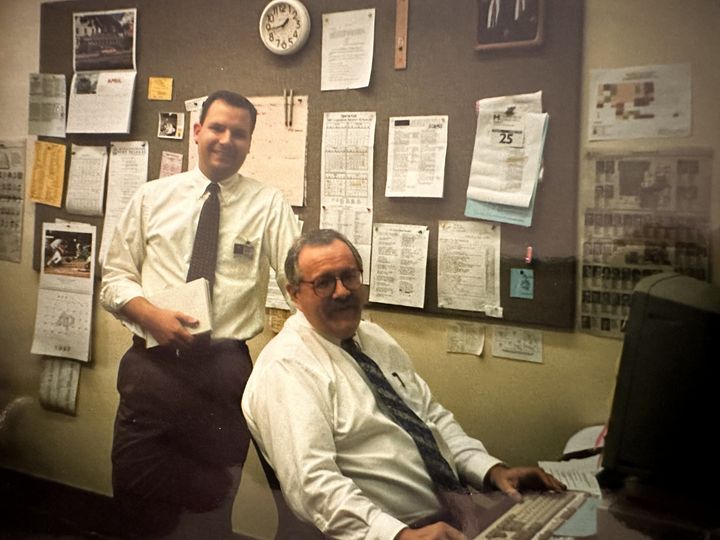
Scott Bauer (left) and JL Schmidt in the AP's Nebraska statehouse office at Capitol.
Scott Bauer - JL taught me how to be a statehouse reporter for The Associated Press. Walking into the state Capitol in Lincoln, Nebraska, in 1996, it's fair to say that I had no idea what I was getting myself into. JL graciously showed me the ropes, not only how to cover the news but how to conduct yourself in a sometimes difficult environment.
JL embodied Nebraska to me. He taught me the people, places, characters and history that mattered. He told stories, like how he covered the Wounded Knee takeover in 1973, but he also listened. I remember a state senator coming into the office to ask JL if he should run for governor. JL told him he could if he wanted to, but he would lose. The senator (wisely) decided against it.
JL dispensed advice I still use to this day like, "Just because you sat through an eight-hour hearing doesn't mean the reader has to." He also taught me how to deal with sometimes unreasonable editors with lines like, "Two hands, eight hours!"
And he was cool. He told me stories about seeing Bob Dylan live in 1966. And one day he brought in a large poster of Pink Floyd's The Wall for use in our office. I'm not sure any other AP offices had that on the wall!
The year I spent working alongside JL was a defining one. When I heard of his passing, I thought back to the lunch we had a couple of summers ago in Lincoln. I hadn't seen JL in years, but he was still the same to me. Smiling, laughing, telling stories. I told him then how much I appreciated him and how much he meant to me. It turns out that was our last conversation. But I can still hear JL talking to 24-year-old me in the AP office in the Capitol. And I'm still learning from him.
JL meant a lot to me then. And he still means a lot to me now.
-0-
Mike Holmes - I first worked with J.L. when we were both reporters at The Lincoln Star in the 1970s, and later as AP colleagues. We had enjoyed monthly lunches since retiring, sharing old stories, commentary on current news, and a fondness for old cars. (He one-upped me there, with his post-journalism job running the Classic Car Collection.) I’ll remember J.L. as a dogged newsman in pursuit of a story, a marvelous storyteller and someone who was always ready to share laugh.
Palm Springs pickleball player shares how sports has changed his life
| |
|
Cliff Schiappa - Here in Palm Springs there has been much discussion about expanding the public outdoor pickleball court facility from the current 12 to a much larger complex with 24 courts. Of course with such a major undertaking there is always controversy because of different perspectives from multiple community groups.
When the Parks and Recreation Commission held public hearings recently, a number of pickleball players attended to make brief remarks supporting the expansion. There were also a few folks representing the adjacent Animal Shelter, concerned a new parking lot would reduce dog-walking space. (The parking lot was an unfounded rumor.)
Figuring most speakers would address the technical aspects of the project, I chose to tell a story. After all, as a journalist and non-profit fundraiser, I know how stories can move people. I gave my two-minute speech and when I was done, people in the audience were wiping their eyes! And then this story appeared in Sunday's edition of The Desert Sun, a Gannett paper serving the Coachella Valley.
Here's the link: Palm Springs pickleball player shares how sports has changed his life
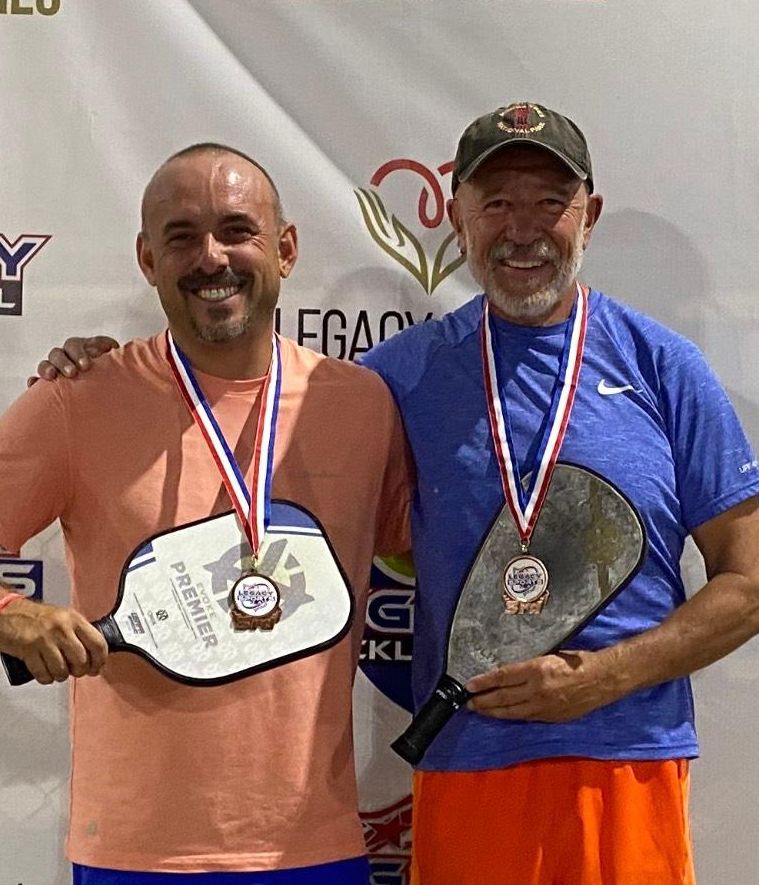
And the photo? - Doubles pickleball partners Diego Mercuri, left, and Cliff Schiappa (former Kansas City AP assistant bureau chief and photographer) are seen displaying their bronze medals from the Legacy Pickleball Tournament in 2022.
| 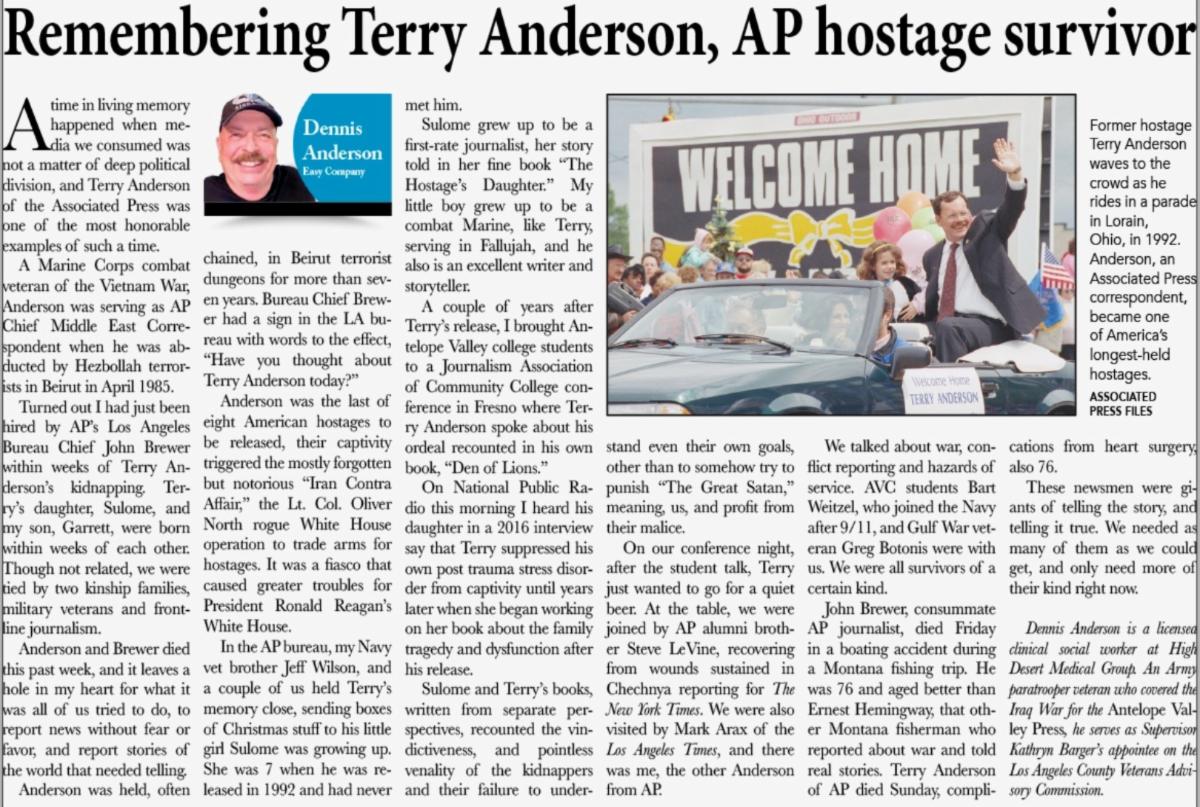 | Colleague Dennis Anderson wrote this story that appeared in the Antelope Valley Express, in Palmdale, Calif. | |
Stories of interest
Inside the Crisis at NPR (New York Times)
By Benjamin Mullin and Jeremy W. Peters
NPR employees tuned in for a pivotal meeting late last year for a long-awaited update on the future of the public radio network.
After many tumultuous months, marked by layoffs, financial turbulence and internal strife, they signed in to Zoom hoping to hear some good news from NPR’s leaders. What they got instead was a stark preview of the continued challenges ahead.
“We are slipping in our ability to impact America, not just in broadcast, but also in the growing world of on-demand audio,” Daphne Kwon, NPR’s chief financial officer, told the group, according to a recording of the meeting obtained by The New York Times.
For the past two weeks, turmoil has engulfed NPR after a senior editor assailed what he described as an extreme liberal bias inside the organization that has bled into its news coverage. The editor, Uri Berliner, said NPR’s leaders had placed race and identity as “paramount in nearly every aspect of the workplace” — at the expense of diverse political viewpoints, and at the risk of losing its audience.
Read more here. Shared by Len Iwanski, Dennis Conrad.
-0-
FTC votes to ban noncompete agreements (The Hill)
BY TAYLOR GIORNO
The Federal Trade Commission (FTC) voted 3-2 on Tuesday to ban noncompete agreements that prevent tens of millions of employees from working for competitors or starting a competing business after they leave a job.
From fast food workers to CEOs, the FTC estimates 18 percent of the U.S. workforce is covered by noncompete agreements — about 30 million people.
The final rule would ban new noncompete agreements for all workers and require companies to let current and past employees know they won’t enforce them. Companies will also have to throw out existing noncompete agreements for most employees, although in a change from the original proposal, the agreements may remain in effect for senior executives.
What to know about the FTC ban on noncompete agreements
“It is so profoundly unfree and unfair for people to be stuck in jobs they want to leave, not because they lacked better alternatives, but because noncompetes preclude another firm from fairly competing for their labor, requiring workers instead to leave their industries or their homes to make ends,” FTC Commissioner Rebecca Slaughter (D) said in prepared remarks.
The new rule is slated to go into effect in 120 days after it’s published in the Federal Register. But its future is uncertain, as pro-business groups opposing the rule are expected to take legal action to block its implementation.
Read more here. Shared by Mark Mittelstadt.
-0-
Most Americans say a free press is highly important to society (Pew)
BY KIRSTEN EDDY
A large majority of Americans see the freedom of the press as highly important to the well-being of society. But many express concerns about potential restrictions on press freedoms in the United States – and say that political and financial interests already have a lot of influence on news organizations. These findings come from a new Pew Research Center survey ahead of World Press Freedom Day on May 3.
Nearly three-quarters of U.S. adults (73%) say the freedom of the press – enshrined in the First Amendment to the U.S. Constitution – is extremely or very important to the well-being of society. An additional 18% say it is somewhat important, and 8% say it is a little or not at all important.
Some demographic groups are more likely to view press freedom as highly important to society. For instance, White and Asian Americans (78% each) are more likely than Hispanic (61%) and Black (60%) Americans to say it is extremely or very important. U.S. adults with more formal education and higher income levels also are significantly more likely than those with less formal education and lower incomes to say this.
There are no major differences by political party.
Read more here. Shared by Len Iwanski.
| |
Today in History – April 25, 2024 |  | |
Today is Thursday, April 25, the 116th day of 2024. There are 250 days left in the year.
Today’s Highlights in History:
In 404 B.C., the Peloponnesian War ended as Athens surrendered to Sparta.
On this date:
In 1507, a world map produced by German cartographer Martin Waldseemueller contained the first recorded use of the term “America,” in honor of Italian navigator Amerigo Vespucci.
In 1859, ground was broken for the Suez Canal.
In 1862, during the Civil War, a Union fleet commanded by Flag Officer David G. Farragut captured the city of New Orleans.
In 1898, the United States Congress declared war on Spain; the 10-week conflict resulted in an American victory.
In 1901, New York Gov. Benjamin Barker Odell, Jr. signed an automobile registration bill which imposed a 15 mph speed limit on highways.
In 1915, during World War I, Allied soldiers invaded the Gallipoli Peninsula in an unsuccessful attempt to take the Ottoman Empire out of the war.
In 1945, during World War II, U.S. and Soviet forces linked up on the Elbe River, a meeting that dramatized the collapse of Nazi Germany’s defenses. Meanwhile, delegates from some 50 countries gathered in San Francisco to organize the United Nations.
In 1990, the Hubble Space Telescope was deployed in orbit from the space shuttle Discovery. (It was later discovered that the telescope’s primary mirror was flawed, requiring the installation of corrective components to achieve optimal focus.)
In 1992, Islamic forces in Afghanistan took control of most of the capital of Kabul following the collapse of the Communist government.
In 2002, Lisa “Left Eye” Lopes of the Grammy-winning trio TLC died in an SUV crash in Honduras; she was 30.
In 2013, President Barack Obama consoled a rural Texas community rocked by a deadly fertilizer plant explosion that killed 15 people, telling mourners during a memorial service at Baylor University they were not alone in their grief.
In 2018, Danish engineer Peter Madsen was convicted of murder for luring a Swedish journalist onto his homemade submarine before torturing and killing her; Madsen was later sentenced to life in prison.
In 2019, former Vice President Joe Biden entered the Democratic presidential race, declaring the fight against Donald Trump to be a “battle for the soul of this nation.”
In 2021, “Nomadland,” Chloe Zhao’s portrait of itinerant lives on open roads across the American West, won Best Picture at the 93rd Academy Awards; Zhao was honored as best director.
In 2022, Elon Musk reached an agreement to buy Twitter for roughly $44 billion, promising a more lenient touch to policing content on the social media platform where he – then the world’s richest person – had made a habit of promoting his interests and attacking his critics to his tens of millions of followers.
In 2023, President Joe Biden formally announced that he would be running for reelection in 2024, asking voters to give him more time to “finish this job” and extend the run of America’s oldest president for another four years.
Today’s Birthdays: Actor Al Pacino is 84. Rock musician Stu Cook (Creedence Clearwater Revival) is 79. Singer Bjorn Ulvaeus (ABBA) is 79. Actor Talia Shire is 79. Actor Jeffrey DeMunn is 77. Rock musician Steve Ferrone (Tom Petty & the Heartbreakers) is 74. Country singer-songwriter Rob Crosby is 70. Actor Hank Azaria is 60. Rock singer Andy Bell (Erasure) is 60. Rock musician Eric Avery (Jane’s Addiction) is 59. Country musician Rory Feek (Joey + Rory) is 59. TV personality Jane Clayson is 57. Actor Renee Zellweger is 55. Actor Gina Torres is 55. Actor Jason Lee is 54. Actor Jason Wiles is 54. Actor Emily Bergl is 49. Actor Marguerite Moreau is 47. Actor Melonie Diaz is 40. Actor Sara Paxton is 36. Actor/producer Allisyn Snyder is 28. Actor Jayden Rey is 15.
| |
Got a photo or story to share? | |
|
Connecting is a daily newsletter published Monday through Friday that reaches more than 1,800 retired and former Associated Press employees, present-day employees, and news industry and journalism school colleagues. It began in 2013. Past issues can be found by clicking Connecting Archive in the masthead. Its author, Paul Stevens, retired from the AP in 2009 after a 36-year career as a newsman in Albany and St. Louis, correspondent in Wichita, chief of bureau in Albuquerque, Indianapolis and Kansas City, and Central Region vice president based in Kansas City.
Got a story to share? A favorite memory of your AP days? Don't keep them to yourself. Share with your colleagues by sending to Ye Olde Connecting Editor. And don't forget to include photos!
Here are some suggestions:
- Connecting "selfies" - a word and photo self-profile of you and your career, and what you are doing today. Both for new members and those who have been with us a while.
- Second chapters - You finished a great career. Now tell us about your second (and third and fourth?) chapters of life.
- Spousal support - How your spouse helped in supporting your work during your AP career.
- My most unusual story - tell us about an unusual, off the wall story that you covered.
- "A silly mistake that you make"- a chance to 'fess up with a memorable mistake in your journalistic career.
- Multigenerational AP families - profiles of families whose service spanned two or more generations.
- Volunteering - benefit your colleagues by sharing volunteer stories - with ideas on such work they can do themselves.
- First job - How did you get your first job in journalism?
- Most unusual place a story assignment took you.
Paul Stevens
Editor, Connecting newsletter
paulstevens46@gmail.com
| | | | |