ANTIPHOSPHOLIPID SYNDROME (APS) PROGRAM UPDATE | |
Thank you for your interest in and support of our APS Program! We continue to pursue personalized, proactive treatments for APS with a long-term goal of a cure. We do this work to make lives better, and we hope we can use these emails to build a community of others who want the same. We're all in this together! | |
Early Career Research Awardee – Jacqueline Madison, MD | |
|
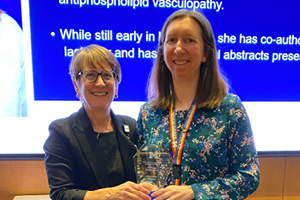
Congratulations to Dr. Jacqueline Madison, Clinical Assistant Professor of Internal Medicine and Pediatrics, who received the Department of Pediatrics Chairs Award - Early Career Research Award on January 28, 2025. This honor recognizes Dr. Madison's work in APS, lupus, and the transition from pediatric to adult rheumatology care. Read More.
|
|
2025 Pediatric Antiphospholipid Syndrome Consensus Conference | |
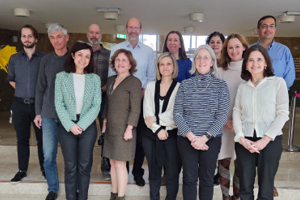
Dr. Jacqueline Madison attended the Pediatric Antiphospholipid Syndrome Consensus Conference on January 23-24, 2025 in Ljubljana, Slovenia as an invited international expert in pediatric APS. This first-of-its-kind meeting was organized by the Childhood Arthritis and Rheumatology Research Alliance and the Pediatric Rheumatology European Association.
| |
The conference's goal was to bring together rheumatologists, hematologists, and patient representatives to discuss the most important clinical aspects of APS that should be prioritized in future studies. Dr. Madison was joined by participants from Brazil, Canada, Italy, Slovenia, and Turkey, as well as Florida, Massachusetts, New York, and Texas.
The Slovenian hosts, Dr. Tadej Avcin and Dr. Mojca Avramovic, also arranged for the traveling visitors to see some of the beautiful sights of Slovenia.
| |
APS PROGRAM COMMUNITY Q&A SERIES | |
Can GLP-1 Medications Be Considered for Weight Loss in Patients with APS? | |
|
The APS Program Community Q&A Series, written by Dr. Ray Zuo, was created to answer questions we receive from the APS Program community. In this month’s edition, Dr. Zuo, along with the help of hematologist, Dr. Lauren Shevell, explore GLP-1 drugs, how they work, and whether they are a safe option for people with APS. Read more.
We are interested in providing additional relevant patient education and would like to hear your thoughts. Share your ideas by sending an email to MichiganANSWERS@med.umich.edu.
|
|
|
ANTIPHOSPHOFAQ:
SOME NOTES FROM MY INBOX…
by Dr. Jason Knight
| |
I frequently receive insightful questions about APS from health care providers. The answers to these questions can be valuable in supporting other providers in the care of patients with APS. Below is one such question. | |
|
Question:
Hello, Dr. Knight. I work in private practice, and we see several patients per year started on direct oral anticoagulants (DOACs) who have a pre-existing diagnosis of a systemic autoimmune disease. Unfortunately, APS tests were not always assessed before the blood clotting event (many without risk factors). And now, once started on a DOAC, the lupus anticoagulant test can’t really be interpreted. In your lecture, you mentioned a test (I believe anti-PS?) that can be checked. Is this a substitute for lupus anticoagulant testing in patients on DOACs? Is this test available in the community?
| |  |
|
Answer:
That's a good and nuanced question! The testing we find helpful in the situation you describe is for anti-phosphatidylserine/prothrombin (anti-PS/PT) antibodies. These antibodies will cause a positive lupus anticoagulant test when present at high levels. Anti-PS/PT testing is available in most places. A negative test doesn't work quite as well since one occasionally finds a lupus anticoagulant-positive patient with neither anti-beta-2 glycoprotein I antibodies nor anti-PS/PT antibodies. But it is rare. I am relatively confident you will find it to be a useful tool in your toolbox. Preventing even one stroke is a serious win!
| | |
|
Closing thoughts:
We find the anti-PS/PT test to be particularly helpful in patients already taking anticoagulants, especially direct oral anticoagulants (DOACs) like apixaban and rivaroxaban or heparin products like enoxaparin. Such agents make the lupus anticoagulant panel impossible to interpret. While not a perfect substitute, strongly positive anti-PS/PT testing predicts the patient would very likely have a positive lupus anticoagulant test. Such information helps us personalize the patient’s care going forward. For example, we might recommend the patient switch from a DOAC to a vitamin K antagonist like warfarin, which better protects against antiphospholipid antibody-associated strokes.
| | |
|
SPARK BARK:
WHAT’S SPARKY UP TO A-HOUND TOWN?
by Amelia K. Knight
| |
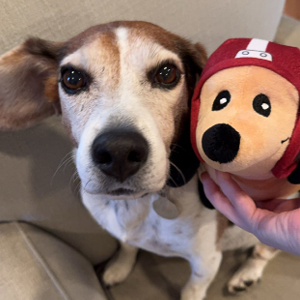
Sparky is an 8-year-old beagle we adopted 7 years ago after he was found meandering the country roads. He has overcome countless obstacles and has lived to tell many tails. (Though, tail jokes are still a bit of a sensitive subject for him.) | |
Sparky’s favorite holiday is Christmas. He woke up bright and early in anticipation of his gifts. His turn to open gifts was last since he was the household's eldest (dog years). Unfortunately, when he unboxed his first gift, it at first seemed almost like a sick prank. A groundhog stuffed animal! This was really upsetting for him as he almost saw it as a taunt. However, we assured him it had nothing to do with the backyard groundhog he never seems to be able to scare away for good. He eventually seemed to warm up to it, and everyone started noticing a striking resemblance between the two of them! It seems that beagles and groundhogs must have had a common ancestor over the course of evolution.
Since then, Sparky has been ringing in the new year with many resolutions. He decided to no longer bark at potentially friendly groundhogs (in honor of his stuffed animal). The plan was implemented on January 1st but only lasted circa 3 minutes when he took his first trip into the backyard. Not all hope for change was lost, though. He also decided to dedicate himself to a strict no-naps policy as he planned to instead spend that time getting himself into peak physical form. This was going well until he saw a particularly sunny patch of rug and couldn’t help but just rest his eyes. This turned into a 4-hour nap, and that’s when he decided maybe New Year’s resolutions were not for him.
As you can see, Sparky’s holiday season has had its ups and downs, which is why, on Valentine's Day, he really wanted to turn over a new leaf. This Valentine’s Day, he really wants to emphasize his appreciation for all his fans and viewers at home! He really tries to stay humble, but he knows he is kind of a beacon of hope for many. So, he can’t help but spread the love by allowing me to share his bimonthly tails. (Still a bit of a sour joke.)
That’s all for now! Thanks for reading this month's edition of Spark Bark!
|
|
|
Donations to our APS Research Labs directly fuel innovative pilot projects and critical infrastructure that can be difficult to fully support through traditional funding mechanisms. Your generosity keeps our research moving forward. We welcome your ideas and involvement!
We are deeply grateful to the 97 individuals who have contributed to the Michigan APS Program so far. Every donation, whether $10 or $10,000, has a meaningful impact.
Dr. Ray Zuo recently secured the capital to purchase a cutting-edge IncuCyte Live-Cell Imaging System, a game-changing tool that will open new frontiers in APS research. However, maintaining this vital piece of equipment requires an expensive annual service contract - something donors like you can potentially help us with. Your generosity has already empowered bold investments in cutting-edge science - now, you can help sustain them.
The uncertain landscape of federal funding has made this a challenging time for our group. But your continued generosity can help ensure that the pace of discovery does not slow.
Donate to the APS Gift Fund today and help drive progress toward a cure!
| | | | |