What Are Predator Tactics?


A person engaging in predatory behavior can be anyone. That's why it's important to know the tactics that predators use. In this month's guide, you will learn:


  • The definition of a predator
  • The most common perpetrators
  • The tactics that predators use
  • How to talk to youth about predators (how can they avoid their traps?)


Please Note: Best practice regarding terms is to refer to someone as a "person engaging in predatory behavior" — we have chosen to simplify to the term "predator" to streamline this newsletter.


WHAT IS A PREDATOR?


Individuals who use various forms of manipulation to exploit another person for their own gratification or personal gain.


The types of exploitation can include:

  • Sexual
  • Physical
  • Psychological
  • Emotional


According to RAINN, "research reveals that most perpetrators are not scary strangers lurking in the shadows; they are people their victims knew—and often trusted."


Source: RAINN

Source: Power Over Predators


WHO ARE THE MOST COMMON PERPETRATORS?


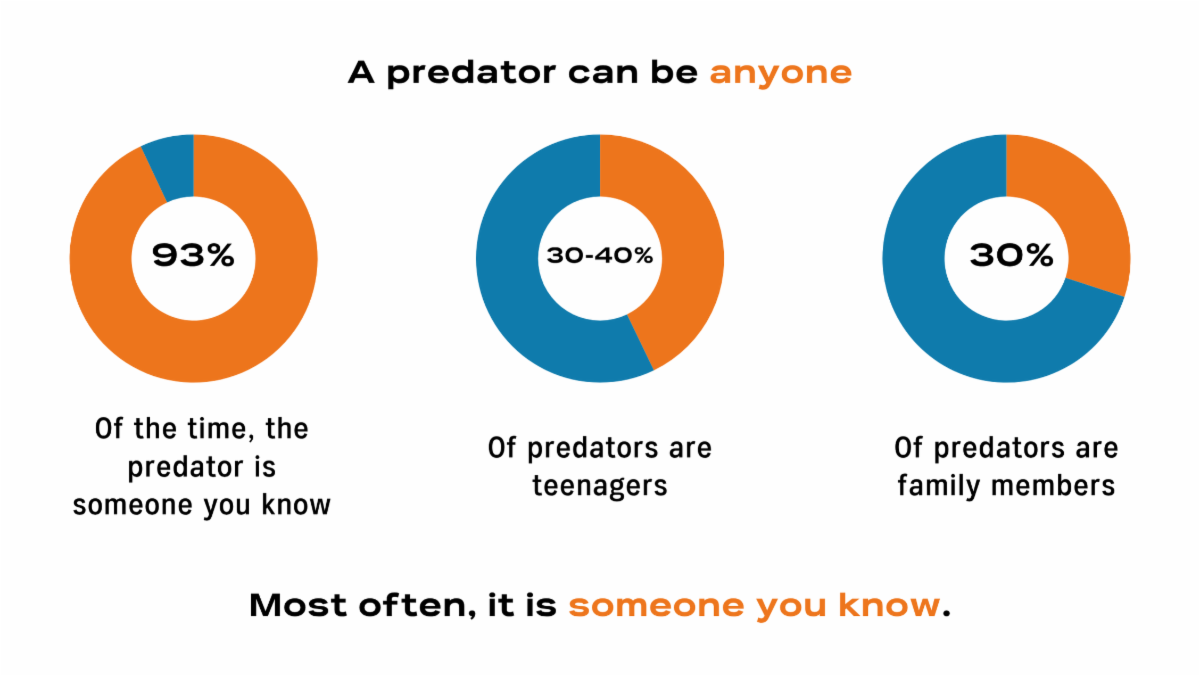
A predator can be anyone. 93% of the time in sexual exploitation, the predator is someone the victim knows.


The most common perpetrators are:


  1. Romantic partners
  2. Family members


Source: Power Over Predators

Allan, C., Winters, G. M., & Jeglic, E. L. (2023). Current Trends in Sex Trafficking Research. Current Psychiatry Reports, 25(5), 175–182.


WHAT TACTICS DO PREDATORS USE?


You can't identify who a predator is by what they look like. People who engage in predatory behavior often use 3 steps:


Step 1: Hide in Plain Sight


  • It is not always a creepy person lurking in the bushes. They live in the open and often go unnoticed in our community.


Step 2: Befriend You, Identify Your Needs, and Work to Fulfill Those Needs


  • They get to know you and identify what matters to you. Is it material needs (have food, shelter, transportation, new clothes or technology) or emotional needs (you want to feel less lonely and need a friend or romantic partner, you want to be accepted on your sports team, etc)?
  • They act like they care about things that interest you to get you materially or emotionally dependent on them.


Step 3: Manipulation


  • To manipulate someone is to control or influence a person cleverly or unfairly.
  • They put unhealthy, unsafe, unwanted, or illegal conditions in order to keep meeting the needs they fulfill.
  • Examples: "I'll get you the new soccer cleats if you send me a photo of yourself." OR "I need someone who is as invested in this relationship as I am. If you love me, you would sleep with me."


Note: Most exploitation occurs on the internet.


  • In order to keep someone silent, predators often make a victim feel like it was their fault. "You added me on social media" OR "you said yes the first time".


REMEMBER


No matter what, abuse is always the fault of the abuser.

  • No one ever has the right to cause you harm for their gain. Even if you added them on social media or said yes the first time, it does not give anyone permission to hurt you.


Source: Power Over Predators


HOW TO TALK TO YOUTH ABOUT PREDATORS & HOW THEY CAN AVOID THEM


It's important to have a conversation with your children about the traps that predators use. This isn't meant to build fear, rather it is the first step in preventing exploitation.


  • Keep in Mind: Prepare your kids for the world instead of trying to manipulate the world to be safe for your child (Love 146, 2025). We want to wrap our kids in bubble wrap to keep them safe, but age-appropriate conversations are what truly keep our kids safe.
  • Talk About the Signs: Understanding safe vs. unsafe adult, the difference between a secret and a surprise, what to do if someone asks you to do something that is unsafe, unhealthy, unwanted, or illegal.
  • Teach Them How to Set Boundaries: That they should take note if something makes them feel uncomfortable or scared, that they can leave those situations, that they can always say "no."
  • Teach Them About Internet Safety: Most exploitation takes place online, which is why it is important that kids know the risks and are equipped to respond to such risks (Click orange button below for more information).
  • Share Reminders: Use words of truth to encourage kids and build up their self-esteem — "You matter." "You are worth protecting."


Source: Love 146

Source: Know2Protect

Source: Monique Burr Foundation for Children


A SPECIAL THANK YOU


We want to acknowledge the important work that Desiree Wiesen-Martin and her students at the University of Wisconsin - River Falls have done for C.A.S.T.!


The research for this month's Preventative Power: Hope in Motion newsletter was done by the following students of CRIM 241 Victimology Class:


  • Crystal Baker
  • Pearrin Chhay
  • Lydia Greene
  • Trista Ibberson


We are incredibly grateful to Desiree and her student's for their dedicated work and enthusiasm for making positive change.! View the students full research and project by clicking on the button below.


Looking For More Prevention Resources?


Want additional talking points, situational drills, and a person to have direct Q&A? Request a FREE virtual or in-person speaker from C.A.S.T. for topics like:


  • Human Trafficking 101
  • Parent Workshops
  • Youth Presentations
  • Round Tables (small groups sessions for brainstorming and Q&A)


Want to Share With Us How You Are Taking Steps Toward Prevention?


P.O. Box 251001,

Woodbury, MN, 55125

www.castmn.org

Facebook  Instagram