Specializing in Survey Research on Natural Resource and Outdoor Recreation Issues
| | New Research Sheds Light on Attitudes Toward Moose Management in Maine | | |
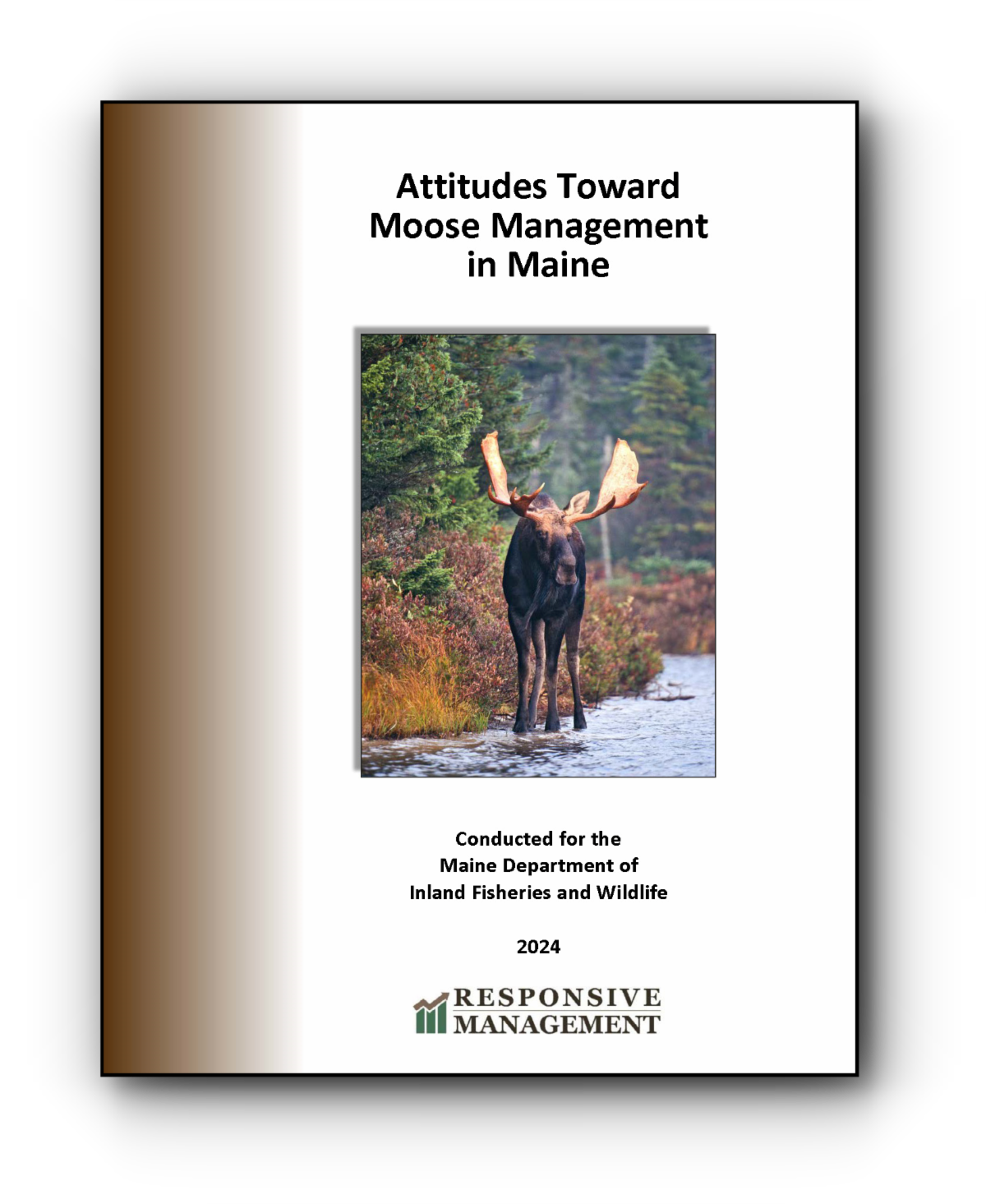
Responsive Management recently worked with the Maine Department of Inland Fisheries and Wildlife (MDIFW) on a major study to examine attitudes toward moose management in Maine. Initiated by a recommendation from the Maine Legislature and a designated stakeholder committee, the research was conducted to assess levels of satisfaction and dissatisfaction with the moose season structure and timing, the extent of conflicts between user groups (for instance, between hunters and wildlife viewers seeking moose), and support for or opposition to various potential changes to the moose season under consideration.
The study area included Northern Maine, the Moosehead Lake Area, the Western Mountains, and Downeast Maine, which are the portions of the state where moose viewing, moose hunting, and related activities typically occur.
Because of the range of opinions and diversity of perspectives on moose management in Maine, Responsive Management designed the study to include both rigorous probability-based random sampling as well as a mechanism to allow qualitative feedback from anyone wishing to contribute input on the topic.
| | |
The resulting methodology included scientific surveys of several key groups in the Moosehead Lake Area, Western Mountains, and Northern and Downeast regions of Maine:
- Maine general population residents who lived in the study area or who traveled to the study area for recreational purposes.
- Licensed Maine hunters who hunted in the study area.
- Licensed Maine anglers who fished or engaged in other recreation in the study area.
- Maine professional guides who provided services in the study area.
- Maine landowners who owned or managed more than 100,000 acres, with at least one tract in the study area.
- Maine tourism-related businesses that served customers in the study area.
| | To collect additional feedback, Responsive Management designed an online public input forum hosted on a dedicated website and updated periodically with questions and discussion prompts on the study topics. Comments and other data from the forum were analyzed separately after the forum remained active for several months. | | | | |
Some of the major findings from the study include the following:
- Moose are extremely important to Mainers. Most people want to see moose, and it is important to an overwhelming majority of Mainers that moose exist.
- Most groups feel Maine’s moose population is about right, although anglers and guides more often indicated that it is too low.
| |
- Support for hunting, including moose hunting, and hunting as a way to control populations, is high among residents, hunters, recreationists, anglers, and guides.
- Although more than 50% of guides and 26% to 42% of hunters, recreationists, and anglers say that crowding by other people is a problem during moose season, they most commonly say it is a minor problem rather than a major problem.
- Most respondents had not experienced a conflict with anyone during moose season. However, guides were more likely than any other group to indicate that they experienced a problem during moose season (30% of guides experienced a conflict, compared to no more than 10% of the other groups).
- The survey identified several of the state’s Wildlife Management Districts (WMDs) where conflicts during moose season are most common: these include WMDs 1 through 6 and 8 and 9.
- The most common types of conflicts during moose season include blocked roads, traffic congestion at access areas, and other hunters taking hunters’ desired locations for hunting.
- Among all guides surveyed, 25% had a conflict involving blocked roads, 13% had a conflict involving traffic congestion, and 9% had a conflict stemming from a preferred hunting location being taken.
- Among all hunters, 7% experienced blocked roads, 4% experienced traffic congestion, and 3% lost preferred hunting spots to other hunters.
- Among all recreationists, 2% had a conflict with blocked roads, 2% experienced traffic congestion, and 1% had a conflict related to a hunting spot being occupied.
- Most residents, hunters, recreationists, anglers, and guides want Maine’s moose season structure to remain the same.
- The overwhelming majority of residents, hunters, recreationists, anglers, and guides trust MDIFW to manage moose and to set the appropriate framework for the moose hunting seasons.
| | Responsive Management’s scientific, probability-based surveys for the Maine moose project were conducted using a multimodal data collection approach that included interviews by phone and online. The random samples of hunters and anglers were drawn from all eligible individuals in the license databases, regardless of the contact information available for each person. This resulted in a representative sample free of any potential bias. General population residents and other respondents were also contacted by text message as a way to further engage each group. Respondents who could not be reached through one mode (e.g., phone) were later contacted using a different mode (e.g., email). | | | |
This approach avoided the bias that would have resulted from limiting the survey to only a single mode of contact. For example, conducting the survey entirely online using email addresses would have underrepresented those who lacked an email address or reliable access to the internet, less avid recreationists and those less interested in the study topic, and those without proficient reading skills. Responsive Management’s multimodal survey methodology ensured the integrity and representativeness of each random sample by providing multiple modes and opportunities for people to participate in the survey.
Additionally, the online public input forum ensured that all residents and stakeholders had a further means of contributing their opinions.
| | |
The full report from the Maine moose management survey is accessible here.
| |
About Responsive Management
Responsive Management is an internationally recognized survey research firm specializing in natural resource and outdoor recreation issues. Responsive Management has conducted research for federal and state fish and wildlife agencies, conservation NGOs, outdoor equipment manufacturers, and universities throughout the United States for 35 years.
| | |
35 years of continuous survey research only on
natural resource and outdoor recreation issues
| | | | |