September 2026

Any comments/suggestions please email the editor at editor@redrockrx.com

Edited by Malcolm Fraser MD, CMD


BREAKING NEWS!

COVID-19 Vaccines Approved by FDA for 2026–27

On August 27, 2026, the FDA approved updated COVID-19 vaccines for the 2026–2027 season. The new formulations target XFG, a JN.1-descendant variant that has been prominent among circulating strains.


The approved options include:

  • Pfizer-BioNTech Comirnaty XFG
  • Moderna Spikevax XFG
  • Novavax/Sanofi Nuvaxovid XFG
    

For adults age 65 and older, the FDA labeling is straightforward: the vaccines are approved regardless of whether another underlying high-risk condition is present. One important distinction is that FDA approval is not the same as CDC vaccination guidance.


As of August 28, 2026, the CDC reports that COVID-19 activity in the U.S. is increasing, even though overall respiratory illness activity remains very low.

As always, your Red Rock pharmacist will keep you updated on the latest vaccine recommendations and guidance.

Shixian Wang

Director of Operations


Another Reason for Our Residents Over 60 to Get 
the Shingles Vaccine

Recent research has shown that the Shingrix vaccine, which protects against shingles, may also provide cardiovascular benefits for people over age 60.


Individuals vaccinated during the 2017 season with 
Zostavax (a live-attenuated shingles vaccine available since 2005) were compared with those vaccinated in 2018 with Shingrix (a recombinant herpes zoster vaccine). The study found that the Shingrix group had:


  • Improved cardiovascular outcomes
  • Fewer ischemic heart disease events
  • Fewer heart failure events
    

The difference was only about 1%, but nationwide, that could translate into hundreds of thousands of cases. The findings suggest that Shingrix may provide a cardioprotective benefit in addition to protecting against shingles.


Here at Red Rock, we have always proactively advocated for vaccination against shingles, and this recent study further supports our position.


Shingrix was approved in late 2017 for adults age 50 and older, while Zostavax was withdrawn from the U.S. market in 2020.

Shixian Wang

Director of Operations


More details about the study can be found in Nature Medicine:

Read the Nature Medicine study


Every Interaction Is Marketing


When people hear the word marketing, they often think of advertisements, websites, brochures, or trade show booths. While those tools certainly have their place, the most powerful marketing in long-term care pharmacy doesn't come from a campaign. It comes from every interaction we have with our customers.


At Red Rock Pharmacy, our reputation isn't built by what we say about ourselves. It's built by what nurses, administrators, caregivers, and families say about us after they hang up the phone, receive a delivery, or work with one of our team members.


Customer service is marketing.


Every phone call answered by a knowledgeable team member, every urgent medication delivered on time, every consultant pharmacist who helps solve a clinical challenge, and every marketer who follows through on a promise contributes to the story our customers tell about Red Rock. Those experiences become our brand.


In long-term care, customers remember how a pharmacy responds when something doesn't go as planned. Anyone can provide medications when everything is running smoothly. The true difference is demonstrated during after-hours emergencies, last-minute admissions, medication shortages, or unexpected clinical questions. Those moments build confidence and strengthen relationships that can last for years.


Research consistently shows that retaining existing customers is significantly more cost-effective than acquiring new ones, making exceptional service one of the best long-term growth strategies for any organization. Satisfied customers are also more likely to recommend a trusted partner to colleagues and peers, creating opportunities that no advertisement can match.


Every member of the Red Rock team plays a role in this process. Drivers represent our reliability. Pharmacy technicians demonstrate accuracy and efficiency. Pharmacists provide trusted clinical expertise. Customer service staff create positive first impressions. Marketers open doors, but it is the collective experience delivered by the entire organization that keeps those doors open.


At Red Rock Pharmacy, every conversation, every delivery, and every solution is another opportunity to earn trust.


And trust remains the most valuable service we provide.

Dave Rimlinger,

Director of Marketing


Survey Update – Part 1


The Kaiser Family Foundation (KFF) published a major nursing home analysis in July, and it is one of the most important recent KFF nursing home publications, particularly as it relates to CMS surveys.


Using June 2026 Nursing Home Compare data, KFF examined approximately

137,000 deficiencies from nursing homes' most recent surveys and found that:


  • 75% of deficiencies were identified through routine inspections rather than complaint investigations.
  • Only about 5% of deficiencies reached the level of actual harm or immediate jeopardy.
    

The policy context is particularly noteworthy because federal oversight is placing greater priority on complaint-triggered inspections versus routine inspections.

The data suggests that this policy shift could result in fewer deficiencies being identified through the survey process.


Survey Update – Part 2


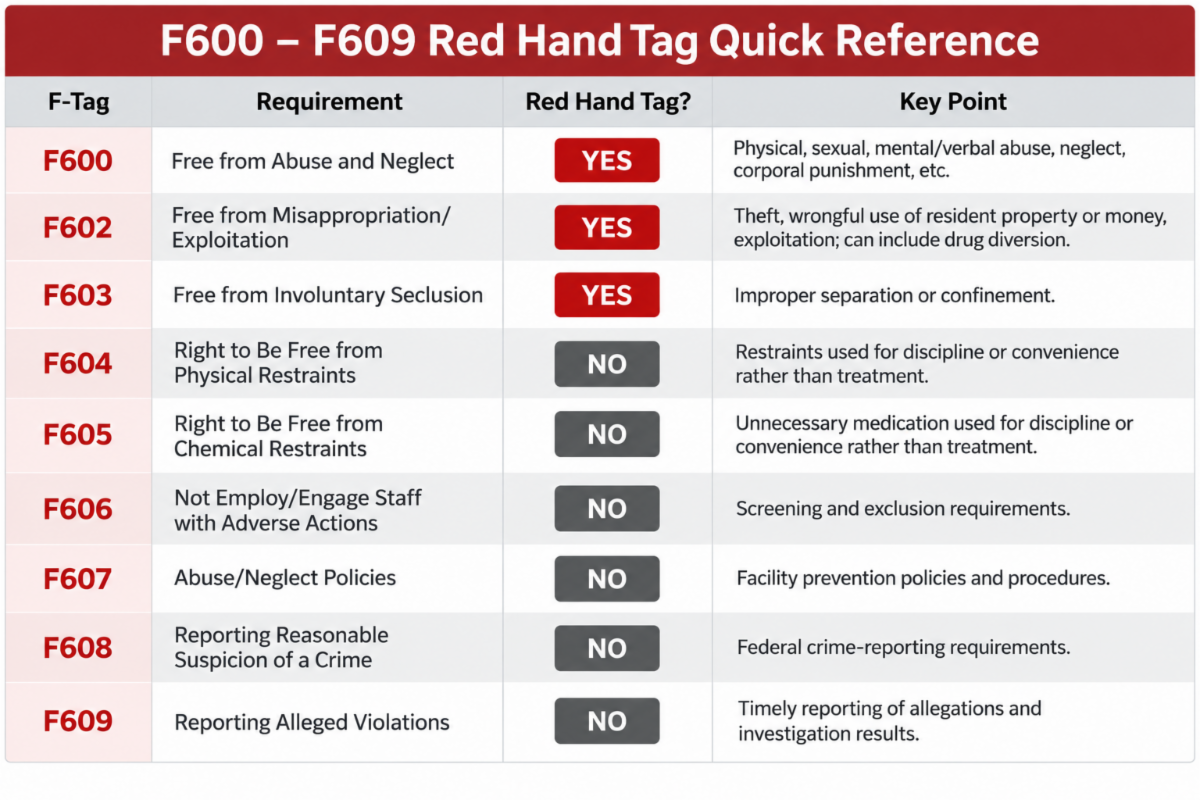
Which F-Tags Between F600 and F609 Can Result in a Red Hand on Nursing Home Care Compare?


Here is a useful one-page cheat sheet:

CMS specifically defines an “abuse citation” for purposes of the Care Compare icon as F600, F602, or F603.


When F600, F602, or F603 Produces the Red Hand

There are two pathways:


1. Harm-Level Citation

A G or higher F600, F602, or F603 citation on the most recent standard survey, or a complaint/focused infection-control survey during the preceding 12 months, qualifies the facility for the icon.


2. Repeat Citation

A D or higher F600, F602, or F603 citation in the current period, plus another qualifying abuse citation during the previous period (including the previous standard survey or a qualifying complaint survey 13–24 months earlier), can also trigger the icon.


The Practical Rule

F600/F602/F603 + G–L → Red hand from a single qualifying citation.

F600/F602/F603 + D–F → Red hand only when the repeat-citation criteria are satisfied.

F605 alone → Does NOT trigger the red hand.


Future issues of the Red Rock Report will provide more details about how the Red Hand criteria for F600–F603 are evolving.


Hypertension Is Undertreated in the U.S.


Up to 23 million people may be eligible for blood pressure (BP)-lowering medications based on the updated 2025 American Heart Association/American College of Cardiology guideline, according to a recent study published in the Journal of the American Heart Association.


More than 80 million U.S. adults were evaluated to determine eligibility for blood pressure-lowering medication under the updated guidelines. Treatment recommendations take into account blood pressure levels as well as factors such as diabetes, chronic kidney disease (CKD), cardiovascular disease, and overall cardiovascular risk.


The study also found that millions of adults who met criteria for treatment were not currently taking blood pressure-lowering medication, highlighting an important opportunity to improve hypertension treatment and prevention.


The Bottom Line

Controlling blood pressure is an important part of long-term health. Lifestyle changes—including a healthy diet, regular physical activity, maintaining a healthy weight, and reducing excess sodium—can play an important role in managing blood pressure. When lifestyle changes aren't enough, blood pressure-lowering medications may also be recommended.


Learn more about the research:

Read the study in the Journal of the American Heart Association


What Geriatric Emergency Departments Do Differently


Since 2017, the American College of Emergency Physicians (ACEP) has accredited more than 600 Geriatric Emergency Departments across the United States, including 73 in Department of Veterans Affairs medical centers.


San Diego has been a leader in this effort. Since 2022, every adult emergency department in San Diego has been accredited as a geriatric emergency department, designed to address the specific risks and needs of older patients. Recent studies suggest this approach can reduce hospital admissions and deaths among older adults while also lowering healthcare costs.


So, What Do They Do Differently?

Geriatric emergency departments may incorporate several features specifically designed for older adults:


  • Patients can go directly to a room, reducing unnecessary waiting.
  • Gurneys have thicker mattresses to help prevent skin breakdown.
  • Patients are routinely offered thicker blankets to help them stay warm.
  • Staff pay close attention to hydration and address dehydration when appropriate.
  • Rooms may be smaller and quieter, with curtains and sound-absorbing materials to reduce ambient noise.
  • Cushioned chairs are available for visitors, and external windows can help patients distinguish between day and night, which may help reduce delirium.
  • Glaring lights can be dimmed, and eye masks and earplugs may be offered to promote sleep.
    

Geriatric emergency departments are classified by ACEP from Level 1, for those meeting the highest number of criteria, to Level 3.


Why It Matters

Adults age 75 and older visit emergency departments at a higher rate than any other age group except infants—76 visits per 100 people in 2022.


Research cited by KFF Health News found that patients treated in geriatric emergency departments had a 39% lower likelihood of hospital admission and a 38% reduction in 30-day mortality. Geriatric emergency departments also saved Medicare up to approximately $3,000 per visit.


These findings highlight how adapting emergency care to the specific needs of older adults may improve outcomes while also reducing unnecessary hospitalizations and healthcare costs.


Read the full article:

KFF Health News – Geriatric Emergency Departments Explained


If you have any questions, ask your Red Rock Consultant Pharmacist