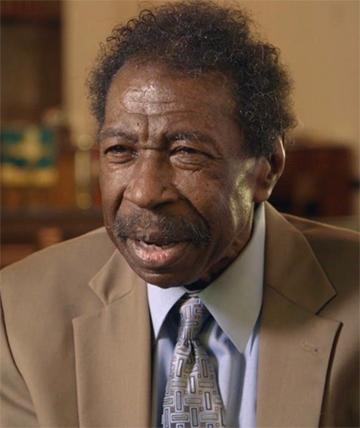
NO GREATER LOVE:
Remembering Bruce Carver Boynton,
Attorney and Social Justice Activist
by Ayesha G. Mutope-Johnson
Selflessness is the key ingredient of human greatness –
the measure in us of the Divine.
In December 1958, a young Howard University law student boarded the Trailways bus to go home to Selma, Alabama for the Christmas holiday. When the bus made a 40-minute layover in Richmond, Virginia he disembarked and went to get a sandwich. The restaurant area in the Trailways terminal had one section marked “Whites Only” and another marked “Colored”. The young African American man took one look at the very unsanitary “Colored” section with its large puddle of water in the middle of the floor, and moved to the “Whites Only” section to order his meal. That choice became the most significant decision of Bruce Carver Boynton’s life.
Within minutes, the restaurant had called the police to have Boynton removed. He was taken downtown to spend a night in jail and appear in court the next day, where he was convicted
of misdemeanor trespass and fined $10. It was days before he could get home to his family in Selma, but he did not let the matter rest there. He appealed the misdemeanor conviction as a
violation of his Civil Rights, taking it all the way to the U.S. Supreme Court, where Thurgood Marshall successfully argued Boynton’s right to eat at a desegregated counter. Boynton v.
Virginia (1960). In a rare interview with the Montgomery Advertiser in 2016, Boynton stated: “I was hungry and just wanted a cheeseburger and a cup of tea on that cold night. I also pointed out
that, as an American citizen, I was entitled to get that burger and tea.”
History tells us that it was this young man’s courageous choice to sit in the “Whites Only” section, his selfless decision to appeal a mere misdemeanor case, and his determination to see the case through to the Supreme Court, that led to the famous Freedom Rides of 1961. But for these choices, made at great personal risk, segregated interstate travel and segregated bus terminal facilities would have persisted much longer in the South. Apart from paying a fine, and ending up with a criminal record, when Boynton graduated law school and returned home to Selma, the State of Alabama would refuse to give him a law license. Being denied the right to practice law in his own home state, Boynton had to relocate to Chattanooga, Tennessee where he practiced law for several years. It was six years later (1965) before he would be granted an
Alabama law license; and another 53 years (2018) before he would be issued an apology by the Alabama State Bar.
But what makes a person disregard personal well-being and safety, and make a choice which (though it would surely benefit millions for generations to come) could surely cause him injury or even death. In the late 1950s and early 1960s Jim Crow South, an African American could be attacked, injured, lynched or burnt at the stake by Whites, and meet no justice. Besides, Southern law enforcement was cruel and vicious to Blacks, and this was completely sanctioned by state and local government. While studying law in Washington, DC., Boynton would have been aware of nonviolent protests in his home state of Alabama like the Montgomery Bus Boycott (1955-56), and would have heard of the ascendancy of the brutal Commissioner Bull Connor in Birmingham by 1958. Boynton knew all these things, yet he risked everything to take a stand and assert his Civil Rights.
Bruce Carver Boynton (middle name for his godfather, George Washington Carver) was born on June 19 (Juneteenth), 1937. Clearly a prodigy, he received his high school diploma at 14, his Bachelors degree from Fisk University by the age of 18 and completed Howard Law school by the time he was 21. His parents, Amelia and Samuel Boynton were ardent civil rights activists
from before he was born, and for all of his life he knew them risking their lives by knocking on doors to register voters, leading marches and voting rights campaigns. In an interview with the Advertiser in 2015, he said: “I grew up watching my parents working hard to register Black people to vote. My dad started doing that as far back as 1929, and my mother wasn’t far behind.” In another interview, he described his mother as a “Tower of Defiance”. She was, among many other roles, the first woman and the first African American, in 1964, to run for Congress from Alabama.
Samuel Boynton died in 1963, but Amelia continued with these efforts for all of her life, until her death in 2015 at the age of 104. Five months before her death (March 2015), though
wheelchair-bound, she was hand in hand with President Obama and Representative John Lewis, making the symbolic Edmund Pettus bridge crossing on the 50th Anniversary of Bloody Sunday.
The anniversary was significant for her, because on March 7, 1965, in a peaceful voting rights march from Selma to the Alabama capital of Montgomery, the police met the marchers with tear
gas and billy clubs, causing massive injury. Seventeen marchers were hospitalized and another 50 were treated for injuries. Among these were John Lewis whose skull was fractured, and Amelia
Boynton who was beaten unconscious and left lying at the end of the bridge.
Bruce Boynton spent his entire career in the selfless work of being a civil rights lawyer and activist, and he became Alabama’s first Black special prosecutor. In 2018, U.S. District Judge Myron Thompson said of Boynton: He did something that very few people would have the courage to do. He said no. To me he’s on par with Rosa Parks. His life is a teaching lesson for all of us about how we can make a difference. All he wanted was as cheeseburger, and he changed the course of history.
On Monday, November 23, 2020, Bruce died peacefully, just two weeks before 60th Anniversary of his landmark case. His name will forever be associated with desegregation of bus terminal facilities. His boyhood home still stands on a Selma street named for his parents. As he drew his last breath, the Dallas County Commission of Alabama voted to rename an annex of the County Courthouse for two prominent African American attorneys. Bruce Carver Boynton was one of them.