|
|  |
INDEPENDENT INVENTORS
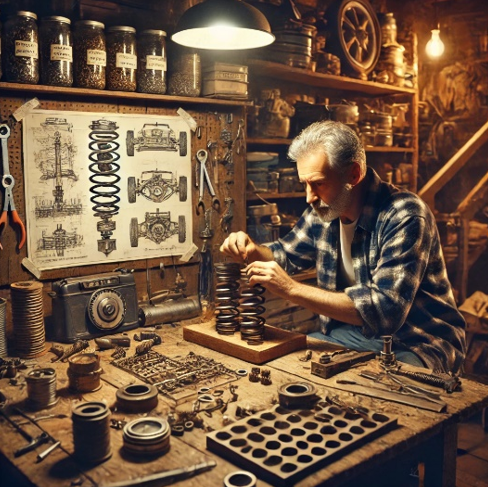
Imagine a small, cluttered garage, the walls lined with shelves holding jars of nuts, bolts, and old tools. A single overhead lamp illuminates a workbench covered with sketches, parts, and half-finished prototypes. It’s in just this setting that many advancements in automobile technology were born. The independent inventor contributed many advancements to the automobile.
In 1911, Charles Kettering, working out of a friend’s barn, invented the electric starter, replacing the hand crank for starting engines. His invention was first used in the 1912 Cadillac.
In 1945, Ralph Teetor invented cruise control, originally called the "Speedostat," which allowed drivers to maintain a constant speed without keeping their foot on the gas pedal. Family lore suggests that Teetor was inspired to invent cruise control one day while riding with his family's lawyer. The lawyer would slow down while talking and speed up while listening. This annoyed Teetor motivating him to find a solution.
The first turn signal was invented by Florence Lawrence, a silent film actress and inventor, in 1914. She developed a mechanical signaling arm that could be raised or lowered by the driver to indicate a turn, which she called an "auto signaling arm." However, it was not commercially produced or widely adopted at the time. She also invented the first mechanical brake signal. She did not patent either of these inventions, however, and as a result she received no credit for, nor profit from, either one.
| |
The intermittent windshield wiper was invented by Robert Kearns, an American engineer, in the 1960s. Kearns developed the idea after experiencing frustration with the standard wipers of the time, which either ran continuously or not at all, even during light rain. He patented his design in 1967, which allowed for the wipers to pause between wipes, mimicking the natural blinking of the human eye.
Kearns initially pitched his invention to major automotive manufacturers, but his idea was rejected. Later, many car companies began incorporating intermittent wipers into their vehicles without –-crediting or compensating Kearns. This led to a long legal battle, where Kearns sued Ford, Chrysler, and other automakers for patent infringement. He eventually won significant settlements in the 1990s, which recognized his contribution to automotive technology.
The story of automobile innovation is filled with the ingenuity and persistence of the independent inventor. These inventors remind us that great ideas can come from anywhere and that the spirit of innovation is often found in the most unexpected places.
If you have an idea or an invention for the automobile, I’d love to hear about it. Email me at cruisintimes@gmail.com
…bob
| | |
STAY TUNED WITH CRUISIN' TIMES: IMPORTANT ANNOUCEMENT
| |
|
GEAR UP WITH CRUISIN' TIMES:
PRODUCT ALERT
| |
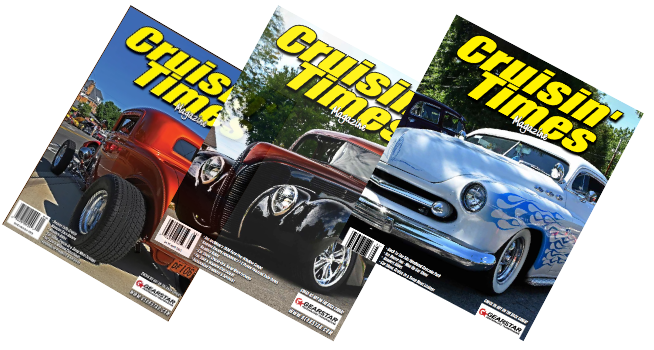
Drive into the fast lane with our print subscription! | |
|
🚗 8 PRINT ISSUES + 12 DIGITAL ISSUES FOR JUST $40!
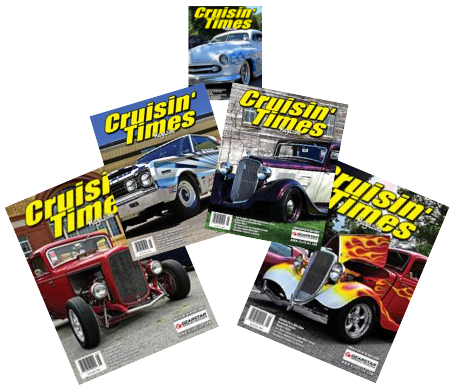
Get your hands on a year's subscription to our exclusive car magazine. Each issue is packed with event listings, car show coverage, and a featured ride.
Print issues will be for the following months: March/April, May, June, July, Aug, Sept/Oct
🌟 Take a Sneak Peek!
Not sure yet? Head over to our website to read a sample issue. Experience the thrill and excitement that awaits in every page.
🔥 Sign Up Today
Don’t miss this opportunity to join a community passionate about cars. Visit our website now and choose the subscription that suits you best!
| |
GET UP TO SPEED:
FEATURED EVENTS
| |
WANTED:
READERS RIDE SUBMISSIONS
| |
Cruisers, we STILL want to see your rides 🏎️
Keep your incredible ride submissions coming for consideration and placement in the print magazine!
| |
Free submissions are included in the magazine on a first come, first served basis.
There is a 200 character limit to "Your Story" and a limit of one image will be used in the magazine.
Cruisin' Time reserves the right to reject inappropriate images or descriptions.
| |
|
CONNECT WITH CRUISIN' TIMES | | |
Revive the glory days, connect, read, and share cherished car stories on the Cruisin' Times blog! | |
Stay up to date while being on the go with our free digital edition for our eNewsletter subscribers! | |
|
Q: Why is the magazine only offered in print for 8 issues a year?
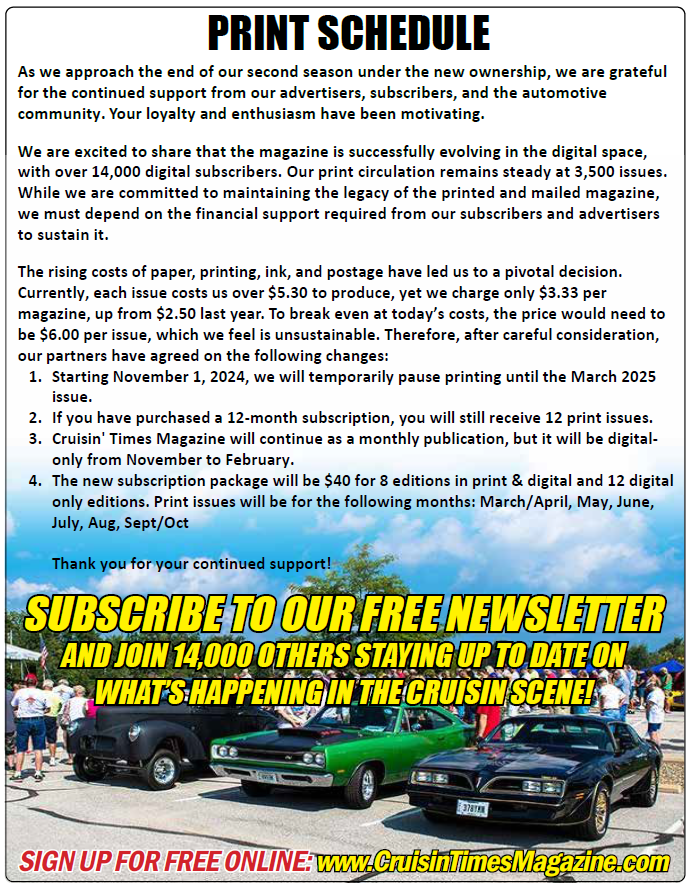
A: As we approach the end of our second season under the new ownership, we are grateful for the continued support from our advertisers, subscribers, and the automotive community. Your loyalty and enthusiasm have been motivating.
We are excited to share that the magazine is successfully evolving in the digital space, with over 14,000 digital subscribers. Our print circulation remains steady at 3,500 issues. While we are committed to maintaining the legacy of the printed and mailed magazine, we must depend on the financial support required from our subscribers and advertisers to sustain it.
The rising costs of paper, printing, ink, and postage have led us to a pivotal decision. Currently, each issue costs us over $5.30 to produce, yet we charge only $3.33 per magazine, up from $2.50 last year. To break even at today’s costs, the price would need to be $6.00 per issue, which we feel is unsustainable. Therefore, after careful consideration, our partners have agreed on the following changes:
- Starting November 1, 2024, we will temporarily pause printing until the March 2025 issue.
- If you have purchased a 12-month subscription, you will still receive 12 print issues.
- Cruisin' Times Magazine will continue as a monthly publication, but it will be digital-only from November to February.
- The new subscription package will be $40 for 8 editions* in print & digital and 12 digital only editions.
*March/April, May, June, July, Aug, Sept/Oct
| | | | |