|
President's Message
The Conquest and Destruction of Jericho
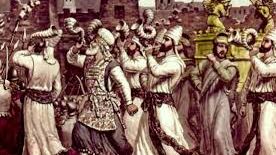
“On the seventh day they rose early, at the dawning of the day, and marched around the city in the same manner seven times. It was only on that day that they marched around the city seven times. And at the seventh time, when the priests blew the trumpets, Joshua said to the people, ‘Shout, for the LORD has given you the city.’” (Joshua 6:15–16)
After the Passover, the angel who had drawn his sword initiates the battle. Although the angel does not explicitly state the reason for his coming, the unfolding events of chapter 6 clearly demonstrate that the battle surrounding the land of Canaan cannot be decided by human strength alone. Much like Moses’ encounter with the angel at the burning bush, Joshua meets the angel, gains strength from this encounter, and prepares himself to carry out the task set before him.
The Conquest and Destruction of Jericho (6:1–21)
The fortified city of Jericho stood like a barred gate blocking the entrance to the land of Canaan. The decisive battle that takes place here becomes a model for the entire conquest of Canaan. On one side stand strong walls and gates tightly shut; on the other side stands God, who promises victory to His people and comes to their aid. No human power or strategy could bring down the walls of Jericho. The Israelites march around the city with the ark of the covenant—the sign of God’s presence—at the center of their ranks. The ram’s horn trumpets produce a sound that pierces the hearts of those who hear it.
The details of marching around Jericho for seven days are not entirely clear. This difficulty can be resolved by understanding the text as a weaving together of two different traditions. According to one tradition, the soldiers marched silently around the city once a day for six days and shouted on the seventh circuit of the seventh day (vv. 3, 10, 16). According to another tradition, the priests blew the ram’s horn trumpets from the beginning. The procession of priests evokes the image of a liturgical ceremony. Silence and shouting are both intimidating yet opposing elements, and this war narrative that includes both is not intended to explain the fall of Jericho as a psychological phenomenon. Both traditions regard the collapse of Jericho’s walls as an inexplicable miracle.
The Salvation of Rahab’s Family (6:23–25)
As the spies had promised, Rahab and her family are spared from destruction. They are granted the right to dwell among Israel. According to Matthew 1:5, they were more than foreigners merely tolerated outside the camp of Israel. The expression “she has lived among Israel to this day” implies that they ultimately became a people set apart as God’s own. They likely lived outside the camp while undergoing purification rites, and through such rituals they would have been considered holy and allowed to belong to the Israelite community. This shows that even a foreigner, and even one with a morally corrupt past, could be cleansed and become part of God’s people if their impurity was washed away. Furthermore, it reveals the universal love of God, who ultimately cleanses all people from sin. Rahab later married Salmon of the tribe of Judah and gave birth to Boaz, who became the great-grandfather of King David.
Rahab and her family were rescued safely not only because the two spies felt personally indebted to her, but more fundamentally because they had sworn in the name of the LORD to grant her request for salvation. Had they failed to rescue Rahab and her family, it would have compromised the faithfulness of God Himself. Therefore, the act of leading Rahab and her household safely out of Jericho demonstrates the certainty of God’s salvation and His faithfulness in guiding and protecting those whom He intends to save. The two spies and the Israelites who carried out this task were simply servants of God, embodying and putting into action His faithfulness.
Reflection
Joshua saved those in the city of Jericho who had set themselves apart and desired to become the people of the LORD. In the midst of war, it is not easy to give special and careful attention to rescuing Rahab and her family. Nevertheless, the fact that Joshua did not forget them clearly demonstrates how faithful he was, not only before God but also before people.
Joshua had previously heard the report of the two spies and remembered both the kindness they had received from Rahab and the promise they had made to her. When the appointed time came, he faithfully fulfilled that promise. Such an attitude on Joshua’s part teaches us well what our basic posture should be before God and before others.
|