This time of year is all about transitions. We're making a transition from darkness to light (amen); from frigid to, well, less cold. And most excitingly, we're making a transition from the reflection and planning we do in the winter months to the take-action mode we switch to come spring. 


Over the past few months, we've been laying the groundwork for an exciting project. The Know Your Fisherman campaign started as an idea among the fishing community I work with in Montauk, New York. In Montauk, as in many small ports around the country, community-based commercial fishermen are a dwindling breed. 


We thought that if more consumers got to know what goes into fishing: how fishermen work, how they treat their catch, where it goes when it leaves the boat - we could rally support and build markets for their catch. If you Know Your Fisherman, you're more likely to support him or her. 


So, with the help of some other FLC members, we're hatching the Know Your Fisherman campaign to build awareness, market demand and policy support for small-and-mid-scale commercial fishermen and their catch. 


There are so many ways you can help us build and get the word out about this campaign. Want to get involved? Drop us a line at knowyourfisherman@gmail.com. We'd love to hear from you. 


Onward, 

Sean Barrett

Co-founder, Dock to Dish

Montauk, NY


We'd like to share:

Building community
...through skill building

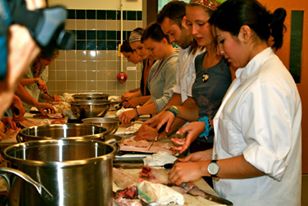
Slow Fish USA is steadily growing and connecting students all over New England to local fishing communities. Recent workshops in New Hampshire and Rhode Island has students rolling up their sleeves to learn more about working with whole, locally-caught seafood. 

University of New Hampshire students learn to break down whole fish at a Slow Fish workshop. 


But it doesn't have to stop in New England. Slow Fish USA has produced this great guide to hosting a Slow Fish workshop - anywhere there's a fishing community and a student community! 

Influencing policy
Securing fleet diversity in New England

The New England Fleet Diversity Amendment 18 will reach a critical juncture at this April's New England Fisheries Management Council meeting. The policy seeks to create scale-appropriate fishing measures within key fishing grounds and promote affordable access to small and medium scale fishermen. It also seeks to prevent large-scale corporate consolidation of fisheries access into the hands of a few. Community based fishermen, Fish Locally Collaborative allies, and NAMA have been weighing-in on this policy over the past 4 years. April's meeting will be a critical series of votes and we'll be looking to create action opportunities for our allies as we head into April. Keep your eyes out!


Transforming markets
Know Your Fisherman

One of the key pieces of our Know Your Fisherman campaign is the purchasing pledge. We'll be reaching out to restaurants and institutions  to shift purchases of wild, locally-caught, traceable seafood by 10% generate a critical mass of signed pledges in 2015.

We think that if enough people who buy seafood sign the pledge, we'll generate enough momentum to make headway toward building truly viable localized markets for seafood. If you're a buyer and want in, drop us a line at knowyourfisherman@gmail.com. 

credit: Lisa Sinicki


Out and About
The event season gets underway

NAMA will be speaking at two great events this coming weekend: J ust Food? Forum on Justice in the Food System  at Harvard University and the Long Island Food and Films Feast a t the Cinema Arts Centre in Huntington, NY. 

What we're reading
Overlooked, underloved, lesser-known (just don't call it trash).

Chefs are cooking with rudderfish, redfish, and lingcod - and loving it. Alaskans are working on ways to draw young people into the fishing business. Obama takes action on IUU. Warmer, less productive Pacific waters = seapup mortality :(


Thank you for all that you do. Catch you next month!