Week 11: July 4, 2026

Still thinking about that startup idea?

Let's talk timing.

,


This week we're covering the big question of when to launch — year one, year two, or as an alum. We'll also dig deeper into the tradeoffs of each path, plus the real (and surprisingly substantial) funding opportunities schools offer entrepreneurs along the way. Whichever path you're leaning toward, a little timing strategy now can save you a lot of headaches later.


The 100 Week Sprint team

To-do's this week

Got 5 minutes? Jot down ideas that you’ve been considering. Treat yourself to a new “offline” journal to ideate.

Got 30 minutes? Brainstorm people you can meet at school who could be “game changers” in your industry (professors, alumni, etc.)

Got an hour? Take a first pass at the 10-slide loop for an initial idea. Give yourself a clear time limit!

When Should You Launch? Choosing Your Entrepreneurship Timeline in the MBA


You're heading to business school with a business in mind — or at least the itch to build one. The question isn't whether to pursue it. The question is when.


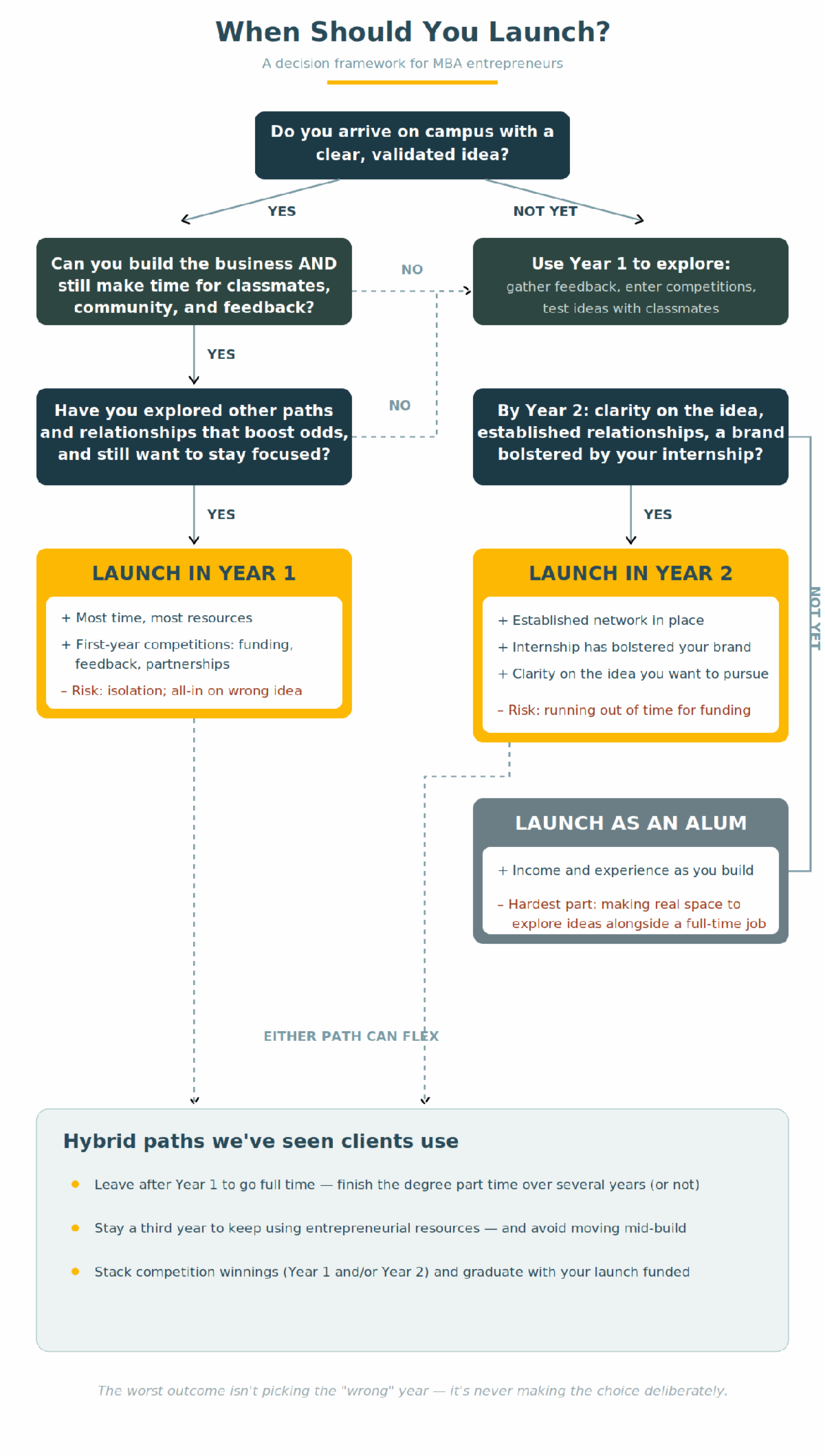
Broadly, you have three options: launch in your first year, launch in your second year, or wait until you're an alum, perhaps two to three years out of school. Each path has real advantages and real costs, and we've watched clients succeed (and struggle) on all three. Here's how to think it through.


Option 1: Launch in Year One

Going all-in from day one gives you the most time and the most access to resources to build your business — especially if you arrive on campus already clear on your idea. At some schools, entrepreneurship competitions begin in the first year, and those competitions can create funding opportunities, structured feedback, and chances to explore partnerships — all while you still have runway ahead of you.


But there are downsides. If you're focused entirely on your business, you may not make time to meet new people in your program — and end up feeling left out of the community you came to join. There's also a riskier trap: you may be pursuing the wrong idea and not take enough time to gather feedback before diving in fully. First year is when your idea should be stress-tested, not just executed.


Option 2: Launch in Year Two

By second year, you have established relationships in place. You may have completed an internship that bolsters your brand. And critically, you may have real clarity about the idea you want to pursue — clarity that during your first-year you didn't have.


The downside is the clock. With only a year left, you may run out of time to secure funding for the business before graduation pulls you toward other commitments.


Option 3: Launch as an Alum

Some people wait until they've graduated and worked for a few years. The challenge here is making space to fully explore your ideas and opportunities while you're committed to doing well at your full-time job. Some people are able to do that. Others struggle. The structure, resources, and dedicated time that school provides are hard to replicate when you're building nights and weekends.

The Paths in Between


The three options above aren't the only ones. We've seen clients craft hybrid paths that worked remarkably well:


Leave after first year. Some clients build enough of a business in year one that they want to focus on it full time. They leave after their first year and complete the degree part time over several years — if they complete it at all.


Stay a third year. Others extend their MBA to a third year specifically to keep using their school's entrepreneurial resources. A couple of our clients stayed on campus for that third year so they didn't have to move their family — or themselves — in the middle of a very targeted, focused period of building the business.

Starting a Business Costs Money; Some Schools Have Some


A number of schools offer funding opportunities in first year, second year, or both, and they can be incredibly helpful. In recent years, we've seen clients graduate with more than enough financing to actually fund the start of their business.


The numbers at top programs are real money, not token prizes:


Harvard Business School awards $75,000 grand prizes in each track of its annual New Venture Competition, with hundreds of thousands of dollars in total cash and in-kind prizes distributed each year. Recent MBA winners include Rea Savla (MBA 2024), whose venture Solara — an on-demand solar irrigation service for farmers in India — took the $75,000 Social Enterprise grand prize.

Chicago Booth's Edward L. Kaplan New Venture Challenge is arguably the most lucrative student competition in the country: in a recent year it awarded a record $1.6 million across its finalist teams, with the first-place team, Andes STR, taking home more than $660,000 in investment. The NVC's track record speaks for itself — Grubhub and Braintree (the company behind Venmo) both launched through this competition while their founders were Booth students.


Columbia runs the Startup Columbia venture competition, which distributes more than $200,000 in non-dilutive cash grants each year to student founders, alongside Columbia Business School's own ecosystem of programs — summer startup grants, the Build Lab accelerator for second-years, and the Entrepreneurial Greenhouse for graduating students.


MIT's $100K Entrepreneurship Competition awards a $100,000 grand prize plus additional prizes across multiple phases throughout the year — and its alumni roster includes companies like HubSpot and Akamai. Because it's open to teams across MIT, Sloan MBA students frequently partner with engineering and PhD classmates, which is itself a co-founder matchmaking opportunity.


UC Berkeley Haas hosts LAUNCH, the UC system's startup accelerator and competition, with tens of thousands of dollars in prize money at its annual Demo Day and a track record as a feeder into Y Combinator and top-tier VCs. Hiroki Koga (MBA 2017) won LAUNCH with Oishii Farm — the vertical farming company whose premium strawberries have since become famous well beyond campus.


The takeaway: if funding your launch is a concern, the availability and timing of these programs should factor into both your school choice and your launch timeline. Many of these competitions begin in first year — which strengthens the case for engaging early, even if you don't go all-in until later.

The Bottom Line


There's no universally right answer — but there is a right answer for you. It depends on how clear you are on your idea, how much you value the community experience of your program, your funding needs, and your personal circumstances. The worst outcome isn't picking the "wrong" year. It's drifting through school without ever making the choice deliberately.

Missed a week or two? Click here for our article archives.

Having trouble viewing this email? Open it in a new window.

Explore more on 100weeksprint.com
Facebook  LinkedIn