INSIGHT | December 2024


Wishing you peace and joy in 2025!


New open-source digital twin of Mcity Test Facility makes test track available to researchers anywhere

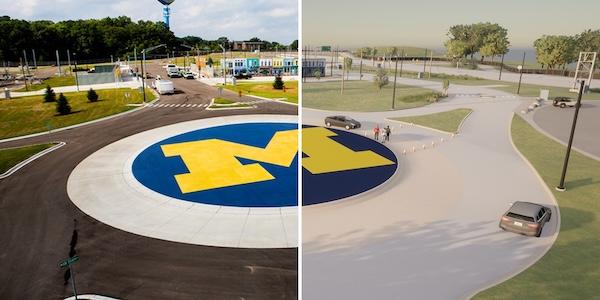
The first open-source digital twin of the Mcity Test Facility is now available to the public, giving researchers around the world a new free tool. A digital twin is a virtual representation of a physical environment that also exchanges data with that environment, enabling simulation and testing. The new Mcity twin, developed with support from the National Science Foundation, provides a faster, safer, less expensive way to test autonomous and connected vehicle software.


INTRODUCING THE MCITY DIGITAL TWIN

Mcity opens for remote testing of AV technologies by academic, industry researchers nationwide

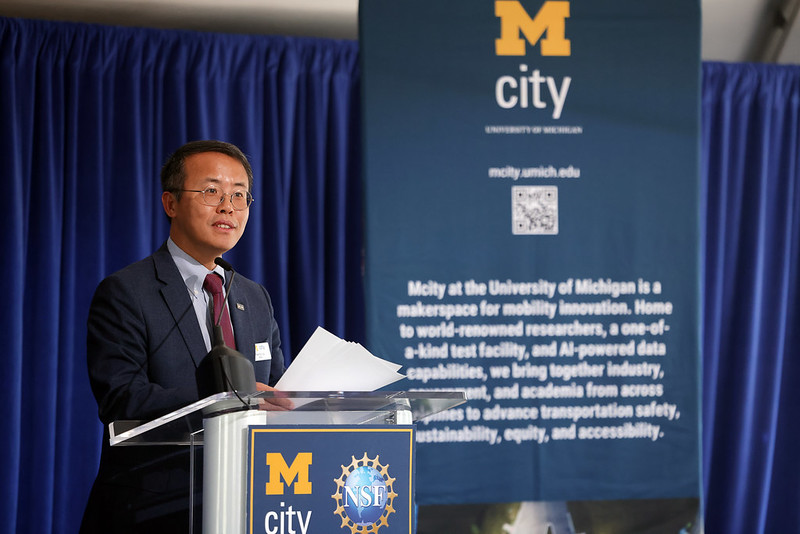
Following two years of upgrades, the University of Michigan’s hub for autonomous testing officially kicked off the availability of remote use capabilities in October with a series of demonstrations for industry and state and federal government officials. By allowing outside researchers to tap into Mcity research vehicles and testing technologies from afar, U-M seeks to accelerate the development of autonomous vehicle technologies to enable safer and more efficient transportation. Developing the technology to support remote use was funded by the National Science Foundation through a project known as Mcity 2.0.


LEARN HOW MCITY 2.0 WORKS

Want to test your tech at Mcity without ever leaving home?


Here's your chance! Mcity, with support from NSF, is now accepting proposals to use Mcity 2.0 capabilities.


Winners get 5 days of mixed-reality testing, including use of Mcity vehicles, our test facility, and test engineers. They can also use Mcity's two new open-source tools: the Mcity digital twin and TeraSim, a traffic simulator and adversarial scenario-generator.


There will be three rounds of awards. Round One winners were named Dec. 16.


Round two deadline to submit: January 15

Round three deadline to submit: March 15


Meet Round 1 Winners and Apply Now

Mcity Staff Spotlight

As video game geek in grade school, Mcity principal engineer discovered a passion for programming

Mcity Principal Engineer Derek Johnson started programming thanks to the video games he played in grade school. These days, however, Johnson finds that programming video games isn’t nearly as interesting as programming the changes coming to Mcity 2.0. “I don't play games as much anymore, and I think that's because Mcity satisfies that desire," he says. "We're literally making Mcity the game right now.” 


MEET DEREK JOHNSON

Mcity Director Henry Liu is featured in a recent Associated Press story about the need for federal autonomous vehicle (AV) testing standards. A federal regulatory framework would contribute to innovation, Liu said, speed the deployment of AVs, and assure consumers the vehicles are safe.


READ THE AP STORY

COMING EVENTS


Ann Arbor AI, ML & Computer Vision Meetup

January 16, 2025

5:30 - 8:30 pm ET

U-M Transportation Research Institute Collaboration Space

Register: https://myumi.ch/Pk4ZV


Speakers include:

  • Daniel Bogdoll, a visiting research scholar at Mcity and PhD student at Karlsruhe Institute of Technology, Germany. He has been working in the field of mobility for nine years and currently focuses on detecting unusual scenarios.
  • Dr. Jason Corso, a professor of electrical engineering and computer science at the University of Michigan and co-founder and CEO of Voxel51, an AI software company.
  • Gautham Sholingar, a senior manager leading AV Simulation product management for NVIDIA Omniverse. Gautham has several years of experience working in simulation, AI/machine learning, and automated driving, with prior roles at Ford Motor Company and MathWorks.


Twitter  Youtube  


A MAKERSPACE FOR MOBILITY INNOVATION


Mcity at the University of Michigan is an interdisciplinary, public-private partnership bringing together industry, government, and U-M researchers across campus to transform mobility for the benefit of society.