|
|
NFFV Action Alert
Upcoming
Health and Human Services Committee Hearing
Thursday, February 19, 2026
1:30 PM, Room 1524
| |
| |
Oppose
LB843 - Require the Department of Health and Human Services to file a Supplemental Nutrition Assistance Program waiver for refugees and immigrants
| | |
The Stated Intent: LB843 would ensure immigrant Nebraskans recently excluded from the Supplemental Nutrition Assistance Program through H.R.1 have access to food through SNAP. The bill instructs DHHS to request a federal SNAP waiver to return immigrant eligibility in Nebraska SNAP to pre-H.R.1 rules.
| | |
So what is LB843 all about?
LB843 is very straight forward in that it would require The Department of Health and Human Services to apply annually for a wavier so immigrant and refugees would be eligible for Supplemental Nutrition Assistance Program - SNAP benefits. The following is the language:
No later than October 1, 2026, and every October 1 thereafter, the department shall submit a Supplemental Nutrition Assistance Program waiver pursuant to section 17(b) of the federal Food and Nutrition Act of 2008 to the United States Department of Agriculture to waive Supplemental Nutrition Assistance Program eligibility changes for refugees and immigrants enacted through section 10108 of Public Law 119-21.
| | |
The history
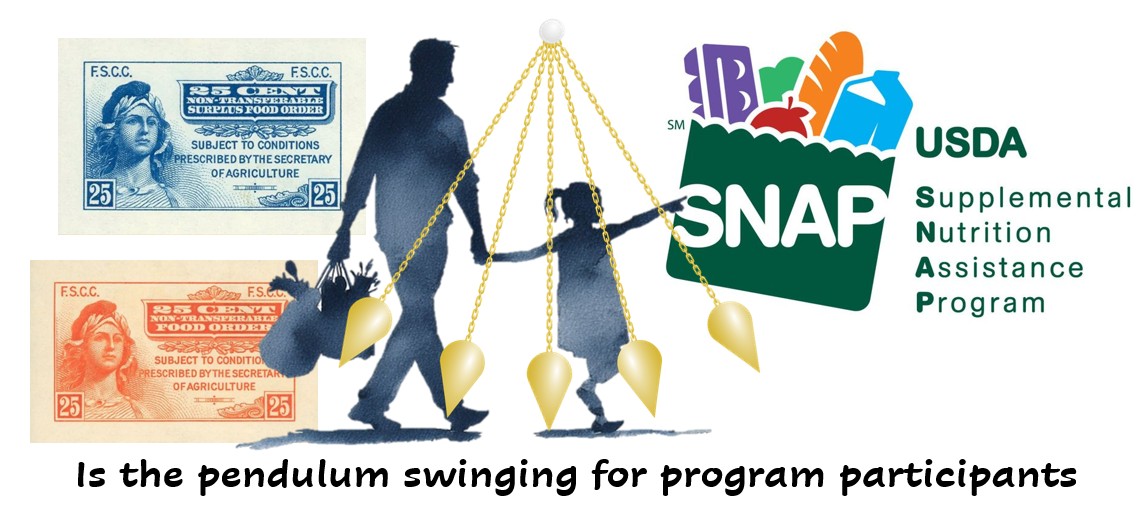
I'm sure many of you are familiar with the history around the U.S. Supplemental Nutrition Assistance Program - SNAP. It started out under Franklin D. Roosevelt's New Deal and was called the Food Stamp Plan. It was a temporary initiative that started in 1939 and was designed to address two key issues, widespread unemployment and massive agricultural surpluses. Participants bought orange stamps for cash to buy any food and then received blue bonus stamps, a 50% bonus value, for surplus foods like butter, eggs, and produce. The program ran from 1939 to 1943 when WWII boosted employment and eliminated surplus.
The program was revived in 1961 as a pilot under President John F. Kennedy. President Lyndon B. Johnson signed the Food Stamp Act in 1964 making the program permanent as part of his War on Poverty. The big difference between the 1961 program and the early 1939-1943 program was the elimination of the purchase mandate on surplus food items. Stamps could now buy any food except imports or non-essentials like alcohol. Participants still had to pay a discounted amount based on income and family size to receive the bonus value covering the difference to reach a nutritional adequate diet.
The Food Stamp Act of 1977, signed by President Carter, fully eliminated the purchase requirement, allowing eligible households to receive their full benefits for free based on need. When this was fully implemented, participation surged by 1.5 million in the first months post 1979, reaching 20 million by year's end.
In 2008, the Food , Conservation, and Energy Act renamed the program to SNAP to reflect its focus on nutrition and reduce stigma about the program. The program transitioned from paper coupons to Electronic Benefit Transfer (EBT) cards which function like debit cards.
Today, the program serves approximately 42 million Americans monthly, making it the largest federal nutrition assistance program in the U.S. Vimo has an article "A Brief History of SNAP: How America's Food Stamp Program Evolved and What's Next" that explains the history in greater detail if you want to explore further.
| | |
Citizenship Changes
Eligibility focused on income and household status without explicit citizenship requirements from the program's inception through the 1964 Food Stamps Act and subsequent amendments. Legal immigrants were generally treated the same as U.S. citizens, while undocumented individuals were ineligible under broader federal aid rules.
The Person Responsibility and Work Opportunity Reconciliation Act (PRWORA) of 1996 significantly amended the Food Stamp Act, introducing major changes to eligibility, work requirements, and sanctions. Part of the eligibility changes were restrictions for noncitizens. Most legal immigrants were barred from receiving food stamps. There was a five year waiting period for many qualified aliens and outright ineligibility for others.
However, the Emergency Supplemental Appropriations Act of 1997, The Agricultural Research, Extension and Education Reform Act of 1998, The 2002 Farm Bill, and The 2014 Farm Bill all had line items to increase SNAP eligibility for noncitizens.
The One Big Beautiful Bill Act (OBBBA) of 2025 swung the pendulum restricting SNAP eligibility for noncitizens. Eligible noncitizen groups include lawful permanent residents, Cuban and Haitian entrants, compact of free association citizens, and U.S. nationals. Those losing eligibility include refugees, asylees, survivors of human trafficking, individuals paroled into the U.S. for humanitarian reasons, and registry aliens. Undocumented immigrants remain ineligible as before. States can opt to use their own funds for broader eligibility but OBBBA doesn't mandate or fund this.
| | |
Recipients and Expense
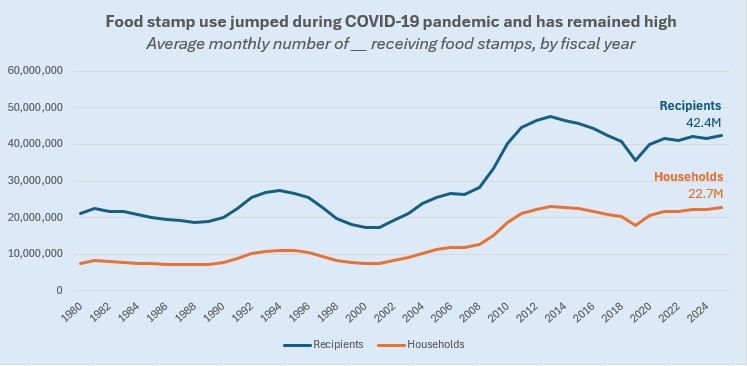
SNAP recipients have been on a steady climb since 2000 with it peaking during the great recession starting around 2008. There was a spike during the pandemic as well. The chart below highlights this (credit Pew Research). It also shows the impact of the 1996 PRWORA Act mentioned above. Changes in the Act marked a shift toward a more conditional, work-focused food assistance system. Broader goals of PRWORA were to promote personal responsibility and reduce long-term welfare dependency.
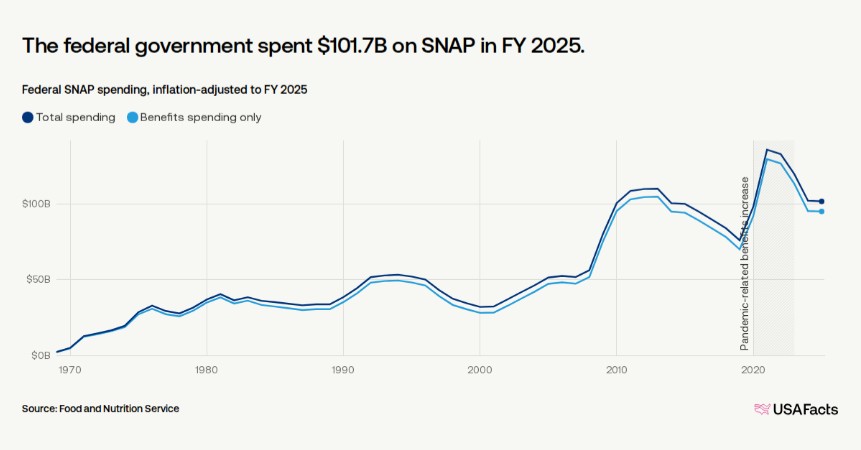
| | With the number of recipients growing, so are expenditures. Interestingly, even though recipients spiked during the great recession, spending spiked during the pandemic. | | |
SNAP benefits have always been paid for by the federal government whiles states handle eligibility: screening applications, certification, issuing benefits, and program oversight. These administrative costs have traditionally been split 50/50 between states and the federal government.
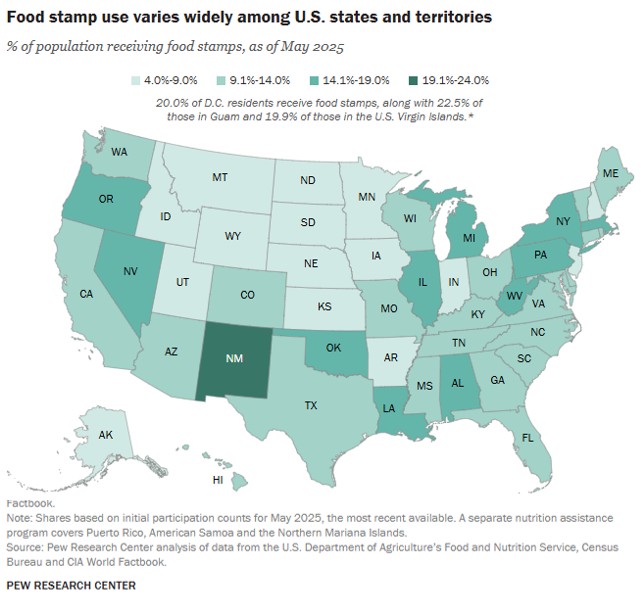
SNAP recipients vary dramatically by state as Pew Research's chart shows.
| | |
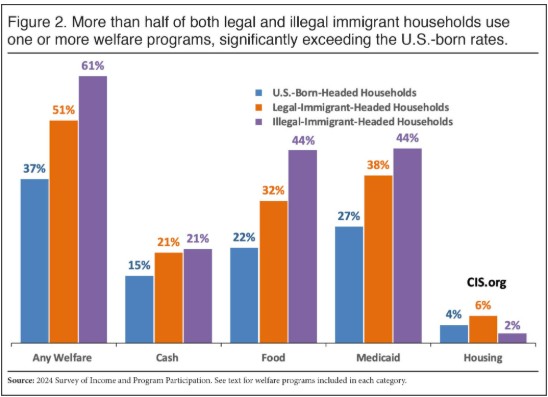
Tying this to LB843, we have this from the Center for Immigrations Studies - CIS:
"Figure 2 and Table 2 indicate that households headed by illegal immigrants, also called the undocumented or unauthorized, have higher overall welfare use rates than the U.S.-born and the difference is statistically significant.13 We estimate that 60.7 percent of illegal immigrant households use one or more welfare programs, a large and statistically significant higher rate than the U.S.-born households."
| | |
Illegal immigrants are using SNAP benefits at a larger rate than U.S. born household. You may think this is because immigrants have lower incomes and need more help. However, CIS concluded in their article:
"Somewhat surprisingly, we also find that higher-income, better-educated, and childless immigrant households are all more likely to use welfare than their U.S.-born counterparts."
"First, it shows that past efforts to prevent immigrants, including illegal immigrants, from using the welfare system have not been very effective when the totality of the welfare system is considered, though it could make some difference for specific programs. Second, immigrant welfare dependence means that current immigration is unlikely to improve the fiscal picture of the government."
"There is an unfortunate tendency for many to think of immigrants one-dimensionally. This is especially true in the business community, where they are seen simply as workers. But this ignores the enormous impact immigrants have on American society, including the welfare system. Given their welfare use rates, knowledge of government programs is clearly extensive in immigrant communities."
"To be sure, use of welfare is only one facet of immigration. But the impact immigrants are having on the welfare system and public coffers at least needs to be part of the immigration debate."
The U.S. needs to be more financially responsible as does this state. Providing SNAP benefits to illegal immigrants is not responsible.
| | |
Things to watch for
It was mentioned that the federal government has always funded 100% of SNAP benefits. That could be changing for states with high SNAP payment error rates. The Vimo article linked to above has this to say about the new OBBBA Act.
"The Bill states that, starting in fiscal year 2028, the federal government will fully fund SNAP benefits only for states with payment error rates lower than 6%, and states with error rates greater than 6% will be responsible for funding between 5% and 15% of their SNAP benefits. This stands to impact most of the country, as last year, only seven states had error rates lower than 6%, and the national error average was at 11%. With this bill, the pressure on state agencies to maintain high accuracy increases substantially."
That's right, states with high error rates will be required to help pay for funding starting in 2028. The goods new is Nebraska is one of only eight states with an error rate under 6% in 2024. The national average was 10.93%! It will be important for Nebraska to stay under the 6% threshold to keep the 100% federal funding of SNAP.
| | |
Other motivations
There are benefits to SNAP beyond just help for the needy. Having federal dollars flowing into your state or your neighborhood boosts the economy especially in a slowing economy. SNAP benefits generally get spent quickly and locally, stimulating state and regional economies in ways that generate jobs, business revenue, tax receipts, and overall activity that can indirectly benefit state budgets and residents. According to the USDA's Economic Research Service (ERS) for every $1 in new SNAP benefits generates about $1.50 in additional economic activity during a slowing economy.
Is this the motivation for giving benefits to illegal immigrants?
| | |
Let YOUR senator(s) know:
- SNAP benefits were never intended for illegal immigrants. It's always been a program to help U.S. citizens.
- Nebraska should be more focused on maintaining its low error rate so we doesn't loose federal funding.
- Increasing SNAP benefits to stimulate the states economy is short sided. Nebraska needs to overhaul it's tax system making the state more appealing for businesses and employees.
| | |
Your voice is powerful, make it heard on LB843. The committee hearing is scheduled for Thursday, February 19, 2026. NFFV recommends you "Oppose" this bill.
How to be heard? Here are three ways:
-
Most Effective: Testify in person. Going to the Committee hearing and sharing YOUR story with committee member Senators is very impactful. For first time in person testifier here are some helpful hints.
-
Effective: Submit written testimony. If you can't be there in person then submit written testimony. Not sure how to do that, click here. Note: The deadline to submit and verify a comment for the hearing record for LB843 is Thursday, February 19, 2026 at 8:00 AM Central Time.
-
Least Effective: Email your position letter to the Committee Senators and CC your own Senator. For a listing of the Health and Human Services Committee Senators click here. Note: emails should be sent by noon, the business day before the committee hearing. It's not likely these emails will be included in official hearing minutes, however, there is a better chance Committee Senators will see your comments. You can request they be added to meeting minutes in your email to Committee Senators.
| | If you liked the content provided in this Minuteman, consider donating to NFFV. You can donate by clicking the button below or by mailing a check made to Nebraska for Founders' Values. | | |
Nebraskans for Founders' Values
PO Box 255
Walton, NE 68461
| |
| |
NEBRASKANS FOR FOUNDERS' VALUES
Board of Directors Team
www.nffv.org
| | | | |