|
“The time is always right to do what is right.” — Martin Luther King Jr.
| | Leading Off: An Accident? | | |
My tenure as the Chief Human Resources Officer for an 11,000-employee restaurant company based in Memphis was an accident that I learned a lot from.
When I took the job, I had zero HR experience. None. Nada, as they say. Your question is obviously, ‘how did he get the job in the first place?’
There were three elements that made it happen. First, in those days Training and HR were almost always linked and part of the same department, and I had a lot of training experience, and was established as a restaurant operations leader.
Second, the person making the hiring decision was someone who was volunteering for the March of Dimes at the time that my son, Joe, was the local Ambassador and we did a lot of public appearances together.
Between my background, and the decision-maker’s knowledge of the kind of person I was through the volunteer connection, and I'm sure the need to replace a retiring executive, it all fit together.
There was one final test I had to pass before being offered the job. I had to be interviewed by an outside third party, a friend of the hiring executive. He was the, gulp, President of Wendy’s at the time. I walked into the office and immediately after I sat down, he said: “At least you were in the right fraternity.”
It turned out that we were both members of Phi Sigma Kappa at different schools when we were undergraduates.
So that’s how a Vice-President of Operations for a 40-store restaurant chain based in Memphis became the CHRO of the much larger company.
| | |
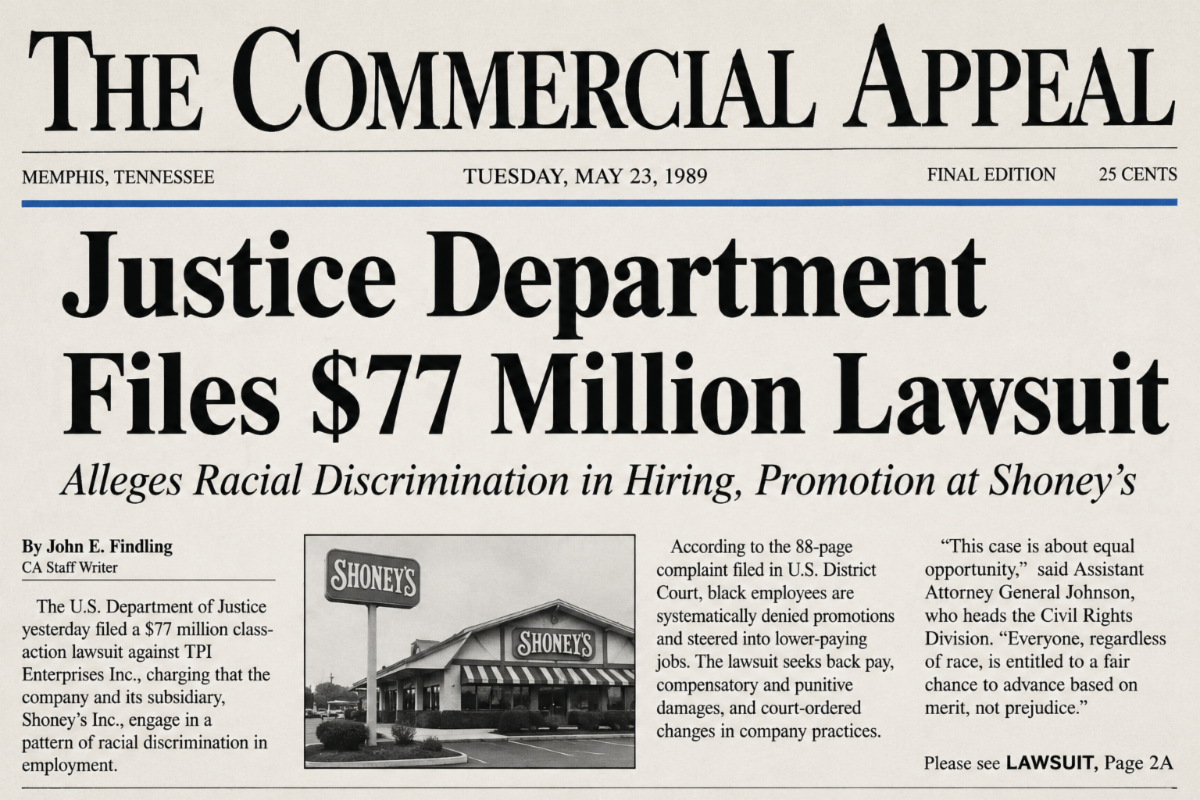
One morning, less than a year into my role, I walked outside to pick up the Commercial Appeal daily newspaper off my driveway.
Splashed across the front page was the headline blaring that the the U.S. Department of Justice had filed a $77 million class-action lawsuit ($217 Million in today's dollars) against our company alleging discrimination in our Memphis-area restaurants during a time before I joined the company.
Still, that was not the kind of morning paper headline any HR executive hopes to read.
| | |
Within hours, owners flew in from New York accompanied by expensive $400 an hour outside counsel ($1,500 an hour in today's dollars). The boardroom quickly filled with executives, lawyers, and anxiety. As the youngest and newest member of the senior team, I mostly listened.
| | |
Our company was swept into a major federal discrimination action at a time when several Shoney's-related organizations were facing intense legal scrutiny.
My responsibility wasn't to litigate the case—it was to help change the company's future.
After the meeting ended, something struck me: everyone seemed focused on proving the government wrong. Very little discussion centered on what would happen if the government was right and won their case.
So, I informally gathered several trusted members of my department and posed a different question to them: "Assume we lose. What will they require us to do besides pay money?"
The conversation changed immediately.
We concluded that regulators would almost certainly expect the company to recruit more aggressively from historically Black colleges and universities, diversify the Human Resources staff, invest in minority communities, create development programs for promising candidates whose résumés might not fit traditional expectations, and implement a variety of additional corrective initiatives.
Then I had another thought. Why wait to be ordered?
| | |
If these were the right things to do after losing the case, they were probably the right things to do before the case was ever decided.
I prepared a detailed proposal, estimated the costs, and asked for time on the agenda when the owners and attorneys returned. I reviewed it with my boss in advance, who had some reservations, but approved it for presenting to the team.
My message was simple:
"We may spend years litigating this case. But if we spend those same years genuinely improving how we recruit, develop talent, and engage with our communities, the government may find much of what it would otherwise require is already underway. Instead of ordering us to do this, and do that, let's have them say 'thank you.'
When I finished presenting, the room fell silent.
Then one of the expensive outside attorneys spoke. "He's right."
| | |
He explained that regulators usually seek not only financial penalties but meaningful organizational change. If the company had already implemented those changes in good faith, it would be viewed far more favorably.
Over the next two years, we put the plan into action. We broadened recruiting efforts, strengthened our Human Resources organization, increased community involvement, and created opportunities for talented people who might otherwise have been overlooked.
The organization became more diverse and more engaged. In fact, one individual we moved into an HR role from one of the restaurant divisions, that I am still in touch with, eventually became president of his own company and later told me that opportunity changed his career.
When the case finally concluded, the outcome surprised many observers.
| | |
The threatened $77 million exposure became a settlement of approximately $700,000, and government representatives acknowledged the substantial progress the company had made and did say 'thank you for your efforts' in the final meeting.
The Justice Department ordered the company to pay but didn't demand that we do anything else. Any corrective action they could have imagined or recommended was already in place and working well.
The biggest lesson I took away had nothing to do with law.
Too often, leaders spend their energy trying to win arguments instead of solving problems. The instinct is to defend, deny, or delay.
But sometimes the smartest strategy is to stop asking, "How do we beat this?" and start asking, "What should we be doing anyway?"
In leadership, assuming you might lose can be the first step toward achieving a far better outcome than anyone expected.
| | Surprise Photo At The End | | Join the Smart Subscribers | | If you are reading this on a social media platform, click below and you'll automatically receive a 'different' story every week on Wednesday. | | |
The Roll Call of states and countries where readers reside: Arizona, California, Colorado, Connecticut, Delaware, Florida, Georgia, Hawaii, Illinois, Indiana, Iowa, Kansas, Kentucky, Louisiana, Maine, Massachusetts, Michigan, Mississippi, Missouri, Montana, New Hampshire, New Jersey, New Mexico, New York, North Carolina, North Dakota, Ohio, Pennsylvania, Puerto Rico, Rhode Island, South Carolina, South Dakota, Tennessee, Texas, Vermont, Virginia, Washington and Washington DC, Wisconsin plus Canada, Conch Republic, Australia and the United Kingdom.
| |
Observations At The Speed Of Life Archive | | |
Ed Doherty
774-479-8831
www.ambroselanden.com
ed-doherty@outlook.com
Forgive any typos please.
| | | | | |