Rail Workers Weekly News Digest
Number 22 - June 2nd, 2020
|
|
Below is a series of articles compiled over the previous week.
They are of interest to railroad workers and activists.
|
|
Article 1 -
CORONAVIRUS NEWS
Transit Industry Leaders Blast CDC for Recommending Commuters Avoid Mass Transit
U.S. transit industry leaders sharply criticized a new
Centers for Disease Control and Prevention
(CDC) recommendation that encourages people to commute to work by driving or using ride-hailing services instead of riding on public transit systems.
The CDC suggested that employers consider encouraging employees to commute by car or as the sole passenger in a ride-hailing service car. The suggestion was included in
guidelines
issued by the agency as the nation's cities emerge from restrictions due to the COVID-19 pandemic.
American Public Transportation Association
(APTA) President and Chief Executive Officer Paul Skoutelas denounced the new recommendation as "misguided," adding that it would "severely hamper our nation's economic recovery."
For many people, the cost of commuting by car is "out of reach," Skoutelas said in a prepared statement."The guidance also doesn't consider the congestion created by millions of cars stuck in traffic. Gridlock and polluted skies are not the mobility future we want emerging from this crisis," Skoutelas said.
Also, the guidance is confusing because it "runs counter to past guidance provided to public transit agencies and riders and what has been provided on air travel," he said. "We urge the CDC to work with APTA and the public transit industry to further develop appropriate guidelines," Skoutelas added.
|
|
MORE COVID-19 RELATED NEWS
|
|
Article 2 -
PASSENGER RAIL NEWS
ACTION ALERT! - Protect Amtrak Workers and Daily Train Service
In a
letter sent to Congressional leaders earlier this week
,
Amtrak CEO Bill Flynn shared the full extent to which Amtrak ridership and revenue are down as a result of the COVID-19 pandemic. Flynn went on to outline a supplemental request for an additional $1.475 billion in funding, while slashing train frequencies and laying off 20% of its workforce.
After taking time to carefully review the proposal and share information with Congressional allies and other stakeholder groups, Rail Passengers is organizing a campaign to secure additional funding for Amtrak with statutory conditions put in place to protect Amtrak workers and maintain sustainable levels of service for the whole network.
“Let's be very clear: while Rail Passengers strongly supports the need to get Amtrak through this crisis with additional funds, any additional funds need to buy certainty for workers and passengers alike,” said Rail Passengers President Jim Mathews. “Daily train service must be the very minimum service level. We're already working with Congress to get this done, but we need your help to make sure that Amtrak has enough funds
to maintain the necessary workforce to fully restore service once demand for travel recovers, and to run all National Network long-distance trains at least daily
.”
The request has already generated opposition from key leadership in Congress. Rep. Dan Lipinski, Chair of the House Transportation & Infrastructure Subcommittee on Railroads—and recipient of this year’s Rail Passengers Association Golden Spike—
issued a condemnation of the plan
, which we are reprinting in full:
“Reports that Amtrak will eliminate up to 20% of its workforce after assurances to the contrary are extremely concerning. This action appears to suggest a continuation of a pattern of misleading statements and mistreatment of workers by Amtrak in recent years. While it is understandable that Amtrak needs additional funding and service flexibility given steep declines in ridership during this crisis, Congress has provided financial assistance to mitigate changes to staffing. After receiving over $1 billion in CARES Act funding, it was my understanding that Amtrak did not plan to furlough any workers due to COVID-19. There are now reports that Amtrak intends to make dramatic cuts to its workforce. It is imperative that Amtrak reverse course with this pattern of disingenuous actions and instead work to be more forthcoming and transparent with Congress and its employees.
|
|
Article 3 -
RAILS GOOD & WELFARE
RWU Members Dustin Wyatt Sustains Life Threatending Injuries in Car Strike
On the night of May 18, 2020, Dustin was put in a difficult situation during a vehicle pile up on the Bonnet Carre Spillway, heading to New Orleans. He noticed the vehicle next to him crash and pulled over in hopes of being able to help. What we know so far about the accident is that the first vehicle which created the pile up was partially in the right lane and there was no time to move out of the way. Dustin was struck by one of those vehicles, forcing his body to fly over the Spillway bridge 25ft forward and 50ft. down. He landed in the marsh lands thankfully in the mud and not in the water. The Fire Department and State Troopers worked hard to reach him with ladders, air boats, and when they finally got him out, he was taken to the hospital by helicopter.
Dustin is a hardworking, loving husband and father to two beautiful young children, Atlas and Freya. He is a good friend to many people across the country and has always cherished the friends and family that he has in his life. When he left that night, none of us could ever imagine something like this would happen. It is truly a miracle that he has survived. Although in critical condition, we do believe he will push through this. We have been faced with an event that will change Dustin's life forever, threatening the career he has worked so hard for and many other goals in the future that he had his eye on.
|
|
Article 4 -
LONG & HEAVY TRAINS
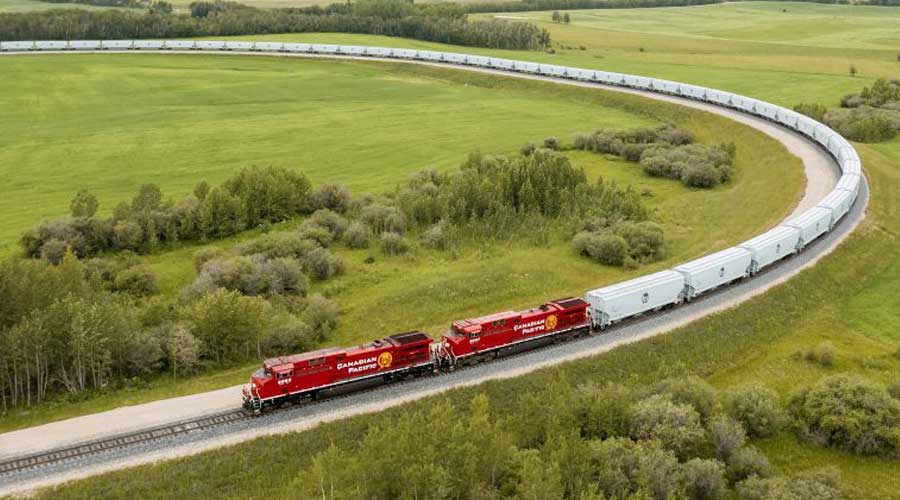
Paterson, CP Mark Launch of the Largest Grain Unit Train
(Editor's Note: While the rail industry may see this as something to crow about, rail workers see this as a step in the wrong direction. Running such monster trains way save the rail carrier money in the short run, but they require a lot of track capacity, slow down the railroad, increase the likelihood that something may go wrong - and when it does go wrong, it is worse - and further reduce rail employment).
Paterson Grain
announced earlier this month the shipment of
Canadian Pacific
's largest ever grain train moved from Paterson's terminal in Bowden, Alberta, to Vancouver, British Columbia.
The train, consisting of 167 new high-capacity hopper cars, was loaded at the company's Foothills Terminal and transported 16,313 metric tons of grain to the Alliance Grain Terminal in Vancouver, Paterson officials said in a press release.
Paterson loaded the train in less than 14 hours and took less than four days to reach the terminal in Vancouver.
|
|
Article 5 -
FREIGHT CARLOAD NEWS
AAR: Week 21 Traffic Trends Show 'Encouraging Signs'
U.S. freight railroads logged 428,715 carloads and intermodal units during the week ending May 23, a 19.2 percent decrease compared with the same week last year,
Association of American Railroads
(AAR) data shows.
Total carloads for the week tumbled 27.5 percent to 190,649 units, while intermodal volume fell 11.2 percent to 238,076 containers and trailers.
Of 20 carload categories, 15 had "modestly higher" loadings during last week than the week before, led by motor vehicles and grain, said AAR Senior Vice President John Gray in a press release.
In addition, intermodal originations were higher last week than in previous weeks, he said.
"While we can't yet say whether rail traffic and, by extension, the economy, have turned a corner, these are all encouraging signs," said Gray. "As areas across the country begin to reopen after the next several weeks, perhaps we can start looking for light at the end of a rather long tunnel."
|
|
Article 6 -
SAFETY REGULATION NEWS
FRA Extension of Safety Waivers to Railroads Puts U.S. Through Another Two Months of Risk
(Editor's Note: Without mentioning the self-inflicted "labor shortage" that the rail carriers have themselves created by furloughing tens of thousands of rail workers in the past year or two, FRA once again does the bidding of the rail carriers).
CLEVELAND, Ohio, May 27, 2020 — The Federal Railroad Administration (FRA) extended safety waivers granted to the Association of American Railroads (AAR) and the American Short Line and Regional Railroad Association (ASLRRA) in the early stages of the coronavirus pandemic recently, again favoring the material concerns of the carriers over the safety of America’s rail workers and of the general public.
The extension runs until the earlier of when the emergency declaration is lifted, or 60 days from letters dated May 21 to the AAR and ASLRRA by the agency governing safety on America’s railroads. The broad waivers concerning numerous safety regulations and training requirements were initially set to expire beginning May 24, 29 and June 9.
The leaders of two of America’s largest rail unions, the SMART Transportation Division (SMART-TD) and the Brotherhood of Locomotive Engineers and Trainmen (BLET), objected to the lengthening of these waivers that they had described as “alarming” when first initiated.
“The agency continues a pattern of FRA appeasement to the carriers,” said SMART-TD President Jeremy R. Ferguson and BLET President Dennis R. Pierce. “Essential safety tasks once again are being deferred with regulators’ blessings while the agency could not be bothered to enact an emergency order to hold carriers accountable to Centers for Disease Control and Prevention minimum health and safety standards for employees during the COVID-19 pandemic.” .....
..... “The continued pattern of rubber-stamping requests by carriers while unabashedly coming up short for the essential workers who have continued to show up and work through the pandemic shows where FRA’s priorities are,” the union presidents said.
|
|
Article 7 -
PASSENGER RAIL NEWS
|
|
“Brain Train” Act Would Expand Intercity Passenger Rail
New major legislation will help fund East-West Rail, South Coast Rail, a Berkshires Housatonic Line, and more
Boston (May 29, 2020) – Senator Edward J. Markey (D-Mass.), a member of the Senate Commerce, Science, and Transportation Committee and the Environment and Public Works Committee, today announced introduction of the
Building Rail Across Intercity Networks To Ride Around Interior of the Nation (BRAIN TRAIN) Act
. This legislation authorizes $5 billion annually, for a total of $25 billion over five years, to invest in “high-performance” intercity passenger rail service that will connect communities within a state, across states, and around the country. High-performance rail means passenger rail service that will enhance transportation capacity, travel times, reliability, and efficiency. Chairman Richard E. Neal (MA-01) will introduce companion legislation in the House of Representatives.
Passenger rail is an essential and popular alternative to traditional highways or air travel. Studies consistently show that expanding passenger rail service will improve mobility, enhance safety, promote economic development, generate new jobs, and protect the environment. Moreover, these benefits are especially pronounced for regions of the country – such as Western Massachusetts – that are historically and persistently unconnected or under-connected.
“Despite clear economic, environmental, and safety benefits, Congress has insufficiently invested in expanding passenger rail,”
said Senator Markey.
“Developing and restoring passenger rail service, especially in communities that have been underconnected, is exactly the kind of recovery program that can help repair the economic damage caused by the coronavirus while correcting long-standing inequities.
|
|
Article 8 -
RAIL SAFETY NEWS
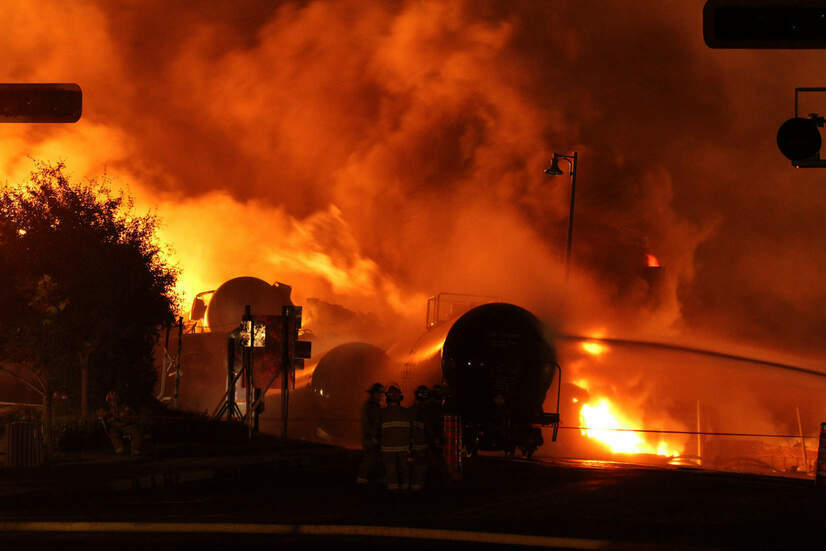
Safety Can't Be a 'Pretext' for Regulating Unsafe Oil Trains, Says Trump Administration
(Editor's Note: The Administration is fond of speaking of "states' rights" ... until a state adopts a law that mandates minimum crew size, or reduced vapor pressure in tank cars to mitigate against explosions in derailments, etc. Then the Feds assume "pre-emption.")
The federal agency overseeing the safe transport of hazardous materials
released a stunning explanation
of its May 11 decision striking down a Washington state effort to regulate trains carrying volatile oil within its borders. A state cannot use “safety as a pretext for inhibiting market growth,” wrote Paul J. Roberti, the chief counsel for the Pipeline and Hazardous Materials Safety Administration (PHMSA).
The statement appeared in the Trump administration's justification for
overruling
Washington’s oil train
regulation
, which
was challenged
by crude-producing North Dakota and oil industry lobbying groups. The Washington rule seeks to limit oil vapor pressure unloaded from trains to less than 9 pounds per square inch (psi) in an attempt to reduce the likelihood that train derailments lead to the now-familiar fireballs and explosions accompanying trains transporting volatile oil.
Roberti wrote: “Proponents of the law insist Washington State has a legitimate public interest to protect its citizens from oil train fires and explosions, but in the context of the transportation of crude oil by rail, a State cannot use safety as a pretext for inhibiting market growth or instituting a de facto ban on crude oil by rail within its borders.”
With this statement, PHMSA is codifying what has been clear for some time at the regulatory agencies responsible for overseeing the transportation of hazardous materials by rail: that is, profits take priority over safety.
Rail Industry 'Pre-emption' and Safety Under Trump
A year ago, the U.S. Department of Transportation (DOT), PHMSA's parent agency, invoked the same legal argument, known as “
pre-emption
,” to overrule state efforts to
require at minimum two-person crews
for operating freight trains. As part of the explanation for that decision, the DOT's Federal Railroad Administration announced that it was adopting a policy of deregulation.
|
|
|
|
|
|
|